मेघदूत: "नीचैर्गच्छत्युपरि दशा चक्रनेमिक्रमेण"

समर्थ शिष्या अक्का : "स्वामीच्या कृपाप्रसादे हे सर्व नश्वर आहे असे समजले. पण या नश्वरात तमाशा बहुत आहे."

G C Lichtenberg: “It is as if our languages were confounded: when we want a thought, they bring us a word; when we ask for a word, they give us a dash; and when we expect a dash, there comes a piece of bawdy.”

C. P. Cavafy: "I’d rather look at things than speak about them."

Martin Amis: “Gogol is funny, Tolstoy in his merciless clarity is funny, and Dostoyevsky, funnily enough, is very funny indeed; moreover, the final generation of Russian literature, before it was destroyed by Lenin and Stalin, remained emphatically comic — Bunin, Bely, Bulgakov, Zamyatin. The novel is comic because life is comic (until the inevitable tragedy of the fifth act);...”

सदानंद रेगे: "... पण तुकारामाची गाथा ज्या धुंदीनं आजपर्यंत वाचली जात होती ती धुंदी माझ्याकडे नाहीय. ती मला येऊच शकत नाही याचं कारण स्वभावतःच मी नास्तिक आहे."

".. त्यामुळं आपण त्या दारिद्र्याच्या अनुभवापलीकडे जाऊच शकत नाही. तुम्ही जर अलीकडची सगळी पुस्तके पाहिलीत...तर त्यांच्यामध्ये त्याच्याखेरीज दुसरं काही नाहीच आहे. म्हणजे माणसांच्या नात्यानात्यांतील जी सूक्ष्मता आहे ती क्वचित चितारलेली तुम्हाला दिसेल. कारण हा जो अनुभव आहे... आपले जे अनुभव आहेत ते ढोबळ प्रकारचे आहेत....."

Kenneth Goldsmith: "In 1969 the conceptual artist Douglas Huebler wrote, “The world is full of objects, more or less interesting; I do not wish to add any more.”1 I’ve come to embrace Huebler’s ideas, though it might be retooled as “The world is full of texts, more or less interesting; I do not wish to add any more.” It seems an appropriate response to a new condition in writing today: faced with an unprecedented amount of available text, the problem is not needing to write more of it; instead, we must learn to negotiate the vast quantity that exists. How I make my way through this thicket of information—how I manage it, how I parse it, how I organize and distribute it—is what distinguishes my writing from yours."

Tom Wolfe: "The first line of the doctors’ Hippocratic oath is ‘First, do no harm.’ And I think for the writers it would be: ‘First, entertain.’"

विलास सारंग: "… . . 1000 नंतर ज्या प्रकारची संस्कृती रुढ झाली , त्यामध्ये साधारणत्व विश्वात्मकता हे गुण प्राय: लुप्त झाले...आपली संस्कृती अकाली विश्वात्मक साधारणतेला मुकली आहे."

Saturday, November 19, 2011

Jhansi Ki Rani: Of Godse and Goya

Today November 19 2011 is 176th birth anniversary of Lakshmi Bai, the Rani of Jhansi


The Telegraph, UK, April 14 2012:

"George Washington has been named as the greatest foe ever faced by the British...The one woman on the list was Rani of Jhansi, who fought British forces in nineteenth century India..."

Kathryn Harrison:


We don’t need narratives that rationalize human experience so much as those that enlarge it with the breath of mystery. For as long as we look to heroes for inspiration, to leaders whose vision lifts them above our limited perspective, who cherish their values above their earthly lives, the story of Joan of Arc will remain one we remember, and celebrate.


Mark Twain on Joan of Arc:

“I studied that girl, Joan of Arc, for 12 years, and it never seemed to me that the artists and the writers gave us a true picture of her. They drew a picture of a peasant. . . . But they always missed the face — the divine soul, the pure character...All the rules fail in this girl’s case. In the world’s history she stands alone — quite alone."

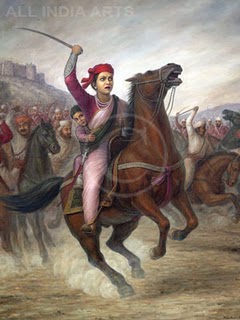
No, Mr. Twain. She does NOT stand alone. India's Rani Lakshmi Bai stands shoulder to shoulder with her.


Artist: Unknown to me

(Does the strapped kid look 12 years old?)

Jhansi's Rani has always been around since I was a kid.

Be it B R Tambe's (भा. रा. तांबे) moving poem:

'रे हिंदबांधवा, थांब या स्थळी । अश्रु दोन ढाळी ॥
ती पराक्रमाची ज्योत मावळे । इथे झांशीवाली ॥'

or Pratibha Ranade's (प्रतिभा रानडे) sensitive and scholarly portrayal 'Zashichi Rani Laxmibai' (झांशीची राणी लक्ष्मीबाई), June 2003 .

But I have always felt a touch of sadness around her. It was never like seeing pictures of Shivaji and his lieutenants.

After I read Godse Bhataji aka Vishnubhat Godse (गोडसे भटजी / विष्णुभट गोडसे)'s classic 'Maza pravas' (माझा प्रवास), 1883, the feeling became even darker because Godse's description of the empire's cruelty inflicted on Jhansi, after its fall, is heart wrenching. (Read a related post on this here.)

Godse's description of his meetings with the Rani are also very vivid and moving.

This is how Godse describes the Rani's escape with her 12-year old son tied to her back:

"बाईसाहेब स्वतः पांढरे घोड्यावर स्वार जाहाली. घोडा तो सुमार अडीच हजार रुपये किमतीचा खंदा होता. त्याजवर आपण बसून आंगावर पायजमा वगैरे सर्वपुरुष पोषाग होताच. टाकीण बूट घातले होते व सर्वांगास तारांचे कवच घातले होते, बराबर अर्ध एक पैसा सुद्धा घेतला नव्हता. फक्त रुप्याचा पेला पदरी बांधून ठेविला होता. कम्बरेस ज्यम्बा वगैरे हतेरे होती. खाकेत तलवार लाविली होती आणि रेसिमकाठी धोतरानी पाठीसी बारा वर्षाचा मुलगा दत्तक घेतलेला बांधून जय शंकर शब्द करून किल्ल्या खाली स्वारी उतरली..."


Artist: Francisco José de Goya y Lucientes (1746-1828)

COURTESY: INSTITUTO CERVANTES, NEW DELHI and Frontline Oct. 07, 2011

"YSON TAN FIERAS": In his portrayal of women caught in conflict, Goya shows women as victims of invaders, and also as guerilla fighters. Here, a woman guerilla fighter who has tied her child around her shoulders while fighting....Much like Lakshmibai.

She is Goya's Jhansi Ki Rani!

Tuesday, November 15, 2011

Peter Roebuck: Regret comes over us for the Life Unled

Peter Roebuck:

"Nothing is sadder than the extinguishing of a young life. Besides the loss itself, and the pain that follows, the premature ending of a life serves as shock, reminds of the fragility and foolishness of our existences. When Princess Di died, her country temporarily became a better place. When David Hookes departed, the sorrow reached beyond his immediate circle and into the masses. Partly, it is the loss of a friend. Partly, it is the realisation that we have been wasting our lives upon nonsense.

Not that it lasts. Still we complain about traffic wardens and shampoo bottles that will not open, and the weather, and the neighbours and taxes and noise and the rest of it. And then a child dies, or a friend is suddenly removed, or a familiar face vanishes, whereupon regret comes over us for the life unled."

('Departures' from 'IT TAKES ALL SORTS', 2005)

Albert Camus:


"There is but one truly serious philosophical problem and that is suicide. Judging whether life is or is not worth living amounts to answering the fundamental question of philosophy. All the rest – whether or not the world has three dimensions, whether the mind has nine or twelve categories – comes afterwards. These are games; one must first answer..."

('The Myth of Sisyphus')


I do not like most Cricket writers today.

But the late Peter Roebuck did NOT belong there. He was up there with two fellow Australians: Jack Fingleton- writer of such classics like 'Cricket Crisis', 'Brightly Fades the Don', 'The Ashes Crown the Year'- and Ian Chappell.

I lap up their every word.

As I have said earlier, one of the few bright spots in India's Sportstar was Mr. Roebuck's occasional column.

PR will be remembered for many things. But I will remember him especially for his reporting of third day of second test between India and Australia played at Melbourne Cricket Ground on 26-30 December 1999.

It was a debut series of then fiery and fit Brett Lee.

PR writes:

"This was a day to remember, a day on which Brett Lee made a startling first appearance in his country's colors and Sachin Tendulkar stood alone at the crease defying formidable odds with courage and skill.

It was a glorious confrontation between old and new, mighty and promising, an expression of the great gifts of the game, the brilliance of batsmanship, the excitement of pace and the powers needed to reach the gods. Meanwhile, a superb leg-spinner also bowled with artistry and cunning as he pursued his own landmark. It wasn't a day to have stayed in bed. There haven't been many better...

...Meanwhile, Tendulkar stood firm like St Paul's Cathedral in the Blitz. Any fool can score runs against tame bowling. Anyone can impress in easy circumstances. Like a true champion, Tendulkar rises in the tightest corners. He, too, had to keep an eye on Lee's yorkers and took evasive action as the speedster flung down a bumper. It was a tremendous struggle between them, as the master craftsman fought tooth and nail, while the gregarious youngster streamed into bowl and ended a metre or two from his adversary.

Tendulkar alone could resist the force of this fierce assault. He seemed to be playing in a different match from anyone else except Sourav Ganguly, for whom Lee reserved the fastest ball of the day. Unaffected by the wickets tumbling around him, and realising the need to push the score along, Tendulkar moved from caution to aggression as he launched a breathtaking attack on the Australian bowling.

Eight long years ago, he appeared in this land as a teenager with superb skills and enough spirit to fuel an entire team. Now he has reappeared as a man bearing responsibility and carrying it lightly, for he does not allow any situation to be his master.

When Tendulkar reached his 100, the entire crowd rose in acclamation. His dismissal, caught on the boundary, brought the crowd to its feet a second time.
It had been the perfect day. The visiting champion had scored a century. And a new fast bowler had arrived on the scene."

Today, almost 12 years later, we have very different Messers Tendulkar and Lee from what are described here. Once I adored them, now I don't like watching either of them. And now Mr. Roebuck too has departed.

Peter Roebuck:

"...Yet it is the vulnerability that is interesting. Impregnability is an act. Kerry O’Keeffe’s recent autobiography was appreciated because he described his hard times and his failings. It was an act of courage, not a sales pitch. Writing those sorts of books is not about self-expression but self-examination. Everything else belongs in a comic book."

('Dealing with life' from 'IT TAKES ALL SORTS', 2005)

Sunday, November 13, 2011

Grotesque Looking Gangs of India: Vasant Sarwate Lalit Diwali 2011

William Butler Yeats:

TURNING and turning in the widening gyre
The falcon cannot hear the falconer;
Things fall apart; the centre cannot hold;
Mere anarchy is loosed upon the world,
The blood-dimmed tide is loosed, and everywhere
The ceremony of innocence is drowned;
The best lack all conviction, while the worst
Are full of passionate intensity.
('The Second Coming')


This is what historian Vishwanath Kashinath Rajwade (विश्वनाथ काशिनाथ राजवाडे) said almost a century ago:

"तात्पर्य, हिंदुस्थानांत होऊन गेलेली सर्व सरकारे मूठभर अल्पसंख्यांकांची आहेत व ह्या मूठभर अल्पसंख्यांकांचे सरकार त्यांच्याच सारख्या इतर मूठभर परंतु समबल किंवा वरचढबल अल्पसंख्यांक सरकारच्या ऊर्फ टोळीच्या हातून नाश पावते. त्यात गावकर्यांचा हात शपथेला सुद्धा नसतो."

(In summary, all the governments of Hindusthan have been of handful minorities and these administrations of handful minorities are destroyed by equally or more powerful minority governments or gangs. The people don't play their hand even for taking oath.)

['Maharashtra va Uttarkokanachee vasahat' (महाराष्ट्र व उत्तरकोंकणची वसाहत) from 'The Mahikavati Bakhar' (महिकावतीची बखर), 1924]

The first word that entered my mind when I saw Vasant Sarwate's (वसंत सरवटे) picture below was 'gangs' (टोळ्या) mentioned in Rajwade quote.

Gangs of corrupt politicians, crooked bureaucrats, robber baron businessmen, bakelite celebrities, crony capitalists, fundamentalists of all hue, terrorists, cacophonic media...

Rajwade wrote the quoted lines when India was not free.

Democracy was supposed to change that. The group in white attire carrying a flag in Sarwate's picture on the right reminds me of that hope, that promise, that 'tryst with destiny'.

UK's Financial Times is not a Left Wing paper.

Edward Luce is their Washington bureau chief. Earlier he was their South Asia Bureau Chief based at New Delhi. He is the author of 'In Spite of the Gods: The Strange Rise of Modern India' (2006).

He writes about American democracy in November 2011:

"A driver is stuck in a jam in Washington. A man knocks on his window: “Terrorists have kidnapped Congress, and they’re asking for $100m otherwise they’ll burn them with gasoline,” the man says. “We’re going from car to car to get donations.” What are people giving on average, asks the driver? “Oh, about a gallon,” comes the reply.

Mischievous though it is, the joke received a good reception when it was recently circulated to an email list of Washington insiders – a group of retired diplomats and academics. It is difficult to imagine Bob Hope delivering such a gag. In today’s climate, no amount of contempt seems too much for the country’s once highly trusted democratic institutions."

And one can argue that Indian democracy is in worse shape than American. No amount of contempt seems too much for the country’s once highly trusted democratic institutions.

As venerable Martin Wolf (of FT again) says: As inequality rises, the sense that we are equal as citizens weakens. In the end, democracy is sold to the highest bidder. That has happened often before in the history of republics.

Another thing that came to my mind on seeing Sarwate's cover was a famous song from Raj Kapoor's 'Awaara' (1951)- 'Mujhko chahiye bahar'...Its imaginary hell represented by flames and grotesque statues and a desperate cry of Manna Dey- voice of pathos seeking hope- 'Mujhko ye narak na chahiye; mujhko phool, mujhko geet, mujhko preet chahiye...Mujhko chahiye bahar'.

I still remember how disturbed I felt watching the sequence first time on big screen in 1970's. I needed some balm which came with serene 'ghar aaya mera pardesi'.

Director: Raj Kapoor; Cinematography: Radhu Karmakar; Art Direction: M.R. Achrekar; Set Decoration: K. Damodar

Artist: Vasant Sarwate, Lalit (ललित), November-December 2011

(I see one light violet colour face wearing bindi/pendant. I feel it represents a gang of bakelite celebrities.)

Sarwate himself says about the picture that, while drawing it, his own cover of Sahitya Academy Award winning collection of poems of Mangesh Padgaonkar's (मंगेश पाडगांवकर) 'Salam' (सलाम),1980- salute- was on his mind.

I know 'Salam'. I have heard Padgaonkar reciting it from the stage of Balgandharva Natyagraha (बालगंधर्व नाटय़गृह) in Miraj (मिरज). I liked it OK.

But when my overwhelming feeling is of deep fear, almost terror, only when I recover from it slightly, I may raise my hand in salute (salam), for survival!

Click on the respective year to see Sarwate's past covers of Lalit Diwali 2010, 2009, 2008 and 2007.

click on the above to get a larger view of part of Rajwade's original article

['Rajwade Lekhsangrah' (राजवाडे लेखसंग्रह) editor: Tarkateerth Lakshman-shastri Joshi (संपादक: तर्कतीर्थ लक्ष्मणशास्त्री जोशी), 1958]

Friday, November 11, 2011

Chairman, Press Council of India: I have a poor opinion of most media people

Jean Dreze, Amartya Sen:

"...India’s recent development experience includes both spectacular success as well as massive failure. The growth record is very impressive, and provides an important basis for all-round development, not least by generating more public revenue (about four times as much today, in real terms, as in 1990). But there has also been a failure to ensure that rapid growth translates into better living conditions for the Indian people. It is not that they have not improved at all, but the pace of improvement has been very slow—even slower than in Bangladesh or Nepal. There is probably no other example in the history of world development of an economy growing so fast for so long with such limited results in terms of broad-based social progress.

There is no mystery in this contrast, or in the limited reach of India’s development efforts. Both reflect the nature of policy priorities in this period. But as we have argued, these priorities can change through democratic engagement—as has already happened to some extent in specific states. However, this requires a radical broadening of public discussion in India to development-related matters—rather than keeping it confined to simple comparisons of the growth of the gnp, and naive admiration (implicit or explicit) of the high living standards of a relatively small part of the population.
An exaggerated concentration on the lives of the minority of the better-off, fed strongly by media interest, gives an unreal picture of the rosiness of what is happening to Indians in general, and stifles public dialogue of other issues. Imaginative democratic practice, we have argued, is essential for broadening and enhancing India’s development achievements."

Nicholas Taleb


"....journalism may be the greatest plague we face today- as the world becomes more and more complicated and our minds are trained for more and more simplification".

“To be competent, a journalist should view matters like a historian, and play down the value of information he is providing…Not only is it difficult for the journalist to think more like a historian, but it is, alas, the historian who is becoming more like the journalist.”

Carl Sagan

“The dumbing down of America is most evident in the slow decay of substantive content in the enormously influential media, the 30-second sound bites (now down to 10 seconds or less), lowest common denominator programming, credulous presentations on pseudo-science and superstition, but especially a kind of celebration of ignorance. “

Kanti Bajpai, The Times of India, October 14, 2011:

"But seriously, most Indian television news is a disgrace. Production is shocking, the viewer is assailed by 'breaking news', and there is almost nothing about the news behind the news. Investigative reporting usually consists of a reporter in the 'field' - the field being a major Indian city - waving a piece of paper around claiming that he has got access to a top secret internal government memorandum. If you look at the eyes of the reporter and the anchor, you cannot help the feeling that neither of them knows very much or cares very much about the issue. Television is largely theatre, and it is theatre they are determined to deliver."


It was great fun reading Press Council of India's chairman Justice Markandey Katju's views on Indian journalists in The Times of India Nov 1 2011.

"The general rut is very low and I have a poor opinion of most media people. Frankly, I don’t think they have much knowledge of economic theory or political science or literature or philosophy. I don’t think they have studied all this...

...Indian media is very often playing an anti-people role. It often diverts the attention of the people from the real problems which are basically economic. 80 per cent people are living in horrible poverty, unemployment, facing price rise, health care (problems).”

I feel sorry for Mr. Katju because he seems to be overlooking a golden rule: this business of journalism is about pure entertainment.

As Nicholas Taleb says:

“Most journalists do not take things too seriously. After all, this business of journalism is about pure entertainment, not a search for truth, particularly when it comes to radio and television. The trick is to stay away from those who do not seem to know that they are just entertainers and actually believe that they are thinkers.

Some hope is implied in Mr. Taleb's statement for newspapers. Like in this quote of Isaac Chotiner: Newspapers have changed considerably in the past two centuries. They currently stand as one of the very few barriers to a media universe that is comprised of almost nothing but outbursts and opinions.

But some of the newspapers I see regularly are nothing but "outbursts and opinions" wrapped in commercial advertisements.

As far as television news: ALESSANDRA STANLEY- "In today’s television news market, that cable network and its stars are like the financiers they cover: media short-sellers trading shamelessly on publicity, good or bad, so long as it drives up ratings. There isn’t enough regulation on Wall Street, and there’s hardly any accountability on cable news: it’s a 24-hour star system in which opinions — and showmanship — matter more than facts."

But what about some of those high profile TV anchors interviewing national and international political/business leaders, sportspersons, writers, film-stars and other celebrities?

Taleb: “The interview is illustrative of the destructive aspect of the media, in catering to our heavily warped common sense and biases… (Interviewer) might even be someone of the utmost intellectual integrity, his profession, however, is merely to sound smart and intelligent to the hordes. ”


Artist: James Stevenson, The New Yorker, July 21 1980

Will we ever get as lucky as the gentleman in the picture above? "No news tonight." If we do, I won't be interested in knowing 'why'.


I agree with diagnosis but disagree with the medicine Mr. Katju has in mind and I quote:

" He also said he had written to the PM demanding that the Press Council be given “more teeth’’. Only last month, Katju had said in another TV interview that he would not shy away from using the “danda” to rein in erring journalists."

'Danda' won't work. It reminds me of 'The Emergency'. People's education may work. In the long run.


Artist: Sudhir Tailang, The Asian Age, November 2 2011

Sunday, November 06, 2011

Dileep Pardeshi- When Marathi Language Teacher was a Hero to Middle Class

Anon:

"Can't believe we officially have 7 billion people on Earth...yet the top news is Kim Kardashian's marriage"

Stephen Marche:


"Celebrities are not appendages of our society anymore; they are the basis of our communal lives. Literature and architecture, art and politics, are at most sidelights—small, ancient alleyways down which fewer and fewer minds wander. Pop culture has long since left the word culture behind to become the primary way we understand the world."

Pauline Kael:

“When we championed trash culture, we had no idea it would become the only culture.”


Marathi writer Dileep Pardeshi (दिलीप परदेशी) died recently.

He taught higher Marathi at division A on ground floor of Class 12th Science at Willingdon College, Sangli in year 1976-77.

I was in division B on first floor and I don't remember who taught Marathi to us because I bunked most Marathi periods! But I used to hear about his teaching from my friends in division A. Almost no one bunked his class.

Today I miss Pardeshi-sir and so should all those who love Marathi literature because he certainly created love for Mararthi literature among his pupils, many of them just 16-year old studying science and aiming to become engineers and doctors.

As I write this, he reminds me of a long-lost era when a 'mere' teacher of Marathi language was a hero to a large number of middle class students.

And the fact that he dressed stylishly and, if I remember correctly, kept fairly long hair added to his appeal.

A lot of his students, including many pretty girls, from classes 12th to Master of Arts doted on him. (And boy, didn't we feel jealous?)

Does this happen these days in our ad-backed celebrity hell also known as Marathi urban midddle-class popular culture? I doubt.

I have not read his single book in entirety and never thought much of him as a writer. I never tried to meet him even after I (probably) topped the college in Marathi that year beating 12th arts students.

He was a great fan of G A Kulkarni (जी ए कुलकर्णी). (Who wasn't then?)

Here is a letter by him to G A:

courtesy: "Priya Jee E Sa. Na. Vi. Vi.", 1994 (प्रिय जी. ए. स. न. वि. वि.) edited by G A Kulkarni's cousin-sister Ms. Nanda Paithankar (नंदा पैठणकर)

Friday, November 04, 2011

Henry aka गुणाकार...oops गुणाकर

Today November 4 2011 is 63rd Death Anniversary of Carl Anderson, creator of Henry aka गुणाकर.

I have already expressed my love for Phantom (comics) here.

A side attraction of those comics books was one page comics of Henry. In Marathi (मराठी), it was titled as 'Gunakar' (गुणाकर). It used to be printed at the beginning or at the end of the main comics.

Until recently I couldn't figure out how Henry became 'Gunakar' in Marathi. Confusion was even more when I used to read it as 'Gunakaar'(गुणाकार) meaning multiplication in Marathi!

If indeed it were to be 'Gunakaar' (गुणाकार), the English word should have been Asterix!

Artists: René Goscinny & Albert Uderzo

Now, I understand that 'गुणाकर' in Hindi means very gifted ('अत्यंत गुणी').

Because Henry is mute, there was nothing much to translate!

Art Baxter says about Henry:

"One never sought out the HENRY strip on the funny pages (when it was still on the funny pages that is). It was read after the favorites. It was read simply because it was there. The fact is, it was never good but it wasn't terrible either. Yet, we were compelled to see what the bald headed, ass-faced boy was up to that day."

I agree. I read it after the main story of 'The Phantom' or 'Mandrake the Magician' or 'Flash Gordon'.

"Henry is autonomous in the SATURDAY EVENING POST strips. HENRY would not pick up a regular cast of characters, all with no proper names, only titles: the mother, the dog, the bully, the little girl, until it became a William Randolph Hurst comic strip. The SEP HENRY is similar in many ways to the LITTLE RASCAL/OUR GANG comedies of the same era. That is children free from the tyranny of an adult presence (mostly). Children navigating the world as best they can with the knowledge and experience they currently possess. Sometimes they get things right, often get things wrong, and frequently come up with solutions to problems unique to their limited experience. Necessity is the mother of invention with funny surprising results."


Henry is carrying a case of milk bottles on his head. "Sometimes they get things right". Henry has because milk after all builds strong teeth, bones and muscles.

Does this make Henry very gifted 'गुणाकर'?

But if he drops the case...he "often gets things wrong."

Forty Heads of Henry

Wednesday, November 02, 2011

Diamond Jubilee of S D Phadnis's Spell- Mohini

George Orwell:

"In reality there is no kind of evidence or argument by which one can show that Shakespeare, or any other writer, is 'good' ... Ultimately there is no test of literary merit except survival, which is itself an index to majority opinion."

It is hard to believe that we are celebrating diamond jubilee of 86-year old S D Phadnis (शि. द. फडणीस) designed covers of Diwali number of visionary Anant Antarkar (अनंत अंतरकर) founded Marathi magazine Mohini (मोहिनी).

cover of Mohini Diwali 2011 (The posting of this art is for scholarly and educational purposes. Please visit http://www.sdphadnis.com/)

He first did it in year 1952 and he has done it every year since!

Norman Rockwell, whose influence I clearly see on Phadnis's art, during his 50-year career with The Saturday Evening Post, painted more than 300 covers.

Vasant Sarwate (वसंत सरवटे), SDP's close friend, has done every cover of Marathi magazine Lalit's (ललित) Diwali number since 1964.

Sarwate writes on characteristics of SDP's art in 1990:

"जरुर तेवढाच तपशील, चित्रातून म्हणायच आहे ते पाहिल्या बरोबर, बिनचूकपणे पाहणार्याच्या ध्यानात येईल अशी चित्रातील मांडणी आणि डोळ्यास आल्हाद देईल अशी रंगरचना"

(Only necessary details, composition of the drawing done in a manner one grasps accurately what is indended to be convyed as soon as one sees it and colour composition that pleases the eye")

Specifically on Mohini covers by SDP, Sarwate wrote in 1970:

"रंग हे फङणीसांच्या चित्रांच एक महत्वाचं अंग आहे हे त्यांची 'मोहिनी'वरील चित्रं पाहणार्याच्या सहज लक्षात येईल. आल्हाददायक रंगसंगती त्यांच्या चित्रांना स्वप्नमय, तरल स्वरुप देण्यास फार मोठी मदत करतात."

(Colour is an important component of his pictures is pretty obvious to those who look at his pictures on the covers of 'Mohini'. Pleasing colour compositions help big give his pictures dreamlike, subtle quality.)

This is how Sarwate draws his friend at work:

['Sahapravasee' (सहप्रवासी), 2005]

Notice how well Sarwate has captured the above qualities of Shi Da's drawings in picture-in-picture.

See my previous post on Shi Da here.

George Orwell has also said: "If a man cannot enjoy the return of spring, why should he be happy in a labour-saving Utopia?… I think that by retaining one’s childhood love of such things as trees, fishes, butterflies and…toads, one makes a peaceful and decent future a little more probable."

To Orwell's list of 'trees, fishes, butterflies and…toads', I would add Shi Da Phadnis's pictures.

I still love them as much as I first saw them as a kid. If 'a peaceful and decent future' materialises, it will be a bonus!

And I hope I will continue to enjoy the sight of anyone combing his/her hair looking into a scooter's mirror and not just of that couple with sunny smiles from Mohini Diwali 2011's cover.

Sunday, October 30, 2011

Bhau Padhye, A Mavali: Loveable Rogue or Lumpenproletariat?

Today October 30 2011 is the 15th death anniversary of Bhau Padhye (भाऊ पाध्ये).

Kathryn Schulz:

"...the lazy man’s “Every unhappy family is unhappy in its own way” is “Fuck this shit.”...In The Mother Tongue, Bill Bryson argues that okay is “the quintessential Americanism” and “the most grammatically versatile of words.” Okay. But surely it has a rival—or a compatriot—in fuck. Wherever it originated (the jury is out), the F-word has flourished in our adolescent American soil. And pace Bryson, its grammatical versatility cannot be topped: You can use it as noun, verb, adverb, adjective, or interjection, not to mention in any mood whatsoever, from exultation to rage..."

('Ode to a Four-Letter Word/ And I don’t mean "okay."')

Jason Flores-Williams:

“Hipster culture today is harmless culture. And that’s an epic tragedy because being hip used to mean that you were heroic and dangerous. That you waged war on soullessness and greed through art and resistance. Being hip meant that you wanted upheaval in society. Being hip meant you were intense lower class, not detached upper class. Being hip meant being revolutionary.”

दुर्गा भागवत: "'लेखकराव' म्हणून इतरांना नावं ठेवणारे स्वतःच लेखकराव होवून बसले"

[Durga Bhagwat: Those who teased others as "establishment-writers" themselves became establishment-writers (insiders)]

The one guy who never became one- Bhau Padhye.

(Contrast this with, from another field, some one like Mr. Sunil Gavaskar, once an enfant terrible of Indian cricket, is now the establishment.)

The title of this post contains a Marathi word मवाली ('Mavali'). Mavali translates as rogue/ hooligan/ hoodlum/ ruffian. One meaning of 'rogue' is 'something or someone different from what is normal or expected'. Indeed, if anyone, Bhau was different.

Recently I came across following.

Economic and Political Weekly dated July 31 2011 has an essay by Juned Shaikh: "Translating Marx: Mavali, Dalit and the Making of Mumbai’s Working Class, 1928-1935"

'The Communist Manifesto' was translated into Marathi as 'Kamyunista Jahirnama' (कम्युनिस्ट जाहीरनामा) in Meerut jail in 1930-31 by Gangadhar Adhikari (गंगाधर अधिकारी) a scientist who had completed his PhD in chemistry from Berlin University in 1926.

The Jahirnama’s classified people in the city of Mumbai into the categories of such as kamgaar, Mavali and dalit.

"Adhikari used the term “mavali” to signify the lumpenproletariat. Mavali, a moniker for people from the hilly regions of western Maharashtra in the Bombay Presidency, signified categories of people prone to create law and order problems for the colonial police. In his explication of key words to the Marathi edition of the Manifesto that was published along with the Jahirnama, Adhikari characterised the Mavali as a class below the working class, who were “paupers” and lived in the city’s slums...Destitute and unemployed workers, paupers, and the lumpenproletariat are a step below the kamgaar varga on the social ladder...

He translated a passage from Das Capital to explain this point further:

"उद्योगधंद्यातून काढून टाकलेले लोक मोठ्यावस्तीच्या शहरातून गर्दी करुन राहतात; व गुंड, दादालोक, मवाली म्ह्णून प्रसिद्धीस येतात. उत्पादन क्रियेची व यांची कायमची फारकत झाली असते; असे लोक अर्थातच पैशा करीता वाटेल त्या प्रतिगामी पक्षाला स्वताला विकण्यास मागे पुढे पहात नाहीत. (The paupers who have been fired from work live in crowded slums in cities and become famous as criminals- (mavali). They have been permanently separated from the means of production and therefore these people do not think twice before selling themselves to counter-revolutionary forces for money).

Mavali indeed is a very complex term.

My affection for Bhau Padhye has been expressed a few times on this blog. One such instance is here.

Recently I read Mr. Narayan Bandekar's (नारायण बांदेकर) interview of Mr. Padhye here.

Agreeing with his high-profile and vocal critic Acharya Atre (आचार्य अत्रे), Bhau admits he is a rogue (मवाली).

"'वासूनाक्या'वरील आचार्य अत्र्यांच्या लेखात मला 'मवाली' म्हटलं व भटकळांनी बदनामीचा खटला करण्यास मला मदत करण्याचं आश्वासन दिलं. पण मला वाटलं, आचार्य अत्र्यांनी मला ही बेस्ट पदवी दिली. माझी वास्तव जीवनातील प्रतिमा का आली कुणास ठाऊक- मी घर उघड्यावर टाकलं नाही एवढ्यावरून-? बाकी सगळं केलं, (म्हणजे बाई, बाटली वगैरे!) मला वाटतं- माझा चष्मा, शोशन्नाचं सामाजिक कार्य आणि समाजवादी बॅकग्राउंड यामुळं ही गफलत झाली असावी. तुम्ही विश्वास ठेवा किंवा ठेवू नका, पण कॉलेज जीवनात काही मुलींनी मला खरोखरच 'मवाली' ठरवलं होतं!"

(Acharya Atre called me a rogue in his article on 'Vasunaka' and Bhatkal promised help to file a lawsuit for libel. But I thought, Acharya Atre has really given me a very good title. I don't know why my image in real life was formed- just because I never abandoned the house- did everything else, (means alcohol, women etc!) I think - my glasses, Shoshanna's social work and socialist background- they created mixup. You believe it or not, but in college life some girls indeed concluded that I was a rogue!")

Now this 'rogue' quality of Bhau is captured so beautifully in following 'cool' picture- spiky hair- more like Havells : Shock Laga ad- on head, wrinkles on forehead, beedi dangling from mouth, glasses, his horizontal stripe little short shirt exposing his crotch, hands in pockets, slightly bent right knee, a bunch of chest hair, and don't-give-a-damn attitude...

(Bhau would have surely liked my reference to Havells ad! For him life was sum total of all that happened around him. There was nothing higher or lower.)

Artist: Vasant Sarwate (वसंत सरवटे) from 'Nivadak Thanthanpal' (निवडक ठणठणपाळ ),1969

ERIN MCKEAN has said: "We like to think that human languages should be more like computer-programming languages: logical, orderly, efficient and goal-oriented. But they are more like our own DNA: complicated and full of junk information but at the same time gloriously mutable, able (for good or ill) to give rise to new living forms." (WSJ, August 10 2011)

Bhau played his part in the process of Marathi's mutation and while doing it, I think, he never sold himself to counter-revolutionary forces for money. He always remained orthogonal. And many Marathi lovers are luckier for it.
Thursday, October 27, 2011

प्रलयकाळी टीरेक्स जाती। तेथे पर्गाटोरियस वाचती ॥Tyrannosaurus Rex goes, Purgatorius lives.

I have been watching Animal Armageddon on Animal Planet this month, October 2011.

First of all it is very humbling. You watch, 65 million years ago, a small mammal Purgatorius, our ancestor, hanging on to her dear life and you realise what all you need to worship in animal kingdom beyond elephants, snakes and cows.

Second I imagine if the likes of Dnyaneshwar (ज्ञानेश्वर), Tukaram (तुकाराम) and Shakespeare knew these extinct animal kingdoms and their annihilation, their imagery would have been even more colourful.

For instance, this is how Tukaram describes the importance of being small (and humble):

तुका म्हणे बरवे जाण| व्हावे ल्हानाहून ल्हान|| महापुरे झाडे जाती| तेथे लव्हाळे वाचती||

(Tuka says become smaller than small. In a deluge trees are washed out but grass survives.)

Tyrannosaurus Rex goes, Purgatorius lives.

As I watched the documentary television miniseries, I realised that, with luck, I would dodge an animal armageddon in my lifetime.

But yesterday, on Laxmi Pujan day, as I heard and saw crackers being burst so savagely around me, I felt many birds and animals must feel that this indeed was the armageddon of their life.

Deep down, even I can't escape that feeling.

My ancestor Purgatorius

Picture courtesy: Wikipedia

p.s. 'प्रलयकाळी' (cataclysm / universal devastation) is one of my favourite Marathi words. Why? Read this.

Wednesday, October 26, 2011

In Praise of Street sweepers

Today is Lakshmi Pujan, Ashwin Amavasya Shake 1933 (लक्ष्मी पूजन, आश्विन अमावस्या, शके १९३३)

Wikipedia: Lakshmi Pooja, or the worship of the goddess of wealth, is the main event on Diwali in North and West India. It is extremely important to keep the house spotlessly clean and pure on Diwali. Goddess Lakshmi likes cleanliness, and she will visit the cleanest house first. This is also the reason why
the broom is worshiped on this day with offerings of haldi and kumkum (turmeric and vermilion).

R S Sharma:

"Buddhism did not deprecate manual labour. In a second-century sculpture from Bodh-Gaya, the Buddha is depicted ploughing with oxen."

('India's Ancient Past', 2005)

Martin Luther King Jr., 1954:

"If a man is called to be a streetsweeper, he should sweep streets even as Michelangelo painted, or Beethoven composed music, or Shakespeare wrote poetry. He should sweep streets so well that all heaven and earth will pause to say, here lived a great streetsweeper that did his job well."

P L Deshpande (पु ल देशपांडे):

"उषा: तुम्हांला सगळ्याचाच मझा वाटतो.

काकाजी: पहिलं नीट म्हणजे बराबर मझा दिसतो. इंदूर स्टेशनात एकदा एक भंगी दोन लंब्या झाडू घेऊन कचरा काढीत होता. उषा, अरे ऐश्या झाडू फिरवीत होता, की तुझ्या सतीशला बॅट देखील फिरवता येणार नाही तशी."

("Usha: You think everything is fun.

Kakaji: If you look carefully, you notice fun alright. At Indore station once a street-sweeper was sweeping using two long brooms. Usha, the way he was brandishing broom, your Satish won't be able to wave a (cricket) bat.")

['Tujhe Ahe Tujapashi', 1957 (तुझें आहे तुजपाशीं)]

(If you like Pu La's Kakaji, you may want to read this.)

Artist: Eldon Dedini (1921-2006), The New Yorker, October 7 1961