मेघदूत: "नीचैर्गच्छत्युपरि च दशा चक्रनेमिक्रमेण"

समर्थ शिष्या अक्का : "स्वामीच्या कृपाप्रसादे हे सर्व नश्वर आहे असे समजले. पण या नश्वरात तमाशा बहुत आहे."

G C Lichtenberg: “It is as if our languages were confounded: when we want a thought, they bring us a word; when we ask for a word, they give us a dash; and when we expect a dash, there comes a piece of bawdy.”

C. P. Cavafy: "I’d rather look at things than speak about them."

Martin Amis: “Gogol is funny, Tolstoy in his merciless clarity is funny, and Dostoyevsky, funnily enough, is very funny indeed; moreover, the final generation of Russian literature, before it was destroyed by Lenin and Stalin, remained emphatically comic — Bunin, Bely, Bulgakov, Zamyatin. The novel is comic because life is comic (until the inevitable tragedy of the fifth act);...”

सदानंद रेगे: "... पण तुकारामाची गाथा ज्या धुंदीनं आजपर्यंत वाचली जात होती ती धुंदी माझ्याकडे नाहीय. ती मला येऊच शकत नाही याचं कारण स्वभावतःच मी नास्तिक आहे."

".. त्यामुळं आपण त्या दारिद्र्याच्या अनुभवापलीकडे जाऊच शकत नाही. तुम्ही जर अलीकडची सगळी पुस्तके पाहिलीत...तर त्यांच्यामध्ये त्याच्याखेरीज दुसरं काही नाहीच आहे. म्हणजे माणसांच्या नात्यानात्यांतील जी सूक्ष्मता आहे ती क्वचित चितारलेली तुम्हाला दिसेल. कारण हा जो अनुभव आहे... आपले जे अनुभव आहेत ते ढोबळ प्रकारचे आहेत....."

Kenneth Goldsmith: "In 1969 the conceptual artist Douglas Huebler wrote, “The world is full of objects, more or less interesting; I do not wish to add any more.”1 I’ve come to embrace Huebler’s ideas, though it might be retooled as “The world is full of texts, more or less interesting; I do not wish to add any more.” It seems an appropriate response to a new condition in writing today: faced with an unprecedented amount of available text, the problem is not needing to write more of it; instead, we must learn to negotiate the vast quantity that exists. How I make my way through this thicket of information—how I manage it, how I parse it, how I organize and distribute it—is what distinguishes my writing from yours."

Tom Wolfe: "The first line of the doctors’ Hippocratic oath is ‘First, do no harm.’ And I think for the writers it would be: ‘First, entertain.’"

विलास सारंग: "… इ. स. 1000 नंतर ज्या प्रकारची संस्कृती रुढ झाली , त्यामध्ये साधारणत्व व विश्वात्मकता हे गुण प्राय: लुप्त झाले...आपली संस्कृती अकाली विश्वात्मक साधारणतेला मुकली आहे."

Thursday, May 26, 2011

Brands from my Birth: 51 years later

Apple's brand is now worth $153 billion, according to a study by Millward Brown, a global brands agency. (May 9, 2011)

The past issues of Chandoba (चांदोबा) are available online here.

I looked up the issue of the month I was borne May 1960.

Following products/companies have either half or full page ad:

1. Parle Monaco Biscuits


Caption on the top right reads: "सुशीलेच्या पार्ट्या म्हणजे नाविन्यानें नटलेल्या!" (Sushila's parties are bedecked with newness!)

[
remember Monaco too once was 'new' (on the lines of 'every word was a poem once').

Today, I feel, Monaco biscuits are one of the most value for money products in the market. The other day I was surprised to see the number of biscuits that still come in a five-rupees pack.

But I wonder if stylish Sushila- although a bit too anorexic for a 1960's look and certainly far cry from fellow Chandoba women- serves them in her party anymore!

And when did you last hear a girl in a party-giving Marathi home named Sushila? Isn't it so pre-historic? Now the criterion for a new-born child's name is: its meaning should not be understood by any one but parents.
]

2. Calendars by Sharda Enterprises

3. Books published by Cottage industry

4. Remy Beauty Products


(its fragrance now has vanished.)

5.
Nutrine Confectionery Company (now part of the Godrej group)

6. Iris Inks

7. Energy food

8. Lama Hair Dye

9.
Rexona

10.
Lifebuoy

11. Parry's sweets


I may not be thriving but a number of products/ companies- bold and in green- from the list above are!

Apple was just a fruit in 1960, will it return to be just a fruit in 2062? I won't know!

Monday, May 23, 2011

Waiting almost 50 Years to Answer Back

Look at the picture below BUT DON'T LOOK AT THE CAPTION BELOW YET. Linger over it and take it in...


Artist: Robert J. Day, The New Yorker, December 22 1962

Caption sounds so intuitive...so integral to the picture...

Mr. Day was easily one of the best in his business. And the picture above is a testimony to that.

Read more on this cartoon here.

Now, how should a 21st century peahen react to this HIM?

Paul Wood has the asnwer.


‘What? This old thing?’

Artist: Paul Wood, The Spectator, January 2011

Mr. Peacock hopefully will be more careful now.

Thursday, May 19, 2011

बकुलगन्धे बन्या एलो दखिन हावाय स्त्रोते

Perhaps above all, he valued contact with nature, when all five senses were active at once.

We are celebrating completion of 150 years of Rabindranath Tagore's birth on May 3 2011.

Another 150-year old thing we are celebrating, and Tagore too would have joined in, is Rani Baug (राणीची बाग)- Mumbai's botanical garden and zoo that was inaugurated in 1861. Read an excellent article on the subject from Frontline May 2011 here. (Did Tagore ever get to visit it? He travelled a lot.)

I have taken out of our cupboard, one more time, one of the best books on Tagore's life in any language: 'Ravindranath: Teen Vyakhyane' by P L Deshpande 1980 (रवींद्रनाथ: तीन व्याख्याने, पु. ल. देशपांडे).

TIRTHANKAR ROY wrote in review of Uma Das Gupta's 'Rabindranath Tagore: A Biography' EPW Jan 22 2005:

"Rabindranath Tagore is a difficult subject for a biography.

His artistic creations and thoughts were expressed in forms so diverse that no single book can give a sufficient account of the output.

He was not just a literary figure. He believed in, and tirelessly campaigned for, a vision of moral and material development of India. He translated that vision into practice, in the process expending vast quantities of energy and nearly all his private resource.

Despite the existence of these different planes, artistic-cum-personal and practical-cumcollective, the two planes were firmly integrated in his mind and in the conduct of his life. Capturing the source of this integration is made difficult by the almost complete absence of personal accounts by Rabindranath of his inner mental world, and of the most creative part of his life. He was a lonely person, friendless despite being surrounded by a band of admirers. His creative output was so individual, and the action programme so politically incorrect in his time, that he was more often subject to attacks and misplaced admiration than to genuine understanding.

The measure of an authentic biography of Rabindranath is how well it can capture the common foundation of these different planes, artistic and practical, and at the same time connect these visible worlds with the less visible and frequently misunderstood person.

Major biographies in English and Bengali, some of them running into several volumes, focus on the historical details at some expense of the bigger picture, or pay more attention to the artistic side..."

I wrote to Mr. Roy this:

"...Indeed Rabindranath Tagore is a difficult subject for a biography. The best work I have seen on the subject is in Marathi - "Ravindranath: Teen Vyakhyane" by the late Pu La Deshpande (August 1981).

Until I read the book, I did not realize how we miss someone like Tagore in Marathi. Pu La's book focuses on "bigger picture". It does "not lose sight of the essential unity between the different planes" in Rabindranath's life. It tries hard to capture the common foundation of these different planes, artistic and practical, and at the same time connect these visible worlds with the less visible and frequently misunderstood person" and all this in a slim volume of 112 pages.

Now I only wish a book like this got written in Marathi on the subject of Satyajit Ray."

Mr. Roy wrote back to me on March 9 2005:

"...Anyway, I did enjoy your comment, and am very glad (the author of the book will be happy too I am sure) to see the reference to Pu La, which goes on to show that you need one well-rounded personality to write effectively about another. I have seen Pu La in Santiniketan in the mid-1970s, it is a place he enjoyed visiting. And if I remember right, he came to our house with the actor Sombhu Mitra, who was a friend of my father's. Your email revived that small but very bright piece of memory..." etc.

Pu La's book touches upon but does not focus all that much on Mr. Roy writes here:

"...Rabindranath, more than any of his significant contemporaries, took the fight for freedom to its logical conclusion in urging that aggressive nationalism was a form of unfreedom, and no better than any other kind of sectarianism...

...Perhaps the most influential link between freedom and moral progress at the time was supplied by Hindu revivalism. Hinduism seemed to represent a cultural distinctness that might uphold the sense of a nation. Rabindranath, after briefly and uneasily toying with Hindu pride, firmly rejected it. The religious route to nation and culture, for him, deepened injustices within Indian society, and at the same time, rejected the good with the bad from western culture. Eventually, he rejected the very idea of a nation based on the us-and-them principle, that is, on perceived differentness between peoples. More than half of his life was spent
speaking out passionately against nationalism, and speaking for the idea of unity and cooperation among human beings. He was doing this at a time when nationalism was at its most aggressive run throughout the world, including India..."

Marathi speaking B G Tilak (बाळ गंगाधर टिळक), probably the most popular leader in India from the beginning of the century until his death in 1920, stood for Hindu revivalism and aggressive brand of nationalism. Surely, Tagore's relationship with educated Maharashtra must have been uneasy. (For instance, he never became as popular as Sharat Chandra Chatterji among Marathi readers.)

Even in today's Maharashtra- where 'nationalism' now comes dressed in forms like cricket, caste, religion and language- there are far more takers for Tilak than Tagore.

As I thumbed through Pu La's book I came across this line of Tagore:

'बकुलगन्धे बन्या एलो दखिन हावाय स्त्रोते' (As southerly started blowing, fragrance of Bakul flooded)

And I remembered how integral Bakul once was to my life. Bakul tree was just few meters away from our house in Miraj. We often gathered its flowers from the ground that was quite dirty at times for our mother's and sister's garlands (गजरा). If I try I can still smell its mild fragrance...

And when did I last hold and smell a Bakul flower?

(Bakul- Common name: Spanish cherry Botanical name: Mimusops elengi)

I can write about many things I learnt reading Pu La's book but the most important was how Rabindranath made learning Bengali so interesting for kids. I envy those who start formally learning their mother tongue with the help of Rabindranath. (I remember those dreadful Marathi lessons like: कमल हरण बघ, कमल नमन कर...etc from Std I).

I had also written to Pu La about his book. I said how I should have read it before I went to live in Assam and Bengal c1989-92. If I had, I would have appreciated a lot of things there better.

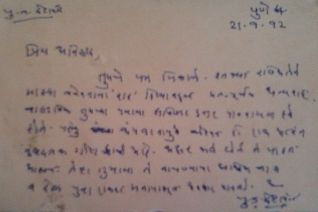
This is Pu La's reply dated Sept 21 1992:

पु ल देशपांडे पुणे ४

प्रिय अनिरुद्ध, 21.9.92

तुमचे पत्र मिळाले. इतक्या रसिकतेने माझ्या लेखनाला 'दाद' दिल्याबद्दल मनःपूर्वक धन्यवाद. वास्तविक तुमच्या पत्राला सविस्तर उत्तर पाठवायला हवे होते. परंतु कंपवातामुळे लेखन ही एक अत्यंत कष्टदायक गोष्ट झाली आहे. अक्षर कसे होते ते पाहत आहाच. तेव्हा तुम्हाला ते वाचण्याचा अधिक त्रास न देता पुन्हा एकदा मनापासून आभार मानतो.

सही पु ल देशपांडे


SCHLEICHERA OLEOSA / kusum located at Rani Baug, Mumbai (courtesy: SHUBHADA NIKHARGE and Frontline May 20 2011)

Frontline article says: An uncertain future awaits Mumbai's 150-year-old botanical garden with rare and endangered tree species.

Let us save it for our own future and in the name of Rabindranath Tagore, a passionate lover of gardens.

Monday, May 16, 2011

Did Arnold ever quit grabbing them so that we could hear him?

CNN May 16 2011:

"Police say Strauss-Kahn was naked when he tried to force himself on a N.Y. hotel employee."

PTI / The Times of India on May 11 2011:

"One of America's most high profile couples, former California governor Arnold Schwarzenegger and wife Maria Shriver, have announced their separation after 25 years of marriage...

...During the 2003 elections to elect the next governor of California, reports surfaced about Schwarzenegger's lengthy history of groping women. At the time, Shriver defended her husband, helping him to victory..."


Artist: Mike Luckovich in year 2003

This cartoon has 'Avaj' (आवाज), a Diwali issue, like quality. I haven't read Avaj for a number of years now but I used to like some of their 'naughty' cartoons.

Don't forget Playboy has published some of the best cartoons ever. It still does. Therefore, along with Playboy interviews, cartoons still offer a good excuse to read Playboy!

Saturday, May 14, 2011

Vladimir Lenin, Where will you go now?

"लेनीन, आता तू कोठे रे जाशील?" [borrowing from the title of S M Mate's (श्री. म. माटे) “Banseedhara, Where will you go now?” (बन्सीधरा, आता तू कोठे रे जाशील?) short-story/ book.]

The Asian Age, May 14 2011:

"A virtual tsunami unleashed by Trinamul Congress chieftain Mamata Banerjee made history here on Friday — dethroning the longest-serving democratically-elected Communist government in the world. The star of Vladimir Lenin — to whom the state’s CPI(M)’s rulers routinely paid public tribute and whose photograph had pride of place in their offices — had well and truly dimmed after 34 long years..."

Following picture may guide Ms. Banerjee what to do with Lenin's photographs.

(You may want to see a previous post on Mr. Lenin here.)


Artist: Eldon Dedini, The New Yorker, 27 Nov 1989

Last night I was touched when Ms. Banerjee remembered the late Mr. Rajeev Gandhi fondly. I think expressing gratitude when you are sitting on the mountain of what you think is a success, especially to someone who is long gone and can't give you anything now, is a hallmark of a sensitive human. She also quoted a beautiful Tagore's Bengali couplet. And above all she looks so Indian.


"Are we looking at India's future Prime Minister?"

(Photo courtesy: PTI and The Asian Age)

Tuesday, May 10, 2011

Contesting Chandoba's Photo Caption Competition

Bob Mankoff of The New Yorker said on January 19 2011:

"When The New Yorker started its caption contest, in 2005, it quickly became the world’s most popular weekly cartoon caption contest. I don’t have any data to back this up, but back then, just having a weekly cartoon caption contest made us the world’s most popular one. Five years and more than a million and a half entries later, a Google search for “cartoon caption contest” yields about 292,000 results...

I’ve been pretty frustrated by all of them, not due to the copycat factor but because I haven’t been able to win..."

I can understand Mr. Mankoff's frustration.

I wonder when did the first picture (photo, cartoon...) caption contest debut anywhere in the world?

For me it started in children's magazine 'Chandamama'. Marathi version of it 'Chandoba' (चांदोबा) was launched in April 1952. (Past issues of Chandoba are available here.)

I don't know in which month's issue the caption contest was launched but when I started reading the magazine, c 1967, it was well established.

In Marathi, it was called 'photo jodanaave chadaaod' (फोटो जोडनावे चढाओढ). I think as a family we tried to win the contest by attempting it a couple of times but failed.

Here is a typical contest:

Contest: from January 1969 issue

Winning Entry: from March 1969 issue by Ms. Lata Kharade, Mumbai (लता खराडे, मुंबई)

"आपण दोघे मित्र जणू / शुभ्र वेषांत !" "मैत्रीचा गोड घास घे / तुझ्या मुखांत !!"

(p.s. Today they may get an entry saying that we shouldn't encourage feeding animals in captivity at zoo!)

Sunday, May 08, 2011

David Hume, for whom Adam Smith called Samuel Johnson the son of a whore, is now 300

ROBERT ZARETSKY says:

"TODAY is the 300th birthday of David Hume, the most important philosopher ever to write in English, according to The Stanford Encyclopedia of Philosophy. The conferences being held on Hume this year in Austria, the Czech Republic, Russia, Finland and Brazil suggest that the encyclopedia’s claim is perhaps too modest..."( The NYT, May 6 2011)

(any thing in India?)

Here are five posts, containing David Hume, on this blog:

1. Why, why no David Hume, Vinda?

2. Will Jayant Narlikar One Day Write Marathi Sceptical Essays?

3. Why Vinda Karandikar Didn't Choose David Hume

4. Evening of September 3 2003- Dilip Chitre followed by Vinda Karandikar

5. Why Minus Times a Minus Equals a Plus?

George Scialabba on Adam Smith who was a bosom friend of David Hume:

"...He never fell afoul of civil or religious authority, had no mistresses, and engaged in no public quarrels.
(A semi-public one, though. Shortly after Hume’s death, Smith met Samuel Johnson at a party. Johnson spoke slightingly of Hume, Smith defended him, and their exchanges grew increasingly heated until Johnson exclaimed, “Sir, you lie!” To which Smith retorted, “Sir, you are the son of a whore!” and stalked out.).."

Friday, May 06, 2011

राजहंस माझा: बालगंधर्व

Govindrao Tembe: "I consider Narayanrao very cultured man because he never talks about himself."
(गोविंदराव टेंबे: "नारायणरावांना मी फार सुसंस्कृत मनुष्य समजतो - कारण ते स्वतःबद्दल कधी बोलत नाहीत -")


Simone de Beauvoir on Simone Weil:

“Her intelligence, asceticism, and total commitment as well as her sheer courage, filled me with admiration…I especially envied her for her heart.”


Vladimir Nabokov:

"The centuries will roll by, and schoolboys will yawn over the history of our upheavals; everything will pass, but my happiness, dear, my happiness will remain, in the moist reflection of a streetlamp, in the cautious bend of stone steps that descend into the canal's black waters, in the smiles of a dancing couple, in everything with which God so generously surrounds human loneliness."


One such act of God was the creation of Bal Gandharva (बालगंधर्व) aka Narayan Shripad Rajhans (नारायण श्रीपाद राजहंस).

It's preposterous but true that, as a kid, I once performed, in my school annual, on the same stage on which Bal Gandharva had made his debut- at Hansprabha talkies (हंसप्रभा टॉकीज), now called Balgandharva Natyagraha (बालगंधर्व नाटय़गृह), in Miraj (मिरज), in year 1906 when the great Shahu Maharaj (शाहू महाराज) was in the audience.

(btw- They should have preserved Hansprabha as a heritage structure. Also, I don't know by what name the theatre- built by the king of Miraj state- was called when it opened in c1906 but for a very long time it was Hansprabha.)

We lived just 100m away from the stage of Hansprabha. I couldn't quite appreciate then that one of the greatest Marathi sepaking personalities of 20th century had left his footprints in the sand surrounding Hansprabha, where our mother took us many evenings to play. [Another such giant, historian and playwright, Vasudevshastri Khare (वासुदेवशास्त्री खरे) 1858-1924, had lived opposite of Hansprabha.]

Over the last few months, I have finished reading probably the two most important books on the life of Bal Gandharva:

1. 'Bal Gandharva Vyaktee Aani kala' (बालगंधर्व / व्यक्ती आणि कला) by Vasant Shantaram Desai (वसन्त शान्ताराम देसाई) first published in 1959, my edition year 1987, pages: 334

2. 'Gandharvayug' (गंधर्वयुग) by Gangadhar Gadgil (गंगाधर गाडगीळ) first published 2005, pages: 187.

'Dada, te aale na-' (दादा, ते आले ना) from 'Swayamvar' (स्वयंवर) , 1929

I enjoyed reading both the books but in the end was disappointed by them.

I also read articles by N S Phadke (ना सी फडके) and Pralhad Keshav Atre (प्रल्हाद केशव अत्रे), two very popular and perceptive critics of the then art scene in Maharashtra, on Bal Gandharva.

None of them does adequate, let alone full, justice to the life of Bal Gandharva, the narrative that was, like King Lear, a greater tragedy than the two most popular Marathi stage tragedies of 20th century: 'Ekach Pyala'(एकच प्याला) by R G Gadkari (राम गणेश गडकरी) and 'Natasamrat' (नटसम्राट) by V V Shirwadkar (वि वा शिरवाडकर).

Having lived disabled and destitute for many years before the death, even Bal Gandharva's funeral at Pune was a rushed affair- according to Desai's book- because some people felt that there could be a claim that he had converted into Islam and hence should be given final rites accordingly.

The person who understood BG much better than these wordsmiths was another Gandharva, Kumar Gandharva , no relation, who expressed that knowledge in his inimitable album 'Mala Umajalele Balgandharva' ('मला उमजलेले बालगंधर्व').
Ten songs there show you BG in ten dimensions. Personal favourite- 'Tat Karee duhita' (तात करी दुहिता).

Mark Twain:

“I lost Susy thirteen years ago; I lost her mother—her incomparable mother!—five and a half years ago; Clara has gone away to live in Europe; and now I have lost Jean. How poor I am, who was once so rich! … Jean lies yonder, I sit here; we are strangers under our own roof; we kissed hands good-by at this door last night—and it was forever, we never suspecting it. She lies there, and I sit here—writing, busying myself, to keep my heart from breaking. How dazzlingly the sunshine is flooding the hills around! It is like a mockery."


Prem, Seva, Sharan (प्रेम, सेवा, शरण), 1960

I plan to return to the subject of Bal Gandharva a few more times over the next several months.

A new Marathi film is being released on the subject of Bal Gandharva today. Subodh Bhave (सुबोध भावे) is playing the title role. In promos, he looks the part great.

But being Bal Gandharva is not sum of looks, sarees/jewellery/attars, great singing voice, distinctive and stylish elegance, fine art direction, rich sets, playwrights like Krushnaji Prabhakar Khadilkar, music directors like Govindrao Tembe, fellow artists of the stature of Keshavrao Bhosale, accompanists like Ahmed Jan Thirakwa, well wishers like Solicitor P S Lad, musical instruments like organ, wealthy patrons, doting public, integrity of character, humility, pre-WWII society...It's primarily about heart.

The question that haunts me today is: Does Mr. Bhave have the heart as large as that of Bal Gandharva? We shall soon find out...

One of the best Marathi films and one of the greatest biopics in the history of world cinema, Sant Tukaram, 1936 (संत तुकाराम), became both popular and critical success largely because of the quality of acting of Vishnupant Pagnis (विष्णुपंत पागनीस).

[p.s on May 20 2011, Vasant Sarwate (वसंत सरवटे) suggested me N S Phadke (ना सी फडके)'s novel 'akherache band' (अखेरचे बंड), a part of which, he said, is based on Bal Gandharva'a life.

Sarwate who has watched Bal Gandharva perform a few times, including Sangeet Manapman (संगीत मानापमान), spoke to me on many other aspects of BG's art and the new Marathi film based on his life. More on it later...]

More p.s.:

I watched the film in October 2011. As expected, Mr. Bhave took me as close to the late Bal Gandharva in flesh and blood as possible. The way he stood, the way he gestured, the way he sang, he moved me. (He probably could have spoken with more tenderness.) But the movie sadly is a disappointment.

Monday, May 02, 2011

If only Cartoons were Drones and Laughs were Bullets...

The New York Times May 2 2011: President Obama said that Osama bin Laden had been killed in a firefight during a "targeted operation" Mr. Obama ordered in Pakistan.

Mike Luckovich has drawn most laughs out of me at the cost of Osama bin Laden. He takes the Mickey out of Mr. Laden just by the way he draws him.

[p.s. To "take the Mickey (out of someone)" means to take the fight, the vigor, the gravity, the self-importance out of them, by mocking them, usually in a very subtle way.]

I don't know if Mr. Laden followed Luckovich or had any sense of humour.

Here is a small selection.

Needless to say it's as much comment on Mr. Laden as it is on America.

caption: Laden : I brought chaos and destruction to New York's financial district...His lackey: I hear you get bonus for that...


caption: Laden: Here's my plan for destroying America: we sneak in and marry each other...


caption: Laden: I couldn't carry on my sports drink but this is one of those Dell notebooks with an exploding battery.

Saturday, April 30, 2011

Why Minus Times a Minus Equals a Plus?

George Santayana:

"(Pierre-Simon) Laplace is reported to have said on his deathbed that science was mere trifling, and that nothing was real but love."

('The Life of Reason' / 'the Phases of Human Progress', in five volumes from 1905 to 1906)

George Orwell:

Then the question arises, Why are beggars despised?--for they are despised, universally. I believe it is for the simple reason that they fail to earn a decent living. In practice nobody cares whether work is useful or useless, productive or parasitic; the sole thing demanded is that it shall be profitable. In all the modem talk about energy, efficiency, social service and the rest of it, what meaning is there except "Get money, get it legally, and get a lot of it"? Money has become the grand test of virtue. By this test beggars fail, and for this they are despised.

(Down and Out in Paris and London, 1933)


J Sri Raman

'
Nucleus and Nation' is especially recommended for anyone interested in studying, or engaged in a struggle against nuclear nationalism and militarism. Anderson helps us comprehend the history of an Indian science that has given the country the Bomb but no solution to socio-economic backwardness.

(EPW, April 23 2011)

Dr. Jayant Narlikar has written an essay "Don’t blind kids with science" (The Asian Age, April 13 2011)

He says:

"...Indeed, in general, our school science texts seek to present the subject in a cut and dried form so that the student gets the impression that it was always that way. He is not aware of the birth pangs suffered by the scientists involved, often being misled, sometimes running a race to establish priority, or even making an over-claim so as to attract more funds for future work. Ambient social conditions can play a significant part in deciding which way science moves. The rapid research on the atomic bomb was inspired by its potential importance as the ultimate weapon during World War II...

...Chandrasekhar is credited with the discovery of the mass limit on stable white dwarf stars. Reading the technical account of his work conveys the imaginativeness and depth of understanding of the young scientist, then under 25 in age. But such accounts do not convey his mental agony when he had to face severe criticism and ridicule from an unexpected quarter. No less a person than Eddington, in an unexpected attack on Chandrasekhar’s ideas, tore his theory apart. This confrontation took place in the august debating hall of the Royal Astronomical Society in London. The typical neutral person in the audience left the meeting under the impression that the idea of a rather inexperienced young scientist had been demolished by an experienced leader in the field. Yet, in science an ultimate objectivity eventually prevails. Within a few years Chandrasekhar was vindicated and went on to receive the Nobel Prize. But episodes like these need to be part of the student’s curriculum so as to give him or her the right perspective on science and its practitioners..."

Why do we want to give our students the right perspective on science and its practitioners?

1> I don't think most middle-class parents of India's students want their wards to have "the right perspective on science". They just want their kids to excel in competitive exams and get wealthy asap.

2> Most Indian corporates don't want their employees to have "the right perspective on science". They just want them to be able to execute "the straight line extrapolations" of the managements and meet quarterly earnings or sales quotas.

"The straight line extrapolations" is explained here by Stefan Stern:

"...As Rich Lyons, the dean of the Haas School of Business at the University of California, Berkeley, points out, the straight line extrapolations on a number of important graphs lead you to a pretty scary place.
Over the next few decades the earth’s population looks set to climb to about 9bn. Temperatures and sea levels are rising. But we may not have enough habitable land, water, energy or food to cope with these changed circumstances. Future healthcare costs in a world of greatly increased longevity are daunting. See it human. The outlook is bad..."

(FT, July 12 2010)

3> If we want to give "the right perspective on science", why not begin the effort by teaching them that science also is a kind of faith?

Betrand Russell explains:

"...The great scandals in the philosophy of science ever since the time of Hume have been causality and induction. We all believe in both, but Hume made it appear that our belief is a blind faith for which no rational ground can be assigned...

...Science, as it exists at present, is partly agreeable, partly disagreeable.

It is agreeable through the power which it gives us of manipulating our environment,and to a small but important minority it is agreeable because it affords intellectual satisfactions.

It is disagreeable because, however we may seek to disguise the fact, it assumes a determinism which involves, theoretically, the power of predicting human actions; in this respect, it seems to lessen human power.

Naturally people wish to keep the pleasant aspect of science without the unpleasant aspect; but so far the attempts to do so have broken down..."

To most students and their parents "it (the science) is agreeable through the power which it gives us of manipulating our environment".

"To a small but important minority" (that perhaps includes Dr. Narlikar), "it is agreeable because it affords intellectual satisfactions".

Let us turn to giving "the right perspective on practitioners of science".

Bertrand Russell:

"...We all know that Galileo and Darwin were bad men;...Almost all the Renaissance artists were bad men..."

Clive Cookson:

"The author (Michael Brooks) starts by reminding us of Einstein’s unappealing personal life – among other things making passes at his mistress’s daughter, breaking his promise to give all his Nobel prize money to his wife Mileva, evading tax and abandoning his schizophrenic son to die a “third-class” patient in a mental institution.

Then the book analyses the many “shady moments” in Einstein’s professional life: cherry-picking data to support his theories, appropriating advances made by others and, once he had made his name, using fame shamelessly for further self-advancement.
The equation most closely associated with Einstein, E=mc2, did not come as a surprise to those in the know when he first proposed it in 1905, Brooks claims. And Einstein failed in eight attempts to prove E=mc2 during the next 41 years, though others succeeded – yet he had appropriated the equation as his own and he dismissed attempts to set the record straight, with aggressive assertions of his “priority”..." (FT, July 8, 2011)

These guys were as human as us.

Alexander Waugh writes:

"... Mathematics, in which physicists vest unwarranted confidence, is far too blunt a tool. It worked for Newton, Maxwell and Einstein because they found equations that accurately described the classical world. But with the discovery, in the early 20th century, of quantum mechanics, everything changed. Subatomic particles do not behave like large visible objects. One cannot measure a particle’s position and its velocity at the same time; the arrow of time cannot be observed in particle interactions; and (so Hawking believes) for a particle to travel between two points it has to take every ‘possible path’ between them simultaneously. The number of possible paths from A to B is, he claims, infinite. If this is correct, then it becomes a feature of the quantum world that all history, and all possible histories, also take place simultaneously.

How can mathematics, however sophisticated, be up to the task of dealing with this? Numbers, after all, were created by humans to describe things in the observed world. They are adjectival. How can one ascribe a number to a particle, or to its position, or its velocity if, while travelling from A to B, it is said to be in an infinite number of places simultaneously?

If numbers are not to be trusted, then it follows that mathematics is even worse. Have you ever tried asking a mathematician why a minus times a minus equals a plus? Try it. He cannot answer, except by specific reference to the man-made artificialities of algebra. Outside of these, the concept has no application and no meaning. One should be equally suspicious of mathematical infinities. In very simple terms, if you divide 10 by three in base ten you get 3.3 recurring (infinitely). Equally you could say that the answer is 31/3 with no infinite recurrence. In his famous Brief History of Time, as well as in the present book, Hawking finds himself constantly frustrated in his attempts to describe the universe because of the ‘plague of infinities’ that come into his maths at every turn...."

(The Spectator, 11th September 2010)

Therefore, sure we can teach our students science using a wider canvas but, more importantly, why not we teach them our great books, classics?

That might give them the right perspective, not just on science and its practitioners, but on much larger thing called life.

Artist: Mischa Richter, The New Yorker, 16 June 1962