मेघदूत: "नीचैर्गच्छत्युपरि दशा चक्रनेमिक्रमेण"

समर्थ शिष्या अक्का : "स्वामीच्या कृपाप्रसादे हे सर्व नश्वर आहे असे समजले. पण या नश्वरात तमाशा बहुत आहे."

G C Lichtenberg: “It is as if our languages were confounded: when we want a thought, they bring us a word; when we ask for a word, they give us a dash; and when we expect a dash, there comes a piece of bawdy.”

C. P. Cavafy: "I’d rather look at things than speak about them."

Martin Amis: “Gogol is funny, Tolstoy in his merciless clarity is funny, and Dostoyevsky, funnily enough, is very funny indeed; moreover, the final generation of Russian literature, before it was destroyed by Lenin and Stalin, remained emphatically comic — Bunin, Bely, Bulgakov, Zamyatin. The novel is comic because life is comic (until the inevitable tragedy of the fifth act);...”

सदानंद रेगे: "... पण तुकारामाची गाथा ज्या धुंदीनं आजपर्यंत वाचली जात होती ती धुंदी माझ्याकडे नाहीय. ती मला येऊच शकत नाही याचं कारण स्वभावतःच मी नास्तिक आहे."

".. त्यामुळं आपण त्या दारिद्र्याच्या अनुभवापलीकडे जाऊच शकत नाही. तुम्ही जर अलीकडची सगळी पुस्तके पाहिलीत...तर त्यांच्यामध्ये त्याच्याखेरीज दुसरं काही नाहीच आहे. म्हणजे माणसांच्या नात्यानात्यांतील जी सूक्ष्मता आहे ती क्वचित चितारलेली तुम्हाला दिसेल. कारण हा जो अनुभव आहे... आपले जे अनुभव आहेत ते ढोबळ प्रकारचे आहेत....."

Kenneth Goldsmith: "In 1969 the conceptual artist Douglas Huebler wrote, “The world is full of objects, more or less interesting; I do not wish to add any more.”1 I’ve come to embrace Huebler’s ideas, though it might be retooled as “The world is full of texts, more or less interesting; I do not wish to add any more.” It seems an appropriate response to a new condition in writing today: faced with an unprecedented amount of available text, the problem is not needing to write more of it; instead, we must learn to negotiate the vast quantity that exists. How I make my way through this thicket of information—how I manage it, how I parse it, how I organize and distribute it—is what distinguishes my writing from yours."

Tom Wolfe: "The first line of the doctors’ Hippocratic oath is ‘First, do no harm.’ And I think for the writers it would be: ‘First, entertain.’"

विलास सारंग: "… . . 1000 नंतर ज्या प्रकारची संस्कृती रुढ झाली , त्यामध्ये साधारणत्व विश्वात्मकता हे गुण प्राय: लुप्त झाले...आपली संस्कृती अकाली विश्वात्मक साधारणतेला मुकली आहे."

Saturday, September 03, 2011

Why do Maharashtra's Cartoonists Spare their Targets? Naji al-Ali, Ali Farzat...

Monica Osborne:

Germans may not have been aware of every aspect of Hitler’s plan to exterminate the Jews and eliminate political dissenters, but they had an acute understanding of the diabolical nature of his vision, and instead of acting against it they sometimes laughed about it.

(review of 'Dead Funny: Humor in Hitler’s Germany' by Rudolph Herzog)

I often feel that activists (and international celebrities) like Arundhati Roy are lucky when it comes to freedom of expression in India because the Indian state makes sure that they are not touched by anyone. They also are financially secure if not wealthy by Indian standards.

But when it comes to common man, he has to constantly look over his shoulder to write or say something that may ruffle feathers of fundamentalists of all hue in Maharashtra.

I am sure a few of Maharashtra's cartoonists feel the same way. They would have taken on these forces if they felt secured. The mock would have run amok. They would have drawn their targets panzers...err pants down.

On July 26 2009, I wrote about legendary Palestinian cartoonist Naji al-Ali here who was shot dead on August 29, 1987.

Now The New York Times reports "Political Cartoonist Whose Work Skewered Assad Is Brutally Beaten in Syria":

"BEIRUT, Lebanon — Masked gunmen severely beat Syria’s best-known political cartoonist on Thursday, breaking his hand and leaving him to bleed on the side of a road in Damascus, activists said.

The attack came days after the artist, Ali Farzat, published a cartoon showing President Bashar al-Assad hitching a ride out of town with Col. Muammar el-Qaddafi of Libya, who was toppled from power this week..." (August 26, 2011)

The Guardian had rightly asked in July 2002:

"Favoured by Syria's new president (President Bashar al-Assad), Ali Farzat, leading cartoonist and popular newspaper publisher, seemed to have a licence to mock. Can it last?"

In India, many political and social activists have been attacked or even killed but luckily for cartoonists they seem to have been spared so far. Also, as said earlier, cartoonists too play safe.

I had not seen the work of Mr. Farzat. I saw it on Guardian's website.

The pictures are absolutely wonderful. Even those which I don't fully understand.

See one of them below.

On tele, 'Mushy Love in the time of Torture'? Look at the right foot and the right hand of the captive. They lie severed on the ground!

Absolutely gut-wrenching. Brings home the power of the cartoon as a medium.


Artist: Ali Farzat

From 'Dead Funny: Humor in Hitler’s Germany' by Rudolph Herzog:

Jokes told by German Jews-

How many types of Jews are there? Two: optimists and pessimists. All the pessimists are in exile, and the optimists are in concentration camps.

The Gestapo is about to shoot some Jews when the commanding officer walks up to one of them and growls, “You almost look Aryan, so I’ll give you a chance. I wear a glass eye, but it’s not easy to tell. If you can guess which eye it is, I’ll let you go.” Immediately, the Jew answered, “The left one!” “How did you know?” asks the Gestapo commander. “It looks so human.”

Monica Osborne:

The Holocaust is a tale, among other things, of the most staggering breakdowns of ethical responsibility. Neighbors turned on neighbors, and people closed their eyes to atrocities committed on a daily basis—evil was everyday and commonplace, an idea that is critical to Herzog’s premise, which is that the jokes told in Nazi Germany by ordinary citizens reveal the extent to which they were also responsible for the terrors committed by Nazis on behalf of the state. Herzog is accurate in his assessment that when we laugh at Hitler, we “dismiss the metaphysical, demonic capabilities accorded to him by postwar apologists” and others who would have us believe that Hitler’s capacity for evil was not human. Laughing at Hitler might have been a way back to ethical responsibility, because inherent in the laugh is an acknowledgment of just how frightening the human capacity for evil can be.

Wednesday, August 31, 2011

गंगाराम चिंतामण तांबट: The Hidden Marathi Artist In A British Archive

ROBERTA SMITH:

Art historians rarely rest, and the world is generally a better place for their exertions. Scholars of the great painting traditions of India, for example, have taken knowledge of their subject to new levels in the past few decades, with their assiduous combing of documents, deciphering of inscriptions and scrutinizing of artworks.

Their immediate aim has been to name the names of Indian artists and identify their creations, pinning down as never before who did what, where and when. Their motive has been to dispel the long-held view, especially in the West, that these often small, transcendent works were made by unlauded artisans toiling away in monasteries and imperial workshops.
(Putting Names to the Greats of Indian Art, Sept 29 2011)

On September 23 2007, I wrote "Perhaps Beautiful but Surely A Fraud: Thomas Daniell’s Painting of Peshwa Court."

I wish to revisit that post.

D G Godse (द ग गोडसे) informs us that Sir Charles Warre Malet, British ambassador to Peshwa's Pune court, has praised Gangaram Chintaman Navgire-Tambat's (गंगाराम चिंतामण नवगिरे-तांबट) work and some of Gangaram’s work apparently is still preserved in Malet’s estate.

['Ek Darbar Chitra ani Charitra' (एक दरबारचित्र आणि चरित्र) included in his book ‘Samande Talash’,1981 (समंदे तलाश)]

Tambat's work is preserved alright but NOT in Malet's estate anymore.

Tambat must be first Marathi artist (painter) whose work has been clearly attributed to him. We must thank 'wily' Sir Malet- who was one of the architects of eventual demise of the Maratha empire at the hands of the British- for this.

Yale University has organised a seminar "Gangaram Chintaman Tambat: The Hidden Indian Artist in a British Archive" on October 12, 2011 5:30 PM - 6:30 PM Speaker/Performer: Holly Shaffer.

It's an opening lecture for the exhibition "Adapting the Eye." Visit image sheet of the exhibition here.

"...Adapting the Eye explores the complex and multifaceted networks of British and Indian professional and amateur artists, patrons, and scholars in British India in the later eighteenth and early nineteenth centuries, and their drive to create and organize knowledge for both aesthetic and political purposes...

...A pivotal figure in this rich cultural interchange was the highly accomplished Indian draftsman and sculptor Gangaram Tambat, who drew on both indigenous and European artistic conventions; his remarkable hybrid drawings are juxtaposed with works by British artists, including William Hodges, William and Thomas Daniell, Robert Mabon, and James Wales."

I wish to reproduce two pictures of Mr. Navgire-Tambat courtesy Yale Center for British Art, Paul Mellon collection. These drawings on paper were commissioned by Malet and the British artist James Wales.


How many better drawn Rhinos have you seen? Me none.

(A Rhinoceros in the Peshwa’s Menagerie at Poona, Nov. 1790, 1790, watercolor and gouache, Yale Center for British Art, Paul Mellon Collection.)

If you have been to an old-style gyms - तालीम or व्यायामशाळा in Maharashtra, I am sure you know how good this is.

(Three Jeyties Exercising, ca. 1792, watercolor and black ink on paper, Yale Center for British Art, Paul Mellon Collection.)

There are two more drawings of Mr. Tambat in the image sheet:

1> View of Parbati, the Hill near Poona occupied by the Temples at which the Peshwa frequently Worships, 1795, watercolor and graphite with pen and brown ink on paper.

Luckily for us we can still recognise Parvati in this drawing. But for how long?

2> The Temple at Ekvera, ca. 1793, grey washes, watercolor and chalk on six joined sheets of paper.

This is a wonderful drawing, inviting me to the temple one more time, to come and observe it closely, with the help of Mr. Tambat's eyes.

This is all great but the question that bothers me is: When will Pune university hold the exhibition of Pune's own son Gangaram Chintaman Tambat?

Monday, August 29, 2011

When Indian People would like a word with their Members of Parliament...

Indian lawmakers keep talking about people... how they are their sole representatives etc.

Well, Indian people decided to meet them in Delhi in August 2011.

Brilliant J B Handelsman, creator of UK Punch's 'Freaky Fables', about whom I have already written, in January 2010, here has captured that moment...Talk of prescience of cartooonists.

Focus your attention on the senator's face...is he scared?

Artist:(the late) J B Handelsman (1922-2007), The New Yorker, October 19 1998

Saturday, August 27, 2011

का अण्णा हवासा पण अक्का 'नकोशी'? Why desire Anna but Akka 'Nakoshi'?

Raina Lipsitz:

Today, we don't make movies about women that are even worth fighting about. Whenever I'm dispirited by the crassly sexist ethos that governs Hollywood (as well as television, politics, and the corporate world) today, I think of "Thelma and Louise" and remember a time, not so long ago, when women were allowed to be human, if only in the movies.


Both words Anna and Akka have entered Marathi lexicon from her elder sisters - Dravidian languages- Tamil, Kannada, Telugu.

1> My mother (1937-2006) a person with a very liberal outlook in most social matters was really pleased, even proud, when my sister, my brother and I all had a male child as first born.

2> My wife pointed out to me long time ago that many middle-class couples she knew, majority of them Brahmin, living in India, had only one child if it was male and two children if their first child was a female!

(By the way my sister, my brother and I continue to have only one child!)

On the front page of The Times of India August 24 2011, following two news items of appeared:

1> "Parents rush to name their newborn after Anna: Anna’s magic has given birth to a new trend in Madhya Pradesh. At least 22 newborn children born in MP’s Damoh district between August 16 to 22 have been named after the Gandhian campaigner in one district alone..."

2> "GENDER BIAS:
In fact, ‘Nakoshi’, or a similar-meaning ‘Nakusa’, are the names of as many as 222 girls aged up to 16 as identified by the district health administration in the villages of Satara. The department, which is continuing with its task of identifying such girls, has begun the process of renaming them...

,,,“Most of these girls were the second or third girl child in the family, when all their parents were hankering after was a boy,” said Satara district health officer Bhagwan Pawar. “What’s more, most of the parents seem to have no qualms about having named these girls ‘Nakoshi’ or ‘Nakusa’, saying the names only expressed what they felt when the child was born.”
Speaking to TOI, the mother of a girl named ‘Nakoshi’ said: “We longed for a male child. When our fifth child also turned out to be a girl, we named her Nakoshi,” she said nonchalantly...

,,, As per the provisional figures of the 2011 census, Maharashtra’s child sex ratio declined to 883 in 2011 from 913 in 2001 — a sharp fall of 30 points. The child sex ratio in Satara district is 881"

I wish Anna were a lady with a name 'Akka' (अक्का). Maybe people would have named their Nakoshi as Akka.

Wednesday, August 24, 2011

Learning from Sant Janabai & Simone Weil: Restoring Dignity to Menial Labour

Today Aug 24 2011 is 68th death anniversary of Simone Weil.

I had to know who Ms Weil was when I read her this quote some time ago: “All the tragedies which we can imagine return in the end to the one and only tragedy: the passage of time.”- reminiscent of कालमूलमिदं सर्व भावाभावौ सुखासुखे॥ (महाभारत १/१/२४७) [Mahabharat 1/1/247: Living and death, happiness and sadness all originate in time.]

Simone Weil, pictured above, believed that the only antidote available to the sickness of the modern world caused by up-rootedness is a social order grounded in physical labour. Read a memorable essay by Peter Foges here.

Great Bhakti poet Janabai (c 13/14th century), a Dalit, worked all her life as a maid, doing all kind of menial work.

I don't know if Janabai would agree with Ms. Weil or not but she used to unite with her Lord Vitthal while doing her work and not while praying. In fact, she felt it was her Vitthal who was doing all her work.

This is what Janabai said:

झाडलोट करी जनी । केर भरी चक्रपाणी ॥१॥
पाटी घेऊनियां शिरीं । नेऊनियां टाकी दुरी ॥२॥
ऐसा भक्तिसी भुलला । नीच कामें करुं लागला ॥३॥
जनी ह्मणे विठोबाला । काय उतराई होऊं तुला ॥४॥

[When Jani swept the floor, her Lord (Chakrapani) gathered up the dirt.
Carried the basket over his head, to dump it in the distance.
infatuated by the devotion, started doing lowly work.
Jani says to (Lord) Vithoba, how do I thank you enough.]

"दळिता कांडिता । तुज गाईन अनंता ॥१॥
न विसंबे क्षणभरी । तुझे नाम ग मुरारी ॥२॥
नित्य हाचि कारभार । मुखी हरि निरंतर ॥३॥
मायबाप बंधुबहिणी । तू बा सखा चक्रपाणी ॥४॥
लक्ष लागले चरणासी । म्हणे नामयाची दासी ॥५॥"

(As I mill and pound the grain । I sing your name the Infinite ॥1॥
I don't pause even for a moment । as I chant your name Murari ॥2॥
I make this my daily task । Hari on my tongue incessantly ॥3॥
You are mother-father brother-sister । you are my friend Chakrapani ॥4॥
My attention is focused on your feet । says the maidservant of Namdev ॥5॥)

"Weil herself was preternaturally a worker by brain, not by hand. Small, myopic, physically awkward and weak, it is difficult to think of anyone less suited to toil in a factory, workshop or field."

We don't know about physical qualities of Janabai. Maybe even she too was "small, myopic, physically awkward and weak". But that didn't stop her from embracing her daily backbreaking routine as a kind of communion with her god.

"Weils's uncompromising attitudes, disheveled physical appearance, monotonous voice and lack of almost all conventional social grace did her few favors, but she eventually managed to find employment in a steel plant, an experience that proved physically, emotionally and spiritually shattering. It seared her like a branding iron."

For Janabai, my guess is, such an experience would have been "physically, emotionally shattering" but not "spiritually".

“What a factory ought to be” Weil wrote to a friend, “is a place where one makes hard painful but joyous contact with real life. Not the gloomy place it is.”

I don't know if Janabai has called her workplace "gloomy". And even if she had felt it to be gloomy, she would have called upon Vitthal to help her as she does here:

'' सुंदर माझे जाते गे । फिरे ते बहु टेके गे।
ओव्या गाऊ कौतुके । तू ये रे बा विठ्ठला ।।
जीवशीव दोन्ही खुंटे । प्रपंचाचे नेटे गे।
लावुनि पाची बोटे गे। तू ये रे बा विठ्ठला।।''

(My lovely grindstone, how sweetly it spins
as I sing your praise, Come to me, Vitthala

Twin poles of World and Spirit, are the smooth wooden handles
my five fingers grasp by turns, Come to me, Vitthala)

"At the same time the spiritual Simone was becoming increasingly mystical and Christian —she drew close to the Catholic Church in her later years, but resisted the final baptismal step. This led her to crave release from academia and the abstract life of the mind and lose herself in obedience. Like early medieval mystics, Saint Teresa of Avila or Saint John of the Cross, she prayed that her individuality be obliterated by the necessities of toil, that her intelligence might be extinguished through punishing physical fatigue. At times she turned for solace and inspiration to the Bhagavad-Gita and other sacred Hindu texts. (Did she read Janabai?) These notions—anathema to left-wing French intellectuals then and now—became her vocation. Like Leo Tolstoy, she saw a connection between physical fatigue and spirituality, and hoped, however foolishly, to have a religious experience on the factory floor. “Physical work” she wrote in her best known book Gravity and Grace, “makes us experience in the most exhausting manner, the phenomenon of finality.” Workers, she wrote, “need poetry more than bread, and religion alone can be the source of it.”

Perhaps the purest expression of Weil’s mystical notion of the sanctity of physical labor comes at the end of her essay “La Condition Ouvrière,” published, as were most of her writings, long after her death. “If man’s vocation is to achieve pure joy through suffering, manual workers are better placed than all others to accomplish it in the truest way.”..."

Peter Foges says Weil "hoped, however foolishly, to have a religious experience on the factory floor".

I don't think it was foolish at all. Going by Janabai's experience, Weil was on the right track.
Artist: Lee Lorenz, The New Yorker, October 30 1971

Tuesday, August 23, 2011

Was Mahatma a Pioneer in the Art of Media Manipulation?

Pankaj Mishra:

"Gandhi’s greatest contribution to the arsenal of political activism, however, is his theory and practice of bringing together great masses of highly motivated and disciplined protesters in public spaces. Here his spiritual beliefs were crucial: the assumption, in particular, that, regardless of the regime people lived under—democracy or dictatorship, capitalist or socialist—they always possessed a freedom of conscience, an inner capacity to make moral choices in everyday life. As his mass campaigns often proved, and the recent Arab uprisings have affirmed, such strongly self-aware individuals acting cooperatively in the spotlight of the world media could come to wield an astonishing amount of moral authority—the “authentic, enduring power” of people that, as Hannah Arendt wrote in her analysis of the Prague Spring of 1968, a repressive regime or government could neither create nor suppress through the use of terror, and before which it must eventually surrender."

(May 2 2011, The New Yorker)

Some people say Anna Hazare is a product of Indian electronic media...they say he manipulates media or media manipulate him... Or both.

As Pankaj Mishra argues, 'the spotlight of the world media' was central to Mahatma's activism. And so is to Anna Hazare's.

Before I go to media aspect, let me discuss Mr. Mishra's 'disciplined protesters in public spaces'.

Joseph Lelyveld writing on Quit India movement of 1942:

"...Gandhi's last campaign hadn't achieved anything like his standard of nonviolent discipline...By the end of the year, nearly one thousand persons had been killed in clashes with the police...Indian nonviolence had always been imperfect, "limited in both numbers and quality," he coolly told American correspondent- that is, in the availability of trained satyagrahis who could be relied on to make the requisite self-sacrifice- but "it has infused life into the people which was absent before." He isn't threatening or justifying violence, but assuming for the moment the position of a detached observer, a realist, he seems to be suggesting that this time it couldn't be ruled out. This Gandhi sounds like the pre-Mahatma of 1913 who warned the South African authorities he might lose control of his movement."

('Great Soul Mahatma Gandhi and His Struggle with India', 2011, page 287)

Now to media.

Lelyveld on Gandhi's days in Noakhali 1946:

"...A pioneer in the art of press manipulation, Gandhi insisted the journalists file not on the words that had actually come out of his mouth but on versions he "authorized" after his own sometimes heavy editing of the transcripts..." (ibid, page 298)

On this blog, I have written about P L Deshpande's (पु देशपांडे) very poular play 'Tujhe Ahe Tujapashi', 1957 (तुझें आहे तुजपाशीं). There is a character of Acharya facing off with character of Kakaji.

Acharya in the play pauses to say something 'profound' so that his followers get a chance to take out their notebooks and pencils to note it down. He even repeats it for their convenience!

I was told that Acharya was not a caricature of Gandhiji but some of Gandhi's followers.

I am not so sure after reading Lelyveld.

Monday, August 22, 2011

Rereading Vasant Sarwate at Ramlila Maidan in August 2011

Indian government until August 22 2011 to the supporters of The Jan Lokpal Bill and middle-class people in general...


caption:

मी लोकशाहीचा कट्टा पुरस्कर्ता आहे. मग त्यासाठी सर्वच्या सर्व जनतेविरुद्ध लढा द्यावा लागला, तरी बेहत्तर, मी माझी भूमिका जरासुद्धा बदलणार नाही, सांगून ठेवतो!..."

(I am an ardent supporter of democracy. And for that if I have to fight the entire populace, I could not care less, I will not change my stance even one bit, I am telling you!...")

Artist: Vasant Sarwate first published in 1969, (वसंत सरवटे)

[courtesy: 'Reshalekhak Vasant Sarwate' (रेषालेखक वसंत सरवटे) edited by Dileep Majgaonkar / Madhukar Dharmapurikar (दिलीप माजगावकर / मधुकर धर्मापुरीकर ), 2009]

This was published in one of the best Marathi periodicals- despite its soft(?) Hindutva bent- of all time - 'Manoos' (माणूस).

Political cartoons of Sarwate that were published in Manoos from 1969-1972 tell us more about Indian democracy as practised in Maharashtra than any history book. Particularly see his cartoon on hunting expedition of the then chief minister Vasantrao Naik (वसंतराव नाईक).

This collection proves how in the field of political cartoons Sarwate is equal to the likes of Abu Abraham and R K Laxman. And if you add the rest of his repertoire to it, he is better than both.

We at Miraj used to get Manoos for a long time by post. I used to pounce on it. I still remember many things from it- Sadanand Borse's (सदानंद बोरसे) reviews of films for instance. My father and my brother both were handsome contributors to its contents over a number of years.

Like almost all good Marathi periodicals, it died long time ago...

Sunday, August 21, 2011

What if Anna Hazare were to be an Army Deserter

K.N. PANIKKAR:

"Indian democracy has evolved an institutional structure on the basis of the principles and prescriptions laid down in the Constitution. But there is a wide gulf between precept and practice. Democracy as practised by the state and society is far removed from the ideal form of democracy in which equalities – political, cultural and economic – are continuously negotiated. The gulf between the concept and practice may not be fully bridged ever, but it could be reduced through continuous public reasoning and dialogue. Amartya Sen has argued that the availability of a most perfect institutional structure need not necessarily ensure the success of democracy. The success would largely depend upon the intervention of human agency for using the available opportunities.

What democracy does in India is only a caricature of what democracy really is."

(Frontline, Aug. 13-26, 2011)

The Times of India, August 21 2011:

"...The RTI reply from Dakshin ASC records (South) dated August 3 puts the record straight that Anna "never deserted" the Army, and that he was "honourably" discharged from the armed forces on completion of the 12 years of his service..."

What if he deserted army? What has it to do with the movement he has started now? Is deserting army a mistake? And even if it is, did not Mahatma Gandhi constantly make mistakes if not blunders and tried to learn from them?

According to Wiki:

"During the First World War, Bertrand Russell was one of a very small number of intellectuals engaged in pacifist activities, and, in 1916, he was dismissed from Trinity College following his conviction under the Defence of the Realm Act. A later conviction resulted in six months' imprisonment in Brixton prison. Russell was released from prison in September 1918."

Adam Hochschild has written a book 'To End All Wars: How the First World War Divided Britain' on these 'pacifist activities'.

Maurice Walsh:

"...Hochschild's book is not another lament for a lost generation, a mere backward look at the folly and waste of war. He sets out to restore to this story those who at the time proclaimed the fighting to be madness, in the face of mass conformity moulded by one of the greatest propaganda campaigns in history...".

Adam Hochschild:

"...during this greatest crisis of his generation, loved his country deeply but believed from the very first moments that the war was an appalling mistake.

Part of Russell’s intellectual bravery lay in his willingness to confront that last set of conflicting loyalties. He described himself poignantly in the autumn of 1914 as being “tortured by patriotism. . . . I desired the defeat of Germany as ardently as any retired colonel. Love of England is very nearly the strongest emotion I possess, and in appearing to set it aside at such a moment, I was making a very difficult renunciation.” What left him even more anguished was realizing that “anticipation of carnage was delightful to something like ninety per cent of the population. . . . As a lover of truth, the national propaganda of all the belligerent nations sickened me. As a lover of civilization, the return to barbarism appalled me. As a man of thwarted parental feeling, the massacre of the young wrung my heart.” Over the four years to come, he never yielded in his belief that “this war is trivial, for all its vastness. No great principle is at stake, no great human purpose is involved on either side. . . . The English and French say they are fighting in defence of democracy, but they do not wish their words to be heard in Petrograd or Calcutta.”..."

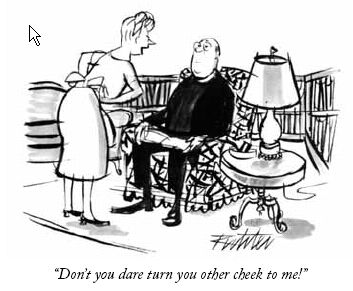
Artist: Alan Dunn, The New Yorker, June 11 1966

If we don't put our democracy in order, we will hear even erstwhile law-abiding citizens saying: I don't obey the law even if I do agree with it.

Saturday, August 20, 2011

Can Anna Hazare be compared to Mahatma Gandhi? How clean a smell he manages to leave behind!

A favourite repost of Anna Hazare's detractors is - He is no Gandhi. (Someone writes he is not a patch on Jayaprakash Narayan.)

Maybe he is not. But are they so sure?

I have now read most of Joseph Lelyveld's 'Great Soul: Mahatma Gandhi and His Struggle with India', 2011.

And the overwhelming feeling I constantly got while reading the book: how human Gandhi was. Hardly a saint for sure if I compare him to the saints I know Kabir, Dnyaneshwar, Tukaram, Namdev...He was a politician and social activist.

Was Gandhi successful in what he set out to achieve in personal and public life?

It's hard to judge his personal life. Although reading the section of Lelyveld's book on his 'experiments in brahmacharya' (pages 303-308), I feel his personal life was tormented.

And public life?

Mahatma Gandhi: "India has still to attain social, moral and economic independence in terms of its 700,000 villages as distinguished from its cities."

Lelyveld: "...India has now been free and independent for about four months. And the leading shaper of that independence unsettled and despairing...No single catastrophe served as catalyst for his decision to start seventeenth and final fast on January 13 (1948). In the days running up to the fast, he'd been forcefully struck by several indications that matters were on a downward slide. First he received a detailed account of rampant corruption at all levels of the newly empowered Congress movement in the Andhra region of southeastern India...Announcing the fast at his prayer meeting on January 12, the Mahatma mentioned the insecurity of Muslim and the Congress's corruption..." (page 337-338)

Andrew Roberts: "...of the four great campaigns of Gandhi's life—for Hindu-Muslim unity, against importing British textiles, for ending Untouchability and for getting the British off the subcontinent—only the last succeeded, and that simply because the near-bankrupt British led by the anti-imperialist Clement Attlee desperately wanted to leave India anyhow after a debilitating world war."

Why do I then like a billion others still admire Gandhi? Why do I hang my head in shame that his killer was a Maharashtrian Brahmin like me?

George Orwell:

“One may feel, as I do, a sort of aesthetic distaste for Gandhi, one may reject the claims of sainthood made on his behalf (he never made any such claim himself, by the way), one may also reject sainthood as an ideal and therefore feel that Gandhi's basic aims were anti-human and reactionary: but regarded simply as a politician, and compared with the other leading political figures of our time, how clean a smell he has managed to leave behind!

(This essay of George Orwell, Peter Davison speculates, could have been influenced by Balraj Sahni who worked with Gandhiji in 1938 and with Orwell at the BBC. Orwell brought Mr. Sahni and his future wife, Damyanti, together.

From 'George Orwell, A Life in Letters', 2010)

Anna Hazare too is a politician and social activist and so far he has managed to leave behind only clean smell!


Artist: Mischa Richter, The New Yorker, Apr 23 1960

Thursday, August 18, 2011

Marathi Anna Hazare's Hindi: Let us march against Corruption

David Ogilvy:

When Aeschines spoke, they said, “How well he speaks.” But when Demosthenes spoke, they said, “Let us march against Philip.”..."


In 1991, there were three candidates in fray to become the 9th Prime Minister of India: P. V. Narasimha Rao, Sharad Pawar, and Madhavrao Scindia.

I remember 'India Today' quoting a Congress source saying that the best Marathi speaking among them would become the Prime Minister! (All three of them spoke fluent Marathi.)

Mr. Rao won the race.

Just for the record: the late Mr. Rao has translated Marathi classic H N Apte's (ह. ना. आपटे) 'Pan Lakshat Kon Gheto' (पण लक्षात कोण घेतो) into Telugu.

People admire Anna Hazare for various things. I admire him first for speaking Hindi so effectively. The last Marathi person speaking Hindi so effectively on national stage was probably the late Pramod Mahajan.

This is not unprecedented. Read 'exploits' of another 'simpleton' Marathi, Saint Namdev (CE 1270-1350), who has been hailed by Vinoba Bhave as the first great classical writer in Hindi ('पहिला अभिजात उत्तम लेखक') here.

I wonder how effective Hindi B G Tilak and Dr B R Ambedkar, two of the most popular Marathi speaking national leaders, spoke.

The other day Mr. Hazare said: "the Prime Minister is just echoing Kapil Sibbal" in Hindi something like this: "प्राइम मिनिस्टर कपिल सिब्बल की री ओढ़ रहे है." Oh, it was so delightful!

Sharad Yadav once said in Lok Sabha that the President of India Pratibha Patil should have made her address in Hindi instead of English.

His rationale: Not some jingoism but "When Marathi people speak Hindi, it is so sweet." (My son says Mr. Yadav won't say this if he hears my Hindi!)

Read Shivaji-maharaj's likely expertise of Farsi language here. Had he got the opportunity to speak at the court of Mughal, would he have moved them with his command of Persian?

On this blog, I have already quoted Ramachandra Guha reviewing "The Argumentative Indian: Writings on Indian History, Culture and Identity" by Amartya Sen for 'The Economic and Political Weekly':

"...All works of history must necessarily be selective; still, reading Sen’s book, a younger reader may come away thinking that, apart from the splendid aberration of Rabindranath Tagore, there were no Indian intellectuals or arguers between the age of Akbar and the age of Hindutva.

I wonder – is Sen’s neglect of what I have called the proximate argumentative tradition linked somewhat to the characteristic insularity of the Bengali intellectual? The typical “bhadralok” scholar travels a straight line between Kolkata and some point to the west: this might be London or, by way of variation, Paris or Moscow or Havana or New York.

But his interest in other parts of India is pretty nearly non-existent. In this respect his Bengali cosmopolitanism is also a Bengali parochialism.

Thus one member of the species has written that “Bengal was the site of the most profound response to the colonial encounter”, and that the province’s capital city, Calcutta, “was the crucible of Indian nationalist politics, and the home…of modern Indian liberal consciousness itself”.

Writing from neutral Bangalore, I would instead award the honour to the state of Maharashtra (as is now is).

Consider a few names: Ranade, Gokhale, Phule, Agarkar, Ambedkar.

Now consider a few more: Tarabai Shinde, V R Shinde, D D Karve, Shahu Maharaj.

If one sees “liberal consciousness” as being composed of individual rights, caste reform, and gender equality, then I think the contributions of these Marathi-speakers rate rather higher than those of their (admittedly more loquacious) Bengali counterparts..."

An 'ordinary' Marathi person, like many of the names quoted above, is once again likely to make it big on the national stage. He has begun well. He has proven that language is no barrier. Whether he succeeds or not, we shall find out in good time.