मेघदूत: "नीचैर्गच्छत्युपरि च दशा चक्रनेमिक्रमेण"

समर्थ शिष्या अक्का : "स्वामीच्या कृपाप्रसादे हे सर्व नश्वर आहे असे समजले. पण या नश्वरात तमाशा बहुत आहे."

G C Lichtenberg: “It is as if our languages were confounded: when we want a thought, they bring us a word; when we ask for a word, they give us a dash; and when we expect a dash, there comes a piece of bawdy.”

C. P. Cavafy: "I’d rather look at things than speak about them."

Martin Amis: “Gogol is funny, Tolstoy in his merciless clarity is funny, and Dostoyevsky, funnily enough, is very funny indeed; moreover, the final generation of Russian literature, before it was destroyed by Lenin and Stalin, remained emphatically comic — Bunin, Bely, Bulgakov, Zamyatin. The novel is comic because life is comic (until the inevitable tragedy of the fifth act);...”

सदानंद रेगे: "... पण तुकारामाची गाथा ज्या धुंदीनं आजपर्यंत वाचली जात होती ती धुंदी माझ्याकडे नाहीय. ती मला येऊच शकत नाही याचं कारण स्वभावतःच मी नास्तिक आहे."

".. त्यामुळं आपण त्या दारिद्र्याच्या अनुभवापलीकडे जाऊच शकत नाही. तुम्ही जर अलीकडची सगळी पुस्तके पाहिलीत...तर त्यांच्यामध्ये त्याच्याखेरीज दुसरं काही नाहीच आहे. म्हणजे माणसांच्या नात्यानात्यांतील जी सूक्ष्मता आहे ती क्वचित चितारलेली तुम्हाला दिसेल. कारण हा जो अनुभव आहे... आपले जे अनुभव आहेत ते ढोबळ प्रकारचे आहेत....."

Kenneth Goldsmith: "In 1969 the conceptual artist Douglas Huebler wrote, “The world is full of objects, more or less interesting; I do not wish to add any more.”1 I’ve come to embrace Huebler’s ideas, though it might be retooled as “The world is full of texts, more or less interesting; I do not wish to add any more.” It seems an appropriate response to a new condition in writing today: faced with an unprecedented amount of available text, the problem is not needing to write more of it; instead, we must learn to negotiate the vast quantity that exists. How I make my way through this thicket of information—how I manage it, how I parse it, how I organize and distribute it—is what distinguishes my writing from yours."

Tom Wolfe: "The first line of the doctors’ Hippocratic oath is ‘First, do no harm.’ And I think for the writers it would be: ‘First, entertain.’"

विलास सारंग: "… इ. स. 1000 नंतर ज्या प्रकारची संस्कृती रुढ झाली , त्यामध्ये साधारणत्व व विश्वात्मकता हे गुण प्राय: लुप्त झाले...आपली संस्कृती अकाली विश्वात्मक साधारणतेला मुकली आहे."

Wednesday, January 08, 2014

Is it a Selfie of Rembrandt?

S. Radhakrishnan, 'Indian Philosophy', Volume 1, 1927:

"The individual self is ever unsatisfied with itself and is struggling always to become something else. In its consciousness of limitation, there is a sense of the infinite. The finite self which is limited, which ever tries to rise beyond its sad plight, is not ultimately real. The true self has the character of imperishableness."


David Shariatmadari, The Guardian, January 1 2014:

"Previous generations seem to have been more aware of the sense of false security that images can provide – portrait paintings were often accompanied by a memento mori – often a well-placed skull signified that death was inescapable. The selfie lacks this handy feature. As we happily snap away, are we are engaged in a kind of mass denial? Things can be preserved, we seem to be saying, perfectly, digitally, and for ever."

I learnt in November 2013 that "selfie" has been named as word of the year by Oxford Dictionaries.

It is defined as "a photograph that one has taken of oneself, typically one taken with a smartphone or webcam and uploaded to a social media website"


Posing for a selfie photo at the memorial service of Nelson Mandela in December 2013 (courtesy: AFP / Getty)

The New Yorker's Robert Mankoff has some fun with this selection of the word  here.

There is not a cartoon by Peter Arno,  I don't love and so too was the case with this one. He rib-tickles me all the time.

Artist: Peter Arno, The New Yorker, 1 January 1959

My favourite 'Selfie' cartoon although is this:


Artist: Ed Fisher, The New Yorker,  11 February 1956

My caption today would be: "That's your selfie, I suppose".

I was moved to almost tears by what Jonathan Jones has to say about the following picture on his Guardian blog on November 21 2013:

"...Rembrandt, at the age of about 59, looks at us from the depth of his years, and with the authority of his craft. He has portrayed himself holding his brushes, maulstick and palette, in front of two circles drawn on a wall. Why the circles? Do they represent a sketch for a map of the world? Or is Rembrandt alluding, with this drawing on a brown surface, to stories that say the first picture was a drawing made with a stick in sand?
His eyes contain so much knowledge and melancholy that even looking at this painting on a computer screen, I get the eerie feeling that Rembrandt is looking back and weighing up my failures. You can deduce the power of the original.

He was a failure when he painted this, a proud man reduced to poverty by his enthusiastic spending – but here he throws it back on the burghers of Amsterdam. Art is not a business; it is a struggle with eternity. Rembrandt stands not proudly or arrogantly, but in the full consciousness of the heroic nature of his work.
First there is nothing, then there is a circle. The human hand, guided by the eye and the brain, makes a mark that only we can make – there are no other geometricians but us, no other animal that can draw or presumably conceive a circle.

From the circle to this portrait is another leap. Rembrandt has mapped himself with such craggy truthfulness that we simply stand and look back, wondering if we can ever be as real as he is..."

 But I still have a question....Is the picture Rembrandt's selfie?


"Detail from Portrait of the Artist" c.1665 from the collection at Kenwood House

Artist: Rembrandt Van Rijn

Photo courtesy: English Heritage

Saturday, January 04, 2014

The Women Come And Go, Talking of Julian Peters

Today January 4 2014 is  126th Birth Anniversary of T S Eliot

 T S Eliot:

“No honest poet can ever feel quite sure of the permanent value of what he has written. He may have wasted his time and messed up his life for nothing.”
 
T S Eliot, 'The Love Song of J. Alfred Prufrock', 1915:

"...Oh, do not ask, 'What is it?'
Let us go and make our visit.


In the room the women come and go
Talking of Michelangelo.


The yellow fog that rubs its back upon the window-panes,
The yellow smoke that rubs its muzzle on the window-panes, ..."


"...Eliot attracted widespread attention for his poem 'The Love Song of J. Alfred Prufrock', which is seen as a masterpiece of the Modernist movement." (Wikipedia)

The poem will celebrate its centenary in 2015.

As soon I read this poem around 1982, I liked it, although I did not understand a lot of it.

I particularly loved these two lines:

"In the room the women come and go
Talking of Michelangelo."

Why? I don't know.

 (On September 28 2007, I wrote a post  "In the Room the Women Come And Go, Talking of Dev Anand", on Dev Anand's autobiography.)
  
On the art of comics, Holland Cotter says in the New York Times, November 15 2013:

"Comic art is, on a very basic level, about concentration, about fitting a complete world in a small space and keeping it coherent and readable."

Isn't poetry about the same: 

"fitting a complete world in a small space and keeping it coherent and readable."?

Recently,  I got too see an adaptation of the Eliot's poem as a comic book by Julian Peters


Artist: Julian Peters

Now, there are five frames in the picture above.

The third, "Let us go and make our visit",  is fine and so is the fourth, "In the room the women come and go Talking of Michelangelo", and so are the frames one and two at the top where the poet is shown dressing up.

They all are very good drawings but add no value to my appreciation of the poem.

But wait...what makes the comic strip of Peters special is the fifth frame depicting the following line:

"The yellow fog that rubs its back upon the window-panes"

That is the way the fog rubs its back upon the window-panes as the poet walks by...Wonderful. 

I hope when they celebrate the poem in 2015, they will also remember Julian Peters's adaptation.

Tuesday, December 31, 2013

Jean-Jacques Sempé's Picture Moves us to Penance?

John Gray, February 2012:

"...Comte wanted his new religion to be based on science, so the temples of humanity pointed only as far as science could reach. That is why his new church failed. The very idea of a science-based religion is an absurdity. The value of religion is that it points beyond anything that can be known by the methods of science, showing us that a mystery would remain even if everything could be finally explained. The heart of religion isn't belief, but something more like what Keats described as negative capability: "being in uncertainties, mysteries, doubts, without any irritable reaching after fact and reason"..."


Ned Flanders:

"Why me, Lord? Where have I gone wrong? I've always been nice to people! I don't drink or dance or swear! I've even kept kosher just to be on the safe side! I've done everything the Bible says; even the stuff that contradicts the other stuff! What more could I do?" 

 (The Simpsons, 'Hurricane Neddy', Season 8 Episode 8, Aired December 29, 1996)
 
Look at the following picture by great cartoonist Jean-Jacques Sempé. 


Artist: Jean-Jacques Sempé (August 17 1932 - )

courtesy: Madhukar Dharmapurikar (मधुकर धर्मापुरीकर) 

In a church, an old lady is stunned to find a mouse, with a halo around its head, is being chased by a ferocious looking cat. The outcome looks almost certain.

Unfortunately, all the details in the picture are not very clear. For instance, there are a couple of paintings on the wall of the church. And if you look closely, you will notice they depict some kind of violence. 

Andrew Graham-Dixon writes in "Caravaggio A Life Sacred and Profane", 2012:

"Caravaggio’s art is made from darkness and light. His pictures present spotlit moments of extreme and often agonized human experience. A man is decapitated in his bedchamber, blood spurting from a deep gash in his neck. A man is assassinated on the high altar of a church..."


'The Beheading of St John', 1608    Location St. John's Co-Cathedral, Valletta

Artist: Caravaggio  ( "In the blood gushing from the saint’s neck, Caravaggio signed his name. It is his only signature on a painting.")

In Sempe's church, it's not going to be a man but just a mouse. But in the background, there is probably a Caravaggio.


Edward Mendelson has said:

"Great institutions thrive on internal contradictions and irresolvable divisions. This has always been the case with governments and universities, and especially with religions..."

A church mouse that has earned its halo, no less, finds no mercy as it is about to breathe its last.

While reviewing 'Hunting Evil/ The Nazi War Criminals Who Escaped and the Quest to Bring Them to Justice' by Guy Walters, Deborah E.Lipstadt says:

"...The Vatican also went out of its way to protect criminals. It provided passports, refuge and other means of support for them. While the church's record during the war may be open to some debate, its record in helping the murderers escape responsibility afterward is clear, as has been documented by both Michael Phayer in "The Catholic Church and the Holocaust, 1930-1965" and Gerald Steinacher in "Nazis auf der Flucht..."

Is Sempe's church protecting the killer cat?

Mr. Graham-Dixon says in the book quoted above:

"...The second half of the sixteenth century witnessed a widespread call to order – a movement intended to take religious art back to the values of an earlier and supposedly purer time. Carlo Borromeo was at its forefront. As well as containing recommendations of every kind about church architecture and decoration, his Instructiones set out his views on art with typical forthrightness. No animals or other distracting details should be included, unless actually mentioned in the biblical text that the artist had been instructed to illustrate. In the seventeenth chapter of his book, devoted to the correct representation of sacred events, Borromeo determined the appropriate fines and punishments for artists who failed to meet the strictest standards of decorum. In Milan, errant artists as well as heretics were liable to come to the attentions of the archbishop’s famiglia armata. No painter could be in any doubt about what was required of him. Images should be clear and direct. It was the job of art simply to educate spectators and move them to penance..."

In Sempe's picture, there are two animals...there are lots of distracting details...even then Sempe's picture perhaps moves us to penance! 

Saturday, December 28, 2013

Farooq Sheikh Proved that Nerd Could Win the Girl

The Hindu, December 28 2013:

"Veteran actor Farooq Sheikh, who is best remembered for his performances in films like ‘Garm Hava’, ‘Shatranj Ke Khiladi’, ‘Chashme Buddoor’ and ‘Kissi Se Na Kehna’, died after suffering a heart attack here (Dubai). He was 65."

Kundan Shah:

"...Gul Anand, the producer of funny, quaint, off-beat romantic films such as Chashme Baddoor, was interested in distributing Jaane Bhi Do Yaaro (JBDY) when it was complete. At the last minute, the deal went sour for some reason. However, what he said to me personally was very revealing. “See, I am going to buy your film, Kundan,” he said, “but if you had come with the script of this film to me to produce it, I would’ve thrown it out of the window. It’s so difficult… impossible… to see this film on paper.” ..."

Mr. Sheikh died on Friday December 27.

I have seen three of the four films mentioned above. And although I like Garm Hava, I love CB and SKK. I don't know what KSNK is.

Sai Paranjpye's (सई परांजपे) CB, 1981 became a cult film for me like Kundan Shah's  JBDY, 1983. I could not shake them off for a long time.

Then I thought of myself as a nerd and Mr. Sheikh proved that the nerd could win the girl. I wanted to name my future wife Neha after Deepti Naval in CB.


Mr. Baswani died on July 27 2010 and I called him an eternal Sancho Panza.

Now he is joined by his Don.


courtesy: owners of the copyright to the film, probably PLA Entertainment.

Friday, December 27, 2013

His Secular AK47 Became the Coca-Cola of Small Arms

When Suredra Paul, owner of the Apeejay group and brother of UK-based Swraj Paul,  was brutally murdered by militants in Assam near Chabua on May 9 1990, my wife and I almost heard the gunshots because we lived only a few kilometers away from the scene at Doom Dooma.

Later we came to know that the murder was done with a weapon called AK-47 and any 'idiot' could operate it with ease and that it was easily and cheaply available in Assam.

I still remember that eerie afternoon. Luckily we did not see any AK-47 while we lived there. It seems as of today the rifle has killed more people than any other firearm in the world!

In the wee hours of November 8 1990, we were asked to leave our tea-garden homes, with as little baggage as possible,  on a gun-mounted Indian military truck before being airlifted from Sookerting airfield- almost never used for nondefense purpose- in an Indian Airlines Boeing flight to dodge the bullets of Ulfa's AK-47's.


courtesy: Frontline dated December 8-21 1990

(I knew well all the employees from the picture above and the late Mr. Deepak Sen lived in the bungalow above.

By the way,  the cars were not "abandoned" by any definition of that word. They were parked in the head office because the military convoy  carrying us started from that point. Managing Director was NOT evacuated with us. He was already in Kolkata.)

A lot of blood has since been shed in the streets of India. 

Mikhail Kalashnikov, credited with creating the AK-47, the most popular assault rifle in history, died at age 94 on December 23 2013.

Nigel Fountain  writes in the Guardian while reviewing Michael Hodges's 'AK47: The Story of the People's Gun', on  July 28 2007:

"...With 650 rounds pumped out a minute, Kalashnikov's cheap and cheerless, charismatic assembly of tube and wood has, with added global trickle-down, put mass slaughter inside the budgets of ordinary Joes - and Abdullahs and Reiks - everywhere..."

Not just Joes,  Abdullahs and Reiks but also Baruah's, Singh's, Prabhakaran's...


Artist: Tome Toles, July 2009

Tuesday, December 24, 2013

Is He Coming Tonight?


"There's nothing sadder in this world than to awake Christmas morning and not be a child."


Deborah Solomon:
“...Rockwell had celebrated the small and local, not the global and cinematic. But the emphasis on the common man that was central to America’s sense of self in 20th-century America gave way, in the television-centered 1960s, to the worship of celebrities, whose life stories and marital crises replaced those of the proverbial next-door neighbor as subjects of interest and gossip...”


"Is He Coming?", 1919 

 Artist: Norman Rockwell

Courtesy: Norman Rockwell Museum

Sunday, December 22, 2013

I Have Measured Out My Life with Tea Spoons...एकच कप

Anton Chekhov:  

"When I stop drinking tea and eating bread and butter I say, "I've had enough." But when I stop reading poems or novels I say, "No more of that, no more of that."…" 

 W H Auden, 'The Dyer's Hand And Other Essays', 1948:

"Solid food is to the drunkard a symbolic reminder of the loss of the mother's breast and his ejection from Eden."

Artist: Lisa Congdon 

This illustration is for T S Eliot's poem: 

"...For I have known them all already, known them all:
Have known the evenings, mornings, afternoons,
I have measured out my life with coffee spoons;..."  

("The Love Song of J. Alfred Prufrock")
     
In my case, I have measured out my life with coffee spoons (for first 23 years) and then  tea-spoons.


In a famous essay "A Nice Cup of Tea", George Orwell writes: "If you look up ‘tea’ in the first cookery book that comes to hand you will probably find that it is unmentioned; or at most you will find a few lines of sketchy instructions which give no ruling on several of the most important points.This is curious, not only because tea is one of the main stays of civilization in this country, as well as in Eire, Australia and New Zealand, but because the best manner of making it is the subject of violent disputes..."   (1945/ 1946).
 

Orwell was wrong then and is even more wrong now because he doesn't mention India.
Today tea (चहा) is Maharashtra's, indeed majority of India's,  favourite drink. It is the main stay of civilization in India, even more than it's in England, Australia and New Zealand.

I am not sure, which is the first reference to the drink, in the historical records  of Maharashtra, but there is a reliable reference to Maratha diplomat (मुत्सद्दी)/ chieftain (सरदार) Sakharambapu Bokil (सखारामबापू बोकील) (? - 1781) being fond of the drink.  

However, I have still not come across a great poem on tea in Marathi. There are quite a few on booze but not a single (great) one on tea. There are a few in English of course.  (Read this essay by Kate Kellaway.)

Sample this:  

"...I read the tea leaves
as if they were words

left over from a conversation
between two cups…" 

(Kenny Knigh, "Lessons in Tea-Making")

Endless cups of tea...conversation...wonderful...This could have been easily written in Marathi

"...वाचतो मी पत्ती चहाची
जणू ते शब्दच 
राहून गेलेले संवादातील 
दोन कपामधल्या..."  

Or won't we all identify with this?

John Agard:  

"Put the kettle on
It is the British answer
To Armageddon.

Never mind taxes rise
Never mind trains are late
One thing you can be sure of
And that's the kettle mate…"

("ठेव किटलीत आधण 
हेच असे भारतीय उत्तर 
प्रलयाला 
गेली उडत महागाई, रुपयाची घसरण
होवू  देत लोकलला उशीर
एका गोष्टीची  मात्र खात्री बाळग
ती म्हणजे किटली-मित्र …")


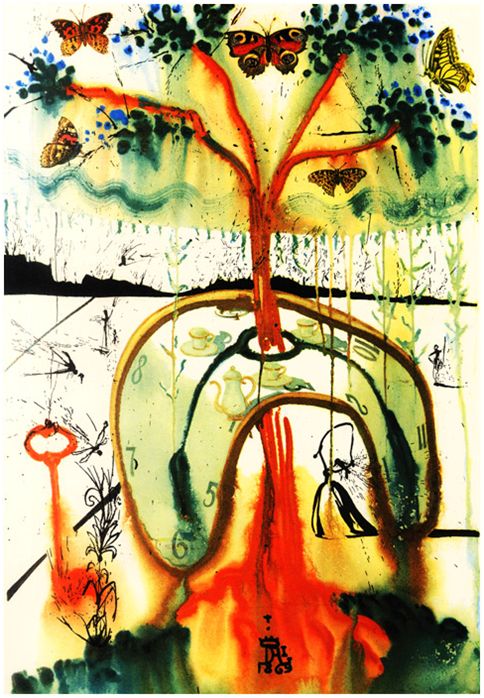
'Mad Tea Party' in  'Alice In Wonderland'
 
Artist:   Salvador Dali

Wednesday, December 18, 2013

Honey, I'll Make Sure You Wear the Same Perfume Today...

Caesar: 
"He hath given his empire
Up to a whore." 
[from William Shakespeare's "Antony and Cleopatra" (III, vi, 66-67)]


courtesy: Facebook page

Wikipedia:

"Soong May-ling made several tours to the United States to lobby support for the Nationalist's war effort. She drew crowds as large as 30,000 people and in 1943 made the cover of TIME magazine for a third time."  


In 2009, I read a book review of  "THE LAST EMPRESS / Madame Chiang Kai-shek and the Birth of Modern China" by Hannah Pakula by Jonathan Mirsky.

What struck me most was this:

"...Christopher Isherwood, traveling in China with W. H. Auden, met Madame Chiang in the late 1930s. He caught her aura exactly: “She could be terrible, she could be gracious, she could be businesslike, she could be ruthless. . . . Strangely enough, I have never heard anybody comment on her perfume. It is the most delicious either of us has ever smelt.”..."

And in September 2013, I saw this beautiful snap of Soong Mei-ling (1897-2003) (aka Madame Chiang Kai-shek) and Generalissimo Chiang Kai-shek (1887-1975) in Frontline dated October 4 2013:


Photo:THE HINDU ARCHIVES 

courtesy: Frontline and The Hindu Archives
 
My caption to this photo would be: 

"Honey, Auden and Isherwood really liked my perfume. Now, I'll make sure you wear the same one today."


The original caption is: 

Taipei: January 3, 1950: Madame Chiang reaches for the legion of merit medal sent to Generalissimo Chiang Kai-shek by U.S. President Franklin Roosevelt.

Saturday, December 14, 2013

As I Prepare to Buy AAP Brand of Tooth-powder in 2014...

Today December 14 2013 is 89th Birth Anniversary of Raj Kapoor (1924 - 1988)


Lao Tzu (6th century BCE):

"...The more laws and restrictions there are,
The poorer people become.
The sharper men's weapons,
The more trouble in the land.
The more ingenious and clever men are,
The more strange things happen.
The more rules and regulations,
The more thieves and robbers..."


Thomas Paine (1737- 1809):

"...Society in every state is a blessing, but government even in its best state is but a necessary evil; in its worse state an intolerable one;..."

Alexander Herzen (1812-1870):

"...There are periods when man is free in a common cause. Then the activity towards which every energetic nature strives, coincides with the aspirations of the society in which he lives. At such times—which are rare enough— everything flings itself into the whirlpool of events, in it finds life, joy, suffering and death..." 

Peter Marshall (1946 - ), "Demanding the Impossible: A History of Anarchism", 1992/ 2008 :

"...Anarchism remains not only an ultimate ideal, but increasingly a practical possibility. If we are to survive nuclear annihilation and ecological disaster, if we can steer between the Scylla of roaring capitalism and the Charybdis of authoritarian socialism, then we may reach the land where a free society of relative abundance exists in harmony with nature, where the claims of the free individual are reconciled with general solidarity. Even if we cannot reach it in our lifetimes, we can at least enjoy the exhilaration of the journey, sailing our ship together towards the beckoning horizon without fettering slaves in the hold or shooting the albatross on the way."

Our father encouraged us to watch all Raj Kapoor films. I liked some and found others boring. But I truly love three of them:

1. Jagte Raho (1956)

2. Shree 420 (1955)

3. Mera Naam Joker (1970)

For me, Amit Maitra and Sombhu Mitra's  'Jagte Raho' is the greatest Indian film ever made.  It remains highly underrated. I keep watching it and discovering new 'angles' I had not seen earlier. 

'Mera Naam Joker' is like a Shakespearean tragedy. But it goes little awry in the last third of the film when Padmini arrives on the scene.

As I watched the aftermath of Delhi assembly elections on TV  in December 2013, I remembered more and more of 'Shree 420'.

Whenever Mr. Arvind Kejriwal spoke I kept thinking about Raj Kapoor's speeches from the film...What innocence...What hope!


courtesy: Shemaroo and legal owner of copyright to the film

First, I remembered the scene where Mr. Kapoor tries to sell his brand of tooth powder and almost gets away with it. I would never get angry with RK for his attempt to con the crowd because I always prefer him to Nemo.


Nemo (on right) and his toothless crony 

 courtesy: Shemaroo and legal owner of copyright to the film

Similarly I have millions of questions for  AAP but I am likely to vote for it next time around - the way I would have voted in favour of Janata party in 1977 had I been eligible to vote then- because I prefer RK's likely anarchy to Nemo's regime.

I hope Mr. Kejriwal also makes the speech like the one RK makes towards the end of the film when he reminds people that you can't build a house for Rs. 100.


courtesy: Shemaroo and legal owner of copyright to the film 

"Delhiites, They all are Shree 420 alright but you have to pay a reasonable price for a unit of electric power and a kg of onions."

No matter what, I know the life of a common man over the ages has always been like that of RK's character in 'Jagte Raho' but with a new hope in my heart,  I am ready to try AAP brand of tooth powder in 2014 because I am just fed up of Nemo and his toothless crony.