मेघदूत: "नीचैर्गच्छत्युपरि च दशा चक्रनेमिक्रमेण"

समर्थ शिष्या अक्का : "स्वामीच्या कृपाप्रसादे हे सर्व नश्वर आहे असे समजले. पण या नश्वरात तमाशा बहुत आहे."

G C Lichtenberg: “It is as if our languages were confounded: when we want a thought, they bring us a word; when we ask for a word, they give us a dash; and when we expect a dash, there comes a piece of bawdy.”

C. P. Cavafy: "I’d rather look at things than speak about them."

Martin Amis: “Gogol is funny, Tolstoy in his merciless clarity is funny, and Dostoyevsky, funnily enough, is very funny indeed; moreover, the final generation of Russian literature, before it was destroyed by Lenin and Stalin, remained emphatically comic — Bunin, Bely, Bulgakov, Zamyatin. The novel is comic because life is comic (until the inevitable tragedy of the fifth act);...”

सदानंद रेगे: "... पण तुकारामाची गाथा ज्या धुंदीनं आजपर्यंत वाचली जात होती ती धुंदी माझ्याकडे नाहीय. ती मला येऊच शकत नाही याचं कारण स्वभावतःच मी नास्तिक आहे."

".. त्यामुळं आपण त्या दारिद्र्याच्या अनुभवापलीकडे जाऊच शकत नाही. तुम्ही जर अलीकडची सगळी पुस्तके पाहिलीत...तर त्यांच्यामध्ये त्याच्याखेरीज दुसरं काही नाहीच आहे. म्हणजे माणसांच्या नात्यानात्यांतील जी सूक्ष्मता आहे ती क्वचित चितारलेली तुम्हाला दिसेल. कारण हा जो अनुभव आहे... आपले जे अनुभव आहेत ते ढोबळ प्रकारचे आहेत....."

Kenneth Goldsmith: "In 1969 the conceptual artist Douglas Huebler wrote, “The world is full of objects, more or less interesting; I do not wish to add any more.”1 I’ve come to embrace Huebler’s ideas, though it might be retooled as “The world is full of texts, more or less interesting; I do not wish to add any more.” It seems an appropriate response to a new condition in writing today: faced with an unprecedented amount of available text, the problem is not needing to write more of it; instead, we must learn to negotiate the vast quantity that exists. How I make my way through this thicket of information—how I manage it, how I parse it, how I organize and distribute it—is what distinguishes my writing from yours."

Tom Wolfe: "The first line of the doctors’ Hippocratic oath is ‘First, do no harm.’ And I think for the writers it would be: ‘First, entertain.’"

विलास सारंग: "… इ. स. 1000 नंतर ज्या प्रकारची संस्कृती रुढ झाली , त्यामध्ये साधारणत्व व विश्वात्मकता हे गुण प्राय: लुप्त झाले...आपली संस्कृती अकाली विश्वात्मक साधारणतेला मुकली आहे."

Wednesday, March 23, 2011

The Kama Sutra: It's NOT for me but have Blairs read it?

William Leith's review of Oliver James's 'Affluenza: How to Be Successful and Stay Sane':

"...One of the scariest parts of the book is James's analysis of New Labour politicians. Have they been infected with the virus (of Affluenza)? Well, just think of Tony Blair and his property dealings, his flash holidays, his spray-on tan. Think of Peter Mandelson, who said: "We are seriously relaxed about people becoming very, very rich." Think of Prescott. Think of Cherie Blair...
"Just as Aids is stalking the globe, so is the Affluenza virus," says James. I think he's right..."


Wendy Doniger:

"The emphasis on the physical postures of yoga may have been bolstered by the sensational publication, in 1883, of Sir Richard Burton’s English translation of the Kamasutra, a text that became notorious for its “positions”. The tendency to confuse the teachings of yoga and the Kamasutra may have led to the overemphasis on the “positions” in both, since yoga was always associated with sex in India and came to be eroticized in England, and the general English and Indian ignorance of the cultural content of the Kamasutra was matched by their ignorance of the philosophical content of (classical) yoga. Both yoga and the Kamasutra served the schizophrenic Victorian combination of public condemnation of sex and private obsession with it..."


(The Times Literary Supplement, March 2 2011)


I have still not read Kama Sutra. I have seen it. I have read about it. I have seen its portrayal in breath taking carvings of Khajuraho.

It's supposed to descibe "64 types of sexual acts"...overemphasis on the “positions”...Phew...pant...!!!

Sam Jordison has written a review-
easily one of the funniest prose pieces I have read- of it for Guardian, Feb 14 2011
:

"...Don't think you escape either, girls:

"Sprinkle a mixture of powdered milkweed thorns, hogweed, monkey's shit and root of glory lily on a woman. She will not want sex with anyone else."

Meanwhile, beware of the man who's taken another nugget of advice from the book and approaches you with his penis covered in the powder of "a kite that has died of natural causes, mixed with honey and gooseberries". He intends to bewitch you!

All of the above is taken from the new Penguin edition of the book that's generally held up as the last word in ancient wisdom about sack-play: The Kama Sutra. It's further confirmation of my belief that the wisdom of the ancients is most generally to be ignored. After all, most of human endeavour in the past 2,000 years has been dedicated to escaping such stuff and similar wisdom about flatness of the earth, the importance of blood draining, the way fire is powered by lignin, and a man who trotted around Galilee claiming to be able to cast out demons..."

Bart Simpson once tells Homer Simpson: "Oh, dad. Nobody can rationalize like you." (Season 17, Episode 20, 'Regarding Margie')

I would say the same to Tony Blair. Therefore, I would also hire him as a salesman. He would best his sales target every quarter.

They say a good sales person is the right combination of empathy and ego-drive.

Reading what is quoted below, looks like Tony Blair has another prominent 'drive'.

On March 19 2011, The Asian Age:

"...Former British Premier Tony Blair’s wife Cherie has lifted the lid on her sex life, saying that her husband “still excites me in all possible ways”.

“We’ve been married 31 years and known each other 35 and even now he still excites me in all possible ways,” the Sun tabloid quoted the 56-year-old mother-of-four as saying in an interview with a magazine.

Cherie, a Queen’s Counsel, giggled when asked how the couple spend their time when the former Prime Minister returns from his trips as envoy to West Asia.

Tony, 57, once joked he could make love “at least five times a night” and the couple also claim to be members of the mile high club. Last year, Tony revealed in his memoirs how he “devoured Cherie’s love” the night before he became Labour leader in 1994.He wrote: “I was an animal following my instinct.”

Cherie had son Leo, who is now 10, when she was 45 and living in Downing Street.She later revealed the pair conceived the child on an official stay at Balmoral in Scotland as it’s embarrassing to bring contraceptive “equipment” for the castle, where servants unpack wash bags.

But Cherie admitted some things have changed over the years.

Recalling watching the fireworks after the 1981 Royal Wedding, she said her husband lifted her on to his shoulders adding, “He couldn’t do that now. He would probably collapse.”"


Does The Kama Sutra describe a 'position' where a woman climbs on to a man's shoulder?
Picture courtesy: The Asian Age, March 19 2011

By the way, I have never even thought of lifting my wife or fantasised lifting any other woman on my shoulders!

My body is too weak for it. But on the positive side, I feel, I don't suffer from 'Affluenza'.


"...So why are we, in James's words, so fucked up? It's because of what James calls Selfish Capitalism, or, more catchily, "Affluenza", a virus-like condition that spreads through affluent countries. In these countries, notably English-speaking ones, people define themselves by how much money they make. They are also ruled by superficial values - how attractive they look, how famous they are, how much they are able to show off. As the sociologist Erich Fromm would have put it, we have moved from a state of "being" to a state of "having". Now we are obsessed with what other people think of us, and we've lost touch with our own feelings..."

Saturday, March 19, 2011

India's Top 10 Foreigners. My list

Wendy Doniger:

"...And so from the very start India was a place made up of land and people from somewhere else..."

[Chapter 2, 'Time and Space in India' from her book 'The Hindus: An Alternative History', 2009]

(notice the word: 'land' in the quote above)

The Times of India reported on December 10 2009 that Dr. Dwarkanath Shantaram Kotnis (द्वारकानाथ शांताराम कोटणीस) is in the list of China's top ten foreigners who made exceptional contributions to the country in the past 100 years.

What an honour!

Very few native Marathi speaking persons have been feted on such a scale on the global stage.

What about top ten foreigners, not necessarily friends or well-wishers, who have visited India since Alexander the great and shaped India's destiny for the better or the worse?

Here a foreigner means someone who was not borne or raised in the subcontinent.

Here is an attempt:

Alexander the great 356–323 BCE

Mahmud of Ghazni 971-1030

Vasco da Gama 1460/1469–1524

Babur 1483-1531

Ahmad Shah Durrani/Abdali 1722–1773

Robert Clive 1725–1774

William Jones 1746-1794

Thomas Babington Macaulay 1800–1859

The Lord Curzon of Kedleston 1859–1925

Mother Teresa 1910–1997


Artist: Mischa Richter, The New Yorker, 9 October 1965

Tuesday, March 15, 2011

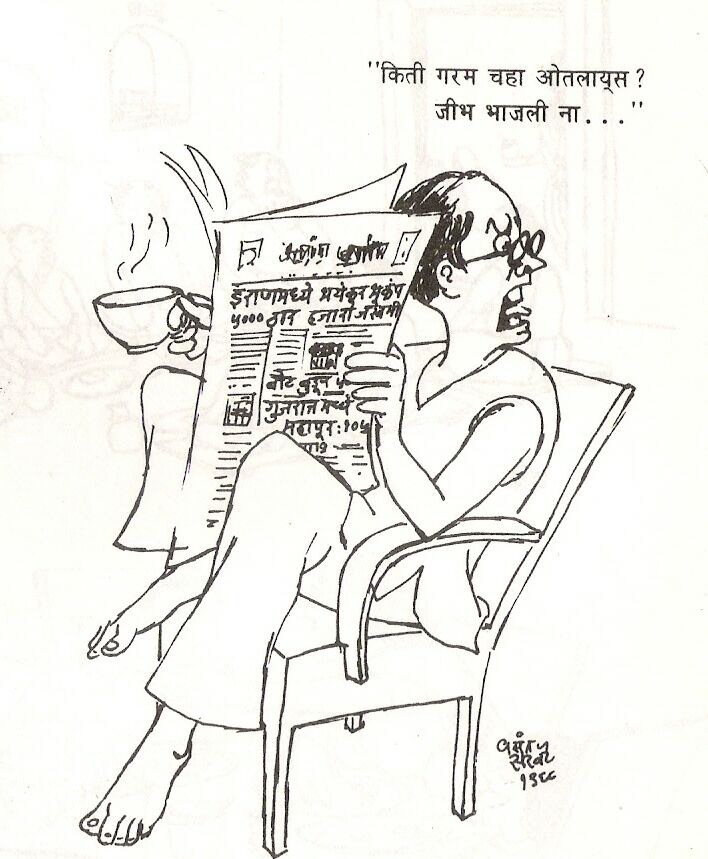
मी: "अंजु, किती गरम चहा ओतलायस ? जीभ भाजली ना..."

I, Aniruddha G. kulkarni, was heard shouting at my wife on Friday March 11 2011 afternoon watching BBC / CNN:

"Anju, how hot have you poured tea? Tongue is torched..."


(Open the picture in another browser window to get a clearer view of the news in the Marathi broadsheet* held by HIM.)

Artist: Vasant Sarwate (वसंत सरवटे), 1968

* the broadsheet he is reading has these news-items: "A quake in Iran kills 5,000 and injures thousands", "floods in Gujarat killing hundreds", "Boat capsizes" etc!

Aah! Tamil films

Business Standard on Saturday Oct 2 2010:

"Rajini fells all records with sci-fi entertainer Endhiran...The year’s biggest box-office event, Endhiran’s first day, first show, kept its date. On Friday, the big-budget, multi-lingual Rajinikanth starrer, with an ‘official’ budget of Rs 162 crore and ‘unofficial’ budget based on market rumour of Rs 250-300 crore, opened to packed houses, with tickets sold out days in advance...

# Biggest budget for any movie in Indian film industry
# To be shown on 2,250 screens worldwide, including in China
# First Tamil film album in iTunes World Album Top 10
# First Indian sci-fi movie with 1,500 graphical shots"

गोविंदराव टेंबे: "नवीन काहीतरी करावं हे धारिष्ट्यच आपल्या सिनेमावाल्या लोकांत नाही , त्यामुळे आणि त्यामुळेच त्यांची अशी दुर्दशा झाली आहे."

['सांस्कृतिक महाराष्ट्राचे शिल्पकार : गोविंदराव टेंबे', 2006 लेखक: डॉ. सौ. चारुशीला दिवेकर]

(Govindrao Tembe: "Thers is no courage among our cinema people to do something bold and because of that and that alone they are in terrible shape."

from "Sanskritik Maharashtrache Shilpkar : Govindrao Tembe", 2006 by Dr. Mrs. Charusheela Divekar)


'Enthiran The Robot' was shown on Sony TV on the evening of March 13 2011. I couldn't see it because I wanted to watch the live coverage of the last day of Yonex All England Badminton Championships.

Rajinikanth's (Shivaji Rao Gaekwad, शिवाजीराव गायकवाड) first language is Marathi and he still speaks the language with some relish and certainly much 'better'- for my ears at any rate- than many Marathi 'celebrities'.

Earlier I wrote a post on Marathi films on Dec 18 2007. Read it here Ugh! Marathi Films.

Since then I have seen parts of both 'Mee Shivaji raje Bhosale boltoy' (मी शिवाजी राजे भोसले बोलतोय) and Natrang (नटरंग).

I did not like the former at all and found the latter OK.

But frankly 'Natrang' is not close to many Marathi films of the past, especially a few of those starring Nilu Phule (नीळू फुले), Arun Sarnaik (अरुण सरनाईक), Ganpat Patil (गणपत पाटील), Ramesh Deo (रमेश देव), Jayshree Gadkar (जयश्री गडकर), Usha Chavan (उषा चव्हाण), Leela Gandhi(लीला गांधी)- (has a Marathi speaking woman ever danced better than her?)...

[The other day I watched 'Mumbaicha Jawai' (मुंबईचा जावई) . What a wonderful film with some brilliant acting by Sharad Talwalkar (शरद तळवलकर) and others!]

I have already quoted following earlier.

Suhas Palshikar: "...preferential treatment to locals is always an easy and attractive policy proposal. What is wrong with it? It is wrong simply because it creates an untenable category of “local”. In administrative parlance it becomes “domicile” – meaning resident for 15 years. This strategy practically abandons diversity. Apart from raising issues of definition of the local, such a policy encourages inbreeding and denies its beneficiaries he advantage of greater exposure and competition. It produces ghettoisation at schools, colleges and at workplaces – resulting in non-diverse social universes –hostels, localities and cities...."

More than anything else, I feel, this ghettoisation affects Marathi culture deeply.

Almost no Marathi cultural program shown on TV is complete without talking about "outsiders". For them, not just Hindi, but any other language or its native speaker is a fair game.

Even the devastating floods of 2009 in North Karnataka- where lacs of Marathi speakers live- were NOT covered in any depth by most Marathi media. (btw- They are covering March 2011 Japanese quakes in great depth!)

Like Vilas Sarang (विलास सारंग) says about Marathi literary world, this Marathi media world too is afflicted with "inbreeding".

As I have said earlier, Namdev is arguably the greatest bilingual Indian writer because apart from his enormous talent, his vision was worldly and heart large. (Where was he domiciled? Maharashtra or Punjab?)

If Marathi has to assert itself on India and the world stage, her 'lovers' need to do some serious re-thinking on how to get there.

Returning to Endhiran, look at the picture below.


Artist: Alan Dunn, The New Yorker, July 17 1937

"I dread the day when I'll have to tell him about sex."

Maybe. But what about telling him what happens after the sex?

In Enthiran, like '3 Idiots' in 2009, robot Chitti manages a complex child delivery successfully.


p.s. We as a nation are obsessed with producing babies!

Saturday, March 12, 2011

सांगे गोविंदराव टेंबेंची किर्ती

Will Durant:
“Civilization exists by geologic consent, subject to change without notice"


As I mentioned earlier, 100 years ago today Sangeet Manapman (संगीत मानापमान) was staged for the first time.

Although its great subsequent succes was because of team effort, men-of-the-match were writer Krushnaji Prabhakar Khadilkar (कृष्णाजी प्रभाकर खाडिलकर), actors Bal Gandharva (बालगंधर्व) & Nanasaheb Joglekar (नानासाहेब जोगळेकर) and music composer Govindrao Tembe (गोविंदराव टेंबे).

I consider myself singularly lucky that on March 9 2011, I obtained a Marathi book on Govindrao Tembe's life: 'सांस्कृतिक महाराष्ट्राचे शिल्पकार : गोविंदराव टेंबे', 2006 लेखक: डॉ. सौ. चारुशीला दिवेकर ("Sanskritik Maharashtrache Shilpkar : Govindrao Tembe", 2006 by Dr. Mrs. Charusheela Divekar). The books comes with an audio CD. The book has detailed information on every song of Manapman.

I had been aware of its existence for a while now but then it was priced at Rs. 700. Now, it's available at Rs. 250/- from 'Granth Abhiman', Panaji (rajhaunsvitaran@dataone.in).

At that price it is a steal. When I ordered the book they sent it immediately wrapped in probably the best packing I have seen. The entire experience was a real pleasure.

I now have heard the CD and thumbed through the book, all 648 pages. I am in love with the book. I will keep reading it for many months to come.

Tuesday, March 08, 2011

Sheila, The Eternal Woman, dating back 4000 years, 2000 years, 1 year

Filmstar Akshay Kumar said, in a lighter vein, on TV program 'Jhalak Dikhla Jaa', that Sheila of 'Tees Maar Khan' is Sindhi because she herself says: "My name is Sheila, Sheila Ki Jawani"...S K Jawani!

(Surname ending with 'ni'...by that logic I, too, am Sindhi...after meeting me after many years a hostel-mate felt that I looked like an Iranian...So Sindhi is closer home!)


(bronze 'dancing girl' from Mohenjo-daro in Sind, Pakistan c 2000 BC)

She is Sindhi alright! Let us call her Sheila.

This is how- in one of the most moving pieces of prose- historian John Keay describes her in his book 'India: A History', 2000:

Although probably not dancing, the `dancing girl' is unquestionably `a pleasing little thing'. Naked save for a chunky necklace and an assortment of bangles, this minuscule statuette is not of the usual Indian sex symbol, full of breast and wide of hip, but of a slender nymphet happily flaunting puberty with delightful insouciance. Her pose is studiously casual, one spindly arm bent with the hand resting on a déhanché hip, the other dangling so as to brush a slightly raised knee. Slim and attenuated, the legs are slightly parted, and one foot — both are now missing- must have been pointed. She could be absent-mindedly surveying her wardrobe, except that her head is thrown back as if challenging a suitor, and her hair is somehow dressed into a heavy plaited chignon of perilous but intentionally dramatic construction. Decidedly, she wants to be admired; and she might be gratified to know that, four thousand years later, she still is.

[I trust only the late D G Godse (द ग गोडसे) to write stuff comparable to this, or even better than this, on such a subject, in Marathi.]

Here is an example of "the usual Indian sex symbol, full of breast and wide of hip":


(MITHUNAS, CAVE 3, Kanheri, 2nd century A.D. )

Does Ms. Katrina Kaif, below, too belong to the category of "...not of the usual Indian sex symbol, full of breast and wide of hip, but of a slender nymphet"?


They say, like history, fashion is cyclical.

There are three pictures above: 4000 year, 2000 year and 1 year.

Ladies in the first and the third have a lot in common. But I wonder when Ms. Kaif will get her own John Keay.

6010 CE?

Sunday, March 06, 2011

वसंतराव आगाशे: "पिटातल्या प्रेक्षकांप्रमाणे शिट्या काय मारताय?"...Vasantrao Agashe of Vasant Vyakhyanmala, Miraj

Our teacher at Miraj High School (मिरज हाय स्कूल), Vasantrao Agashe (वसंतराव आगाशे) died at Pune on March 5 2011.

I am eternally grateful to Agashe-sir not for his teaching but for making "Vasant Vyakhyan Mala" (वसंत व्याख्यान माला), spring lecture series, happen every year at Miraj (मिरज). Agashe-sir worked tirelessly and selflessly for its success. He also motivated a number of young volunteers to work with him.

There was no ideological bias in the selection of speakers. Organisation of every evening used to be impeccable. I spent dozens of my evenings in the summers of 1970's there and later discussed the lecture passionately with my parents and willing friends.

Staunch Gandhian Narhar Kurundkar (नरहर कुरुंदकर), who often came calling, once told his majority Brahmin audience that he was now going to praise Mahatma Gandhi knowing fully well that a lot of his audience disliked, if not hated, Gandhi!

I also remember how Vitthalrao Gadgil (विठ्ठलराव गाडगीळ) regaled his audience with anecdotes from Indian and British parliaments.

Sadly, I never attended any of Setu Madhavrao Pagdi's (सेतु माधवराव पगडी) lectures there who too came for a number of years. I now realise the enormity of my loss.

But I did not like Agashe-sir's teaching. He taught us higher English in HSC first year. I did not like his speeches too. Particularly his flowery language. But he was very popular among certain types of students.

I remember those students- many studious girls among them- giving him a 'fishpond': "ज्ञानाच्या सागरातील राजहंस" ('Swan in the sea of knowledge') or something similar at our school social (aka gathering) in 1975. I was amused.

Once there was quite a bit of whistling at the back of our class. I was sitting there. He was not used to so much of commotion in his class. He reprimanded us with these words (he never beat a student):

"पिटातल्या प्रेक्षकांप्रमाणे शिट्या काय मारताय?"

("Why are you whistling like the spectators seated in the theatre pit?")

I liked the pun alright!

By the way, I never whistled at Vasant Vyakhyan Mala. There I behaved the way Agashe-sir wanted a student to behave in his class.

Thank you, Agashe-Sir. For many delightful spring evenings and the pun. And sorry for being a bit(?) of nuisance in the class.


 The building in the background is Miraj Vidyarthi Sangh aka Khare Mandir

Thursday, March 03, 2011

Why some Cartoonists are More Equal

FT, March 1 2011:

"Rajat Gupta, who ran McKinsey for almost a decade, has been hit with civil insider trading charges for allegedly sharing secret information he learnt as a board member of Goldman Sachs and Procter & Gamble with Galleon Group founder Raj Rajaratnam...

...The insider trading charges against Mr Gupta are a stunning setback for the one-time global managing director of McKinsey, the consulting firm. It also marks one of the highest profile insider trading charges brought against a bank director..."


According to Wikipedia Mr. Gupta holds a bachelor of technology degree in Mechanical Engineering from the Indian Institute of Technology, Delhi (IIT) and an M.B.A. from Harvard Business School.

More than a year ago, Feb 19 2010, for the rationale I still don't understand, Tiger Woods's apology was aired live in India on many news channels.

Or maybe I do after reading this:

Frank Rich:"...We’ve rarely questioned our assumption that 9/11, “the day that changed everything,” was the decade’s defining event. But in retrospect it may not have been. A con like Tiger’s may be more typical of our time than a one-off domestic terrorist attack, however devastating..."

(My father often used to wonder, in 1970's, why Marathi newspapers followed lawn tennis by dedicating vast amounts of column centimetres to it.

Then there was no tv and hence most people probably knew tennis only through cinema.)

But the channels never aired Mr. Woods's apology to his clubs.

Now this is where a cartoonist comes in, a very good one like Mike Luckovich.


Artist: Mike Luckovich

Sunday, February 27, 2011

In Praise of Hunter-gatherer Kakaji / of Pu La's 'Tujhe Ahe Tujapashi'

Holly Brubach:

Bogart’s appeal was and remains completely adult — so adult that it’s hard to believe he was ever young. If men who take responsibility are hard to come by in films these days, it’s because they’re hard to come by, period, in an era when being a kid for life is the ultimate achievement, and “adult” as it pertains to film is just a euphemism for pornography.

(Feb 4 2011, WSJ)

I must have read P L Deshpande's (पु ल देशपांडे) 'Tujhe Ahe Tujapashi', 1957 (तुझें आहे तुजपाशीं) dozens of times. Once I knew all its dialogues by heart.

My favourite character from the play is that of Kakaji (काकाजी).

Read the following set of dialogues from the play:

"काकाजी: जाऊ द्या यार. जंगलात तर दोनच वेळा. दिवस आणि रात्र. भूक लागली की जेवायची वेळ आणि थकलो की झोपायची.

आचार्य : म्हणजे मी समजत होतो , की हा वाडा चोवीसच वर्षे मागे आहे. पण नाही , अगदी आदिमानवाच्याच काळात आहे. जंगलात राहणार्या आदिमानवानं त्यानंतर काही प्रगति केल्याचं ह्या वाड्याच्या कानावर आलेलं दिसत नाही.

काकाजी: कुणाला ठाऊक काय केलंय ते? प्रगति की अधोगति !"

(Kakaji: Let it be friend. In jungle there are just two times. When hungry it's eating time and when tired sleeping one.

Acharya: I was thinking this house was behind the times by twenty-four years. But no, it's in prehistorical period. Looks like it has not heard any progress the primitive man has made since.

Kakakji: Wonder what is it? Progress or degeneration!)

Now this must be one of the most scathing attacks, in 20th century Marathi literature, on the concept of progress, by one of the most popular and main-stream artists and not by an 'outsider' like Bhau Padhye (भाऊ पाध्ये)

Kakaji seems to be praising the life of a hunter-gatherer.

Jared Diamond concurs:

"… Thus with the advent of agriculture and elite became better off, but most people became worse off. Instead of swallowing the progressivist party line that we chose agriculture because it was good for us, we must ask how we got trapped by it despite its pitfalls...

...Forced to choose between limiting population or trying to increase food production, we chose the latter and ended up with starvation, warfare, and tyranny.

Hunter-gatherers practiced the most successful and longest-lasting life style in human history. In contrast, we're still struggling with the mess into which agriculture has tumbled us, and it's unclear whether we can solve it...
"
("The Worst Mistake in the History of the Human Race," Discover Magazine, May 1987, pp. 64-66.)

And on Kakaji's question of progress or degeneration, John Gray says:

"...Today liberal humanism has the pervasive power that was once possessed by revealed religion. Humanists like to think they have a rational view of the world; but their core belief in progress is a superstition, further from the truth about the human animal than any of the world’s religions.

Outside of science, progress is simply a myth."

('Straw Dogs: Thoughts on Humans and Other Animals', 2002)

People asked Pu La if the character of Kakaji was based on the real life figure of Ramubhaiya Date (रामुभैया दाते).

Pu La answered them in 'Gangot' (गणगोत): "Kakaji in the play keeps saying 'I am still young' ('अभी तो मैं जवान हूँ') but here (in case of Mr. Date) the childhood (शैशव ) itself is not over yet."

Today I am enthralled by 'adult' appeal of Humphrey Bogart and Balraj Sahni, the guys who always took responsibility, often beyond our expectations. It's hard to believe if they were ever young.

Kakaji too takes responsibility. A lot of it. Staying unmarried himself, he raises the two kids of his brother after he and his wife pass away.

But unlike Bogarat and Sahani, Kakaji is young forever, perhaps a kid for life. A loveable hunter-gatherer.


Kakaji on the left and Acharya on the right.

Friday, February 25, 2011

Good Bye, Anant Pai, thank you and btw- Why did you tone down?

Creator of the Amar Chitra Katha, Anant Pai passed away on February 24, 2011.

As a tribute to him, I am recycling my old post.

I was a voracious reader in my childhood. For recreation, I read only Marathi until I was almost 12 or 13. Magazine “Chandoba” (“Chandamama” in Hindi) was one of my favourite. We did not buy it every month because my father did not like it much. Amar Chitra Katha (ACK) was borne in 1967 but I could lay my hands on it much later.

I thought I liked only stories from “Chandoba” but realized later that I also liked accompanying pictures. Pictures of curvaceous women. I also read a lot of Indian mythology that of course has quite a bit of sex.

Recently ACK completed 40 years of its very successful existence-400 titles, 86 million copies sold.

Mr. Pai, ACK’s creator, admitted to The Times of India (June 29 2007) that imagery of early ACK issues was quite sexy. He said:”…….. our major influences were the sculptures of Ajanta, Ellora…..We may have been a bit over influenced by it….But forget the first 25 titles or so, we have toned it down.”

Pratap Mulick pioneering illustrator of ACK died recently. I hope he never regretted his following picture of Matsyakanya or Vasavadatta or Satyavati or Shakuntala or who ever she is...Even today she makes my knees go wobbly!

Why regret Mr. Pai? I wish to thank you and Mr. Pratap Mulick, particularly for first 25 titles, and to anonymous illustrators of “Chandoba” for giving me pleasure.

You saved me from porn.


Artist: Pratap Mulick
Artist: Robert Weber, The New Yorker, 9 Feb 1998