मेघदूत: "नीचैर्गच्छत्युपरि दशा चक्रनेमिक्रमेण"

समर्थ शिष्या अक्का : "स्वामीच्या कृपाप्रसादे हे सर्व नश्वर आहे असे समजले. पण या नश्वरात तमाशा बहुत आहे."

G C Lichtenberg: “It is as if our languages were confounded: when we want a thought, they bring us a word; when we ask for a word, they give us a dash; and when we expect a dash, there comes a piece of bawdy.”

C. P. Cavafy: "I’d rather look at things than speak about them."

Martin Amis: “Gogol is funny, Tolstoy in his merciless clarity is funny, and Dostoyevsky, funnily enough, is very funny indeed; moreover, the final generation of Russian literature, before it was destroyed by Lenin and Stalin, remained emphatically comic — Bunin, Bely, Bulgakov, Zamyatin. The novel is comic because life is comic (until the inevitable tragedy of the fifth act);...”

सदानंद रेगे: "... पण तुकारामाची गाथा ज्या धुंदीनं आजपर्यंत वाचली जात होती ती धुंदी माझ्याकडे नाहीय. ती मला येऊच शकत नाही याचं कारण स्वभावतःच मी नास्तिक आहे."

".. त्यामुळं आपण त्या दारिद्र्याच्या अनुभवापलीकडे जाऊच शकत नाही. तुम्ही जर अलीकडची सगळी पुस्तके पाहिलीत...तर त्यांच्यामध्ये त्याच्याखेरीज दुसरं काही नाहीच आहे. म्हणजे माणसांच्या नात्यानात्यांतील जी सूक्ष्मता आहे ती क्वचित चितारलेली तुम्हाला दिसेल. कारण हा जो अनुभव आहे... आपले जे अनुभव आहेत ते ढोबळ प्रकारचे आहेत....."

Kenneth Goldsmith: "In 1969 the conceptual artist Douglas Huebler wrote, “The world is full of objects, more or less interesting; I do not wish to add any more.”1 I’ve come to embrace Huebler’s ideas, though it might be retooled as “The world is full of texts, more or less interesting; I do not wish to add any more.” It seems an appropriate response to a new condition in writing today: faced with an unprecedented amount of available text, the problem is not needing to write more of it; instead, we must learn to negotiate the vast quantity that exists. How I make my way through this thicket of information—how I manage it, how I parse it, how I organize and distribute it—is what distinguishes my writing from yours."

Tom Wolfe: "The first line of the doctors’ Hippocratic oath is ‘First, do no harm.’ And I think for the writers it would be: ‘First, entertain.’"

विलास सारंग: "… . . 1000 नंतर ज्या प्रकारची संस्कृती रुढ झाली , त्यामध्ये साधारणत्व विश्वात्मकता हे गुण प्राय: लुप्त झाले...आपली संस्कृती अकाली विश्वात्मक साधारणतेला मुकली आहे."

Monday, June 20, 2011

Will Pigs of Pune Pave its Paths?

"Human stink worse than other animals- While we tend to think of other animals as smelling more unpleasantly than we do, a new study suggests that the truth may actually be the opposite."

('Business Line', February 27 2011)

FT, July 14 2011:

"Pigs at front line in China inflation battle:
Pork prices have risen 57 per cent. Economists say a fall in the cost of the meat could be the key to bringing inflation under control
"

I see so many pigs in our neighbourhood that they keep appearing on this blog often.

Occasionally, I watch them closely. If they were cleaner, I would have probably fondled them.

Recently, I learnt that pigs are far more intelligent than dogs.

Now Carl Sagan's prediction seems more and more likely:

"...Some of the habits of our age will doubtless be considered barbaric by later generations-...or keeping pets; or eating animals and jailing chimpanzees;..."

(“The Dragon in My Garage” from “The Demon-Haunted World” 1996)

And I see not just pigs, but many other species.

In October 2010, I saw an injured donkey limping around for two days, trying to graze on the weeds that grow near road dividers. Third day it was lying dead on the side. And I remembered the story of Saint Eknath (एकनाथ) giving water to a donkey in distress.

Shame on me, I haven't learnt a thing from him.

Pune's roads at the end of rather heavy monsoon 2010 are easily in much better shape than any year since 1999. But as I write early monsoon of 2011 is challenging my contention.

Very soon, I am sure, they will need help. A lot of it.

Kristen Hinman says in The Atlantic:

"How pig manure can pave our streets—and a path to cleaner energy...Enter the executives at Innoventor, a design-build firm based in St. Louis, who, with the help of almost $1 million from the Environmental Protection Agency, have created a contraption that recycles pig waste for road-paving and roofing products. The technology, which Innoventor believes has billion-dollar potential, eliminates the need for manure lagoons and could reduce reliance on fossil fuels...

...The technology passed a milestone in April, when a 300-foot stretch of test pavement went down on a busy Missouri road near a Six Flags amusement park. Lux is confident the road will hold up; he says the binder had to pass more than a dozen lab tests before transportation officials would use it. And no, he doesn’t expect drivers to raise an eyebrow. “I was out there twice on my hands and knees, putting my nose to the pavement,” he swore to me. “The road does not smell.”"

What would pig think about this? "If a Swine could Talk, we could not Understand Him!"

I see in real life arrangements similar to the picture below very often. I enjoy them.


Artist: Carl Rose, The New Yorker, 27 May 1933

But I have yet to see a jenny suckling her baby. Does she envy sow's "happy, happy" motherhood?

Wednesday, June 15, 2011

Where is the Elephant's Version of George Orwell's "Shooting an Elephant"?

Joseph Brodsky:

should the truth about the world exist, it’s bound to be nonhuman.

John Gray:

Scientists searching for extra-terrestrial life ponder anxiously whether mankind is alone in the universe. They would be better occupied trying to communicate with the dwindling numbers of their animal kin.

Baruch de Spinoza:

“the rational quest of what is useful to us teaches us the necessity of associating ourselves with our fellow men, but not with beasts, or things, whose nature is different from our own.”

Ostap Karmodi:

"It’s a common belief that we have some moral progress, some social progress, some political progress. But looking at the twentieth century it seems that it was the cruelest century of them all. It’s unbelievable what people did to other people and what we still do to animals. We’ve actually built concentration camps for cows and chickens who live only to be killed and it structures their entire lives."

David Foster Wallace:

"It’s seems to me that there’s no better example of why corporate interests and economic logic need to be balanced with laws and restrictions on corporate behavior than the fact not only that so many animals are killed, but that they are made to live lives where none of their instincts get to be acted out, where every waking moment of their lives is suffering and torture, all so that meat can be produced for fifty cents less per pound. To me it’s a monstrosity."

ORSON WELLES:

Well, there are two kinds of people who follow the bulls, as they say in Spanish. There are those people who follow because they love the bullfighters, and there is a very small minority who are interested in the bulls, and I was always most interested in the bulls.


On June 8 2011, two elephants entered Mysore by mistake.

A lot has been written and shown about the incident.

A common theme to emerge: crowds aggravated things...The police, which had a tough time controlling the crowd, resorted to a lathi-charge to keep the crowd at bay... The elephants would have been caught faster but for the crowd frenzy and the delay in procuring tranqulisers...

courtesy: Deccan Herald

A similar incident happened some time during 1922-1927 in Moulmein, in lower Burma about which George Orwell- who was posted as Assistant Superintendent in the British Imperial Police- has written a famous essay: “Shooting an Elephant”.

Orwell:

“…That is invariably the case in the East; a story always sounds clear enough at a distance, but the nearer you get to the scene of events the vaguer it becomes…

...But at that moment I glanced round at the crowd that had followed me. It was an immense crowd, two thousand at the least and growing every minute. It blocked the road for a long distance on either side. I looked at the sea of yellow faces above the garish clothes-faces all happy and excited over this bit of fun, all certain that the elephant was going to be shot. They were watching me as they would watch a conjurer about to perform a trick. They did not like me, but with the magical rifle in my hands I was momentarily worth watching. And suddenly I realized that I should have to shoot the elephant after all. The people expected it of me and I had got to do it; I could feel their two thousand wills pressing me forward, irresistibly. And it was at this moment, as I stood there with the rifle in my hands, that I first grasped the hollowness, the futility of the white man's dominion in the East. Here was I, the white man with his gun, standing in front of the unarmed native crowd – seemingly the leading actor of the piece; but in reality I was only an absurd puppet pushed to and fro by the will of those yellow faces behind. I perceived in this moment that when the white man turns tyrant it is his own freedom that he destroys. He becomes a sort of hollow, posing dummy, the conventionalized figure of a sahib. For it is the condition of his rule that he shall spend his life in trying to impress the "natives," and so in every crisis he has got to do what the "natives" expect of him. He wears a mask, and his face grows to fit it. I had got to shoot the elephant. I had committed myself to doing it when I sent for the rifle. A sahib has got to act like a sahib; he has got to appear resolute, to know his own mind and do definite things. To come all that way, rifle in hand, with two thousand people marching at my heels, and then to trail feebly away, having done nothing – no, that was impossible. The crowd would laugh at me. And my whole life, every white man's life in the East, was one long struggle not to be laughed at…”

And then he goes on to shoot the elephant.

"When I pulled the trigger I did not hear the bang or feel the kick – one never does when a shot goes home – but I heard the devilish roar of glee that went up from the crowd. In that instant, in too short a time, one would have thought, even for the bullet to get there, a mysterious, terrible change had come over the elephant. He neither stirred nor fell, but every line of his body had altered. He looked suddenly stricken, shrunken, immensely old, as though the frightful impact of the bullet had paralysed him without knocking him down. At last, after what seemed a long time – it might have been five seconds, I dare say – he sagged flabbily to his knees. His mouth slobbered. An enormous senility seemed to have settled upon him. One could have imagined him thousands of years old. I fired again into the same spot. At the second shot he did not collapse but climbed with desperate slowness to his feet and stood weakly upright, with legs sagging and head drooping. I fired a third time. That was the shot that did for him. You could see the agony of it jolt his whole body and knock the last remnant of strength from his legs. But in falling he seemed for a moment to rise, for as his hind legs collapsed beneath him he seemed to tower upward like a huge rock toppling, his trunk reaching skyward like a tree. He trumpeted, for the first and only time. And then down he came, his belly towards me, with a crash that seemed to shake the ground even where I lay."


(A Fallen Jumbo in a public square in South Pune, picture courtesy: Pudhari पुढारी June 15 2011)

There are doubts whether Orwell himself actually shot the elephant.

Luckily no one was shot in Mysore. But how terrorised those two elephants must have felt as crowds chased them, honking, pelting stones?

I have seen that terrorised state in the eyes of stray dogs, unsure run of chameleons, pigs running for their lives as their owners chase them to grab them to send them on one last trip, and the movement of the snake- I had to kill in our apartment- as it tried to escape, a couple of years ago. Read a related post here.

Orwell's essay is the pride of English language but I have a question: Eightyfive years later, where is the elephant's version of it?


B.C. by Artist: Johnny Hart "Seeing the world from a dog's point of view"

Friday, June 10, 2011

M F Husain: The Horse has now Bolted and is perhaps at Rest

George Orwell:

"...It was so important that she should understand something of what his life in this country had been; that she should grasp the nature of the loneliness that he wanted her to nullify. And it was so devilishly difficult to explain. It is devilish to suffer from a pain that is all but nameless. Blessed are they who are stricken only with classifiable diseases! Blessed are the poor, the sick, the crossed in love, for at least other people know what is the matter with them and will listen to their belly-achings with sympathy. But who that has not suffered it
understands the pain of exile?"


Pico Iyer:

"Now mostly living in New York, (Orhan) Pamuk is perhaps more prey than ever to an exile's sadness, as he finds himself removed from his youth not just by time but space. In response, he has taken to memorializing every last linden tree and halwa seller of his hometown, and to constructing a literal, physical museum of memories that he is planning to take around the world as an exhibition."

U.R. Ananthamurthy:

Rama had been exiled to the forest and Sita was insisting that she would accompany him. Rama tried to tell her that life in a forest would be hard. In the course of the argument, when Rama came up with a strong argument, Sita replied: “In every Ramayana I know, Sita accompanies Rama to the forest. How can you then say no to me?” This is a fascinating example of the intertextuality that unites India.


They say M F Husain was a great artist.

Maybe he was but my mind is clouded with his depiction of Hindu deities. Read related posts here and here. And, more importantly, his pictures don't move me.

But I liked his celebration of A R Rahman's winning of Academy Award. See it here.

I always kind of understood his pain because I too feel exiled living away from Miraj, after our family left it around 1986. Since then I have not been able to call any place I have lived- "My place" (माझे गाव).

Walter de la Mare:
No, No, Why further should we roam
Since every road man Journeys by,
Ends on a hillside far from Home
Under an alien sky

I didn't want to say anything on his passing but was moved by Sudhir Tailang's cartoon-tribute to him. Mr. Tailang has drawn a masterpiece, worthy of the late artist.


Artist: Sudhir Tailang, courtesy: The Asian Age, June 10 2011

This picture reminded me of another cartoon by creators of Chintoo after passing of P L Deshpande (पु ल देशपांडे): Chintoo (चिंटू ) standing at window is looking at a rather hurriedly departing figure of Pu La and a few of Pu La's books are lying near him.

If I had held back a tear or two, that picture gave me an excuse.

Until now there are no tears in my eyes after seeing Mr. Tailang's picture but I feel sad that Mr. Husain had to live and die in exile.

Has he taken a visual museum of memories of India wherever he has gone?

Wednesday, June 08, 2011

Ms. Tagore's body trembles---Why? Lack of Footwear, Not Her Lover's Touch

Paul Johnson:

"The power of a pocket...

For women have no pockets. Why? The question takes us into the murkier depths of the sex war as well as the arcana of sartorial history...

The record shows that the absence of pockets was a huge disadvantage to females and one reason why male superiority was so steadfastly maintained..."

(The Spectator, June 4 2011)


I was taken aback when a few years ago my wife Anju asked me if I had ever noticed that heroines in Hindi films seldom wore footwear while singing a duet (song) outdoor.

Be it in on farms, in jungle, on rubble, in snow, through fire, on glass, in water, on boulder, in rain...

I hadn't.

Since then I have always paid attention to the feet of dancing dames and found, to my horror, that Anju is almost always right.

Another thing we often notice- while watching Hindi film songs- is, even in severe cold, those Indian dames don't wear clothes covering their entire body while men wear suits and even headgear!

"palako.n ke piichhe se kyaa tumane kah Daalaa phir se to faramaanaa" (पलकों के पीछे से क्या तुमने कह डाला फिर से तो फ़रमाना) is one of the best songs I have heard.

[Film: Talaash (1969) Music Director: S D Burman, Lyricist: Majrooh, Singers: Rafi, Lata Mangeshkar]

Notice, how, even in snow, Sharmila Tagore is walking barefoot while Rajendra Kumar is wearing nice shoes. Also, notice the difference in the kind of clothes they are wearing.

There is a line in the song:

...दुनिया ना देखे धड़के मेरा मन रस्ता सजन मेरा छोड़ो
तन थरथराए उँगली हमारी देखो पिया न मरोड़ो...

तन थरथराए? Body trembles?...Lack of footwear, Ma'am.


Surely Two Species: One from cold Mars, One from boiling Venus

Friday, June 03, 2011

Dinanath Dalal...ध्यास मात्र अभिजात चित्रकलेचा!

[You may want to visit Facebook page I have created: Dinanath Dalal (In Marathi: दीनानाथ दलाल). I post updated information on Shri. Dalal and his art there.]

Exhibition of Dinanath Dalal's (दीनानाथ दलाल), 1916-1971, art was inaugurated on May 30 2011- Dalal's 95th birth anniversary- at Pune.

S D Phadnis (शि द फडणीस) said on the occasion that Dalal built a bridge over the divide between sensibility of an ordinary man and the art of painting.

Indeed.

For instance, look below at the picture Phadnis and others are looking at. It is artist's imagination of Shivaji's court. I don't know how accurate it is historically but I always thought Shivaji's court looked like that!


courtesy: Pudhari (पुढारी), May 31 2011

(The lady in the forefront is Suman Kalyanpur सुमन कल्याणपुर .)

(p.s. We attended a family function on June 26 2011 at a community hall- 'Gokul'- in Pune. One of its wall had a replica of this very painting of Dalal. It made my day!)

The person whose pictures I most watched as a kid was Dalal, followed by Bhaiyyasaheb Omkar (भैय्यासाहेब ओंकार), Raghuvir Mulgaonkar (रघुवीर मुळगावकर)...and many anonymous artists, including those who painted the front wall of famous marriage-halls of Miraj with various figures like Jay and Vijay, the gatekeepers of Vishnu.

Dalal gave lacs of Marathi people like me a "vision" to imagine a historical or mythical event. Or simply a beautiful picture to enjoy.

I had already seen dozens of Dalal's pictures before I even learnt his name! I also remember how respectfully his name was always mentioned at our home by our father. (Not many from Marathi art world- not certainly Mulgaonkar- can claim that honour!)

Dalal's influence on the pictures that I see all around in Maharashtra persists to this day. But he is hardly mentioned in 'popular' Marathi media.

Another artist my father respected a lot, Vasant Sarwate (वसंत सरवटे), has written an essay- '...dhyas matra abhijat chitrakalecha!' (...ध्यास मात्र अभिजात चित्रकलेचा!) on Dalal. Find it in his book 'Sahapravasi' (सहप्रवासी), 2005.

No one writing in Marathi could have done more justice to Dalal's talent than Sarwate. [It's likely D G Godse's द. ग. गोडसे essay on Dalal- 'The Genius from an Enchanted land'- is equally good but I haven't still read it.]

Sarwate says we can't imagine the popularity Dalal attained in Maharashtra during 1940-1970. Only Raja Ravi Varma (1848-1906) did it earlier decades...There was probably no prominent Marathi writer whose at least one book's cover was not created by Dalal...His depiction of women became a form of poetry...He can be compared only to C. K. Nayudu and Bal Gandharva (बालगंधर्व).

(Pause a little to appreciate how Maharashtra embraced whole heartedly non-Marathi artist Raja Ravi Varma. It was no big deal in India of those days. Although many of them didn't understand Marathi fully, Bal Gandharva was as much loved by a lot of Gujaratis, Parsees and North Kannadigas as Maharashtrians.)

Sarwate dwells on many fascinating aspects of Dalal's art but the last three paragraphs of his essay are most moving:

"...it can be deduced from his writings that despite huge popular and commercial success Dalal wasn't very happy internally...he wanted to pursue only classical art by giving up commercial art entirely...he couldn't quite do it but because of this burning desire his commercial art undoubtedly was touched by class...And it is a great fortune of Marathi literature and art."

Dalal has left behind a large body of creative output.


This is from Marathi best-selling book 'Raja Shivchhatrapati' (राजा शिवछत्रपति ) by Babasaheb Purandare (बाबासाहेब पुरंदरे).

I remember how devastated I felt when- reading it first time in c 1970- I came across the picture at the end of the book.

Did Shivaji-maharaj too die just like so many of them did in our Miraj neighbourhood? I couldn't quite get over the grief for many days. I still recall the pain when I see it....Dalal's picture, not Purandare's words, had created that mood.

George Orwell has said: "Many children begin to know his characters by sight before they can even read, for on the whole Dickens was lucky in his illustrators."

So was Purandare!

See the picture just below this paragraph. On this blog, I have appreciated beauty of many women- from my mother to Leela Naidu, from Nutan to Ingrid Bergman, from Mohenjo-daro dancing girl to a beauty from Kanheri caves. ...but I have no words to describe Dalal's HER.


Artist: Dinanath Dalal, Courtesy: Jyotsna Prakashan (ज्योत्स्ना प्रकाशन)

Monday, May 30, 2011

Tabula Rasa: Dnyaneshwar, Chales Addams, Hindi films

Steven Pinker's "The Blank Slate: The Modern Denial of Human Nature" is my favourite book.

It's a spirited attack on "tabula rasa" models of the social sciences.

Tabula rasa is the epistemological theory that individuals are born without built-in mental content and that their knowledge comes from experience and perception.

Are individuals borne without built-in mental content?

Read Dnyaneshwar (ज्ञानेश्वर) on the subject.

"जे विवेकग्रामींचां मुळीं । बैसले आहाति नित्य फळीं । तया योगियांचिया कुळीं । जन्म पावे ॥ ४५१ ॥

मोटकी देहाकृती उमटे । आणि निजज्ञानाची पाहांट फुटे । सूर्यापुढें प्रगटे । प्रकाशु जैसा ॥ ४५२ ॥

तैसी दशेची वाट न पहातां । वयसेचिया गांवा न येतां । बाळपणींच सर्वज्ञता । वरी तयातें ॥ ४५३ ॥

तिये सिद्धप्रज्ञेचेनि लाभें । मनचि सारस्वतें दुभे । मग सकळ शास्त्रे स्वयंभें । निघती मुखें ॥ ४५४ ॥

ऐसें जे जन्म । जयालागीं देव सकाम । स्वर्गीं ठेले जप होम । करिती सदा ॥ ४५५ ॥

अमरीं भाट होईजे । मग मृत्युलोकातें वानिजे । ऐसें जन्म पार्था गा जे । तें तो पावे ॥ ४५६ ॥

आणि मागील जे सद्बुद्धि जेथ जीवित्वा जाहाली होती अवधि । मग तेचि पुढती निरवधि । नवी लाहे ॥ ४५७ ॥

तेथ सदैवा आणि पायाळा । वरि दिव्यांजन होय डोळां । मग देखे जैसीं अवलीळा । पाताळधनें ॥ ४५८ ॥

तैसें दुर्भेद जे अभिप्राय । कां गुरुगम्य हन ठाय । तेथ सौरसेंवीण जाय । बुद्धी तयाची ॥ ४५९ ॥"

("Just as light spreads out all around before the rise of the sun, so ominiscience weds him in his childhood without waiting for him to become a youth. Then the intelligence and all the lores acquired in the previous birth attend upon him and all the scriptures issue from his mouth. This yogi takes birth in such a noble family. destring which the denizens of heaven murrer prayers, perform sacrifices (451-455) and sing praises of this mortal world like bards,

Then he acquires the wisdom which he had attained at the end of his previous birth. Just as a fortunate person born with the lags foremost is able to discover, by applying antimony to his eyes, and underground treasure, in the same way his intellect is able to grasp abstruse philosophical doctrines without receiving insttruction of a teacher.")

Now, one mayn't believe in rebirth. But there is no denying "the intelligence, all the lores, the wisdom" one is borne with.

Clearly Dnyaneshwar rejects Tabula Rasa.

Wikipedia:

"Pinker argues that modern science has challenged three "linked dogmas" that constitute the dominant view of human nature in intellectual life:

* the blank slate (the mind has no innate traits) — empiricism
* the noble savage (people are born good and corrupted by society) — romanticism
* the ghost in the machine (each of us has a soul that makes choices free from biology)[1] — mind/body dualism"

Hindi cinema has often- almost every second movie- tackled themes related to 'tabula rasa'...Birth, bringing up, twins/siblings separated at birth...

Look at the picture below.

Straight out of Hindi film's plot? Mallifert twins, after separating at birth, accidentally meet at Patent Attorney's office.

Look at what they have brought along. The same product!

(I can imagine what they will do next. Embrace each other crying and singing a song- "Yaadon Ki Baaraat Nikali Hai Aaj Dil Ke Dwaare. Dil ke dwaare...")


Artist: Chales Addams, The New Yorker, May 4 1981

Thursday, May 26, 2011

Brands from my Birth: 51 years later

Apple's brand is now worth $153 billion, according to a study by Millward Brown, a global brands agency. (May 9, 2011)

The past issues of Chandoba (चांदोबा) are available online here.

I looked up the issue of the month I was borne May 1960.

Following products/companies have either half or full page ad:

1. Parle Monaco Biscuits


Caption on the top right reads: "सुशीलेच्या पार्ट्या म्हणजे नाविन्यानें नटलेल्या!" (Sushila's parties are bedecked with newness!)

[
remember Monaco too once was 'new' (on the lines of 'every word was a poem once').

Today, I feel, Monaco biscuits are one of the most value for money products in the market. The other day I was surprised to see the number of biscuits that still come in a five-rupees pack.

But I wonder if stylish Sushila- although a bit too anorexic for a 1960's look and certainly far cry from fellow Chandoba women- serves them in her party anymore!

And when did you last hear a girl in a party-giving Marathi home named Sushila? Isn't it so pre-historic? Now the criterion for a new-born child's name is: its meaning should not be understood by any one but parents.
]

2. Calendars by Sharda Enterprises

3. Books published by Cottage industry

4. Remy Beauty Products


(its fragrance now has vanished.)

5.
Nutrine Confectionery Company (now part of the Godrej group)

6. Iris Inks

7. Energy food

8. Lama Hair Dye

9.
Rexona

10.
Lifebuoy

11. Parry's sweets


I may not be thriving but a number of products/ companies- bold and in green- from the list above are!

Apple was just a fruit in 1960, will it return to be just a fruit in 2062? I won't know!

Monday, May 23, 2011

Waiting almost 50 Years to Answer Back

Look at the picture below BUT DON'T LOOK AT THE CAPTION BELOW YET. Linger over it and take it in...


Artist: Robert J. Day, The New Yorker, December 22 1962

Caption sounds so intuitive...so integral to the picture...

Mr. Day was easily one of the best in his business. And the picture above is a testimony to that.

Read more on this cartoon here.

Now, how should a 21st century peahen react to this HIM?

Paul Wood has the asnwer.


‘What? This old thing?’

Artist: Paul Wood, The Spectator, January 2011

Mr. Peacock hopefully will be more careful now.

Thursday, May 19, 2011

बकुलगन्धे बन्या एलो दखिन हावाय स्त्रोते

Perhaps above all, he valued contact with nature, when all five senses were active at once.

We are celebrating completion of 150 years of Rabindranath Tagore's birth on May 3 2011.

Another 150-year old thing we are celebrating, and Tagore too would have joined in, is Rani Baug (राणीची बाग)- Mumbai's botanical garden and zoo that was inaugurated in 1861. Read an excellent article on the subject from Frontline May 2011 here. (Did Tagore ever get to visit it? He travelled a lot.)

I have taken out of our cupboard, one more time, one of the best books on Tagore's life in any language: 'Ravindranath: Teen Vyakhyane' by P L Deshpande 1980 (रवींद्रनाथ: तीन व्याख्याने, पु. ल. देशपांडे).

TIRTHANKAR ROY wrote in review of Uma Das Gupta's 'Rabindranath Tagore: A Biography' EPW Jan 22 2005:

"Rabindranath Tagore is a difficult subject for a biography.

His artistic creations and thoughts were expressed in forms so diverse that no single book can give a sufficient account of the output.

He was not just a literary figure. He believed in, and tirelessly campaigned for, a vision of moral and material development of India. He translated that vision into practice, in the process expending vast quantities of energy and nearly all his private resource.

Despite the existence of these different planes, artistic-cum-personal and practical-cumcollective, the two planes were firmly integrated in his mind and in the conduct of his life. Capturing the source of this integration is made difficult by the almost complete absence of personal accounts by Rabindranath of his inner mental world, and of the most creative part of his life. He was a lonely person, friendless despite being surrounded by a band of admirers. His creative output was so individual, and the action programme so politically incorrect in his time, that he was more often subject to attacks and misplaced admiration than to genuine understanding.

The measure of an authentic biography of Rabindranath is how well it can capture the common foundation of these different planes, artistic and practical, and at the same time connect these visible worlds with the less visible and frequently misunderstood person.

Major biographies in English and Bengali, some of them running into several volumes, focus on the historical details at some expense of the bigger picture, or pay more attention to the artistic side..."

I wrote to Mr. Roy this:

"...Indeed Rabindranath Tagore is a difficult subject for a biography. The best work I have seen on the subject is in Marathi - "Ravindranath: Teen Vyakhyane" by the late Pu La Deshpande (August 1981).

Until I read the book, I did not realize how we miss someone like Tagore in Marathi. Pu La's book focuses on "bigger picture". It does "not lose sight of the essential unity between the different planes" in Rabindranath's life. It tries hard to capture the common foundation of these different planes, artistic and practical, and at the same time connect these visible worlds with the less visible and frequently misunderstood person" and all this in a slim volume of 112 pages.

Now I only wish a book like this got written in Marathi on the subject of Satyajit Ray."

Mr. Roy wrote back to me on March 9 2005:

"...Anyway, I did enjoy your comment, and am very glad (the author of the book will be happy too I am sure) to see the reference to Pu La, which goes on to show that you need one well-rounded personality to write effectively about another. I have seen Pu La in Santiniketan in the mid-1970s, it is a place he enjoyed visiting. And if I remember right, he came to our house with the actor Sombhu Mitra, who was a friend of my father's. Your email revived that small but very bright piece of memory..." etc.

Pu La's book touches upon but does not focus all that much on Mr. Roy writes here:

"...Rabindranath, more than any of his significant contemporaries, took the fight for freedom to its logical conclusion in urging that aggressive nationalism was a form of unfreedom, and no better than any other kind of sectarianism...

...Perhaps the most influential link between freedom and moral progress at the time was supplied by Hindu revivalism. Hinduism seemed to represent a cultural distinctness that might uphold the sense of a nation. Rabindranath, after briefly and uneasily toying with Hindu pride, firmly rejected it. The religious route to nation and culture, for him, deepened injustices within Indian society, and at the same time, rejected the good with the bad from western culture. Eventually, he rejected the very idea of a nation based on the us-and-them principle, that is, on perceived differentness between peoples. More than half of his life was spent
speaking out passionately against nationalism, and speaking for the idea of unity and cooperation among human beings. He was doing this at a time when nationalism was at its most aggressive run throughout the world, including India..."

Marathi speaking B G Tilak (बाळ गंगाधर टिळक), probably the most popular leader in India from the beginning of the century until his death in 1920, stood for Hindu revivalism and aggressive brand of nationalism. Surely, Tagore's relationship with educated Maharashtra must have been uneasy. (For instance, he never became as popular as Sharat Chandra Chatterji among Marathi readers.)

Even in today's Maharashtra- where 'nationalism' now comes dressed in forms like cricket, caste, religion and language- there are far more takers for Tilak than Tagore.

As I thumbed through Pu La's book I came across this line of Tagore:

'बकुलगन्धे बन्या एलो दखिन हावाय स्त्रोते' (As southerly started blowing, fragrance of Bakul flooded)

And I remembered how integral Bakul once was to my life. Bakul tree was just few meters away from our house in Miraj. We often gathered its flowers from the ground that was quite dirty at times for our mother's and sister's garlands (गजरा). If I try I can still smell its mild fragrance...

And when did I last hold and smell a Bakul flower?

(Bakul- Common name: Spanish cherry Botanical name: Mimusops elengi)

I can write about many things I learnt reading Pu La's book but the most important was how Rabindranath made learning Bengali so interesting for kids. I envy those who start formally learning their mother tongue with the help of Rabindranath. (I remember those dreadful Marathi lessons like: कमल हरण बघ, कमल नमन कर...etc from Std I).

I had also written to Pu La about his book. I said how I should have read it before I went to live in Assam and Bengal c1989-92. If I had, I would have appreciated a lot of things there better.

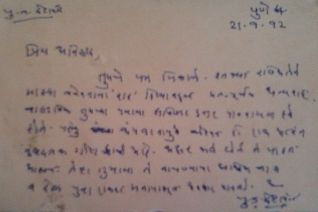
This is Pu La's reply dated Sept 21 1992:

पु ल देशपांडे पुणे ४

प्रिय अनिरुद्ध, 21.9.92

तुमचे पत्र मिळाले. इतक्या रसिकतेने माझ्या लेखनाला 'दाद' दिल्याबद्दल मनःपूर्वक धन्यवाद. वास्तविक तुमच्या पत्राला सविस्तर उत्तर पाठवायला हवे होते. परंतु कंपवातामुळे लेखन ही एक अत्यंत कष्टदायक गोष्ट झाली आहे. अक्षर कसे होते ते पाहत आहाच. तेव्हा तुम्हाला ते वाचण्याचा अधिक त्रास न देता पुन्हा एकदा मनापासून आभार मानतो.

सही पु देशपांडे


SCHLEICHERA OLEOSA / kusum located at Rani Baug, Mumbai (courtesy: SHUBHADA NIKHARGE and Frontline May 20 2011)

Frontline article says: An uncertain future awaits Mumbai's 150-year-old botanical garden with rare and endangered tree species.

Let us save it for our own future and in the name of Rabindranath Tagore, a passionate lover of gardens.

Monday, May 16, 2011

Did Arnold ever quit grabbing them so that we could hear him?

CNN May 16 2011:

"Police say Strauss-Kahn was naked when he tried to force himself on a N.Y. hotel employee."

PTI / The Times of India on May 11 2011:

"One of America's most high profile couples, former California governor Arnold Schwarzenegger and wife Maria Shriver, have announced their separation after 25 years of marriage...

...During the 2003 elections to elect the next governor of California, reports surfaced about Schwarzenegger's lengthy history of groping women. At the time, Shriver defended her husband, helping him to victory..."


Artist: Mike Luckovich in year 2003

This cartoon has 'Avaj' (आवाज), a Diwali issue, like quality. I haven't read Avaj for a number of years now but I used to like some of their 'naughty' cartoons.

Don't forget Playboy has published some of the best cartoons ever. It still does. Therefore, along with Playboy interviews, cartoons still offer a good excuse to read Playboy!