मेघदूत: "नीचैर्गच्छत्युपरि च दशा चक्रनेमिक्रमेण"

समर्थ शिष्या अक्का : "स्वामीच्या कृपाप्रसादे हे सर्व नश्वर आहे असे समजले. पण या नश्वरात तमाशा बहुत आहे."

G C Lichtenberg: “It is as if our languages were confounded: when we want a thought, they bring us a word; when we ask for a word, they give us a dash; and when we expect a dash, there comes a piece of bawdy.”

C. P. Cavafy: "I’d rather look at things than speak about them."

Martin Amis: “Gogol is funny, Tolstoy in his merciless clarity is funny, and Dostoyevsky, funnily enough, is very funny indeed; moreover, the final generation of Russian literature, before it was destroyed by Lenin and Stalin, remained emphatically comic — Bunin, Bely, Bulgakov, Zamyatin. The novel is comic because life is comic (until the inevitable tragedy of the fifth act);...”

सदानंद रेगे: "... पण तुकारामाची गाथा ज्या धुंदीनं आजपर्यंत वाचली जात होती ती धुंदी माझ्याकडे नाहीय. ती मला येऊच शकत नाही याचं कारण स्वभावतःच मी नास्तिक आहे."

".. त्यामुळं आपण त्या दारिद्र्याच्या अनुभवापलीकडे जाऊच शकत नाही. तुम्ही जर अलीकडची सगळी पुस्तके पाहिलीत...तर त्यांच्यामध्ये त्याच्याखेरीज दुसरं काही नाहीच आहे. म्हणजे माणसांच्या नात्यानात्यांतील जी सूक्ष्मता आहे ती क्वचित चितारलेली तुम्हाला दिसेल. कारण हा जो अनुभव आहे... आपले जे अनुभव आहेत ते ढोबळ प्रकारचे आहेत....."

Kenneth Goldsmith: "In 1969 the conceptual artist Douglas Huebler wrote, “The world is full of objects, more or less interesting; I do not wish to add any more.”1 I’ve come to embrace Huebler’s ideas, though it might be retooled as “The world is full of texts, more or less interesting; I do not wish to add any more.” It seems an appropriate response to a new condition in writing today: faced with an unprecedented amount of available text, the problem is not needing to write more of it; instead, we must learn to negotiate the vast quantity that exists. How I make my way through this thicket of information—how I manage it, how I parse it, how I organize and distribute it—is what distinguishes my writing from yours."

Tom Wolfe: "The first line of the doctors’ Hippocratic oath is ‘First, do no harm.’ And I think for the writers it would be: ‘First, entertain.’"

विलास सारंग: "… इ. स. 1000 नंतर ज्या प्रकारची संस्कृती रुढ झाली , त्यामध्ये साधारणत्व व विश्वात्मकता हे गुण प्राय: लुप्त झाले...आपली संस्कृती अकाली विश्वात्मक साधारणतेला मुकली आहे."

Saturday, September 19, 2009

भो पंचम जॉर्ज, भूप, धन्य धन्य!

In last post, we visited the first decade of 20th century. Will continue there a bit longer...

Then my mother's mother, Manu Karandikar, sang following song at her school, praising and well-wishing her emperor- George V of the United Kingdom- almost every day.

I remember having heard a few lines of it from her mouth. (She spoke such witty, stylish Marathi)

भो पंचम जॉर्ज, भूप, धन्य धन्य ! विबुधमान्य सार्वभौम भूवरा ! ॥
नयधुरंधरा, बहुत काळ तूंचि पाळ ही वसुंधरा ॥
शोभविशी रविकुलशी कुलपरंपरा ॥ध्रु।॥ नयधु।॥

संतत तव कांत शांत राजतेज जगिं विलसो ॥
धर्मनीति शिल्पशास्त्र ललितकला सफल असो ॥
सगुणसागरा, विनयसुंदरा ॥१॥ नयधु।॥

नीतिनिपुण मंत्री तुझे तोषवोत जनहृदंतरा ॥
सदा जनहृदंतरा ॥
राजशासनीं प्रजाहि विनत असो शांततापरा ॥
असो शांततापरा ॥२॥नयधु.॥

समरधीर वीर करुत कीर्तिविस्तरा ॥
पुत्र पौत्र सुखवुत तव राजमंदिरा ॥
सौख्यपूर्ण दीर्घ आयु भोग नृपवरा ॥३॥नयधु.॥

भो पंचम जॉर्ज, भूप, धन्य धन्य ! विबुधमान्य सार्वभौम भूवरा ! ॥ नयधु.॥

Manu-tai was in illustrious company.

Kushwant Singh writes: "...Tagore composed and sang Jana gana mana (which later became India's national anthem) in honour of King George V..."

Wikipedia informs: "George was the only Emperor of India to be present at his own Delhi Durbar, where he appeared before his Indian subjects crowned with the Imperial Crown of India, created specially for the occasion...King George V and his Queen sat on golden thrones under a golden umbrella on 11 December 1911 when they proclaimed that the capital of British India would be shifted from Calcutta to Delhi..."

The Durbar was an extravaganza of pomp but fortunately it was the last one.

I wonder what my grandma would have made of following information about her emperor.

Margaret MacMillan while reviewing 'Three Emperors: Three Cousins, Three Empires and the Road to the First World War', by Miranda Carter:

"...George was sent away from home at an early age to join the navy where he spent a miserable, sea-sick time. He was frightened of his father and resented his ill-concealed affairs. He adored ‘motherdear’, who alternated between stifling affection and cheerful neglect. When his beloved older brother, Eddy, died suddenly of pneumonia he found himself to his dismay the heir to the throne. (He also found that he had a fiancée when his parents decided that there was no point in wasting the work that had gone into arranging Eddy’s engagement.) ‘Oh such a piteous, good, feeble, heroic little figure,’ was Max Beerbohm’s assessment of one of George’s first appearances as king in 1910...

...As for George V, as constitutional monarch and an inexperienced one at that, he had virtually no power at all, less even than his grandmother Queen Victoria or his father Edward VII...

...Carter shows how hereditary monarchies made their contribution to the disaster. It’s enough to make one a republican..." (Spectator, September 2, 2009)

Artist: William O'Brian, The New Yorker, 12 October 1963

No, it was a loot, mam!

Wednesday, September 16, 2009

C V Joshi's Bheema Shaligram, Plague in Pune, Swine Flu

NICHOLAS WADE:

"...the Black Death felled at least 30 percent of those it inflicted, whereas a modern plague in India that struck Bombay in 1904, before the advent of antibiotics, killed only 3 percent of its victims..."
(The NYT, August 29 2011)

I recently read 'Rahat-gaadagan' by C V Joshi (1892-1963) ('रहाट-गाडगं', चिं. वि. जोशी).

Marathiworld.com describes it as a collection of Joshi's humorous articles. It's anything but that.

It's a novel written wryly, perhaps inspired by Laxmibai Tilak's 'Smriti Chitre' (लक्ष्मीबाई टिळक, स्मृतिचित्रे).

R K Narayan almost certainly never read or met C V Joshi.

Or did he? I find a lot of similarity between their humour.

Narayan's first novel, Swami and Friends, was published in 1935. By then, C V Joshi's main character- Chimanrao- was well established in Marathi.

Although, 'Rahat-gaadagan' was first published in 1955, it describes the first decade of 20th century.

It is a story of Bheema Shaligram nee Ainapure (borne c1889, married c1899, motherhood c1902, widowed and head shaved c1904, death ?), a Brahmin woman, who now is running her own mess (dining hall). The story is in her own words.

I really enjoyed the book. It easily is one of the best Marathi books I have read.

It also is a social history of the period- Narmada-river with crocodiles, Gujarat, Mumbai, Pune, trains, trams, the misery of Indian women, Marathi musical theatre...and dreaded plague.

Unlike R K Narayan, C V Joshi shuns sex completely.

An example: Bheema's husband performs roles of female characters in a theatre company. A lot of people, including his close family, make fun of him for that. Bheema herself doesn't like it. She might be even suspicious of his virility, particularly because her family was cheated into this marriage.

And yet Joshi completely omits any reference to consummation of their marriage and makes Bheema pregnant in due course!

The swine-flu epidemic that has visited Pune in the summer of 2009 makes the book even more interesting and eerie.

Below I have given three small passages from the book and their translations.


"Like each year plague epidemic had started in Pune. I had completed five years of my stay in Pune and every year plague began after Diwali and continued until Maha Shivratri. First you heard of a rat dying, and then you came to know -in either Bhavani Peth or Magalwar- some woman or man dying of plague..."


"..an acquaintance contracting plague and then the news of his/her death next day arrived. 'Daily-count' would start with four-five infected and three-four died to gallop to two hundred infected and one seventy-five died. There used to be instances when the entire family would contract plague and, since no one survived it, their valuables would be looted by the neighbours.
Almost all the educated people used to go and stay in the huts built on the grounds of Chaturshringi; but we, from old Tapkeer Galli and Phadke's Bol, were not quitters. Our priest Tamanna Charya used to laugh at the people who got scared of plague and ran into the jungle. He would say: Pune's deity, Kasba's Ganpati, was protector of Kasba, old Tapkeer Galli and Phadke Bol and hence his carriage- rat- would never cause any harm to its owner's favourite children
."

"My father-in-law's friend Marutirao came to our house without wearing a headgear. My husband was lying in bed and my brother-in-law was sitting nearby doing accounts of the school and private tuitions. Without taking a seat, Marutirao said: "Vasu-Bandu today I am in deep trouble. My brother-in-law came from Koregaon yesterday carrying plague infection and has just died. It requires minimum of eight people to carry him (to cremation ground); but who will volunteer to carry the one who has died of plague! If you both come, it will be a great help to us."

Just substitute the word 'plague' with 'H1N1'...So much has changed in Pune in last hundred years and yet so much is the same!

Will more vicious H1N1 become annual fixture on Pune winter calendar i.e. from Diwali until Maha Shivratri?


Bheema-aajee Shaligram nee Bheema Ainapure (भीमा-आजी शाळिग्राम, भीमा ऐनापुरे) busy with her job much later in her life (c 1950's).
Artist: S G Joshi सीताराम गंगाधर जोशी

(Vasant Sarwate has done a moving appreciation of unsung S G Joshi's art in his book "Parakee Chalan", 1989. The picture above is from the same essay.)

Sunday, September 13, 2009

यथा मनुष्यं च मोबाईलं च

One of my favourite shloka श्लोक from Ramayana रामायण is:

"यथा काष्ठं च काष्ठं च समेयातां महार्णवे। समेत्य तु व्यपेयातां कालमासाद्य कंचन।
एवं भार्याश्च पुत्राश्च ज्ञातयश्च वसूनि च ।
समेत्य व्यवधावन्ति ध्रुवो ह्येषां विनाभवः ॥" [2/105/26, 1/105/27]

(In a great ocean, two logs meet, they come together;
after some time they separate.
Similarly wife, son, relations and wealth come together and then after some time they start going away from each other because their separation is pre-determined.)

But this doesn't apply to the man and his mobile!

Reuters reported on August 1 2009:

"A mobile phone lost at sea for four days washed up in perfect condition in Taiwan after drifting 37 km (23 miles) and was discovered by a park lifeguard who tracked down the shocked owner to return it, the finder said on Friday.

Yu Hsin-leh of Taipei lost the phone on July 24 while snorkeling near the Taiwan port city of Keelung, Taiwan's United Daily News reported..."

Look at the picture below.

It's s if Yu Hsin-leh's phone screamed- "Guess where I am!" and was found!


"Guess where I am!"

Artist: Paul Wood, Spectator

Thursday, September 10, 2009

Hurry to proclaim Victory in the face of Failure?

Recently, in August 2009, I watched a program on Discovery Channel about the space shuttle Columbia disaster.

It was done candidly. There was no attempt to hide any fact or to protect any one.

No surprise that heads rolled at NASA after the inquiry into the disaster.

Recently former Defence Research & Development Organisation scientist K Santhanam claimed that the 1998 Pokhran-II test was a ‘fizzle.’

Prime Minister Manmohan Singh said: “A wrong impression has been given by some scientists which is needless. Mr. Kalam has clarified that the tests were successful.”

Homi Nusserwanji Sethna: “What did he (Kalam) know about extracting, making explosive grade? He didn’t know a thing. By being a president, he appeared to wear the stature. He relied on atomic energy to gain additional stature.”

On India's moon mission, The Hindu reported on August 29 2009:

'Ten months after it was launched, India’s maiden moon mission, the ambitious Chandrayaan-1, came to an abrupt end today after ISRO lost communication with the spacecraft, cutting short the dream odyssey that was expected to last two years.

"The mission is definitely over. We have lost contact with the spacecraft," Project Director of the Chandrayaan-1 mission, M. Annadurai, told PTI.

However, he said: “It (Chandrayaan-1) has done its job technically...100 per cent. Scientifically also, it has done almost 90-95 percent of its job"'.

Why this hurry to proclaim victory in the face of possible failure?


Artist: Tony Auth

Monday, September 07, 2009

Nimdu Kirana Gharana, namdu Kirana angadi

Bhimsen Joshi once famously told Gangubai Hangal: Nimdu Kirana Gharana, namdu Kirana angadi.

(Yours is Kirana Gharana, mine is kirana shop).

(Frontline, Aug. 01-14, 2009)

This is a very moving example of appreciation of Gangubai Hangal's music and Bhimsen Joshi's self-deprecating sense of humour.

But I have yet to read a better appreciation of music- even any art- than that done of Maujuddin Khan's Bhairavi by Govindrao Tembe.

Read it below. I am unable to translate it into English.


['माझा संगीत व्यासंग', गोविंदराव टेंबे, 1939 ('My Study of Music' by Govindrao Tembe)]

Oh how I wish I were there...I may not have understood the music but I sure would have cried!

Notice how little this writing is influenced by English. This is native brilliance expressed in the language of Laxmibai Tilak.

Another virtue of Tembe's entire writing is the absence of self promotion or 'I'.

In the passage above 'I' enters very reluctantly: "...Mistakenly my hand touched tanpura's string...".

Remember, Tembe himself was a giant in the field of music. N S Phadke has called him the architect of Marathi Natya Sangit. I have still not heard better popular music than his compositions for Sangeet Manapman (1911).

Little wonder M V Dhond gives this piece of Tembe a seat at the literary high table occupied by Jagannath Pandit, Bhavabhuti and above all Dnyaneshwar.

['ज्ञानेश्वरी: स्वरूप, तत्वज्ञान आणि काव्य', म. वा. धोंड, 1980 ('Dnyaneshwari: Swarup, Tatvadnyan Ani Kavya' by M V Dhond)]


Govindrao Tembe (1881-1955)

picture courtsey: Shree. Shankarrao Ghorpade, Kolhapur

Friday, September 04, 2009

Tiger-infested Nallamalla or Human-infested Earth?

While reporting Andhra Pradesh chief minister Y S R Reddy's accident, The Times of India's headline on September 3, 2009 reads: "YSR's chopper goes missing over dense Naxal & tiger-infested jungle."

Tiger-infested?

The Free Dictionary gives meaning of 'infested' as "To inhabit or overrun in numbers or quantities large enough to be harmful, threatening, or obnoxious."

Have tigers 'infested' Nallamalla forests?

Why not be more humble when we took almost 24 hours just to find out what happened to the chopper of Y S R Reddy- one of the most important men in Indian public life?

If anyone indeed is infesting anything, we humans are infesting earth.

In her latest book 'The Year of the Flood', Margaret Atwood has written about a near future in which mass murder may be the best way to save the world.

Mass murder of humans.

That, of course, will be role reversal because so far- for other species- we have been mass murderers.

Michael Crichton in 'The Lost World' :

'"Human beings are so destructive," Malcolm said. "I sometimes think we're a kind of plague, that will scrub the earth clean. We destroy things so well that I sometimes think, maybe that's our function. Maybe every few eons, some animal comes along that kills off the rest of the world, clears the decks, and lets evolution proceed to its next phase."'

Derrick Jensen and Aric McBay in their book "What We Leave Behind":

"Industrial civilization is incompatible with life. It is systematically destroying life on this planet, undercutting its very basis. This culture is, to put it bluntly, murdering the earth. Unless it's stopped -- whether we intentionally stop it or the natural world does, through ecological collapse or other means -- it will kill every living being. We need to stop it."

Thursday, September 03, 2009

Why did liberal D G Godse sketch for V D Savarkar's book?

V D Savarkar: "I have no quarrel with Mr Jinnah's two-nation theory. We Hindus are a nation by ourselves and it is a historical fact that Hindus and Muslims are two nations."

In early 1970's, I read '१८५७ चे स्वातंत्र्यसमर', लेखक: स्वातंत्र्यवीर विनायक दामोदर सावरकर ('1857's War of Independence' by Swatantryaveer Vinayak Damodar Savarkar, first published in English in 1909 in Great Britain).

I really liked it. In the past, the book had moved the likes of Bhagat Singh and Subhas Chandra Bose.

In 2007, it was published again. I came across it on August 28 2009.

I am trying to re-read parts of it. I am not liking it.

The best part of the book is wonderful line drawings made by D G Godse (द ग गोडसे). They probably were not there in the edition I had read earlier. Godse made them for the book's 1947 edition that was published by Phoenix publication, Mumbai.

Here are two of the drawings:
They just sum up what in the end 1857 was: Hangings and shootings.

D G Godse, as I knew him, was a die-hard liberal, a great proponent of composite culture of India. All of his literary work reflect that. The two-nation theory would be Godse's worst nightmare.

Then, why did he draw for Savarkar's book?

One possible reason: Savarkar's rabid anti-Muslim views were formed much time after, post-Andaman, he wrote this book. Maybe this was Godse's way of appreciating a part of Savarkar. The same part Bhagat Singh and Subhas Chandra Bose had highly appreciated earlier.

[Most intellectuals of Maharashtra have struggled with the dilemmas Savarkar poses. Even great historian Y D Phadke (य. दि. फडके) couldn't escape them.]

Second possible reason: Godse could work with authors he did not really like. For instance, there was no love lost between Vishram Bedekar (विश्राम बेडेकर) and him but he created the beautiful cover of Bedekar's award winning book: 'एक झाड आणि दोन पक्षी', १९८६ (Ek Zad Ani Don Pakshi, 1986). BTW- For me, the cover is better than the rest of the book!

Returning to 1857...

Geoffrey Moorhouse:

"...There was savagery on all sides in 1857, while at home Lord Palmerston wanted to see Delhi deleted from the map in reprisal for what had happened there. Atrocities against the British were also committed at Kanpur, where women and children were butchered without mercy, too, which guaranteed the appalling retribution that followed when the rebellion was put down.John Nicholson, who became a cult figure among his native troops (they thought he was an incarnation of Vishnu) and his fellow countrymen, proposed "a bill for the flaying alive, impalement or burning of the murderers of the [British] women and children of Delhi"; and one of his soldiers (a Quaker, no less) habitually bayonetted sepoys while chanting Psalm 116. That's the one that begins "I am well pleased: that the Lord hath heard the voice of my prayer"..."

(November 11, 2006, The Guardian)

Khushwant Singh:

"Indian scholars are not the only falsifiers of events. British historians indulged in it with equal zeal. Take, for instance, the Revolt of 1857. While the British call it the Sepoy Mutiny, Indians describe it as the First War of Independence. In fact, it was more than a mutiny of some sepoys of the forces of the East India Company. And it was by no means a war of independence waged by oppressed Indians.

A vast majority of Indians were opposed to it and large numbers of Indians helped to suppress it. Its Muslim supporters wanted to restore Mughal rule and bullied a reluctant Bahadur Shah Zafar to become their leader. Even the poet, Asadullah Khan Ghalib, kept a respectable distance from them. Hindus who rose in rebellion were led by their erstwhile rulers who had been ousted by the British. The credit for making 1857 the year of India’s First War of Independence goes largely to the pseudo-historian, Jawaharlal Nehru..."

Mr. Singh is wrong. It was not Nehru. It was Vinayak Damodar Savarkar who made 1857 the year of India’s First War of Independence.

Monday, August 31, 2009

History Lies in the Eyes of the Beholder

Movie "Inglourious Basterds" featuring Brad Pitt is based on events of World War II.

Kate Williams writes about it in Spectator:

"We are fast forgetting how to be guilty about the past...

...And now we have Inglourious Basterds, vehemently promoted and polarising the critics. To the accompaniment of pumping rock music, (Brad) Pitt shouts the importance of ‘murder, torture, intimidation and terror’ as he encourages his Jewish-American troops to scour occupied France for ‘the German’ and leave him ‘disembowelled, dismembered, disfigured’. ‘The German has no humanity,’ he declares, in a film that has much in common with a violent computer game. War is a joke, thrilling but ultimately empty entertainment..."

Partition of India killed, by some estimates, one million people and yet it is not adequately present in the school text books of Maharashtra.

I thought I was a keen student of history in school and I didn't know much about it.

My son, who is currently studying in class X, doesn't know much about it either.

But currently, thanks to Jaswant Singh's book and his expulsion from the BJP, it rages in mainstream media.

Yesterday, I came across following passage in my son's history book:

"...Collective farming was a novel feature of Joseph Stalin's first 'Five Year Plan'. In order to ensure success of his idea, he used coercive methods and millions of peasants were forced into joining the collective farms. Great progress was achieved. Russia emerged as a powerful country. But all this was done at the cost of liberty of the people."

[from 'Modern World (History)', Standard X, 2007, Maharashtra State Board of Secondary and Higher Secondary Education, Pune-411 005]

They could have got away with this rubbish in 1974-75 when I was in Class X.

Now we know better than "done at the cost of liberty of the people."

J. Bradford DeLong:

"...Call those political leaders whose followers and supporters have slaughtered more than ten million of their fellow humans "members of the Ten-Million Club."

All pre-twentieth century history may (but may not) have seen two members of the Ten-Million Club: Genghis Khan, ruler of the twelfth century Mongols, launcher of bloody invasions of Central Asia and China, and founder of China's Yuan Dynasty; and Hong Xiuquan, the mid-nineteenth-century Chinese intellectual whose visions convinced him that he was Jesus Christ's younger brother and who launched the Taiping Rebellion that turned south-central China into a slaughterhouse for decades in the middle of the nineteenth century...

...By contrast the twentieth century has seen perhaps five people join the Ten Million Club: Adolf Hitler, Chiang Kaishek, Vladimir Lenin, Joseph Stalin, and Mao Zedong.

Hitler, Stalin, and Mao have credentials that may well make them the charter members of the Thirty Million Club as well--perhaps the Fifty Million Club
..."

On page 55 of the said text book, they have a picture of Lenin.


Look at the following picture.

The couple should send the photoframe to the Maharashtra State Board of Secondary and Higher Secondary Education. In the next edition of the text book, the board may use the new picture of Lenin.


Artist: Eldon Dedini, The New Yorker, 27 November 1989

Friday, August 28, 2009

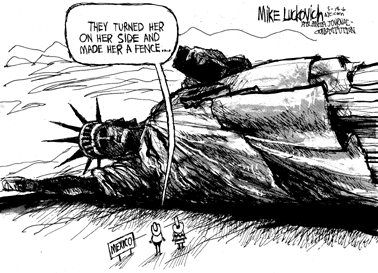
Will the Monument of Shivaji Ask for Tired, Poor, Huddled Masses from Anywhere in India?

Pudhari dated August 26 2009 'proudly' declares:

proposed Shivaji monument in the Arabian sea will be taller than the Statue of Liberty.

Such comparisons are odious. But now that one has been made, I wish to take it further.

Inscription on the Statue of Liberty contains these lines:

'..."Keep, ancient lands, your storied pomp!" cries she
With silent lips. "Give me your tired, your poor,
Your huddled masses
yearning to breathe free,
The wretched refuse of your teeming shore.
Send these, the homeless, tempest-tossed to me,
I lift my lamp beside the golden door!"'

Will the Monument of Shivaji ask for tired, poor, huddled masses from anywhere in India?

Or will we do the same thing that Americans are doing in the picture below?


'They turned her on her side and made her a fence.'

Artist: Mike Luckovich

Staying on the topic of monuments...

James Lamont wrote:

"...The Rajya Sabha, or upper parliamentary house, recently heard that 35 of the country’s centrally protected monuments had disappeared. The list stretches from Assam in the north-east, where the guns of Emperor Sher Shah have vanished, to Karnataka in the south, where a prehistoric site near Mysore has been swallowed up..." (FT, August 10 2009)

Remember 'सह्याद्रीची चोरी' लेखक: रमेश मंत्री ('The Theft of Sahyadri' Author: Ramesh Mantri)?

When mountains are stolen, why not monuments?

Tuesday, August 25, 2009

Vithoba, The Third Man

You can tell, I am drunk on just concluded Ashes.

They say when a team fields a position of third man- and not forward short leg or gully- in cricket field, they are defending.

MICHAEL J. YBARRA has reviewed "The Third Man Factor" By John Geiger in Wall Street Journal dated August 23 2009. Read it here.

He says: "...Accounts of experiencing a supportive presence in extreme situations—sometimes called the "third-man phenomenon"—are common in mountaineering ­literature...

...The Third Man represents a real and potent force for survival," Mr. Geiger writes, "and the ability to ­access this power is a factor, perhaps the most ­important factor, in determining who will succeed against seemingly insurmountable odds, and who will not." Mr. Geiger, however, is at a loss to explain why some can access this power and others can't...

..."Imagine the impact on our lives if we could learn to access this feeling at will," he says. "There could be no loneliness with so constant a companion. There could be no stress in life that we would ever again have to ­confront alone." In the meantime, we have Facebook."

Has any one given better expression to the phenomenon of "The Third Man" than saint-poet Tukaram तुकाराम?

"जेथे जातो तेथे तू माझा सांगाती । चालविसी हाती धरूनिया ॥१॥
चालो वाटे आम्ही तुझा चि आधार । चालविसी भार सवे माझा ॥धॄ॥"

"Wherever I go, Thou art my companion । Having taken me by the hand Thou movest me ।।
I go alone depending solely on Thee । Thou bearest too my burdens।।"

Read the complete poem / abhanga here.

Millions and millions of poor and downtrodden in India have succeeded against seemingly insurmountable odds over centuries. For them, life is a bitch but they are not bitter...

Why?

They are being helped by The Third Man.

Let my Facebook prosper or perish but hope my Vithoba never leaves my side...