मेघदूत: "नीचैर्गच्छत्युपरि दशा चक्रनेमिक्रमेण"

समर्थ शिष्या अक्का : "स्वामीच्या कृपाप्रसादे हे सर्व नश्वर आहे असे समजले. पण या नश्वरात तमाशा बहुत आहे."

G C Lichtenberg: “It is as if our languages were confounded: when we want a thought, they bring us a word; when we ask for a word, they give us a dash; and when we expect a dash, there comes a piece of bawdy.”

C. P. Cavafy: "I’d rather look at things than speak about them."

Martin Amis: “Gogol is funny, Tolstoy in his merciless clarity is funny, and Dostoyevsky, funnily enough, is very funny indeed; moreover, the final generation of Russian literature, before it was destroyed by Lenin and Stalin, remained emphatically comic — Bunin, Bely, Bulgakov, Zamyatin. The novel is comic because life is comic (until the inevitable tragedy of the fifth act);...”

सदानंद रेगे: "... पण तुकारामाची गाथा ज्या धुंदीनं आजपर्यंत वाचली जात होती ती धुंदी माझ्याकडे नाहीय. ती मला येऊच शकत नाही याचं कारण स्वभावतःच मी नास्तिक आहे."

".. त्यामुळं आपण त्या दारिद्र्याच्या अनुभवापलीकडे जाऊच शकत नाही. तुम्ही जर अलीकडची सगळी पुस्तके पाहिलीत...तर त्यांच्यामध्ये त्याच्याखेरीज दुसरं काही नाहीच आहे. म्हणजे माणसांच्या नात्यानात्यांतील जी सूक्ष्मता आहे ती क्वचित चितारलेली तुम्हाला दिसेल. कारण हा जो अनुभव आहे... आपले जे अनुभव आहेत ते ढोबळ प्रकारचे आहेत....."

Kenneth Goldsmith: "In 1969 the conceptual artist Douglas Huebler wrote, “The world is full of objects, more or less interesting; I do not wish to add any more.”1 I’ve come to embrace Huebler’s ideas, though it might be retooled as “The world is full of texts, more or less interesting; I do not wish to add any more.” It seems an appropriate response to a new condition in writing today: faced with an unprecedented amount of available text, the problem is not needing to write more of it; instead, we must learn to negotiate the vast quantity that exists. How I make my way through this thicket of information—how I manage it, how I parse it, how I organize and distribute it—is what distinguishes my writing from yours."

Tom Wolfe: "The first line of the doctors’ Hippocratic oath is ‘First, do no harm.’ And I think for the writers it would be: ‘First, entertain.’"

विलास सारंग: "… . . 1000 नंतर ज्या प्रकारची संस्कृती रुढ झाली , त्यामध्ये साधारणत्व विश्वात्मकता हे गुण प्राय: लुप्त झाले...आपली संस्कृती अकाली विश्वात्मक साधारणतेला मुकली आहे."

Thursday, September 10, 2009

Hurry to proclaim Victory in the face of Failure?

Recently, in August 2009, I watched a program on Discovery Channel about the space shuttle Columbia disaster.

It was done candidly. There was no attempt to hide any fact or to protect any one.

No surprise that heads rolled at NASA after the inquiry into the disaster.

Recently former Defence Research & Development Organisation scientist K Santhanam claimed that the 1998 Pokhran-II test was a ‘fizzle.’

Prime Minister Manmohan Singh said: “A wrong impression has been given by some scientists which is needless. Mr. Kalam has clarified that the tests were successful.”

Homi Nusserwanji Sethna: “What did he (Kalam) know about extracting, making explosive grade? He didn’t know a thing. By being a president, he appeared to wear the stature. He relied on atomic energy to gain additional stature.”

On India's moon mission, The Hindu reported on August 29 2009:

'Ten months after it was launched, India’s maiden moon mission, the ambitious Chandrayaan-1, came to an abrupt end today after ISRO lost communication with the spacecraft, cutting short the dream odyssey that was expected to last two years.

"The mission is definitely over. We have lost contact with the spacecraft," Project Director of the Chandrayaan-1 mission, M. Annadurai, told PTI.

However, he said: “It (Chandrayaan-1) has done its job technically...100 per cent. Scientifically also, it has done almost 90-95 percent of its job"'.

Why this hurry to proclaim victory in the face of possible failure?


Artist: Tony Auth

Monday, September 07, 2009

Nimdu Kirana Gharana, namdu Kirana angadi

Bhimsen Joshi once famously told Gangubai Hangal: Nimdu Kirana Gharana, namdu Kirana angadi.

(Yours is Kirana Gharana, mine is kirana shop).

(Frontline, Aug. 01-14, 2009)

This is a very moving example of appreciation of Gangubai Hangal's music and Bhimsen Joshi's self-deprecating sense of humour.

But I have yet to read a better appreciation of music- even any art- than that done of Maujuddin Khan's Bhairavi by Govindrao Tembe.

Read it below. I am unable to translate it into English.


['माझा संगीत व्यासंग', गोविंदराव टेंबे, 1939 ('My Study of Music' by Govindrao Tembe)]

Oh how I wish I were there...I may not have understood the music but I sure would have cried!

Notice how little this writing is influenced by English. This is native brilliance expressed in the language of Laxmibai Tilak.

Another virtue of Tembe's entire writing is the absence of self promotion or 'I'.

In the passage above 'I' enters very reluctantly: "...Mistakenly my hand touched tanpura's string...".

Remember, Tembe himself was a giant in the field of music. N S Phadke has called him the architect of Marathi Natya Sangit. I have still not heard better popular music than his compositions for Sangeet Manapman (1911).

Little wonder M V Dhond gives this piece of Tembe a seat at the literary high table occupied by Jagannath Pandit, Bhavabhuti and above all Dnyaneshwar.

['ज्ञानेश्वरी: स्वरूप, तत्वज्ञान आणि काव्य', म. वा. धोंड, 1980 ('Dnyaneshwari: Swarup, Tatvadnyan Ani Kavya' by M V Dhond)]


Govindrao Tembe (1881-1955)

picture courtsey: Shree. Shankarrao Ghorpade, Kolhapur

Friday, September 04, 2009

Tiger-infested Nallamalla or Human-infested Earth?

While reporting Andhra Pradesh chief minister Y S R Reddy's accident, The Times of India's headline on September 3, 2009 reads: "YSR's chopper goes missing over dense Naxal & tiger-infested jungle."

Tiger-infested?

The Free Dictionary gives meaning of 'infested' as "To inhabit or overrun in numbers or quantities large enough to be harmful, threatening, or obnoxious."

Have tigers 'infested' Nallamalla forests?

Why not be more humble when we took almost 24 hours just to find out what happened to the chopper of Y S R Reddy- one of the most important men in Indian public life?

If anyone indeed is infesting anything, we humans are infesting earth.

In her latest book 'The Year of the Flood', Margaret Atwood has written about a near future in which mass murder may be the best way to save the world.

Mass murder of humans.

That, of course, will be role reversal because so far- for other species- we have been mass murderers.

Michael Crichton in 'The Lost World' :

'"Human beings are so destructive," Malcolm said. "I sometimes think we're a kind of plague, that will scrub the earth clean. We destroy things so well that I sometimes think, maybe that's our function. Maybe every few eons, some animal comes along that kills off the rest of the world, clears the decks, and lets evolution proceed to its next phase."'

Derrick Jensen and Aric McBay in their book "What We Leave Behind":

"Industrial civilization is incompatible with life. It is systematically destroying life on this planet, undercutting its very basis. This culture is, to put it bluntly, murdering the earth. Unless it's stopped -- whether we intentionally stop it or the natural world does, through ecological collapse or other means -- it will kill every living being. We need to stop it."

Thursday, September 03, 2009

Why did liberal D G Godse sketch for V D Savarkar's book?

V D Savarkar: "I have no quarrel with Mr Jinnah's two-nation theory. We Hindus are a nation by ourselves and it is a historical fact that Hindus and Muslims are two nations."

In early 1970's, I read '१८५७ चे स्वातंत्र्यसमर', लेखक: स्वातंत्र्यवीर विनायक दामोदर सावरकर ('1857's War of Independence' by Swatantryaveer Vinayak Damodar Savarkar, first published in English in 1909 in Great Britain).

I really liked it. In the past, the book had moved the likes of Bhagat Singh and Subhas Chandra Bose.

In 2007, it was published again. I came across it on August 28 2009.

I am trying to re-read parts of it. I am not liking it.

The best part of the book is wonderful line drawings made by D G Godse (द ग गोडसे). They probably were not there in the edition I had read earlier. Godse made them for the book's 1947 edition that was published by Phoenix publication, Mumbai.

Here are two of the drawings:
They just sum up what in the end 1857 was: Hangings and shootings.

D G Godse, as I knew him, was a die-hard liberal, a great proponent of composite culture of India. All of his literary work reflect that. The two-nation theory would be Godse's worst nightmare.

Then, why did he draw for Savarkar's book?

One possible reason: Savarkar's rabid anti-Muslim views were formed much time after, post-Andaman, he wrote this book. Maybe this was Godse's way of appreciating a part of Savarkar. The same part Bhagat Singh and Subhas Chandra Bose had highly appreciated earlier.

[Most intellectuals of Maharashtra have struggled with the dilemmas Savarkar poses. Even great historian Y D Phadke (य. दि. फडके) couldn't escape them.]

Second possible reason: Godse could work with authors he did not really like. For instance, there was no love lost between Vishram Bedekar (विश्राम बेडेकर) and him but he created the beautiful cover of Bedekar's award winning book: 'एक झाड आणि दोन पक्षी', १९८६ (Ek Zad Ani Don Pakshi, 1986). BTW- For me, the cover is better than the rest of the book!

Returning to 1857...

Geoffrey Moorhouse:

"...There was savagery on all sides in 1857, while at home Lord Palmerston wanted to see Delhi deleted from the map in reprisal for what had happened there. Atrocities against the British were also committed at Kanpur, where women and children were butchered without mercy, too, which guaranteed the appalling retribution that followed when the rebellion was put down.John Nicholson, who became a cult figure among his native troops (they thought he was an incarnation of Vishnu) and his fellow countrymen, proposed "a bill for the flaying alive, impalement or burning of the murderers of the [British] women and children of Delhi"; and one of his soldiers (a Quaker, no less) habitually bayonetted sepoys while chanting Psalm 116. That's the one that begins "I am well pleased: that the Lord hath heard the voice of my prayer"..."

(November 11, 2006, The Guardian)

Khushwant Singh:

"Indian scholars are not the only falsifiers of events. British historians indulged in it with equal zeal. Take, for instance, the Revolt of 1857. While the British call it the Sepoy Mutiny, Indians describe it as the First War of Independence. In fact, it was more than a mutiny of some sepoys of the forces of the East India Company. And it was by no means a war of independence waged by oppressed Indians.

A vast majority of Indians were opposed to it and large numbers of Indians helped to suppress it. Its Muslim supporters wanted to restore Mughal rule and bullied a reluctant Bahadur Shah Zafar to become their leader. Even the poet, Asadullah Khan Ghalib, kept a respectable distance from them. Hindus who rose in rebellion were led by their erstwhile rulers who had been ousted by the British. The credit for making 1857 the year of India’s First War of Independence goes largely to the pseudo-historian, Jawaharlal Nehru..."

Mr. Singh is wrong. It was not Nehru. It was Vinayak Damodar Savarkar who made 1857 the year of India’s First War of Independence.

Monday, August 31, 2009

History Lies in the Eyes of the Beholder

Movie "Inglourious Basterds" featuring Brad Pitt is based on events of World War II.

Kate Williams writes about it in Spectator:

"We are fast forgetting how to be guilty about the past...

...And now we have Inglourious Basterds, vehemently promoted and polarising the critics. To the accompaniment of pumping rock music, (Brad) Pitt shouts the importance of ‘murder, torture, intimidation and terror’ as he encourages his Jewish-American troops to scour occupied France for ‘the German’ and leave him ‘disembowelled, dismembered, disfigured’. ‘The German has no humanity,’ he declares, in a film that has much in common with a violent computer game. War is a joke, thrilling but ultimately empty entertainment..."

Partition of India killed, by some estimates, one million people and yet it is not adequately present in the school text books of Maharashtra.

I thought I was a keen student of history in school and I didn't know much about it.

My son, who is currently studying in class X, doesn't know much about it either.

But currently, thanks to Jaswant Singh's book and his expulsion from the BJP, it rages in mainstream media.

Yesterday, I came across following passage in my son's history book:

"...Collective farming was a novel feature of Joseph Stalin's first 'Five Year Plan'. In order to ensure success of his idea, he used coercive methods and millions of peasants were forced into joining the collective farms. Great progress was achieved. Russia emerged as a powerful country. But all this was done at the cost of liberty of the people."

[from 'Modern World (History)', Standard X, 2007, Maharashtra State Board of Secondary and Higher Secondary Education, Pune-411 005]

They could have got away with this rubbish in 1974-75 when I was in Class X.

Now we know better than "done at the cost of liberty of the people."

J. Bradford DeLong:

"...Call those political leaders whose followers and supporters have slaughtered more than ten million of their fellow humans "members of the Ten-Million Club."

All pre-twentieth century history may (but may not) have seen two members of the Ten-Million Club: Genghis Khan, ruler of the twelfth century Mongols, launcher of bloody invasions of Central Asia and China, and founder of China's Yuan Dynasty; and Hong Xiuquan, the mid-nineteenth-century Chinese intellectual whose visions convinced him that he was Jesus Christ's younger brother and who launched the Taiping Rebellion that turned south-central China into a slaughterhouse for decades in the middle of the nineteenth century...

...By contrast the twentieth century has seen perhaps five people join the Ten Million Club: Adolf Hitler, Chiang Kaishek, Vladimir Lenin, Joseph Stalin, and Mao Zedong.

Hitler, Stalin, and Mao have credentials that may well make them the charter members of the Thirty Million Club as well--perhaps the Fifty Million Club
..."

On page 55 of the said text book, they have a picture of Lenin.


Look at the following picture.

The couple should send the photoframe to the Maharashtra State Board of Secondary and Higher Secondary Education. In the next edition of the text book, the board may use the new picture of Lenin.


Artist: Eldon Dedini, The New Yorker, 27 November 1989

Friday, August 28, 2009

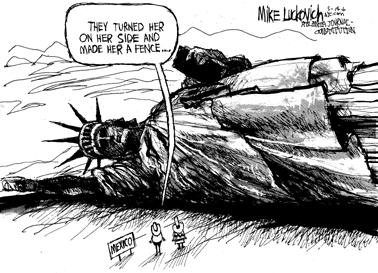
Will the Monument of Shivaji Ask for Tired, Poor, Huddled Masses from Anywhere in India?

Pudhari dated August 26 2009 'proudly' declares:

proposed Shivaji monument in the Arabian sea will be taller than the Statue of Liberty.

Such comparisons are odious. But now that one has been made, I wish to take it further.

Inscription on the Statue of Liberty contains these lines:

'..."Keep, ancient lands, your storied pomp!" cries she
With silent lips. "Give me your tired, your poor,
Your huddled masses
yearning to breathe free,
The wretched refuse of your teeming shore.
Send these, the homeless, tempest-tossed to me,
I lift my lamp beside the golden door!"'

Will the Monument of Shivaji ask for tired, poor, huddled masses from anywhere in India?

Or will we do the same thing that Americans are doing in the picture below?


'They turned her on her side and made her a fence.'

Artist: Mike Luckovich

Staying on the topic of monuments...

James Lamont wrote:

"...The Rajya Sabha, or upper parliamentary house, recently heard that 35 of the country’s centrally protected monuments had disappeared. The list stretches from Assam in the north-east, where the guns of Emperor Sher Shah have vanished, to Karnataka in the south, where a prehistoric site near Mysore has been swallowed up..." (FT, August 10 2009)

Remember 'सह्याद्रीची चोरी' लेखक: रमेश मंत्री ('The Theft of Sahyadri' Author: Ramesh Mantri)?

When mountains are stolen, why not monuments?

Tuesday, August 25, 2009

Vithoba, The Third Man

You can tell, I am drunk on just concluded Ashes.

They say when a team fields a position of third man- and not forward short leg or gully- in cricket field, they are defending.

MICHAEL J. YBARRA has reviewed "The Third Man Factor" By John Geiger in Wall Street Journal dated August 23 2009. Read it here.

He says: "...Accounts of experiencing a supportive presence in extreme situations—sometimes called the "third-man phenomenon"—are common in mountaineering ­literature...

...The Third Man represents a real and potent force for survival," Mr. Geiger writes, "and the ability to ­access this power is a factor, perhaps the most ­important factor, in determining who will succeed against seemingly insurmountable odds, and who will not." Mr. Geiger, however, is at a loss to explain why some can access this power and others can't...

..."Imagine the impact on our lives if we could learn to access this feeling at will," he says. "There could be no loneliness with so constant a companion. There could be no stress in life that we would ever again have to ­confront alone." In the meantime, we have Facebook."

Has any one given better expression to the phenomenon of "The Third Man" than saint-poet Tukaram तुकाराम?

"जेथे जातो तेथे तू माझा सांगाती । चालविसी हाती धरूनिया ॥१॥
चालो वाटे आम्ही तुझा चि आधार । चालविसी भार सवे माझा ॥धॄ॥"

"Wherever I go, Thou art my companion । Having taken me by the hand Thou movest me ।।
I go alone depending solely on Thee । Thou bearest too my burdens।।"

Read the complete poem / abhanga here.

Millions and millions of poor and downtrodden in India have succeeded against seemingly insurmountable odds over centuries. For them, life is a bitch but they are not bitter...

Why?

They are being helped by The Third Man.

Let my Facebook prosper or perish but hope my Vithoba never leaves my side...

Saturday, August 22, 2009

Moral High Ground, Infosys and Gold-In-Sacks

John Gapper:“a lot of people used to think that Goldman Sachs ran the US economy. Now we know it does”.

And what is good for US economy is good for Infosys, darling of Indian media and middle-class. They wanted its chairman, Narayana Murthy, to become the president of the republic.

Infosys chairman always takes moral high ground in public with utterances like:

"Infosys will never touch a tainted company like Satyam...", "Infosys will never do anything unethical..." etc.

It's always definitive, and never: "But real life is messy and real people are complicated" or,
as Lucy Kellaway put it, "There is only one way of capturing the truth of this world, and that is satire. The truest business programme yet made is not The Apprentice. It is The Office."

Infosys’s corporate office has conference rooms named after famous scientists like Albert Einstein and Ramanujam but not after Seneca and Kabir.

Seneca would have gently informed to the occupants of conference room: "What is man? A vessel that the slightest shaking, the slightest toss will break. A body weak and fragile." And Kabir would have reminded that the idea of modern secular India is anchored in the solid foundation laid by the Bhakti Saints.

Reportedly one of Infosys's client is Goldman Sachs.

I wonder what Mr. Murthy thinks of having Goldman Sachs as a client after reading what Paul Krugman said on August 3 2009:

"...some institutions, including Goldman Sachs, have been using superfast computers to get the jump on other investors, buying or selling stocks a tiny fraction of a second before anyone else can react. Profits from high-frequency trading are one reason Goldman is earning record profits and likely to pay record bonuses...

...But suppose we grant that both Goldman and Mr. Hall are very good at what they do, and might have earned huge profits even without all that aid. Even so, what they do is bad for America...

...It’s hard to imagine a better illustration than high-frequency trading. The stock market is supposed to allocate capital to its most productive uses, for example by helping companies with good ideas raise money. But it’s hard to see how traders who place their orders one-thirtieth of a second faster than anyone else do anything to improve that social function...

...For example, high-frequency trading probably degrades the stock market’s function, because it’s a kind of tax on investors who lack access to those superfast computers — which means that the money Goldman spends on those computers has a negative effect on national wealth...

...Neither the administration, nor our political system in general, is ready to face up to the fact that we’ve become a society in which the big bucks go to bad actors, a society that lavishly rewards those who make us poorer."

If Goldman Sachs indeed is guilty as charged, I wonder how Infosys can escape a part of the blame.


Artist: Stuart Carlson, July 16 2009

Wednesday, August 19, 2009

Book Banning, Author Expelling

Today started badly for me.

I began it reading Jagmohan: "...Look at the Indian Parliament. What an uninspiring spectacle it is. The 14th Lok Sabha, for example, had about 100 members who were involved in criminal cases — 30 of whom had been charged with murder, dacoity, rape and extortion. Could an institution, dominated by such men and women, provide a national environment conducive to the realisation of Sri Aurobindo’s great vision?"
(The Asian Age, August 19 2009)

Then it became worse.

A little while ago, one of the most upright members of the 15th Lok Sabha- Jaswant Singh, has been expelled from his party- the BJP.

For writing a book.

This is what I wrote on August 17, 2009 about "JINNAH: INDIA-PARTITION-INDEPENDENCE"
by Jaswant Singh at India Today website:

"I haven't still read the book. But going by excerpt, it has potential to become one of the best book written by an Indian politician.

T S Shejwalkar argues in "Panipat 1761" (available in English and Marathi both) that the third battle of Panipat was fought to save the Mughal empire ( and the then 'secular India') and that the Marathas were sacrificed for the cause.

He further argues that if J L Nehru had shown willingness for similar sacrifice, India may not have been divided in 1947.

Future historians will find it hard to condone J L Nehru.

And why aren't more people in BJP (and in its allies like Shiv Sena) as sensible as Mr. Singh?"

I liked the book excerpt because of following passages:

"...The cruel truth is that this partitioning of India has actually resulted in achieving the very reverse of the originally intended purpose; partition, instead of settling contention between communities has left us a legacy of markedly enhanced Hindu, Muslim, Sikh or other such denominational identities, hence differences. Affirmative action, reservations for Muslims, other castes and communities unfortunately does not dissolve those identities; it heavily underscores them, waters their roots, perpetuating differences through the nutrient of self interest being poured constantly in separateness. Reservation results finally in compartmentalising society, hence ultimately in fragmenting national identity. That is what 'special reservation' for Muslims in India did...

...There are now no more points left to score; all have already been scored, no great issues of partition left to resolve, except one: an inability to understand what, after all, did this partition achieve? Other than constant pain and the suffering of crores of humans, all around, which has now finally moulded itself into a kind of a sealed and an abrasive continuity...

...The partitioning of India is the defining event of the twentieth century for this entire subcontinent. The searing agony of it torments still, the whys and what-fors of it, too. We relive the partition because we persist without attempts to find answers to the great errors of those years so that we may never, ever repeat them. Also, perhaps by recounting them we attempt to assuage some of our pain..."

Jaswant Singh's book has been banned in the state of Gujarat.

Indians have always had difficult relationship with books.

A G Noorani said in Economic & Political Weekly December 1, 2007 :

"Book banning is a civilised form of the vice of book-burning which is a sure symptom of fascism. India has a formidable record of book banning. As with much else, independent India simply took over the habits of the British raj."

A formidable record of book burning too?

According to the late Durga Bhagwat दुर्गा भागवत, Indians burnt down Bhasa’a भास play “Pratima प्रतिमा” because they didn’t like it.

Bhasa wrote ‘Pratima’ based on the life of Rama.

(Source- Easy Conversations: With Durgabai by Pratibha Ranade ऐसपैस गप्पा : दुर्गाबाईंशी, लेखक प्रतिभा रानडे, 1998)

Hope Jaswant Singh has written his own book...

Following cartoon appeared after the publication of L K Advani's tome- “My Country, My Life” in 2008.

The guy throwing away the book in disgust is A B Vajpayee.


Artist: R K Laxman, The Times of India, March 27, 2008

Tuesday, August 18, 2009

Poor India! No Walter Cronkite, no Jon Stewart

I live in Pune and I am more scared by media than the flu. I sure look like a guy in the picture below saying: "but...but...I didn't know the flu caused permanent impotence..."

Reason?

Manish Kakkar wrote on Yahoo India News on Aug 12 2009:

"Two welcome developments over the last couple of days have come as some relief to a beleaguered nation beset with anxiety about swine flu. First, the government of India announced a scale-up of the response to swine flu and spelt out a series of strategic steps it intends to take in concert with the state governments. Second, at least some sections of the media have scaled down the level of alarmist reporting and have sought to douse the prevailing panic among the public...." (CNN-IBN is trying to belong to this section.)

The Hindu reported on August 5 2009:

"The Supreme Court on Tuesday stayed the Bombay High Court order directing the Chief Secretary, Maharashtra government to submit in sealed cover the report of Pradhan Committee which probed `26/11 terror attacks’ in Mumbai...

...the CJI wondered “what is the use of giving details when the High Court itself says give the report in a sealed cover. What is the advantage? Can the court prevent it {terrorist act}? Why should all such information be provided to the court, is it to have discussions in television channels.”

Mr. Salve said, “we all know about the impending danger and the threat perception. But these secret issues can’t be disclosed to the court.” He recalled the live telecast in the news channels of the 26/11 security operations which was reportedly used to guide the terrorists.

It would result in insecurity and create panic among the public."

I don’t know much about And-That's-The-Way-It-Is Walter Cronkite but Americans seem to miss him badly.

I don’t know if we ever had his counterpart in India: a deeply trusted figure on radio or television.

Indian radio was always state owned and hence thoroughly discredited.

Print media in India, in the past, had a few Walter Cronkites. But now...

When Ramachandra Guha recently argued in his address “Ten reasons why India will not and should not become a superpower” at the Aspen Institute in New Delhi, one of the reasons he gave was "supine media". (FT, July 15 2009)

Ayaz Amir wrote in Dawn, December 2 2005:

"IT takes a good two hours in the morning going through a stack of Pakistani newspapers. It takes about half an hour to go through the leading English dailies that you get in Delhi...

...You read them and you get to know more than you probably would want to about happenings in the film or fashion industry. But if you want to know a bit about events in the rest of the world you would have to seek some other fountain of knowledge.

You can’t blame television for being chatty and entertainment-driven because that’s how television sells. But you would expect newspapers to be slightly different. No such luck with Indian papers which, driven by the great forces of the market, have been dumbed down to the point where they are indistinguishable from any other consumer product...

...There’s no point in singling any newspaper out. By and large, they all look like tabloids out of Bollywood, devoted primarily not to anything as gross or insulting as national or international issues but to some form of entertainment...

...Sounds morbid, doesn’t it? Yet comparing it to the Bollywoodization of the Indian media, the conscious pursuit of blandness and mindless entertainment even by such standard-bearers of the Indian press as the Times of India and the Hindustan Times, you wonder which is the more insidious, such over-the-top passion as to be found in Pakistan or the complete loss of passion, at least as mirrored in the press, you see in India?..."

Lucky America. She still has Jon Stewart.


Artist:Nate Beeler, July 20 2009, The Washington Examiner, Washington, D.C.

For more pictures of Nate Beeler, go here.