मेघदूत: "नीचैर्गच्छत्युपरि दशा चक्रनेमिक्रमेण"

समर्थ शिष्या अक्का : "स्वामीच्या कृपाप्रसादे हे सर्व नश्वर आहे असे समजले. पण या नश्वरात तमाशा बहुत आहे."

G C Lichtenberg: “It is as if our languages were confounded: when we want a thought, they bring us a word; when we ask for a word, they give us a dash; and when we expect a dash, there comes a piece of bawdy.”

C. P. Cavafy: "I’d rather look at things than speak about them."

Martin Amis: “Gogol is funny, Tolstoy in his merciless clarity is funny, and Dostoyevsky, funnily enough, is very funny indeed; moreover, the final generation of Russian literature, before it was destroyed by Lenin and Stalin, remained emphatically comic — Bunin, Bely, Bulgakov, Zamyatin. The novel is comic because life is comic (until the inevitable tragedy of the fifth act);...”

सदानंद रेगे: "... पण तुकारामाची गाथा ज्या धुंदीनं आजपर्यंत वाचली जात होती ती धुंदी माझ्याकडे नाहीय. ती मला येऊच शकत नाही याचं कारण स्वभावतःच मी नास्तिक आहे."

".. त्यामुळं आपण त्या दारिद्र्याच्या अनुभवापलीकडे जाऊच शकत नाही. तुम्ही जर अलीकडची सगळी पुस्तके पाहिलीत...तर त्यांच्यामध्ये त्याच्याखेरीज दुसरं काही नाहीच आहे. म्हणजे माणसांच्या नात्यानात्यांतील जी सूक्ष्मता आहे ती क्वचित चितारलेली तुम्हाला दिसेल. कारण हा जो अनुभव आहे... आपले जे अनुभव आहेत ते ढोबळ प्रकारचे आहेत....."

Kenneth Goldsmith: "In 1969 the conceptual artist Douglas Huebler wrote, “The world is full of objects, more or less interesting; I do not wish to add any more.”1 I’ve come to embrace Huebler’s ideas, though it might be retooled as “The world is full of texts, more or less interesting; I do not wish to add any more.” It seems an appropriate response to a new condition in writing today: faced with an unprecedented amount of available text, the problem is not needing to write more of it; instead, we must learn to negotiate the vast quantity that exists. How I make my way through this thicket of information—how I manage it, how I parse it, how I organize and distribute it—is what distinguishes my writing from yours."

Tom Wolfe: "The first line of the doctors’ Hippocratic oath is ‘First, do no harm.’ And I think for the writers it would be: ‘First, entertain.’"

विलास सारंग: "… . . 1000 नंतर ज्या प्रकारची संस्कृती रुढ झाली , त्यामध्ये साधारणत्व विश्वात्मकता हे गुण प्राय: लुप्त झाले...आपली संस्कृती अकाली विश्वात्मक साधारणतेला मुकली आहे."

Thursday, February 16, 2012

I Sort of Like Pawar(s), Thackeray(s), Chavan, Rane(s), Patil, Munde(s), Bhujbal(s)........

Dr. B R Ambedkar (डॉ.भी रा आंबेडकर ):

“Democracy in India is only a top dressing on an Indian soil which is essentially undemocratic...

On the 26th January 1950, we are going to enter into a life of contradictions. In politics we will have equality and in social and economic life we will have inequality...

..How long shall we continue to live this life of contradictions? How long shall we continue to deny equality in our social and economic life? If we continue to deny it for long, we will do so only by putting our political democracy in peril...”

Frank Rich:

"Elections are supposed to resolve conflicts in a great democracy, but our next one will not. The elites will face off against the elites to a standoff..."

Chief Election Commissioner (CEC) of India quoted in 'Business Standard' April 13, 2011:

“If you spend more than [Rs ] two crore to contest an election to become an MLA, you will surely earn [Rs ] 20 crore because you have to pay back … Elections unfortunately have become the biggest area of corruption.”

Keith Hopkins:

"Gladiatorial shows also provided an arena for popular participation in politics. Cicero explicitly recognised this towards the end of the Republic: 'the judgement and wishes of the Roman people about public affairs can be most clearly expressed in three places: public assemblies, elections, and at plays or gladiatorial shows'."

Ingmar Bergman
:

"I've a strong impression our world is about to go under. Our political systems are deeply compromised and have no further uses. Our social behavior patterns, interior and exterior, have proved a fiasco. The tragic thing is, we neither can nor want, nor have the strength, to alter our course. It's too late for revolutions, and deep down inside ourselves we no longer even believe in their positive effects. Just around the corner an insect world is waiting - and one day it's going to roll over our ultra-individualized existence. Otherwise, I'm a respectable Social Democrat".

Today Feb 16 2012 is the election day in municipal corporations of Mumbai and nine other civic bodies.

My wife probably won't vote. She wants a button on the EVM that says "None of the above."

Here is a Marathi article by cartoonist Mangesh Tendulkar (मंगेश तेंडुलकर) why my wife might be right.

courtesy: Pudhari (पुढारी), February 2012, Pune edition

(click on the image above to view readable version)

Please visit http://epaper.pudhari.com

I have already voted

Although, unlike my wife, I wish there were an option "All of the above" because, like the man in following cartoon, I sort of like them all.

They all come on TV (some of them never seem to leave!)...Not just that...

"Oh, how I wish I was like them! I haven't got any horns, more's the pity! A smooth brow looks so ugly. I need one or two horns to give my sagging face a lift. Perhaps one will grow and I needn't be ashamed any more - then I could go and join them. But it will never grow!..." (Eugene Ionesco's 'Rhinoceros')

And I like to think I'm a 'respectable social democrat'.

Artist: James Stevenson, The New Yorker, 21 May 1960

Sunday, February 12, 2012

King Parikshit, Charles Darwin: Ultimately the Worms will Not be Cheated

Today Feb 12 2012 is 203rd birth anniversary of Charles Darwin

The New York Times leader on September 5, 2011:

"How Many Leaves on the Tree of Life?...a recent study led by scientists at Dalhousie University, concludes that there are about 8.7 million species on Earth...And that 8.7 million? It doesn’t include the species of bacteria, which may number in the millions. It is the bare truth to say that no matter how much we think we know about life on Earth, we know almost nothing."


Adam Kirsch:

Yet at the very heart of Darwinism is the principle that there is no such thing as “levels” or “supersession”; as Darwin adjured himself in one of his marginalia, “Never use the word higher or lower.” Human beings are in no biological sense higher than cockroaches; we have simply evolved a different adaptive strategy.

In the same way, regarded simply as a strategy for survival, no human polity is higher or lower than another, only (momentarily) more or less successful.
(Spring 2011)

CHARLES C. MANN (WSJ, Aug 6 2011):

"Before Europeans arrived, the upper Midwest, New England and all of Canada had no earthworms—they had been wiped out in the last Ice Age.
In worm-free woodlands, leaves pile up in drifts on the forest floor. Trees and shrubs in wormless places depend on litter for food. When earthworms arrive, they quickly consume the leaf litter, packing the nutrients deep in the soil in the form of castings (worm excrement). Suddenly, the plants can no longer feed themselves; their fine, surface-level root systems are in the wrong place. Wild sarsaparilla, wild oats, Solomon's seal and a host of understory plants die off; grass-like species such as Pennsylvania sedge take over. Sugar maples almost stop growing, and ash seedlings start to thrive.
Spread today by farmers, gardeners and anglers, earthworms are obsessive underground engineers, and they are now remaking swathes of Minnesota, Alberta and Ontario. Nobody knows what will happen next in what ecologists see as a gigantic, unplanned, centuries-long experiment."


Stephen Jay Gould wrote a brilliant essay to commemorate 100th death anniversary of Charles Darwin in 1982.

It's titled : ‘WORM FOR A CENTURY, AND ALL SEASONS

He wrires:

"...Trifles may matter in nature, but they are unconventional subjects for last books.

Most eminent graybeards sum up their life’s thought and offer a few pompous suggestions for reconstituting the future. Charles Darwin wrote about worms—The Formation of Vegetable Mould, Through the Action of Worms, With Observations on Their Habits (1881)...

...What better than worms: the most ordinary, commonplace, and humble objects of our daily observation and dismissal. If they, working constantly beneath our notice, can form much of our soil and shape our landscape, then what event of magnitude cannot arise from the summation of small effects. Darwin had not abandoned evolution for earthworms; rather, he was using worms to illustrate the general method that had validated evolution as well. Nature’s mills, like God’s, grind both slowly and exceedingly small...

...We who lack an appreciation of history and have so little feel for the aggregated importance of small but continuous change scarcely realize that the very ground is being swept from beneath our feet; it is alive and constantly churning...

...The pleasure of reading Darwin’s worm book lies not only in recognizing its larger point but also in the charm of detail that Darwin provides about worms themselves...

...Here we also find an overt and an underlying theme, in this case leaves and burrows versus the evolution of instinct and intelligence, Darwin’s concern with establishing a usable defi nition of intelligence, and his discovery (under that defi nition) that intelligence pervades ‘lower’ animals as well. All great science is a fruitful marriage of detail and generality, exultation and explanation. Both Darwin and his beloved worms left no stone unturned....

...Then I came to the very last paragraph, and I shook with the joy of insight. Clever old man; he knew full well. In his last words, he looked back to his beginning, compared those worms with his fi rst corals, and completed his life’s work in both the large and the small:

The plough is one of the most ancient and most valuable of man’s inventions; but long before he existed the land was in fact regularly ploughed, and still continues to be thus ploughed by earthworms. It may be doubted whether there are many other animals which have played so important a part in the history of the world, as have these lowly organized creatures...

...A year after publishing his worm book, Darwin died on 19 April 1882. He wished to be buried in the soil of his adopted village, where he would have made a final and corporeal gift to his beloved worms. But the sentiments (and politicking) of fellow scientists and men of learning secured a guarded place for his body within the well-mortared floor of Westminster Abbey. Ultimately the worms will not be cheated, for there is no permanence in history, even for cathedrals..."

(The Oxford Book of MODERN SCIENCE WRITING, RICHARD DAWKINS, 2008)

Parikshit (Sanskrit: परिक्षित्), grandson of great Arjuna, was once the mightiest king in mythological India. He was cursed to die bitten by a snake.

(this is why he was cursed by Shamika-rishi's- in meditation above- son)
courtesy: Amar Chitra Katha and blog http://jayarama.wordpress.com

To escape it, he built a magnificent new palace. It was raised on a single tall pillar, and the base of the pillar was inside a moat. Many warriors and Brahmanas skilled in the art of repelling snakes were placed around the palace to protect the King. The King spent all the time in this palace, surrounded by Brahmanas learned in the Vedas.

Takshaka wanted to avenge the wrongs of the Pandavas committed upon his race- snake people- Nagas.

Takshaka transformed himself into a worm and entered a fruit that were being carried for the king. King chose exactly the same fruit that Takshaka was present in. He took one bite, then the insect came out of the fruit. In an instant, Takshaka assumed his form as a great serpent. He then entwined himself around the hapless king, and sunk his great fangs in Parikshit's neck. As was to be expected, the King fell down dead, charred by the potency of the snake's venom.

Well-mortared floor of a cathedral or a palace on a single tall pillar, worms will not be cheated.Artist: Dana Fradon, The New Yorker, July 2 1960

Thursday, February 09, 2012

Hey, Jay Leno. Don't You Dare Mock Honorary Legislators of the Largest Democracy in the World

Bill Clinton:

"It depends on what the meaning of the word 'is' is. If the--if he--if 'is' means is and never has been, that is not--that is one thing. If it means there is none, that was a completely true statement....Now, if someone had asked me on that day, are you having any kind of sexual relations with Ms. Lewinsky, that is, asked me a question in the present tense, I would have said no. And it would have been completely true."

('Bill Clinton and the Meaning of "Is"' Slate, Sept 13 1998)

Bart Simpson:


"Oh, Dad. Nobody can rationalize like you."

(The Simpsons, Season 17, Episode 20, 'Regarding Margie')

ANNIE MURPHY PAUL:

"Appropriately, yoga seems to have come full circle: flush with cash and focused on perfecting the body, modern yoga has returned to its earthy origins in money and sex."

(The New York Times, Feb 3 2012)


I thought nobody indeed rationalised like Homer Simpson when he justified his action of keep accepting someone else's mail that contained steaks from Omaha, and even a wedding invitation

How wrong I was!

The Hindu, Feb 9 2012
:

"Legislative proceedings are usually far from stimulating and we have grown accustomed to MPs and MLAs stealing a surreptitious nap or even snoring defiantly to escape the tedium of debate. But the three Karnataka BJP ministers who were forced to resign Wednesday morning chose a most unusual way to escape what they regarded as an arid discussion on the drought situation in the State. Much to the embarrassment of themselves and their party, TV cameras caught them transfixed by, ahem, a film clip, on one of their cell phones. Laxman Savadi, who was Minister for Cooperation, may protest till he is blue in the face, but his explanation that he was watching a newsclip about a woman being gang-raped simply doesn't wash. The best that can be said in an age where our legislatures are sporadic witnesses to a range of boisterous activity — fisticuffs, abuse, screaming, overthrown furniture, ripped out microphones, torn papers and flung slippers — is that the trio were at least passing their time in quiet communion. Watching pornographic material in the House is a first in the history of Indian legislatures, but like almost everything else in the sleazy world of politics, somebody's already been there, done that. Last April, an Indonesian MP belonging to an Islamic party that campaigns for anti-pornography legislation was forced to resign after being caught watching porn in parliament, presumably to acquaint himself better with the subject matter of what he was opposing...

...On a serious note, there is an important message in this, one that exposes the unalloyed hypocrisy of those who adopt conservative and hardline postures on issues relating to sex and morality. It is in Karnataka that fundamentalists assaulted women in pubs, ran campaigns against Valentine's Day, launched investigations into the so-called love jihads — all professedly to protect Hindu culture from immoral foreign influences. For a party that likes to think it is different, the porn incident is a severe embarrassment for the BJP..."

Hey, Jay Leno. Don't you dare mock our honorary legislators. They were just acquainting themselves better with the subject matter of what they were opposing or even better: passing their time in quiet communion.

Think of the latter as Yoga and invite them as experts to your couch.


Sex, Religion, Politics...Awesome Threesome


Artist: Bill Lee, The New Yorker, May 20 1974

Tuesday, February 07, 2012

Charles Dickens is Still Laughing with a Touch of Anger but no Triumph, no Malignity

David Hume (‘Of Liberty and Necessity’ in the first Enquiry):

It is universally acknowledged that there is a great uniformity among the actions of men, in all nations and ages, and that human nature remains still the same in its principles and operations. The same motives always produce the same actions: The same events follow from the same causes. Ambition, avarice, self-love, vanity, friendship, generosity, public spirit: these passions, mixed in various degrees, and distributed through society, have been, from the beginning of the world, and still are, the source of all the actions and enterprises, which have ever been observed among mankind. Would you know the sentiments, inclinations, and course of life of the Greeks and Romans? Study well the temper and actions of the French and English: You cannot be much mistaken in transferring to the former most of the observations which you have made with regard to the latter. Mankind are so much the same, in all times and places, that history informs us of nothing new or strange in this particular.


George Orwell has said: "Ultimately there is no test of literary merit except survival, which is itself an index to majority opinion."

('Lear, Tolstoy and the Fool')

And I saw an example of it- longevity rooted in literary merit- yesterday Feb 6 2012 on a Marathi TV news channel.

Its news ticker claimed that Sane Guruji’s (साने गुरूजी) ‘Shyamchi Aai’ (श्यामची आई), 1933 was the most sold book at the book-exhibition held at Chandapur (चंद्रपुर) during 85th "akhil bharatiya marathi sahitya sammelan" (अखिल भारतीय मराठी साहित्य संमेलन) where Marathi books worth Rs. 3 crore were sold.

The claim also appeared in print.

courtesy: Pudhari (पुढारी), February 7 2012, Pune edition, Page 2
(visit http://epaper.pudhari.com)

(btw- I like no other book from that best-seller list but I have read them all!)

The late N S Phadke (ना सी फडके) imagines that the 'time-man' (कालपुरुष) ferries all books in a boat with a limited carrying capacity. As time goes by and new books keep loading, the time-man is forced to discard books of lesser quality.

‘Shyamchi Aai’ remains firmly on board.

My mother bought me the book at Sangli (सांगली) probably in 1972. I must have read it dozens of times. When I saw P K Atre's (प्रल्हाद केशव अत्रे) movie of the same name later at Deval (देवल) talkies in Miraj (मिरज), I cried almost whole time during the movie. (It's so easy to cry in darkness! And that's the problem with watching movies on TV. No darkness, indeed privacy!)

We are witnessing another glorious example of survival based on literary merit as we celebrate 200th birth anniversary of Charles Dickens on Feb 7 2012.

George Orwell assures: Dickens is one of those writers who are well worth stealing.

But to do that, one has to first read him! And unlike Sane-guruji I have hardly read him.

In October 1999, Peter Drucker strongly recommeneded 'Hard Times'
with these words:

"The best description of the divorce of work and family, and of its effect on both, is probably Charles Dickens's 1854 novel Hard Times."

What endorsement! I bought 'Hard Times' but haven't still read it.

My son has read Dickens a lot more than me.

My favourite quote of Dickens remains the one that I remember every Diwali:

"………….a good time: a kind, forgiving, charitable, pleasant time: the only time I know of in the long calendar of the year, when men and women seem by one consent to open their shut-up hearts freely, and to think of other people below them as if they really were fellow-passengers to the grave, and not another race of creatures bound on other journeys..." ('A Christmas Carol')

However, I have read a lot about him.

Graham Greene says:

"Well, there is no such thing as success. The priest can't hope to become a saint- or else it's an illusory dream which vanishes with time; the writer can't hope to write a book equal those of Tolstoy, Dickens or Balzac. He might have dared to believe in the possibility at the outset, but his books always carry a flaw somewhere."

('The Other Man: Conversations with Graham Greene', Marie-Francoise Allain,1981)

'book equal those of Dickens'

But the best essay on Dickens for me is Orwell's:

"...In Oliver Twist, Hard Times, Bleak House, Little Dorrit, Dickens attacked English institutions with a ferocity that has never since been approached. Yet he managed to do it without making himself hated, and, more than this, the very people he attacked have swallowed him so completely that he has become a national institution himself...

...Many children begin to know his characters by sight before they can even read, for on the whole Dickens was lucky in his illustrators. A thing that is absorbed as early as that does not come up against any critical judgement...

...The truth is that Dickens's criticism of society is almost exclusively moral. Hence the utter lack of any constructive suggestion anywhere in his work. He attacks the law, parliamentary government, the educational system and so forth, without ever clearly suggesting what he would put in their places. Of course it is not necessarily the business of a novelist, or a satirist, to make constructive suggestions, but the point is that Dickens's attitude is at bottom not even destructive. There is no clear sign that he wants the existing order to be overthrown, or that he believes it would make very much difference if it were overthrown. For in reality his target is not so much society as ‘human nature’. It would be difficult to point anywhere in his books to a passage suggesting that the economic system is wrong as a system. Nowhere, for instance, does he make any attack on private enterprise or private property...

...His whole ‘message’ is one that at first glance looks like an enormous platitude: If men would behave decently the world would be decent...

...And of course this narrowness of vision is in one way a great advantage to him, because it is fatal for a caricaturist to see too much. From Dickens's point of view ‘good’ society is simply a collection of village idiots. What a crew!...

...One very striking thing about Dickens, especially considering the time he lived in, is his lack of vulgar nationalism...In the whole of A Tale of Two Cities there is not a line that could be taken as meaning, ‘Look how these wicked Frenchmen behave!’...

...When one reads any strongly individual piece of writing, one has the impression of seeing a face somewhere behind the page. It is not necessarily the actual face of the writer. I feel this very strongly with Swift, with Defoe, with Fielding, Stendhal, Thackeray, Flaubert, though in several cases I do not know what these people looked like and do not want to know. What one sees is the face that the writer ought to have. Well, in the case of Dickens I see a face that is not quite the face of Dickens's photographs, though it resembles it. It is the face of a man of about forty, with a small beard and a high colour. He is laughing, with a touch of anger in his laughter, but no triumph, no malignity. It is the face of a man who is always fighting against something, but who fights in the open and is not frightened, the face of a man who is generously angry — in other words, of a nineteenth-century liberal, a free intelligence, a type hated with equal hatred by all the smelly little orthodoxies which are now contending for our souls."


Caption:

Two standing women talking to each other-

"There's a guy reading Charles Dickens."

"Yeah, let's get nearer- he ought to be good for a seat."


Artist: I. (Isidore) Klein 1897-1986, The New Yorker, May 19 1928

He is still laughing...

Artist: Michael Hogue, The American Conservative, January 2012


Google Doodle on Feb 7 2012 Courtesy: Google Inc.

Monday, February 06, 2012

Steven Spielberg’s 'Bhimthadi Tatta'!


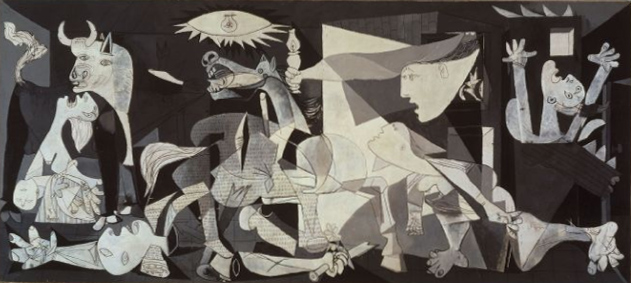
Artist: Pablo Picasso, 1937 courtesy: Wikipedia

I am always moved by Picasso's 'Guernica', above, for its depiction of a war-horse falling in agony as it has just been run through by a spear or javelin.

It was reported on January 25 2012 that Steven Spielberg’s 'War Horse' will compete for six Academy Awards: Best picture, cinematography, original score, art direction, sound editing and sound mixing.

According to Wikipedia the synopsis of the Michael Morpurgo’s novel of 1982 on which it is based:

"At the outbreak of World War I, Joey, young Albert's beloved horse, is sold to the cavalry and shipped to France. His rider Captain Nicholls is killed while riding Joey. The horse is soon caught up in the war; death, disease and fate take him on an extraordinary odyssey, serving on both sides before finding himself alone in No man's land. But Albert cannot forget Joey and, still not old enough to enlist in the British Army, he embarks on a dangerous mission to find the horse and bring him home to Devon."

Accrding to Gervase Phillips, writing for 'History Today':

"...the story unfolds from the perspective of the horse, a device that allows the author to explore the world of those voiceless but sentient creatures and invites us to reflect upon both the misery they have suffered at our hands and the compelling call of compassion that can transcend the boundaries of ‘human’ and ‘animal’... "

'Pack horses carrying ammunition in Flanders'

courtesy: 'The Horse and the War' by Captain Lionel Edwards, 1918

To celebrate the awards nomination news, I am reissuing my earlier post on Maharashtra's favourite pony and war-horse- Bhimthadi Tatta (भीमथडी तट्टं).

Maharashtra's military triumph from CE 1600 to CE 1818 owes a lot to this largely unsung animal.

The Marathi stories like that of Albert and Joey above may not have been documented or even told but it doesn't mean they never happened!

Sir F. W. Fitzwygram:

"It is impossible for a man of average sensibility to observe closely and to note the painful expression and the intelligence of these creatures … to witness their sufferings [and] the brutal treatment which they too often meet from ignorant and cruel men; it is impossible for him to see these things without sorrow, without endeavouring to alleviate their agony …"

('Horses and Stables', 1901)

Many Marathi speaking people feel proud about the military success of Marathas across the subcontinent in 18th century.

Many legends, heroes and myths are borne out of that pride.

A good part of that success was surely due to their mount- a pony aka Bhimthadi-Tatta.

"Maharashtra has Krishna, Nira, Ghodnadi, Bhima, Pravara, Godavari as main rivers. Out of these, more than Krishna, since the water from Bhima, Pravara, Nira, Ghodnadi, Godavari suited the horses better, horses brought up on their water were strong, smart, loyal..."

['Peshwekalin Maharashtra' (पेशवेकालीन महाराष्ट्र) by Vasudev Krushna Bhave (वासुदेव कृष्ण भावे), 1936]

("महाराष्ट्रात कृष्णा, निरा, घोडनदी, भिमा, प्रवरा, गोदावरी या प्रमुख नद्या होत. यांपैकी कृष्णानदीपेक्षांही भिमा, प्रवरा, निरा, घोडनदी, गोदावरी या नद्यांचे पाणी घोड्यांना चांगले मानवणारे असल्यामुळे त्या पाण्यावर पोसलेली घोडी बळकट, चलाख, इमानी व पाणीदार असत.")

I have read a few books describing that period but have never come across the praise for their horses as much as following.

Reviewing "Russia Against Napoleon" by Dominic Lieven that analyses one of the greatest military triumph in history, JENNIFER SIEGEL says:

"...Russia's triumph is also a story of logistics, supplies and, above all, the horse.

The country's leaders mobilized what Mr. Lieven calls "the sinews of Russian power": its vast population (although much smaller than the combined numbers at Napoleon's disposal); its outstanding and plentiful horse stock; its arms manufacturing; and even the sometimes unstable Russian economy.

Of these, it is the horse, and Russia's ability to mobilize its light cavalry to harass Napoleon's rearguard as it retreated across the great European plain, that receives the greatest attention in "Russia Against Napoleon." Coming in a close second to the horse in significance were the victuallers who managed to feed and supply more than a half-million troops during the two-year campaign..."

(WSJ, APRIL 14, 2010)


Is he a bargir बारगीर (cavalryman riding a horse belonging to his leader) or a silahdar शिलेदार (a Persian term meaning a cavalryman who enlisted with his own horse and equipment)?

Saturday, February 04, 2012

I sometimes wonder who all this is really for

(recycling my eralier post)

Henry James, Anton Chekhov, W H Auden, J L Borges, Joseph Conrad, James Joyce, Franz Kafka, Vladimir Nabokov, M Proust, L Tolstoy, M Twain, Evelyn Waugh and E Zola among many others never won literature Nobel!

85th "akhil bharatiya marathi sahitya sammelan" (अखिल भारतीय मराठी साहित्य संमेलन) is upon us. It is being held in Chandrapur (चंद्रपुर) as I write this in Feb 2012.

What connects following authors- not listed in any order- of 20th century in Marathi?

V K Rajwade, Bhalchandra Nemade, Sane Guruji, Bhau Padhye, C V Joshi, Baburao Arnalkar, Vilas Sarang, D G Godse, Vasant Sarwate, Vijay Tendulkar, Natyachhatakar Diwakar, G A Kulkarni, Arun Kolatkar, Dilip Chitre, B S Mardhekar, M V Dhond, T S Shejwalkar, Vinda Karandikar, Balkavi, Keshavsut, Jayant Narlikar, Laxmibai Tilak, Vinoba Bhave, Setu Madhavrao Pagdi, D B Mokashi, Sadanand Rege, Ram Ganesh Gadkari, Namdeo Dhasal, Govindrao Tembe, C T Khanolkar, S N Pendse, R V Dighe, Jaywant Dalvi, Prabodhankar Thackeray, Mahatma Phule, Anil Awachat, Indira Sant...

(वि का राजवाडे, भालचंद्र नेमाडे, साने गुरूजी, भाऊ पाध्ये, चिं. वि. जोशी, बाबूराव अर्नाळकर, विलास सारंग, द ग गोडसे, वसंत सरवटे, विजय तेंडुलकर, नाट्यछटाकार दिवाकर, जी ए कुलकर्णी, अरुण कोलटकर, दिलीप चित्रे, बा. सी. मर्ढेकर, म वा धोंड, त्र्यं शं शेजवलकर, विंदा करंदीकर, बालकवी, केशवसुत, जयंत नारळीकर, लक्ष्मीबाई टिळक, विनोबा भावे, सेतु माधवराव पगडी, दि. बा. मोकाशी, सदानंद रेगे, राम गणेश गडकरी, नामदेव ढसाळ, गोविंदराव टेंबे, चिं त्र्यं खानोलकर, श्री. ना. पेंडसे, र. वा. दिघे, जयवंत दळवी, प्रबोधनकार ठाकरे , महात्मा फुले, अनिल अवचट, इंदिरा संत ...)

They never became the president of All-India Marathi Literature Meet (akhil bharatiya marathi sahitya sammelan)!

See this for the list of those who did.


'I sometimes wonder who all this is really for.'
The Spectator

Friday, February 03, 2012

I will have 2 of Lay's Baked!

Today Feb 3 2012 is 85th Birthday of Vasant Sarwate (वसंत सरवटे)

JANE E. BRODY:

"Developers in the last half-century called it progress when they built homes and shopping malls far from city centers throughout the country, sounding the death knell for many downtowns. But now an alarmed cadre of public health experts say these expanded metropolitan areas have had a far more serious impact on the people who live there by creating vehicle-dependent environments that foster obesity, poor health, social isolation, excessive stress and depression.

As a result, these experts say, our “built environment” — where we live, work, play and shop — has become a leading cause of disability and death in the 21st century. Physical activity has been disappearing from the lives of young and old, and many communities are virtual “food deserts,” serviced only by convenience stores that stock nutrient-poor prepared foods and drinks.

According to Dr. Richard J. Jackson, professor and chairman of environmental health sciences at the University of California, Los Angeles, unless changes are made soon in the way many of our neighborhoods are constructed, people in the current generation (born since 1980) will be the first in America to live shorter lives than their parents do..."

(The New York Times, January 30, 2012)


I have started seeing ads of "Lay's Baked” range on TV. It claims to have 50% less fat.


Image courtesy: PepsiCo India

Verdict of my son and his friends: They are too expensive. That is too few for their buck.

Claims such as '50%' always bring back to me the following brilliant cartoon of Steve Breen.

This was done following McDonald's slashing the calorie content in their ubiquitous French fries by 50% in the USA.


Speech bubbles read as follows:

"Our fries now have 50% less fat"

"Great!"

Kenneth Rogoff:

Highly processed corn-based food products, with lots of chemical additives, are well known to be a major driver of weight gain, but, from a conventional growth-accounting perspective, they are great stuff. Big agriculture gets paid for growing the corn (often subsidized by the government), and the food processors get paid for adding tons of chemicals to create a habit-forming – and thus irresistible – product. Along the way, scientists get paid for finding just the right mix of salt, sugar, and chemicals to make the latest instant food maximally addictive; advertisers get paid it; and, in the end, the health-care industry makes a fortune treating the disease that inevitably results.
Coronary capitalism is fantastic for the stock market, which includes companies in all of these industries. Highly processed food is also good for jobs, including high-end employment in research, advertising, and health care.

So, who could complain?...


(Feb 1 2012)

Monday, January 30, 2012

Joe Sacco's Suvanti is just 1 in 230 million Indians!

Today Jan 30 2012 is 64th death anniversary of Mahatma Gandhi.

Another thing that is 64 year old is the baby in following picture:


Artist: Sudhir Tailang, The Asian Age, January 12 2012

A headline in The Times of India, January 16 2012: "Superpower? 230m Indians go hungry daily."

Nourishment and food are always closely associated with Public Distribution System (aka ration) in India.

The dialogue of character of Pran in Hindi film Upkar (उपकार), 1967 became a huge hit. It sounded something like this: "राशन पे भाशन बहुत है लेकिन भाशन पे राशन नहीं." (There are lots of speeches on ration but there is no rationing of speeches.)

We still have grand speeches (bhashan) on the subject.

The Times of India Jan 11 2012:

"The findings of a report on country malnourished children compelled Prime Minister Manmohan Singh to call malnutrition a "national shame" on Tuesday. A report on Hunger and malnutrition (HUNGaMA) released by the PM in New Delhi on Tuesday states: "Over 25% children in the state (UP) are severely and 58.55% are moderately malnourished." The report has covered 40 districts of UP out of total 112 districts across India."

There are more poor people in just eight Indian states than in all the 26 countries of sub-Saharan Africa, with the large state of Madhya Pradesh comparable in intensity of deprivation to war-ravaged Congo. The incidence of underweight children in Gujarat, one of our most economically-advanced states, is substantially worse than the average for sub-Saharan Africa. (from writings of Pankaj Mishra, Pranab Bardhan)

But none of them reached my heart as starkly as Joe Sacco's comic reportage- 'Kushinagar'- for 'The Caravan' January 2012.

Kushinagar is a town in Uttar Pradesh where Gautama Buddha is believed to have attained Parinirvana after his death.

Mr. Sacco tells us about the ground reality there. He tells us about how Dalit Musaharas (rat-eaters) families survive, if at all.

Sample some of the speech bubbles:

Food! The topic to end all topics!

Suvanti: The women go to the fields where the rats are and we collect the grains that [they store] in their holes, and we bring them here. We go there everyday. Who goes? Just the women. All of us. And children. Even men!

Suvanti says that raiding ratholes is steadier work than agricultural labour.

Suvanti's husband: I might not have a job for many days but she goes to collect [the rat's food] for at least eight months a year.

What about their son Rajinder?

Rajinder: I try to find food in the holes of rats.


speech bubbles in the picture just above read as follows:

"For the Musahars of the Gurumiha Mafitola hamlet , the Below the Poverty Line definition , which government committees endlessly recalibrate, is a moot point because the issue is not merely poverty which might be bearable, but hunger."

"That is their only concern: food."

Thursday, January 26, 2012

I Wish Shrikant Moghe Played Sakharam Binder

I got to see a fair bit of Shrikant Moghe (श्रीकांत मोघे) on TV in Jan 2012 because he was the president of the 92nd Akhil Bharatiya Marathi Natya Sammelan (अखिल भारतीय मराठी नाट्यसंमेलन) that was held at Sangli (सांगली).

(btw- There is no entry in his name in English Wikipedia and just header entry in Marathi Wikipedia as on Jan 24 2012 9:16 AM. Even his profile on The Internet Movie Database is moth eaten.)

I wish he wrote an autobiography. (I don't know if he has already written one and, if not, at his age, one's memory is even more unreliable companion!)

On TV, he was not allowed to even complete some of the sentences, let alone topics!

For instance, he was narrating how he once asked Vijay Tendulkar (विजय तेंडुलकर) if there were only "Sakharam Binder" (सखाराम बाईंडर), "Gidhade" (गिधाडे)-both Teldulkar's plays- to one's life.

Now, instead of letting Mr. Moghe complete what could have been a very interesting response, the "expert" interjected with "Purush" (पुरुष).

Now "Purush" is NOT Tendulkar'a play. It is of Jaywant Dalvi (जयवंत दळवी). But the 'expert' forced Moghe to say "Purush" and in the process killed the original point.

I have never seen Moghe on stage. I have only watched video clips of some of his stage performances.

I have always felt that he has been an under achiever considering his talent.

My father- who has seen them both on live stage- used to rate Nilu Phule's (नीळू फुले) performance in 'Binder' and Moghe's performance in Vasant Kanetkar's (वसंत कानेटकर) 'Lekure Udanda Jahali' (लेकुरे उदंड जाहली) equally highly.

I have seen Nilu Phule's enthralling (and deeply disturbing) 'Binder' at Sahitya Sangh Mandir, Girgaon (साहित्य संघ मंदिर, गिरगाव) and therfore can imagine Moghe's acting prowess.

I would have liked seeing Moghe play Sakharam Binder or Bérenger in Eugène Ionesco's 'Rhinoceros'. My guess: He would have been quite competent if not good.

I have always enjoyed watching him in Marathi black & white cinema. Even his small role of lecherous politician-minister 'Anandrao' (आनंदराव) in 'Simhasan' (सिंहासन), 1980 has left a lasting impression on me.

Here is another example.

Eyes that are groomed on today's pervasive anorexia might be offended but look closer and you will be taken in by Moghe's infectious smile.

[Uma (उमा)-on whom I had a bit of a crush- and Shrikant Moghe 'singing' one of the best songs I have heard: 'Swapnat Rangle Mee' (स्वप्नात रंगले मी) from director Kamlakar Torne's (कमलाकर तोरणे) Marathi film 'Aamhi Jato Amuchya Gava' (आम्ही जातो अमुच्या गावा), 1968.

Music director- Sudhir Phadke (सुधीर फडके), Voice: Asha Bhosle (आशा भोसले), Sudhir Phadke

courtesy: Eros International]

Returning to Mr. Moghe's question to Mr. Tendulkar, I wish to say that there is to life both 'Sakharam Binder' and 'Tujhe Ahe Tujapashi' (तुझे आहे तुजपाशी).

And are they very different to begin with?

To revisit P L Deshpande's (पु ल देशपांडे) play 'Tujhe Ahe Tujapashi', Moghe's role in which became a huge success, from my earlier post:

"काकाजी: जाऊ द्या यार. जंगलात तर दोनच वेळा. दिवस आणि रात्र. भूक लागली की जेवायची वेळ आणि थकलो की झोपायची.

आचार्य : म्हणजे मी समजत होतो , की हा वाडा चोवीसच वर्षे मागे आहे. पण नाही , अगदी आदिमानवाच्याच काळात आहे. जंगलात राहणार्या आदिमानवानं त्यानंतर काही प्रगति केल्याचं ह्या वाड्याच्या कानावर आलेलं दिसत नाही.

काकाजी: कुणाला ठाऊक काय केलंय ते? प्रगति की अधोगति !"

(Kakaji: Let it be friend. In jungle there are just two times. When hungry it's eating time and when tired sleeping one.

Acharya: I was thinking this house was behind the times by twenty-four years. But no, it's in prehistorical period. Looks like it has not heard any progress the primitive man has made since.

Kakakji: Wonder what is it? Progress or degeneration!)

Doubts over progress or degeneration? Sakharam Binder (and Vijay Tendulkar) would nod in approval!

Monday, January 23, 2012

Lucky us, some of them find Édouard Manet's fingers!

Today January 23 2012 is 180th birth anniversary of Édouard Manet

MICHAEL KIMMELMAN:

Manet’s message? That the whole modern world is dangerous, shifty and strange. The camera is just a byproduct and symptom of this altered condition. We must struggle for comprehension; art can help, up to a point. But the old bearings don’t moor us. We’re on our own.

(The New York Times, May 16, 2011)

Édouard Manet:

I am influenced by everbody. But every time I put my hands in my pockets I find someone else's fingers there.

When I put my hands in my pocket I find no fingers, not even my own because I understand so little of the subject of drawing and painting!

It was my weakest subject from kindergarten to the end of second year of engineering. I was so horrified by engineering drawing that I seriously thought of ditching engineering until the late Bam-sir (बाम-सर) came along to rescue me. Also, my younger brother helped me with biology journal of 12th and many journals of engineering.

It's a marvel of Indian higher education system that a person so weak in the subject of drawing gets away with calling himself a mechanical engineer!

When I reached IIT-Madras, it was a big relief to see all academic building blocks marked as "sciences" e.g. "mechanical sciences" except civil which was marked "civil engineering".

Had I arrived at the right place?

And yet I keep chasing pictures, drawings, paintings...all visual arts. Why won't I when the world has artists like Édouard Manet?

Look at the following picture.

I haven't seen more beautiful and funnier picture than this all my life.

Look at the man, his both hands, middle-finger of his left, his right-hand grip on the glass. Follow his eyes. Look at his bow-tie, his sideburn, his moustache...

Is he listening to the lady at all? Is he seducing her? The lady seems to be charmed. I keep wondering what he would do next...will he kiss her lightly on the lips?...

Look at the waiter. What is he looking at or waiting for?

When I see this picture, a lot of quality pictures of 20th century, including some great cartoons, don't surprise me. Manet anticipates them.

Manet has said: Conciseness in art is essential and a refinement. The concise man makes one think; the verbose bores. Always work towards conciseness.

And what else are cartoons if not conciseness?


Artist: Édouard Manet, 'Chez le père Lathuille' ('The Garden of Pere Lathuille'), 1879

Location: The Musée des Beaux-Arts in Tournai, Belgium

Courtesy: Wikimedia Commons

Do a lot of today's artists find his fingers every time they put their hands in their pockets?

The Simpsons has assembled quite a portfolio of allusions to fine art. One of them- below right- is to 'The Luncheon on the Grass' by Manet (1862-63) on below left.

More more such allusions, visit The Simpsons Park.