मेघदूत: "नीचैर्गच्छत्युपरि दशा चक्रनेमिक्रमेण"

समर्थ शिष्या अक्का : "स्वामीच्या कृपाप्रसादे हे सर्व नश्वर आहे असे समजले. पण या नश्वरात तमाशा बहुत आहे."

G C Lichtenberg: “It is as if our languages were confounded: when we want a thought, they bring us a word; when we ask for a word, they give us a dash; and when we expect a dash, there comes a piece of bawdy.”

C. P. Cavafy: "I’d rather look at things than speak about them."

Martin Amis: “Gogol is funny, Tolstoy in his merciless clarity is funny, and Dostoyevsky, funnily enough, is very funny indeed; moreover, the final generation of Russian literature, before it was destroyed by Lenin and Stalin, remained emphatically comic — Bunin, Bely, Bulgakov, Zamyatin. The novel is comic because life is comic (until the inevitable tragedy of the fifth act);...”

सदानंद रेगे: "... पण तुकारामाची गाथा ज्या धुंदीनं आजपर्यंत वाचली जात होती ती धुंदी माझ्याकडे नाहीय. ती मला येऊच शकत नाही याचं कारण स्वभावतःच मी नास्तिक आहे."

".. त्यामुळं आपण त्या दारिद्र्याच्या अनुभवापलीकडे जाऊच शकत नाही. तुम्ही जर अलीकडची सगळी पुस्तके पाहिलीत...तर त्यांच्यामध्ये त्याच्याखेरीज दुसरं काही नाहीच आहे. म्हणजे माणसांच्या नात्यानात्यांतील जी सूक्ष्मता आहे ती क्वचित चितारलेली तुम्हाला दिसेल. कारण हा जो अनुभव आहे... आपले जे अनुभव आहेत ते ढोबळ प्रकारचे आहेत....."

Kenneth Goldsmith: "In 1969 the conceptual artist Douglas Huebler wrote, “The world is full of objects, more or less interesting; I do not wish to add any more.”1 I’ve come to embrace Huebler’s ideas, though it might be retooled as “The world is full of texts, more or less interesting; I do not wish to add any more.” It seems an appropriate response to a new condition in writing today: faced with an unprecedented amount of available text, the problem is not needing to write more of it; instead, we must learn to negotiate the vast quantity that exists. How I make my way through this thicket of information—how I manage it, how I parse it, how I organize and distribute it—is what distinguishes my writing from yours."

Tom Wolfe: "The first line of the doctors’ Hippocratic oath is ‘First, do no harm.’ And I think for the writers it would be: ‘First, entertain.’"

विलास सारंग: "… . . 1000 नंतर ज्या प्रकारची संस्कृती रुढ झाली , त्यामध्ये साधारणत्व विश्वात्मकता हे गुण प्राय: लुप्त झाले...आपली संस्कृती अकाली विश्वात्मक साधारणतेला मुकली आहे."

Monday, April 13, 2009

Piano as an Aquarium Bar

The Times of India (April 10, 2009) has reported passing away of Shakti Samanta without mentioning "An Evening in Paris"(1967).

This was like omitting "Hamlet" from Shakespeare's obituary!

The music of "An Evening in Paris" was composed by Shankar Jaikishan.

Shankar Jaikishan and R D Burman were arguably the most prolific users of piano in Hindi cinema. (It was R D who composed one of the greatest piano songs of Hindi cinema: "pyaar diwaanaa hotaa hai, mastaanaa hotaa hain
har khushee se, har gam se, begaanaa hotaa hain" for Shakti Samanta's Kati Patang [1970] )

I just love piano: its look- majestic like an elephant- and its sound.

Piano was embraced by Indian film industry in 1930’s. Keshavrao Bhole केशवराव भोळे at Prabhat प्रभात was the first to use instruments such as the piano, the Hawaiian guitar and the violin in his compositions.

I have seen a lot of pianos in Hindi films but little of them in real life.

There are so many hummable Hindi film songs where a hero or a heroine is banging away at the piano (to be precise: pretending to do so as almost none of them knew/knows how to play it), onlookers are standing or moving around with a glass in their hands, the story is galloping forward.

Recall Brahmachari (1968):

“Dil Ke Jharoke Mein Tujko Bithakar
Yadoon Ko Teri Maein Dulhan Banakar
Rakhoonga Maein Dil Ke Paas
Mat Ho Meri Jaan Udaas,
Dil Ke Jharoke...”


Piano has always seemed a lot of real estate for me because I have lived largely in small houses. Therefore, I have always wondered: What else can it be put to use?

Here is an idea: aquarium-cum-bar.


Artist: P. C. Vey, The New Yorker, April 13 2009, Cartoon Caption Contest #188

Thursday, April 09, 2009

Obama Seeks Manmohan Singh’s Advice on Paul Kroogman

India’s Prime Minister Manmohan Singh in July 2008:

“The Leader of Opposition, Shri L.K. Advani has chosen to use all manner of abusive objectives to describe my performance. He has described me as the weakest Prime Minister, a nikamma PM, and of having devalued the office of PM…” (The Times of India)

Business Standard:

"USA's President Barack Obama: He (Manmohan Singh) has been doing a wonderful job in guiding India even prior to being the Prime Minister along the path of extraordinary economic growth. That is a marvel, I think, for all of the world," the US President remarked, apparently referring to Singh's pioneering role in India's economic liberalisation..." (April 4, 2009)

Evan Thomas writes:

Paul Krugman has emerged as Obama's toughest liberal critic. He's deeply skeptical of the bank bailout and pessimistic about the economy…

…, he has been critical, if not hostile, to the Obama White House.
In his twice-a-week column and his blog, Conscience of a Liberal, he criticizes the Obamaites for trying to prop up a financial system that he regards as essentially a dead man walking. In conversation, he portrays Treasury Secretary Tim Geithner and other top officials as, in effect, tools of Wall Street…

… says Krugman, "the White House has done very little by way of serious outreach. I've never met Obama. He pronounced my name wrong"—when, at a press conference, the president, with a slight note of irritation in his voice, invited Krugman (pronounced with an "oo," not an "uh" sound) to offer a better plan for fixing the banking system…” (Newsweek April 06, 2009)


“Dr. Singh, before we talk about Pakistan, I want your advice as a well respected economist. Is Paul Kroogman a nikamma (useless) economist?”

Monday, April 06, 2009

The Spell of the House-Breaker may not always Work

Vedas are interesting, lively books. Here is an example.

RIG- VEDA Book vii. Hymn 55. VASTOSPATI AND INDRA:

THE SPELL OF THE HOUSE-BREAKER

[The hymn appears to be made up of three unconnected pieces. The first verse is addressed to Vastospati, the guardian god of the house. Verses 2-4 are addressed by the spirits of Indra's worshippers to one of Yama's dogs who would prevent there entering the home of the pious dead. Sarama, the hound of Indra, was the mother of the two spotted watch-dogs of Yama. Verses 5-8 form a sleep song. It was recited by thieves and house-breakers to put people to sleep.]

5. Sleep mother, let the father sleep, sleep dog , and master of the house.
Let all the kinsmen sleep, sleep all the people who are round about.

6. The man who sits, the man who walks, and whosoever looks on us,
Of these we closely shut the eyes, even as we closely shut this house.

7. The Bull who hath a thousand horns, who rises up from out the sea
By him the strong and mighty one we lull and make the people sleep.

8. The women sleeping in the court, lying with- out, or stretched on beds,
The matrons with their odorous sweets 1 these, one and all, we lull to sleep

('THE RIG- VEDA and VEDIC RELIGION WITH READINGS FROM THE VEDAS' BY A. C. CLAYTON

Author of The Paraiyan (Madras Government Museum Bulletin), Gangai's Pilgrimage, T-he Tamil Bible Dictionary, etc.
CHRISTIAN LITERATURE SOCIETY FOR INDIA, LONDON AND MADRAS, 1913)


Artist: Charles Barsotti, The New Yorker, 6 April 2009, Cartoon Caption Contest #187

My caption:

“Oh, My god! He is either Greek or Roman. 'The Spell of the House-Breaker' recited in Sanskrit has not lulled him to sleep.”

Thursday, April 02, 2009

The Battle of the Shivling: Bringing Down the Pride of Sovereignty to the Level of Petty Life

In India, nepotism and dynasties are thriving like never before.

Maharashtra will see many sons, daughters, nephews of the high and the mighty contesting the Lok Sabha elections. Many will emerge triumphant.

If people are wise, why do they elect them?

Walter Bagehot, 19th-century editor of The Economist, has the answer:

“… people like to see a family on the throne because it brings down the pride of sovereignty to the level of petty life”.

Here is an example of that.

Business Standard March 28, 2009 has reviewed “MADHAVRAO SCINDIA: A LIFE Author: Vir Sanghvi and Namita Bhandare.

“…The Scindia shivling is a flawless emerald, the size of an egg. Legend has it that Mahadji Scindia would wear it under his turban when the Gwalior army went off to battle because it always brought good luck and victory.

That was many decades ago but since then it has always been part of the puja ritual performed by every reigning maharaja and maharani. The monetary value of the emerald is, of course, incalculable, but to the Scindias the emerald has always been a symbol of the family’s good fortune...

[A]s relations between the Rajmata and her son plummeted, the emerald became the focus of a new battle. Suddenly, Vijayaraje decided that she wanted it back. After all, it had been part of her puja when her husband had been alive.

No, said Madhavi Raje. It was her duty as Maharani of Gwalior to worship the shivling to bring good fortune to the Scindias and for the protection of her husband. In any case, the puja was made auspicious only when it was done by a married woman.

The stand-off persisted till Vijayaraje demonstrated that she was not only a Rajmata, she was also a politician.

Fine, she said, if that was Madhavi Raje’s attitude, then she would embark on a fast unto death. She would break the fast only when the emerald was handed over.

A worried Madhavrao decided that a fast unto death by the Rajmata would evoke [sic] too much public attention and embarrass the Scindias.

“Just give her the shivling,” he pleaded with his wife. “Do it for my peace of mind.” Reluctantly, Madhavi Raje complied, perhaps in the hope that it would eventually be returned to her or to her son as an inherent part of the family’s legacy. But after the Rajmata’s death, the shivling was taken into posession by Usha Raje, Madhavrao’s elder sister. Madhavi Raje says Madhavrao did ask Usha Raje to return the emerald. “Maybe if she had returned it, my husband would have been alive today,” she rues.”


Artist: R K Laxman, The Times of India, 11 September 2006


Artist: Everett Opie, The New Yorker, July 23, 1960

Monday, March 30, 2009

The Restored Commandments are in Mandarin

China Daily on March 25, 2009:

“The nation will continue buying US government debt but pay close attention to possible fluctuations in the value of the assets, a vice-governor of the central bank said yesterday.”

The Wall Street Journal on March 13 2009:

Chinese Premier Wen Jiabao expressed concern over the outlook for the U.S. government debt China holds, urging Washington to take effective policies to restore the American economy to health.”

In “History of the World, Part I” (1981), Moses (Mel Brooks) is shown coming down from Mount Sinai after receiving the Law from God. When announcing the giving of the reception of the law to the people, Moses proclaims “The Lord Jehovah has given unto you these fifteen...” (whereupon he drops one of the tablets, which promptly shatters) “Oy...Ten! Ten Commandments! For all to obey!” (source: Wikipedia)

The dropped tablet has now been restored.


Artist: Danny Shanahan, The New Yorker, March 30 2009, Cartoon Caption Contest #186

My caption:

“It says in Mandarin: You shall buy US government debt.”

Monday, March 23, 2009

Posturing of Prakash Karat while Watching a Mao-esque Great Leap Forward

David Pilling says in FT March 18, 2009:

India’s messy democracy works rather well:… China’s murderous Great Leap Forward shows that unchecked authoritarian states are even more prone than messy democracies to make catastrophic mistakes. Indian democracy, as the strong performance of some of its better-run states demonstrates, is perfectly compatible with good governance and fast growth. The hope for next month’s elections is that these qualities can somehow emerge victorious at a national level, however clamorous and baffling the process.”

T N Ninan says in Business Standard March 21, 2009:

“new CPI(M) website was launched on Wednesday, a couple of days after the party’s election manifesto was released. The manifesto is notable in that it does not promise outcomes (what rate of growth, how much increased equality, what level of reduction in unemployment, etc), but makes a list of random observations without any coherent framework: give the states more rights, protect the public sector, offer everyone guaranteed employment, etc…

From the third largest party in the Lok Sabha, this is a document that shows little thought, devoted to endless posturing so that it does not have to offer serious solutions.”


Artist: Mick Stevens, The New Yorker, March 23 2009, Cartoon Caption Contest #185

My caption:

“Listen light-weight…I am Prakash Karat…I am impressed by your Great Leap Forward. Would you be a prime ministerial candidate of our yet-to-be-named front?”

Tuesday, March 17, 2009

Now Showing: Amitabh’s Uranium

In India, the most talked about element in year 2008 was uranium. Panacea to all our problems of national security and energy.

DRAKE BENNETT (NYT March 8, 2009):

“When it comes to press coverage, uranium does pretty well among its peers on the periodic table. Surely strontium or seaborgium or even manganese would kill for its name recognition. But how well do we really know the element in whose long, mushroom-shaped shadow we all live? If someone handed you two rocks and asked which was uranium, would you have any idea how to tell?

Probably not. For most of us, uranium is an abstraction, more like a vitamin or a gigabyte than like, say, copper. We know it is important, and we know more or less what it’s for, but it’s not something we’d recognize by sight.

With “Uranium: War, Energy, and the Rock That Shaped the World,” the journalist Tom Zoellner sets out to rectify that lack of familiarity. Part history and part travel narrative, the book presents the atomic age not through its scientists or grand strategists, but through its raw material: an undistinguished-looking ore, more common than tin, whose destructive power when refined is hard, even today, to imagine. As Zoellner writes, “A single atom of uranium is strong enough to twitch a grain of sand. A sphere of it the size of a grapefruit can eliminate a city.”…”

Uranium deserves to be featured in a blockbuster Hindi film: “Amitabh’s Uranium” (inspired by Mackenna's Gold , 1969)


Artist: Alain, The New Yorker, 8 March 1947

Wednesday, March 11, 2009

Was Holi-2009 Safer?

BBC reported in March 2008:

“A Delhi-based NGO has organised a campaign against drink driving in the city to ensure a safer Holi festival. Activists say thousands of people die in India in road accidents during the two-day festival.

Holi is the Hindu spring festival, when people typically spray each other with coloured water. It is also when traditionally people take alcohol or drinks laced with bhang - an intoxicant derived from the leaves and buds of the cannabis plant.”


Artist: David Sipress, The New Yorker, March 16 2009, Cartoon Caption Contest # 184

My caption:

“Mr. Holmes, I swear all these Dancing Men died on the road, not here. This is where they lay in wet clothes before my bouncers got rid of them.”

Monday, March 09, 2009

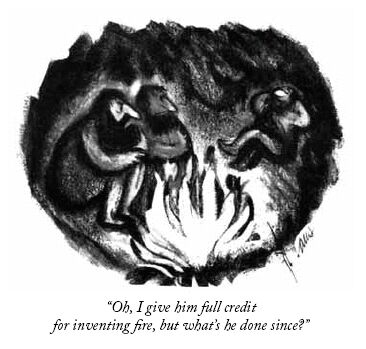
Humans made Fire 790,000+ Years ago...

Humans made fire 790,000+ Years ago and it has been useful ever since.

For instance, more than 100,000 young women were killed in fires in India in a single year, and many of those deaths were tied to domestic abuse, according to a new study published on Monday March 02, 2009.

Business Line reported on November 9, 2008:

"...In rural areas (of India), firewood and chips is by far the most important energy source for cooking. There has been no change over the years — as many as 75.4 per cent of rural households primarily depended on this source in 2006-07, against 75.5 per cent in 1999-00...Surprisingly, 41 per cent of urban households in Kerala depend on firewood and chips, followed by Chhattisgarh and Madhya Pradesh (35-36 per cent) and Rajasthan (34 per cent)..."

Reuters reported on October 26, 2008:

"A new study shows that humans had the ability to make fire nearly 790,000 years ago, a skill that helped them migrate from Africa to Europe.

By analysing flints at an archaeological site on the bank of the river Jordan, researchers at Israel's Hebrew University discovered that early civilizations had learned to light fires, a turning point that allowed them to venture into unknown lands..."

Maybe.


Artist : Robert Kraus, The New Yorker, July 1960

Friday, March 06, 2009

Park Your Nano Right in Your Drawing Room

The Times of India March 3, 2009: "Bookings for Nano will start from March 23: Tata Motors has advanced the booking date for its Nano, touted as the world's cheapest car, in India by three weeks,"


Artist: R K Laxman, The Times of India, September 1 2007


Artist: Tom Cheney, The New Yorker, 9 March 2009, Cartoon Caption Contest 183

my caption:

"I told you: our neighbour's drawing room was right above our bedroom."