ROBERT ZARETSKY says:
"TODAY is the 300th birthday of David Hume, the most important philosopher ever to write in English, according to The Stanford Encyclopedia of Philosophy. The conferences being held on Hume this year in Austria, the Czech Republic, Russia, Finland and Brazil suggest that the encyclopedia’s claim is perhaps too modest..."( The NYT, May 6 2011)
(any thing in India?)
Here are five posts, containing David Hume, on this blog:
1. Why, why no David Hume, Vinda?
2. Will Jayant Narlikar One Day Write Marathi Sceptical Essays?
3. Why Vinda Karandikar Didn't Choose David Hume
4. Evening of September 3 2003- Dilip Chitre followed by Vinda Karandikar
5. Why Minus Times a Minus Equals a Plus?
George Scialabba on Adam Smith who was a bosom friend of David Hume:
"...He never fell afoul of civil or religious authority, had no mistresses, and engaged in no public quarrels.
(A semi-public one, though. Shortly after Hume’s death, Smith met Samuel Johnson at a party. Johnson spoke slightingly of Hume, Smith defended him, and their exchanges grew increasingly heated until Johnson exclaimed, “Sir, you lie!” To which Smith retorted, “Sir, you are the son of a whore!” and stalked out.).."
Sunday, May 08, 2011


Friday, May 06, 2011
राजहंस माझा: बालगंधर्व
Govindrao Tembe: "I consider Narayanrao very cultured man because he never talks about himself."
(गोविंदराव टेंबे: "नारायणरावांना मी फार सुसंस्कृत मनुष्य समजतो - कारण ते स्वतःबद्दल कधी बोलत नाहीत -")
Simone de Beauvoir on Simone Weil:
“Her intelligence, asceticism, and total commitment as well as her sheer courage, filled me with admiration…I especially envied her for her heart.”
Vladimir Nabokov:
"The centuries will roll by, and schoolboys will yawn over the history of our upheavals; everything will pass, but my happiness, dear, my happiness will remain, in the moist reflection of a streetlamp, in the cautious bend of stone steps that descend into the canal's black waters, in the smiles of a dancing couple, in everything with which God so generously surrounds human loneliness."
One such act of God was the creation of Bal Gandharva (बालगंधर्व) aka Narayan Shripad Rajhans (नारायण श्रीपाद राजहंस).
It's preposterous but true that, as a kid, I once performed, in my school annual, on the same stage on which Bal Gandharva had made his debut- at Hansprabha talkies (हंसप्रभा टॉकीज), now called Balgandharva Natyagraha (बालगंधर्व नाटय़गृह), in Miraj (मिरज), in year 1906 when the great Shahu Maharaj (शाहू महाराज) was in the audience.
(btw- They should have preserved Hansprabha as a heritage structure. Also, I don't know by what name the theatre- built by the king of Miraj state- was called when it opened in c1906 but for a very long time it was Hansprabha.)
We lived just 100m away from the stage of Hansprabha. I couldn't quite appreciate then that one of the greatest Marathi sepaking personalities of 20th century had left his footprints in the sand surrounding Hansprabha, where our mother took us many evenings to play. [Another such giant, historian and playwright, Vasudevshastri Khare (वासुदेवशास्त्री खरे) 1858-1924, had lived opposite of Hansprabha.]
Over the last few months, I have finished reading probably the two most important books on the life of Bal Gandharva:
1. 'Bal Gandharva Vyaktee Aani kala' (बालगंधर्व / व्यक्ती आणि कला) by Vasant Shantaram Desai (वसन्त शान्ताराम देसाई) first published in 1959, my edition year 1987, pages: 334
2. 'Gandharvayug' (गंधर्वयुग) by Gangadhar Gadgil (गंगाधर गाडगीळ) first published 2005, pages: 187.
 'Dada, te aale na-' (दादा, ते आले ना) from 'Swayamvar' (स्वयंवर) , 1929
I enjoyed reading both the books but in the end was disappointed by them.
I also read articles by N S Phadke (ना सी फडके) and Pralhad Keshav Atre (प्रल्हाद केशव अत्रे), two very popular and perceptive critics of the then art scene in Maharashtra, on Bal Gandharva.
None of them does adequate, let alone full, justice to the life of Bal Gandharva, the narrative that was, like King Lear, a greater tragedy than the two most popular Marathi stage tragedies of 20th century: 'Ekach Pyala'(एकच प्याला) by R G Gadkari (राम गणेश गडकरी) and 'Natasamrat' (नटसम्राट) by V V Shirwadkar (वि वा शिरवाडकर).
Having lived disabled and destitute for many years before the death, even Bal Gandharva's funeral at Pune was a rushed affair- according to Desai's book- because some people felt that there could be a claim that he had converted into Islam and hence should be given final rites accordingly.
The person who understood BG much better than these wordsmiths was another Gandharva, Kumar Gandharva , no relation, who expressed that knowledge in his inimitable album 'Mala Umajalele Balgandharva' ('मला उमजलेले बालगंधर्व').
Ten songs there show you BG in ten dimensions. Personal favourite- 'Tat Karee duhita' (तात करी दुहिता).
Mark Twain:
“I lost Susy thirteen years ago; I lost her mother—her incomparable mother!—five and a half years ago; Clara has gone away to live in Europe; and now I have lost Jean. How poor I am, who was once so rich! … Jean lies yonder, I sit here; we are strangers under our own roof; we kissed hands good-by at this door last night—and it was forever, we never suspecting it. She lies there, and I sit here—writing, busying myself, to keep my heart from breaking. How dazzlingly the sunshine is flooding the hills around! It is like a mockery."
 Prem, Seva, Sharan (प्रेम, सेवा, शरण), 1960
I plan to return to the subject of Bal Gandharva a few more times over the next several months.
A new Marathi film is being released on the subject of Bal Gandharva today. Subodh Bhave (सुबोध भावे) is playing the title role. In promos, he looks the part great.
But being Bal Gandharva is not sum of looks, sarees/jewellery/attars, great singing voice, distinctive and stylish elegance, fine art direction, rich sets, playwrights like Krushnaji Prabhakar Khadilkar, music directors like Govindrao Tembe, fellow artists of the stature of Keshavrao Bhosale, accompanists like Ahmed Jan Thirakwa, well wishers like Solicitor P S Lad, musical instruments like organ, wealthy patrons, doting public, integrity of character, humility, pre-WWII society...It's primarily about heart.
The question that haunts me today is: Does Mr. Bhave have the heart as large as that of Bal Gandharva? We shall soon find out...
One of the best Marathi films and one of the greatest biopics in the history of world cinema, Sant Tukaram, 1936 (संत तुकाराम), became both popular and critical success largely because of the quality of acting of Vishnupant Pagnis (विष्णुपंत पागनीस).
[p.s on May 20 2011, Vasant Sarwate (वसंत सरवटे) suggested me N S Phadke (ना सी फडके)'s novel 'akherache band' (अखेरचे बंड), a part of which, he said, is based on Bal Gandharva'a life.
Sarwate who has watched Bal Gandharva perform a few times, including Sangeet Manapman (संगीत मानापमान), spoke to me on many other aspects of BG's art and the new Marathi film based on his life. More on it later...]
More p.s.:
I watched the film in October 2011. As expected, Mr. Bhave took me as close to the late Bal Gandharva in flesh and blood as possible. The way he stood, the way he gestured, the way he sang, he moved me. (He probably could have spoken with more tenderness.) But the movie sadly is a disappointment.
Monday, May 02, 2011
If only Cartoons were Drones and Laughs were Bullets...
The New York Times May 2 2011: President Obama said that Osama bin Laden had been killed in a firefight during a "targeted operation" Mr. Obama ordered in Pakistan.
Mike Luckovich has drawn most laughs out of me at the cost of Osama bin Laden. He takes the Mickey out of Mr. Laden just by the way he draws him.
[p.s. To "take the Mickey (out of someone)" means to take the fight, the vigor, the gravity, the self-importance out of them, by mocking them, usually in a very subtle way.]
I don't know if Mr. Laden followed Luckovich or had any sense of humour.
Here is a small selection.
Needless to say it's as much comment on Mr. Laden as it is on America.
 caption: Laden : I brought chaos and destruction to New York's financial district...His lackey: I hear you get bonus for that...
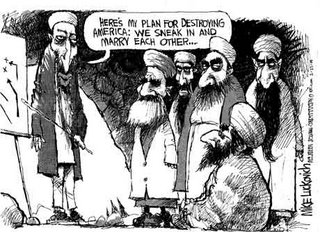
caption: Laden: Here's my plan for destroying America: we sneak in and marry each other...

caption: Laden: I couldn't carry on my sports drink but this is one of those Dell notebooks with an exploding battery.
Mike Luckovich has drawn most laughs out of me at the cost of Osama bin Laden. He takes the Mickey out of Mr. Laden just by the way he draws him.
[p.s. To "take the Mickey (out of someone)" means to take the fight, the vigor, the gravity, the self-importance out of them, by mocking them, usually in a very subtle way.]
I don't know if Mr. Laden followed Luckovich or had any sense of humour.
Here is a small selection.
Needless to say it's as much comment on Mr. Laden as it is on America.
 caption: Laden : I brought chaos and destruction to New York's financial district...His lackey: I hear you get bonus for that...

caption: Laden: Here's my plan for destroying America: we sneak in and marry each other...

caption: Laden: I couldn't carry on my sports drink but this is one of those Dell notebooks with an exploding battery.
Saturday, April 30, 2011
Why Minus Times a Minus Equals a Plus?
George Santayana:
"(Pierre-Simon) Laplace is reported to have said on his deathbed that science was mere trifling, and that nothing was real but love."
('The Life of Reason' / 'the Phases of Human Progress', in five volumes from 1905 to 1906)
George Orwell:
Then the question arises, Why are beggars despised?--for they are despised, universally. I believe it is for the simple reason that they fail to earn a decent living. In practice nobody cares whether work is useful or useless, productive or parasitic; the sole thing demanded is that it shall be profitable. In all the modem talk about energy, efficiency, social service and the rest of it, what meaning is there except "Get money, get it legally, and get a lot of it"? Money has become the grand test of virtue. By this test beggars fail, and for this they are despised.
(Down and Out in Paris and London, 1933)
J Sri Raman
'Nucleus and Nation' is especially recommended for anyone interested in studying, or engaged in a struggle against nuclear nationalism and militarism. Anderson helps us comprehend the history of an Indian science that has given the country the Bomb but no solution to socio-economic backwardness.
(EPW, April 23 2011)
Dr. Jayant Narlikar has written an essay "Don’t blind kids with science" (The Asian Age, April 13 2011)
He says:
"...Indeed, in general, our school science texts seek to present the subject in a cut and dried form so that the student gets the impression that it was always that way. He is not aware of the birth pangs suffered by the scientists involved, often being misled, sometimes running a race to establish priority, or even making an over-claim so as to attract more funds for future work. Ambient social conditions can play a significant part in deciding which way science moves. The rapid research on the atomic bomb was inspired by its potential importance as the ultimate weapon during World War II...
...Chandrasekhar is credited with the discovery of the mass limit on stable white dwarf stars. Reading the technical account of his work conveys the imaginativeness and depth of understanding of the young scientist, then under 25 in age. But such accounts do not convey his mental agony when he had to face severe criticism and ridicule from an unexpected quarter. No less a person than Eddington, in an unexpected attack on Chandrasekhar’s ideas, tore his theory apart. This confrontation took place in the august debating hall of the Royal Astronomical Society in London. The typical neutral person in the audience left the meeting under the impression that the idea of a rather inexperienced young scientist had been demolished by an experienced leader in the field. Yet, in science an ultimate objectivity eventually prevails. Within a few years Chandrasekhar was vindicated and went on to receive the Nobel Prize. But episodes like these need to be part of the student’s curriculum so as to give him or her the right perspective on science and its practitioners..."
Why do we want to give our students the right perspective on science and its practitioners?
1> I don't think most middle-class parents of India's students want their wards to have "the right perspective on science". They just want their kids to excel in competitive exams and get wealthy asap.
2> Most Indian corporates don't want their employees to have "the right perspective on science". They just want them to be able to execute "the straight line extrapolations" of the managements and meet quarterly earnings or sales quotas.
"The straight line extrapolations" is explained here by Stefan Stern:
"...As Rich Lyons, the dean of the Haas School of Business at the University of California, Berkeley, points out, the straight line extrapolations on a number of important graphs lead you to a pretty scary place.
Over the next few decades the earth’s population looks set to climb to about 9bn. Temperatures and sea levels are rising. But we may not have enough habitable land, water, energy or food to cope with these changed circumstances. Future healthcare costs in a world of greatly increased longevity are daunting. See it human. The outlook is bad..."
(FT, July 12 2010)
3> If we want to give "the right perspective on science", why not begin the effort by teaching them that science also is a kind of faith?
Betrand Russell explains:
"...The great scandals in the philosophy of science ever since the time of Hume have been causality and induction. We all believe in both, but Hume made it appear that our belief is a blind faith for which no rational ground can be assigned...
...Science, as it exists at present, is partly agreeable, partly disagreeable.
It is agreeable through the power which it gives us of manipulating our environment,and to a small but important minority it is agreeable because it affords intellectual satisfactions.
It is disagreeable because, however we may seek to disguise the fact, it assumes a determinism which involves, theoretically, the power of predicting human actions; in this respect, it seems to lessen human power.
Naturally people wish to keep the pleasant aspect of science without the unpleasant aspect; but so far the attempts to do so have broken down..."
To most students and their parents "it (the science) is agreeable through the power which it gives us of manipulating our environment".
"To a small but important minority" (that perhaps includes Dr. Narlikar), "it is agreeable because it affords intellectual satisfactions".
Let us turn to giving "the right perspective on practitioners of science".
Bertrand Russell:
"...We all know that Galileo and Darwin were bad men;...Almost all the Renaissance artists were bad men..."
Clive Cookson:
"The author (Michael Brooks) starts by reminding us of Einstein’s unappealing personal life – among other things making passes at his mistress’s daughter, breaking his promise to give all his Nobel prize money to his wife Mileva, evading tax and abandoning his schizophrenic son to die a “third-class” patient in a mental institution.
Then the book analyses the many “shady moments” in Einstein’s professional life: cherry-picking data to support his theories, appropriating advances made by others and, once he had made his name, using fame shamelessly for further self-advancement.
The equation most closely associated with Einstein, E=mc2, did not come as a surprise to those in the know when he first proposed it in 1905, Brooks claims. And Einstein failed in eight attempts to prove E=mc2 during the next 41 years, though others succeeded – yet he had appropriated the equation as his own and he dismissed attempts to set the record straight, with aggressive assertions of his “priority”..." (FT, July 8, 2011)
These guys were as human as us.
Alexander Waugh writes:
"... Mathematics, in which physicists vest unwarranted confidence, is far too blunt a tool. It worked for Newton, Maxwell and Einstein because they found equations that accurately described the classical world. But with the discovery, in the early 20th century, of quantum mechanics, everything changed. Subatomic particles do not behave like large visible objects. One cannot measure a particle’s position and its velocity at the same time; the arrow of time cannot be observed in particle interactions; and (so Hawking believes) for a particle to travel between two points it has to take every ‘possible path’ between them simultaneously. The number of possible paths from A to B is, he claims, infinite. If this is correct, then it becomes a feature of the quantum world that all history, and all possible histories, also take place simultaneously.
How can mathematics, however sophisticated, be up to the task of dealing with this? Numbers, after all, were created by humans to describe things in the observed world. They are adjectival. How can one ascribe a number to a particle, or to its position, or its velocity if, while travelling from A to B, it is said to be in an infinite number of places simultaneously?
If numbers are not to be trusted, then it follows that mathematics is even worse. Have you ever tried asking a mathematician why a minus times a minus equals a plus? Try it. He cannot answer, except by specific reference to the man-made artificialities of algebra. Outside of these, the concept has no application and no meaning. One should be equally suspicious of mathematical infinities. In very simple terms, if you divide 10 by three in base ten you get 3.3 recurring (infinitely). Equally you could say that the answer is 31/3 with no infinite recurrence. In his famous Brief History of Time, as well as in the present book, Hawking finds himself constantly frustrated in his attempts to describe the universe because of the ‘plague of infinities’ that come into his maths at every turn...."
(The Spectator, 11th September 2010)
Therefore, sure we can teach our students science using a wider canvas but, more importantly, why not we teach them our great books, classics?
That might give them the right perspective, not just on science and its practitioners, but on much larger thing called life.
 Artist: Mischa Richter, The New Yorker, 16 June 1962
Tuesday, April 26, 2011
I fancy drowning my sorrows — but not at these prices!
The Times of India April 6 2011:
"...beer and hard liquor will cost 40-60% more in Mumbai and the rest of Maharashtra. The alcoholic beverage industry is reworking costs steeply following the excise duty increase in the latest state budget...
...The soon-to-be unveiled retail price hikes will be one of the biggest anywhere in the country in recent history. A combination of excise duty increase in maximum retail price, basic duty hike on proof litre, and a rejig of the value added tax collection will lead to a massive price spike within a week..."
 I fancy drowning my sorrows — but not at these prices!
Artist: ????, The Spectator, April 9 2011
Friday, April 22, 2011
Like on Internet, in Spacecraft, Nobody knows you're a Dog
I knew (and still do) so much about Apollo 11, other American space missions and NASA. And I know so little about Soviet Yuri Gagarin. (And they say India sided with Soviet Union in the Cold War. Also, I was fired by the passion of communism until I turned 23 or so!)
MARY ROACH writes about "5 feet 2 inches tall and nice as heck" Mr. Gagarin:
"...Strangely, the first man to ascend into the cosmos was a skilled pilot forbidden to use his skills. The controls of Vostok I were locked; the capsule was maneuvered entirely from the ground. As Gagarin himself put it, “I’m not sure if I was the first man in space or the last dog.”..."
(The New York Times, April 9, 2011)
Following, of course, is an iconic cartoon of our age. Read more about it here.
 Artist: Peter Steiner, The New Yorker, July 5 1993
Monday, April 18, 2011
Oh, Just Hanging Out, Reading the Bhimrupi but not the Ramraksha
Today is Hanuman Jayanti- My Kumud-mavashi's birthday. At Miraj the day was always celebrated with some gusto at Bhanu talim.
VERLYN KLINKENBORG:
"...The King James Bible has had an enormous impact on English for the very reason that it captures and preserves — and communicates down through the centuries — the unavoidable rhythms of good English. Its words are almost never Latinate, and its rhythms are never hampered by the literalism that afflicts other translations.
It would have been so easy to get that wrong, to let scholarship overwhelm common sense, to let theology engulf plainness. We owe an enormous debt to William Tyndale’s imaginary plowboy. All who speak this wonderful language still speak in the shadow of the King James Bible."
For a number of years, my brother and I recited shlokas every evening. A couple of times we were thrashed by our father for being frivolous doing it.
I regret that I stopped that practice long time ago. I am trying to revive it.
My father had made us a chart by pasting papers containing sholkas on both sides of a hard cardboard which came from a saree packaging.
The front page started with "Shubhamkaroti" (शुभंकरोती ) and the back page ended with 'Bheemrupee' (भीमरूपी).
After reciting these we recited 'Ramraksha' (रामरक्षा) which we knew by heart.
I never quite liked 'Ramraksha'.
Apart from the fact that it was the last thing standing bewteen us and dinner, it was tongue twisting and hard to understand although the booklet we referred to had its Marathi translation.
Also, I couldn't quite see its literary beauty even after I learnt Sanskrit starting 8th class.
On the other hand, it was a great pleasure reciting Bheemrupee.
It was like reading a great poem by Tukaram तुकाराम with a gaiety of a poem by Balkavi बालकवी or Keshavsut केशवसुत.
This was genius of Samarth Ramdas (समर्थ रामदास). I like his 'Manache Sholka' (मनाचे श्लोक) not for its moral preaching but its literary qualities. For instance "it captures and preserves — and communicates down through the centuries — the unavoidable rhythms of good Marathi."
Or as Adam Haslett says: "...(I am among those who) fell in love with literature not by becoming enthralled to books they couldn’t put down but by discovering individual sentences whose rhythm and rhetoric was so compelling they couldn’t help but repeat them to anyone who would listen,.."
There has been no poet of his class in Marathi since his death in CE 1682.
[I was stunned reading what Samartha's female-disciple Akka (अक्का) has said about life:
"स्वामीच्या कृपाप्रसादे हे सर्व नश्वर आहे असे समजले, पण या नश्वरात तमाशा बहुत आहे."
("By the grace of Swami it is understood that all this is mortal, but there is a lot of drama in this mortal.")
Apart from the profound thought, notice the beauty and brevity of 17th century Marathi there.]
Here is Bheemrupee in full. My apologies for the errors there. I have highlighted parts that really lifted my spirits. (Read D G Godse द ग गोडसे to learn about many fascinating aspects of Samarth Ramdas's art.)
||भीमरूपी स्तोत्र ||
भीमरूपी महारुद्रा वज्र हनुमान मारुती |
वनारी अन्जनीसूता रामदूता प्रभंजना ||१||
महाबळी प्राणदाता सकळां उठवी बळें |
सौख्यकारी दुःखहारी दूत वैष्णव गायका ||२||
दीननाथा हरीरूपा सुंदरा जगदंतरा |
पातालदेवताहंता भव्यसिंदूरलेपना ||३||
लोकनाथा जगन्नाथा प्राणनाथा पुरातना |
पुण्यवंता पुण्यशीला पावना परितोषका ||४||
ध्वजांगें उचली बाहो आवेशें लोटला पुढें |
काळाग्नि काळरुद्राग्नि देखतां कांपती भयें ||५||
ब्रह्मांडें माइलीं नेणों आंवाळे दंतपंगती |
नेत्राग्नी चालिल्या ज्वाळा भ्रुकुटी ताठिल्या बळें ||६||
पुच्छ तें मुरडिलें माथां किरीटी कुंडलें बरीं |
सुवर्ण कटि कांसोटी घंटा किंकिणि नागरा ||७||
ठकारे पर्वता ऐसा नेटका सडपातळू |
चपळांग पाहतां मोठें महाविद्युल्लतेपरी ||८||
कोटिच्या कोटि उड्डाणें झेंपावे उत्तरेकडे |
मंदाद्रीसारखा द्रोणू क्रोधें उत्पाटिला बळें ||९||
आणिला मागुतीं नेला आला गेला मनोगती |
मनासी टाकिलें मागें गतीसी तूळणा नसे ||१०||
अणूपासोनि ब्रह्मांडाएवढा होत जातसे |
तयासी तुळणा कोठें मेरु- मांदार धाकुटे ||११||
ब्रह्मांडाभोंवते वेढे वज्रपुच्छें करूं शके |
तयासी तुळणा कैंची ब्रह्मांडीं पाहतां नसे ||१२||
आरक्त देखिले डोळां ग्रासिलें सूर्यमंडळा |
वाढतां वाढतां वाढे भेदिलें शून्यमंडळा ||१३||
धनधान्य पशुवृद्धि पुत्रपौत्र समग्रही (समस्तही)|
पावती रूपविद्यादि स्तोत्रपाठें करूनियां ||१४||
भूतप्रेतसमंधादि रोगव्याधि समस्तही |
नासती तुटती चिंता आनंदे भीमदर्शनें ||१५||
हे धरा पंधराश्लोकी लाभली शोभली भली (बरी).
दृढदेहो निःसंदेहो संख्या चंद्रकला गुणें ||१६||
रामदासीं अग्रगण्यू कपिकुळासि मंडणू |
रामरूपी अन्तरात्मा दर्शने दोष नासती ||१७||
||इति श्री रामदासकृतं संकटनिरसनं नाम श्री मारुतिस्तोत्रम् संपूर्णम् ||
Even later in life, Bheemrupee has come to my mind the way a good song does. Unannounced!

Artist: Victoria Roberts, The New Yorker, 12 November 1990
(p.s. If my father ever saw me reciting Bhimrupi reclining in sofa, I would be in lot of trouble!)
Thursday, April 14, 2011
How Valuable were India's Dalits?
Today is 120th birth anniversary of Dr. B. R. Ambedkar (भीमराव रामजी आंबेडकर).
Clint Eastwood talking to MICHAEL JUDGE:
'..."Growing up I was always rooting for the jazz musician," he says. "I remember I was disturbed when there was a big objection to Nat King Cole moving into Hancock Park in Los Angeles. I didn't know Hancock Park at that time, because I was just a kid in Oakland. But I always thought: 'God, who wouldn't want to have Nat Cole living next to him?' Not only because he was a popular guy, but he was one of those few popular guys who was a great jazz player as well, a great piano player."...
"It was a disgraceful time," Mr. Eastwood says. "I remember living through it. You had to have all-white bands or all-black bands or they'd send you away. Woody Herman and Ernie Royal had an occasional mixture. But by and large you couldn't play certain places . . . especially in the South, but across the whole country, really."... '
(WSJ, Feb 22 2011)
I read something startling last year.
JOHN STAUFFER:
"On the eve of the Civil War, Southern slaves were the nation's most valuable commodity. They constituted 80% of the gross national product, equivalent to roughly $10 trillion today. Before the war, America's richest tycoons were not Northern industrialists but Southern planters."
(WSJ, MARCH 26, 2010)
I had not come across them as a balance sheet item yet!
Stock options? Yes. (Read: No wonder they were given as stock options!)
Is it possible that India's Dalits- who were treated in their own country as badly as the blacks in US- too were the nation's most valuable resource around 1860?
 Artist: Alan Dunn, The New Yorker, May 7 1927
African-Americans might have looked alike to some but they were- and are- very precious.
Imagine Jazz, comedy, cinema, television, sports and Satyagraha of 20th century without African-Americans.
Sunday, April 10, 2011
NRI loves India...everything...its banks...particularly HSBC
The Times of India, April 9 2011:
"...In a surprising move that takes the American hunt for hidden money beyond the usual Swiss and Caribbean tax havens, the US Justice department's civil tax division asked a Federal Courts permission to force the London-based HSBC Bank to disclose names of thousands of wealthy Indian-American clients who it says maintain accounts with more than $ 100,000 in the banks India branches ostensibly to hide it from the IRS taxman.
In a 47-page statement filed before a San Francisco court, the IRS said there were 9,000 US residents of Indian-origin who had $100,000-minimum-balance accounts at HSBC India but that fewer than 1,400 had disclosed existence of their accounts."
Mind you, they didn't go to Switzerland or Caribbean. They came to their mother-land.
In the past couple of weeks, many of those 7600 (84.4%), cheered Indian team's triumph in ODI cricket WC and Anna Hazare's victory in his fight with corruption. Some of them even went on a symbolic fast.
How patriotic!
 Artist: R K Laxman, The Times of India, Jan 10 2003
Saturday, April 09, 2011
Will today's Bandunana and Pandutatya hear Chitragupta?
The Asian Age March 24 2011:
"Minister of state for environment Jairam Ramesh on Wednesday launched a nationwide campaign to reduce noise levels across India, as it was turning “too noisy”..."
Nikil Saval:
"...What if we tried to listen to nothing? Silence is the feature of our buzzing sound-world we enjoy least, whose very existence we threaten to pave over track by track. Silence is the most endangered musical experience in our time. Turning it up, we might figure out what all our music listening is meant to drown out, the thing we can't bear to hear."
(Slate, March 28, 2011)
Sudhir Venkatesh:
"In public spaces, serendipitous interaction is needed to create the 'mob mentality.' Most iPod-like devices separate citizens from one another; you can't join someone in a movement if you can't hear the participants. Congrats Mr. Jobs for impeding social change."
Stanley Crouch:
"People are uncomfortable in silence because it can breed needless contemplation and may engender a floating into the deeper world of the self."
I celebrated the end of cricket ODI world cup because it was my life's noisiest sports tournament in India. Noisier than even Ganesh Chaturthi and Diwali.
Wiki: Chitragupta (चित्रगुप्त) is a Hindu God assigned with the task of keeping complete records of actions of human beings on the earth. Upon their death, Chitragupta has the task of deciding heaven or the hell for the humans, depending on their actions on the earth.
The interesting aspect is: Chitragupta reads out one's life's balance sheet to the dead.
More than 100 years ago, Shripad Krushna Kolhatkar (श्रीपाद कृष्ण कोल्हटकर) wrote a brilliant article 'Chitraguptacha Jamakharch' ('चित्रगुप्ताचा जमाखर्च') on what happened when his characters Bandunana (बंडूनाना) and Pandutatya (पांडूतात्या), after their death, reached Chitragupta's court and listened to their accounts.
['Sahitya-Battishi : Sudamyache Pohe', 1910 ('साहित्य-बत्तिशी : सुदाम्याचे पोहे')]
Alas there was very little show on the credit side. But at least they heard what was read out.
We mayn't be that lucky.

(apologies for the quality of cartoon's reproduction as my scanner is still down. Please open the picture in another window to get a better view.)
caption in Marathi reads:
"चित्रगुप्त महाराज! वाचून काही उपयोग नाही. हे सर्व मुंबईतून आलेले आहेत न ठार बहिरे आहेत .."
("Chitragupta Maharaj! No point reading. They all have come from Mumbai and are stone-deaf...)
Artist: Vasant Sarwate, 1996
"The Best of Sarwate" editor: Avadhoot Paralkar, Lokvangmay Gruh 2008
[कलावंत: वसंत सरवटे, १९९६ , "सरवोत्तम सरवटे" संपादक: अवधूत परळकर, लोकवाङ्मय गृह 2008]
Subscribe to:
Posts (Atom)