मेघदूत: "नीचैर्गच्छत्युपरि दशा चक्रनेमिक्रमेण"

समर्थ शिष्या अक्का : "स्वामीच्या कृपाप्रसादे हे सर्व नश्वर आहे असे समजले. पण या नश्वरात तमाशा बहुत आहे."

G C Lichtenberg: “It is as if our languages were confounded: when we want a thought, they bring us a word; when we ask for a word, they give us a dash; and when we expect a dash, there comes a piece of bawdy.”

C. P. Cavafy: "I’d rather look at things than speak about them."

Martin Amis: “Gogol is funny, Tolstoy in his merciless clarity is funny, and Dostoyevsky, funnily enough, is very funny indeed; moreover, the final generation of Russian literature, before it was destroyed by Lenin and Stalin, remained emphatically comic — Bunin, Bely, Bulgakov, Zamyatin. The novel is comic because life is comic (until the inevitable tragedy of the fifth act);...”

सदानंद रेगे: "... पण तुकारामाची गाथा ज्या धुंदीनं आजपर्यंत वाचली जात होती ती धुंदी माझ्याकडे नाहीय. ती मला येऊच शकत नाही याचं कारण स्वभावतःच मी नास्तिक आहे."

".. त्यामुळं आपण त्या दारिद्र्याच्या अनुभवापलीकडे जाऊच शकत नाही. तुम्ही जर अलीकडची सगळी पुस्तके पाहिलीत...तर त्यांच्यामध्ये त्याच्याखेरीज दुसरं काही नाहीच आहे. म्हणजे माणसांच्या नात्यानात्यांतील जी सूक्ष्मता आहे ती क्वचित चितारलेली तुम्हाला दिसेल. कारण हा जो अनुभव आहे... आपले जे अनुभव आहेत ते ढोबळ प्रकारचे आहेत....."

Kenneth Goldsmith: "In 1969 the conceptual artist Douglas Huebler wrote, “The world is full of objects, more or less interesting; I do not wish to add any more.”1 I’ve come to embrace Huebler’s ideas, though it might be retooled as “The world is full of texts, more or less interesting; I do not wish to add any more.” It seems an appropriate response to a new condition in writing today: faced with an unprecedented amount of available text, the problem is not needing to write more of it; instead, we must learn to negotiate the vast quantity that exists. How I make my way through this thicket of information—how I manage it, how I parse it, how I organize and distribute it—is what distinguishes my writing from yours."

Tom Wolfe: "The first line of the doctors’ Hippocratic oath is ‘First, do no harm.’ And I think for the writers it would be: ‘First, entertain.’"

विलास सारंग: "… . . 1000 नंतर ज्या प्रकारची संस्कृती रुढ झाली , त्यामध्ये साधारणत्व विश्वात्मकता हे गुण प्राय: लुप्त झाले...आपली संस्कृती अकाली विश्वात्मक साधारणतेला मुकली आहे."

Monday, March 09, 2009

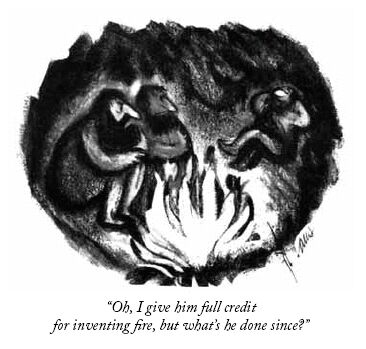
Humans made Fire 790,000+ Years ago...

Humans made fire 790,000+ Years ago and it has been useful ever since.

For instance, more than 100,000 young women were killed in fires in India in a single year, and many of those deaths were tied to domestic abuse, according to a new study published on Monday March 02, 2009.

Business Line reported on November 9, 2008:

"...In rural areas (of India), firewood and chips is by far the most important energy source for cooking. There has been no change over the years — as many as 75.4 per cent of rural households primarily depended on this source in 2006-07, against 75.5 per cent in 1999-00...Surprisingly, 41 per cent of urban households in Kerala depend on firewood and chips, followed by Chhattisgarh and Madhya Pradesh (35-36 per cent) and Rajasthan (34 per cent)..."

Reuters reported on October 26, 2008:

"A new study shows that humans had the ability to make fire nearly 790,000 years ago, a skill that helped them migrate from Africa to Europe.

By analysing flints at an archaeological site on the bank of the river Jordan, researchers at Israel's Hebrew University discovered that early civilizations had learned to light fires, a turning point that allowed them to venture into unknown lands..."

Maybe.


Artist : Robert Kraus, The New Yorker, July 1960

Friday, March 06, 2009

Park Your Nano Right in Your Drawing Room

The Times of India March 3, 2009: "Bookings for Nano will start from March 23: Tata Motors has advanced the booking date for its Nano, touted as the world's cheapest car, in India by three weeks,"


Artist: R K Laxman, The Times of India, September 1 2007


Artist: Tom Cheney, The New Yorker, 9 March 2009, Cartoon Caption Contest 183

my caption:

"I told you: our neighbour's drawing room was right above our bedroom."

Tuesday, March 03, 2009

India’s Lazy Cats Start Building Pyramids in My Drawing Room


Artist: Victoria Roberts, The New Yorker, March 2 2009 Cartoon Caption Contest 182

My caption:

"I know election fever has gripped India. My fat lazy cats have started building pyramids in my drawing room.”

Sunday, March 01, 2009

Why Mahatma Gandhi didn’t find History Very Useful

Historian T S Shejwalkar त्र्यंबक शंकर शेजवलकर (1895 - 1963) argued that Mahatma Gandhi didn’t have much use of history. (Preface to “Panipat 1761”, 1968)

I always wondered why.

After reading John Gray's "Straw Dogs" (2002) I have found a likely reason.

"...If we truly leave Christianity behind, we must give up the idea that human history has any meaning...In India, it was a collective dream, endlessly repeated. The idea that history must make sense is just a Christian prejudice."


Artist: George Price, The New Yorker, 14 August 1948

Friday, February 27, 2009

Unclaimed $1,456 B in Swiss Banks may soon help Indian Democracy

FT reported on February 20, 2009:

“As many as 52,000 American customers hid UBS accounts from the authorities in violation of tax laws, a US government lawsuit against the Swiss bank alleged on Thursday.

The Department of Justice filed a suit seeking to force UBS to disclose the holders of accounts with about $14.8bn in assets.

… UBS reached a landmark settlement with the US government in which the Swiss bank admitted having enabled clients to evade taxes, agreed to pay $780m in fines and turn over about 250 client names to the US…”

PRAFUL BIDWAI wrote in Frontline Feb 13, 2009:

“…Indian businessmen have stashed away billions of dollars in bank accounts abroad. According to a recent report attributed to the Swiss Banking Association, the estimated amount is an astronomical $1,456 billion, higher than the deposits from all other countries put together…”

India may not get $1,456 billion but even the fine amount of $780m looks pretty good.

Timing couldn’t be better because the impending Loksabha elections will surely deplete $1,456 billion considerably.

But spare a thought for an unknown Swiss banker handling Indian accounts. He may lose part of his bonus.

(Since 2001, Mike Luckovich has drawn a few brilliant cartoons of Osama bin Laden and his partner. Here is the latest one.)


Artist: Mike Luckovich

Wednesday, February 25, 2009

M F Husain Draws Statue of Liberty in Oscar Gown

The Asian Age of Feb 24, 2009 has printed the tribute of M F Husain to A R Rahman.

Mr. Husain has drawn Statue of Liberty tastefully, in Oscar gown, wielding Tanpura. She is displaying her considerable assets alright but not nude.

I wonder if he could have shown similar taste drawing Seeta. Read more about it here.


Artist: M F Husain, The Asian Age, February 24, 2009

Tuesday, February 24, 2009

Crouching Housing, Hidden Sanitation and Slum Dog Billionaire

I am happy for SDM but have always felt that good art needs no certification. Rabindranath would be Rabindranath- Dnyaneshwar ज्ञानेश्वर of Bengali-without the Nobel.

A R Rahman may be very good but Indian cinema has created many similar musical giants since Kundan Lal (K.L.)Saigal. (Wasn't he the tallest of them all?)

David Pilling has written "Can slumdogs become millionaires in India?" in FT February 18, 2009.

He says: "...Why are there no slums in China? China is better run than India, with more powerful city mayors who build basic infrastructure to support wealth-creating migrants. Indian politicians court the rural vote. Corruption corrodes infrastructure plans, though some states, such as Gujarat, are improving. China is authoritarian; when workers are no longer required, they can be shipped back to the countryside. A registration system maintains a strict distinction between urban and rural citizens. Democratic India must not go down this route. But it can learn from China by providing clean water, sewerage and basic housing...

...One critic of the film said it was “inconceivable” that a tea-boy from the slum would be allowed on to a television quiz show. Until that changes, India will only progress so far."

So what Mr. Pilling? Watching "Boot Polish"(1954) and listening to its soulful music, people of this country had tears in their eyes and great hope in their hearts and they have clung on to them since then.

And then we will have SDM-II aka SDB. It will eclipse Godfather-II.


Artist: Sudhir Tailang, The Asian Age, February 24, 2009

Monday, February 23, 2009

Indian Pantheon: More Pillars and Assortment of Lesser Areas

Prof. P V Indiresan, Former Director Indian Institute of Technology Madras

“…it is proper for us to enquire why we built temple halls with a thousand pillars a millennium after others had mastered the design of the arch…”

Times of India, November 25, 2008:

“One in every three urban Indians lives in homes too cramped to exceed even the minimum requirements of a prison cell in the US. If that sounds shocking, check this out: In the past 50 years, both the number and proportion of Indians living in homes with a per capita space of less than 100 square feet have gone up substantially. In fact, a majority of Indians have per capita space equivalent to or less than a 10 feet x 10 feet room for their living, sleeping, cooking, washing and toilet needs.”


Artist: Sidney Harris, The New Yorker, 23 February 2009, Cartoon Caption Contest # 181

My caption:

“Remember, we are building Indian Pantheon...use many more pillars, cut down on area and insert terms like carpet area, built-up area, saleable area in the contract.”

Thursday, February 19, 2009

Nighty Purge Campaign in Pune?

When I was growing up in Miraj, it was quite common to see middle-class men walking out in pyjamas.

This blog has already commented on a similar habit of today's Pune residents. Read it here.

Therefore, it was quite amusing to read a report in Business Line on December 14, 2008:

"Community leaders in Shanghai are trying to break up the love affair of some city residents with walking outside in their pyjamas, state media has reported.

The Rixin neighbourhood committee in the city's north-east has begun a campaign to discourage residents' longstanding habit of wearing pyjamas out of their bedrooms and on the streets, the state-run Youth Daily reported.

"We're telling people not to wear pyjamas in the street because it looks very uncivilised," community official Guo Xilin was quoted as saying.

The Shanghainese habit of wearing pyjamas in public emerged alongside China's economic reforms over the past 30 years as it became a sign of prosperity, because it meant people did not sleep in tattered old clothes.

For a still visibly large number of Shanghainese, wearing pyjamas outside has become more a way of life than a fashion statement, and to outsiders, the phenomenon is part of the city's charm.

Guo, however, called pyjama-wearers "visual pollution" and a public embarrassment to the city.

But some residents still argue wearing pyjamas is perfectly acceptable.

"Pyjamas are also a type of clothes. It's comfortable, and it's no big deal since everyone wears them outside," a retiree surnamed Ge was quoted as saying.

Rixin's pyjama purge campaign is not the first of its kind - in the 1990s Shanghai officials put up signs and ran education campaigns to tell people not to stroll around in night gowns.

The campaign's managers eventually gave up."

I wonder why there are no such campaigns in India.

Artist: Barbara Shermund, The New Yorker, 18 Apr 1936

Monday, February 16, 2009

The Greediest Generation has made Traffic Deadlier than Terrorism

Earlier I asked: “What is Deadliest at Pune. Traffic,Temple Queues or Terrorism?”

The answer still is: Traffic.

Black humour now has mushroomed on the subject. Times of India Mirror reported on Jan 1 2009: "Death has a five day week...almost". You are less likely to get killed on a Pune road on Thursdays and Sundays.

Not just that. Times of India reported on December 17, 2008: drowning,poisoning, fire, by falling, electrocution, lightning strikes, due to firearms are also deadlier than terror.

"According to the Planning Commission, the social cost of road accidents in India stands at Rs. 55,000 crore annually. This constitutes 3% of the country's GDP." (Times of India, December 12, 2008)

The cost of terrorism is certainly less than 3% of GDP.

Marathi news daily Pudhari पुढारी reported on Sunday December 08, 2008:

“Pune has 2400 (road) accidents in a year involving 450 deaths.”

Considering this stat, terrorism- even of the latest kind- is a side-show.

Shame on us! The Greediest Generation.

THOMAS L. FRIEDMAN said in NYT on December 07, 2008:

“I’ve been thinking a lot lately about Tom Brokaw’s book “The Greatest Generation,” that classic about our parents and their incredible sacrifices during World War II. What I’ve been thinking about actually is this: What book will our kids write about us? “The Greediest Generation?” “The Complacent Generation?” Or maybe: “The Subprime Generation: How My Parents Bailed Themselves Out for Their Excesses by Charging It All on My Visa Card.”

Our kids should be so much more radical than they are today…”

Should be.

But I don’t see them anywhere. Most of the middle-class kids I see are highly conformists. They want to drive their own vehicle- a big one at that.

Carl Sagan has said:

“…Some of the habits of our age will doubtless be considered barbaric by later generations- perhaps for insisting that small children and even infants sleep alone instead of with their parents; or exciting nationalist passions as a means of gaining popular approval and achieving high political office; or allowing bribery and corruption as a way of life; or keeping pets; or eating animals and jailing chimpanzees; or criminalizing the use of euphoriants by adults; or allowing our children to grow up ignorant.”

India is already guilty of “…exciting nationalist passions as a means of gaining popular approval and achieving high political office; or allowing bribery and corruption as a way of life …”

If Sagan were to be alive and visit Pune now, he would have surely included “keeping public transport paralysed while encouraging more and more private vehicles on lawless roads of Pune” to his list.


‘So do you fancy staying in and getting obese or going out and getting murdered?

The Spectator 2007

My caption:

‘So do you fancy staying in and getting obese or going out and getting killed on a Pune road while driving?’