Monday, December 11, 2006
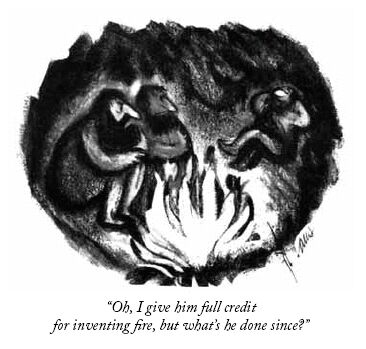



Society still doesn't even know I exist!
 Artist : William Steig Published in The New Yorker issue dated May 28 1960 the week I was borne.
Well, society still doesn't even know I exist! Why should it? Why must there be greatness?
Mukti or Bhakti? Hunter-gatherer or sit-com watching Homo sapien?
Mel Brooks: “Nietzsche whispers to you: ‘Without audacity there is no greatness.’ Freud whispers to you: ‘Why must there be greatness?’ That fight’s still going on. And you don’t understand either one, because they’re both whispering in German."
Monday, December 04, 2006
Vasant Sarwate वसंत सरवटे
Vasant Sarwate वसंत सरवटे remains one of the most under-rated cartoonists in India. Maybe because he has primarily contributed to Marathi publications.
His art has been moving me for more than three decades now.
I have selected two pictures here to represent him. More may follow.
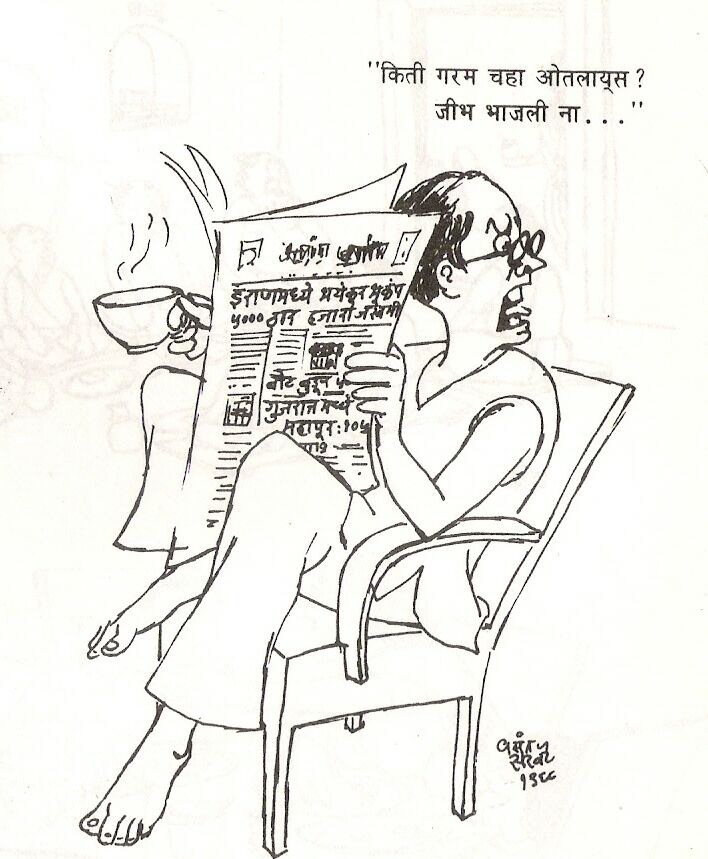
First picture (1968) pokes fun at middle class ethos of Maharashtra, India as effectively as other literary masters of 20th century like the late Shri Kru Kolhatkar, Chi Vi Joshi and Pu La Deshpande did. And in far fewer words.
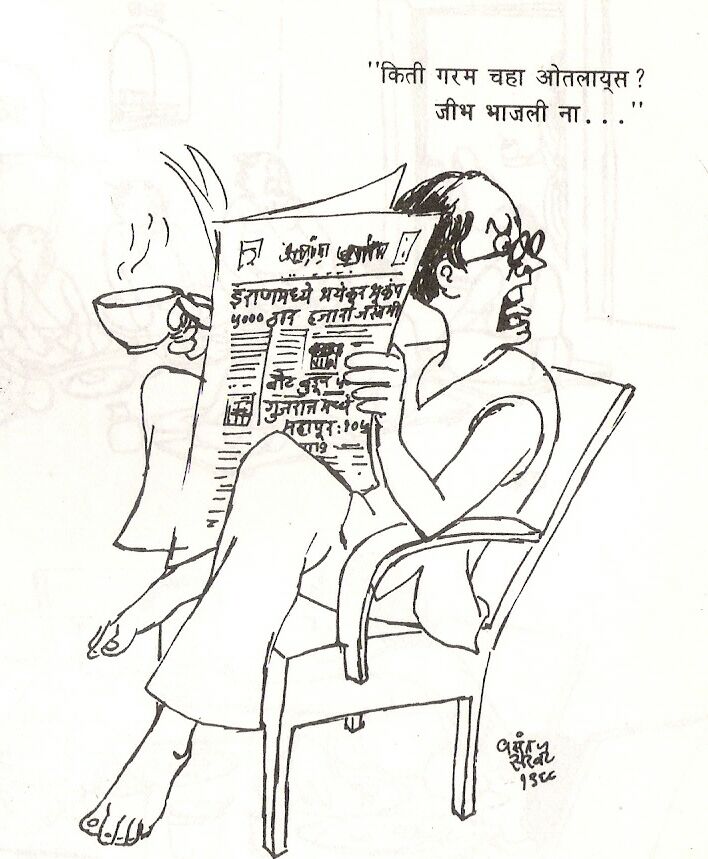
Man has just sipped his tea which perhaps is hotter than usual and it has given him a sore tongue. He admonishes his wife (not in the picture) why she poured such a hot cup. Picture becomes so poignant because the broadsheet he is reading has these news-items: "A quake in Iran kills 5,000 and injures thousands", "floods in Gujarat killing hundreds", "Boat capsizes" etc! Even reading of these catastrophes has not made a dent on our Marathi speaking Homer Simpson's sensitivity. He remains just like HIM.

Second picture is from 1974 (33 years ago!) and brings out visionary qualities of good art.
Architects and urban planners like Charles Correa had opposed expansion of Mumbai into Arabian sea. They saw what would become of Mumbai. But no one 'saw' it better than Sarwate.
Picture shows few in the crowd spotting Bollywood actor Rishi Kapoor flying over them in a helicopter and are shouting his name.
Picture captures beautifully what was eternal in Mumbai- her glamour manifested mainly through film industry and what was changing- her physical landscape, getting perhaps uglier.
Sunday, December 03, 2006
Could you repeat what you've said since we've been married?
Following article is the top ten lister for NYT in calendar 2006.
After reading them I realized I neither asked nor was asked any of these questions. And I tell you living thousands of miles away from New York, most of them are relevant. Marriage indeed travels well!
December 17, 2006
Questions Couples Should Ask (Or Wish They Had) Before Marrying
Relationship experts report that too many couples fail to ask each other critical questions before marrying. Here are a few key ones that couples should consider asking:
1) Have we discussed whether or not to have children, and if the answer is yes, who is going to be the primary care giver?
2) Do we have a clear idea of each other’s financial obligations and goals, and do our ideas about spending and saving mesh?
3) Have we discussed our expectations for how the household will be maintained, and are we in agreement on who will manage the chores?
4) Have we fully disclosed our health histories, both physical and mental?
5) Is my partner affectionate to the degree that I expect?
6) Can we comfortably and openly discuss our sexual needs, preferences and fears?
7) Will there be a television in the bedroom?
8) Do we truly listen to each other and fairly consider one another’s ideas and complaints?
9) Have we reached a clear understanding of each other’s spiritual beliefs and needs, and have we discussed when and how our children will be exposed to religious/moral education?
10) Do we like and respect each other’s friends?
11) Do we value and respect each other’s parents, and is either of us concerned about whether the parents will interfere with the relationship?
12) What does my family do that annoys you?
13) Are there some things that you and I are NOT prepared to give up in the marriage?
14) If one of us were to be offered a career opportunity in a location far from the other’s family, are we prepared to move?
15) Does each of us feel fully confident in the other’s commitment to the marriage and believe that the bond can survive whatever challenges we may face?
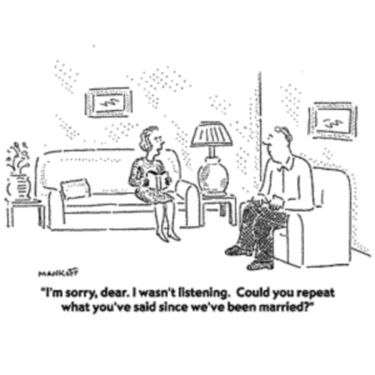 Artist : Robert Mankoff Published : The New Yorker February 21, 2000
p.s. I may not have to repeat what happened since May 22 1987 but some times for my wife and/or I have to for last one day/week/month/quarter!
Don't take it this far

Published in The New Yorker December 4, 2006 Artist: Jason Patterson
Hands-on training can get out of hand..... Designs can get extreme.
Looking for meaning of life?
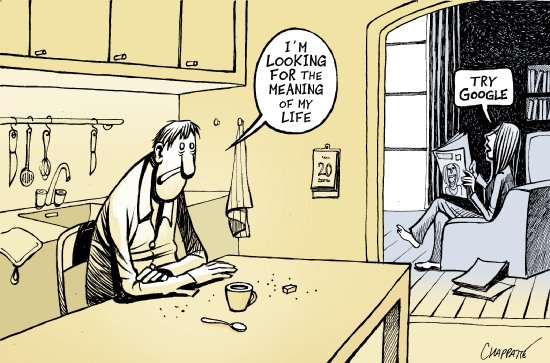
Until recently we all turned to scriptures, Gurus , religion, literature, music, art etc to find meaning of life.
No more?
Happiness. Your proposed week-end sea surfing may have to begin on the road. On your car-top!
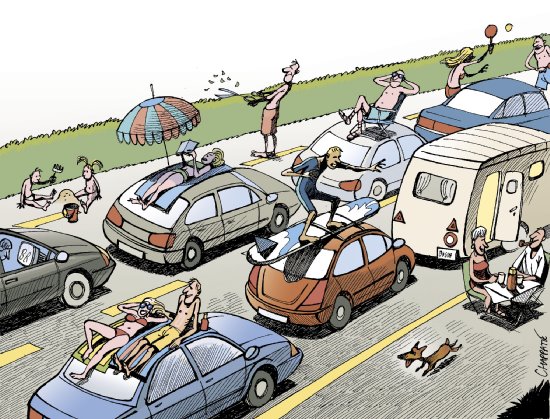
Tons of literature is generated on this subject in the West every year.
That makes Adam Phillips ask: "A culture that is obsessed with happiness must really be in despair, mustn't it? Otherwise why would anybody be bothered about it at all? It's become a preoccupation because there's so much unhappiness. The idea that if you just reiterate the word enough and we'll all cheer up is preposterous."
Most troubling aspect is - nations are getting wealthier not happier.
Here is another take by a practitioner of that dismal science- economics : Paul Krugman.
MONEY CAN'T BUY HAPPINESS. ER, CAN'T IT?
CAMBRIDGE, Mass. -- A few weeks ago my wife and I finally gave in to the pressures of modern life and acquired a cell phone. But it turned out that once we had the thing we had a few questions -- questions we couldn't get answered, because customer service was swamped with similar calls from the thousands of other people who had recently signed on.
Meanwhile, my parents started calling contractors about some minor work on their house -- only to be told that every carpenter and plumber in the area was booked well into next year.
Talk to almost any middle-class American, and you will hear similar stories -- about poor service, excessive traffic, overpriced housing and so on. In fact, there seems to be a sort of rising chorus of complaints about the annoyances of prosperity -- complaints, in effect, that spending lots of money isn't as gratifying as people expected it to be. Most of this is petty stuff, but it is just possible that the chorus of complaints marks the beginning of a broader shift in attitudes -- a shift that will be healthy if it doesn't come too quickly.
Of course, people don't complain about the disappointments of prosperity unless they are prosperous, and in a way all this whining is a symptom of a remarkably successful era in American economic history. Still, you don't have to be an ascetic to wonder if there isn't something a bit manic about the pace of getting and -- especially -- spending in fin-de-siècle America.
Even the dry statistics suggest that something a little strange is going on. Consider: we are now eight years into an economic expansion. Consumer spending traditionally lags behind the economy as a whole in boom times, because families figure that times will not always be that good and that they should save for a rainy day.
This time, however, consumers are leading the charge: while the economy expanded an impressive 4 percent between the first quarter of 1998 and the first quarter of 1999, consumption grew 5.5 percent, and spending on consumer durables -- cell phones, bathroom fixtures, S.U.V.'s and home entertainment systems -- surged an incredible 12 percent.
There are at least two reasons to question whether America's consumption boom is really a good thing.
One is that by conventional standards, the typical American family is being a bit, well, imprudent in spending so much -- indeed, personal savings, never high in this country, have now disappeared almost completely. True, millions of families have seen their wealth surge because of a soaring stock market, but while more people than ever own stock, most still have no significant personal stake in the market.
You might argue that ordinary families are spending freely, despite sluggish wage growth, because they believe that prosperity is here to stay. But survey evidence suggests that many workers remain nervous about job security, a nervousness that manifests itself in a surprising reluctance to demand wage increases.
So why is spending so high? Much of the surge is driven by those families that do own a lot of stock and have been willing to treat recent capital gains not only as durable but as likely to continue. And at least some of the rest is the result of what Robert Frank calls luxury fever: families with annual incomes of $30,000 try to emulate the consumption of those with $60,000, who try to emulate those with $120,000, and so on. Ultimately we are all trying to keep up with the Gateses, and some of us really can't afford it.
And this leads to a deeper concern: there is good reason to think that even those consumers who can afford all this spending will eventually find that they can't get no satisfaction. It is hard to talk about this without sounding either moralistic or supercilious, but it turns out that the folk wisdom is backed by hard statistical evidence: you really can't buy happiness, certainly not for society as a whole.
Partly this is because of congestion effects like the ones my family is experiencing: when few people have cars, the one-car family is king, but when everyone has two, a lot of time is spent in traffic jams.
A more important point, probably, is that human beings are hard-wired to judge themselves not by their absolute standard of living, but in comparison to others. It may be true that in material terms today's borderline poor live as well as the upper-middle class did a few decades back, but that does not stop them from feeling poor. And consumer spending ultimately disappoints because of habituation: once you have become accustomed to a given standard of living, the thrill is gone.
But there is one very powerful argument that can be made on behalf of recent American consumerism: not that it is good for consumers, but that it has been good for producers. You see, spending may not produce happiness, but it does create jobs, and unemployment is very effective at creating misery.
Better to have manic consumers, American style, than the depressive consumers of Japan -- a country where the only consumer durables that have sold well the last few years are home safes, the better to hoard cash in.
This attempt to keep up with people richer than ourselves, however ineffectual it may have been on its own terms, has allowed the United States economy to sail through a global financial storm unscathed, and arguably made the difference between a global wobble and a repeat of the 1930's.
There is a strong element of rat race in America's consumer-led boom, but those rats racing in their cages are what have kept the wheels of commerce turning. And while it will be a shame if Americans continue to compete over who can own the most toys, the worst thing of all will be if the competition comes to a sudden stop.
Now there are faint hints in popular culture -- though certainly not yet in the spending numbers -- that Americans are starting to become disillusioned with high consumption, that in years to come the American consumer will become wiser and more prudent. Let's hope it really happens -- but not too fast.
Equal Opportunity Employer

Published in The New Yorker May 22, 2006 Artist: Charles Barsotti
This is how "corporate- speak" works. Those who have faced it know that it is ominously Orwellian.
Letter to "The Economist":
SIR – The biggest problem in trying to retain talent is that employees tend to be rewarded not for innovation but for how well they play the company game. Companies that are forever reorganising, employ managers who prefer teams based on a “personality cult” and have review systems that are easily manipulated by the reporting manager, tend to reward those who can figure out internal politics more than problem solving, innovation or team building. Indeed, the innovative talent a company thinks it has built up is different to the talent of people to merely advance and survive.
William McNamara
Snohomish, Washington
Saturday, December 02, 2006
Steve Irwin- Hunter became the hunted
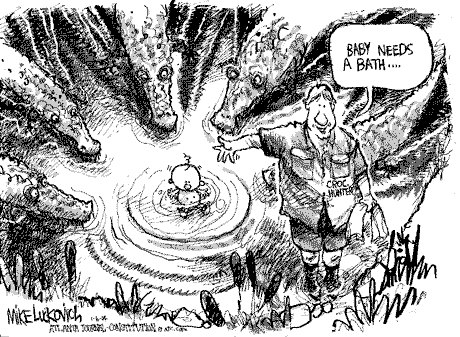 Steve's baby survived on that day but he was not so lucky later....
Germaine Greer
“The animal world has finally taken its revenge on Irwin, but probably not before a whole generation of kids in shorts seven sizes too small has learned to shout in the ears of animals with hearing 10 times more acute than theirs, determined to become millionaire animal-loving zoo-owners in their turn”
Ray Mears
“some things in nature should be left alone. He (Steve Irwin) clearly took a lot of risks and television encouraged him to do that.. It's a shame that television audiences need that to be attracted to wildlife. Dangerous animals, you leave them alone because they will defend themselves. Nature defends itself, it isn't all about hugging animals and going 'ahh'. It's wonderful to observe but you have to be sensible and maintain a safe distance. Television has become very gladiatorial and it's not healthy. The voyeurism we are seeing on television has a cost and it's that cost Steve Irwin's family are paying today."
Gay marriage - Act of Terrorism?

Right wing Americans have made mountain out of molehill of gay marriage. There are fierce debates raging across the land. At times, it seems to be the most important issue around in US. Even more than terrorism.
Richard Dawkins, "America, founded in secularism as a beacon of eighteenth century enlightenment, is becoming the victim of religious politics, a circumstance that would have horrified the Founding Fathers. The political ascendancy today values embryonic cells over adult people. It obsesses about gay marriage, ahead of genuinely important issues that actually make a difference to the world."
Osama has sensed it and is seen ordering his troops to get married to each other instead of driving planes into buildings!