मेघदूत: "नीचैर्गच्छत्युपरि दशा चक्रनेमिक्रमेण"

समर्थ शिष्या अक्का : "स्वामीच्या कृपाप्रसादे हे सर्व नश्वर आहे असे समजले. पण या नश्वरात तमाशा बहुत आहे."

G C Lichtenberg: “It is as if our languages were confounded: when we want a thought, they bring us a word; when we ask for a word, they give us a dash; and when we expect a dash, there comes a piece of bawdy.”

C. P. Cavafy: "I’d rather look at things than speak about them."

Martin Amis: “Gogol is funny, Tolstoy in his merciless clarity is funny, and Dostoyevsky, funnily enough, is very funny indeed; moreover, the final generation of Russian literature, before it was destroyed by Lenin and Stalin, remained emphatically comic — Bunin, Bely, Bulgakov, Zamyatin. The novel is comic because life is comic (until the inevitable tragedy of the fifth act);...”

सदानंद रेगे: "... पण तुकारामाची गाथा ज्या धुंदीनं आजपर्यंत वाचली जात होती ती धुंदी माझ्याकडे नाहीय. ती मला येऊच शकत नाही याचं कारण स्वभावतःच मी नास्तिक आहे."

".. त्यामुळं आपण त्या दारिद्र्याच्या अनुभवापलीकडे जाऊच शकत नाही. तुम्ही जर अलीकडची सगळी पुस्तके पाहिलीत...तर त्यांच्यामध्ये त्याच्याखेरीज दुसरं काही नाहीच आहे. म्हणजे माणसांच्या नात्यानात्यांतील जी सूक्ष्मता आहे ती क्वचित चितारलेली तुम्हाला दिसेल. कारण हा जो अनुभव आहे... आपले जे अनुभव आहेत ते ढोबळ प्रकारचे आहेत....."

Kenneth Goldsmith: "In 1969 the conceptual artist Douglas Huebler wrote, “The world is full of objects, more or less interesting; I do not wish to add any more.”1 I’ve come to embrace Huebler’s ideas, though it might be retooled as “The world is full of texts, more or less interesting; I do not wish to add any more.” It seems an appropriate response to a new condition in writing today: faced with an unprecedented amount of available text, the problem is not needing to write more of it; instead, we must learn to negotiate the vast quantity that exists. How I make my way through this thicket of information—how I manage it, how I parse it, how I organize and distribute it—is what distinguishes my writing from yours."

Tom Wolfe: "The first line of the doctors’ Hippocratic oath is ‘First, do no harm.’ And I think for the writers it would be: ‘First, entertain.’"

विलास सारंग: "… . . 1000 नंतर ज्या प्रकारची संस्कृती रुढ झाली , त्यामध्ये साधारणत्व विश्वात्मकता हे गुण प्राय: लुप्त झाले...आपली संस्कृती अकाली विश्वात्मक साधारणतेला मुकली आहे."

Tuesday, December 24, 2013

Is He Coming Tonight?


"There's nothing sadder in this world than to awake Christmas morning and not be a child."


Deborah Solomon:
“...Rockwell had celebrated the small and local, not the global and cinematic. But the emphasis on the common man that was central to America’s sense of self in 20th-century America gave way, in the television-centered 1960s, to the worship of celebrities, whose life stories and marital crises replaced those of the proverbial next-door neighbor as subjects of interest and gossip...”


"Is He Coming?", 1919 

 Artist: Norman Rockwell

Courtesy: Norman Rockwell Museum

Sunday, December 22, 2013

I Have Measured Out My Life with Tea Spoons...एकच कप

Anton Chekhov:  

"When I stop drinking tea and eating bread and butter I say, "I've had enough." But when I stop reading poems or novels I say, "No more of that, no more of that."…" 

 W H Auden, 'The Dyer's Hand And Other Essays', 1948:

"Solid food is to the drunkard a symbolic reminder of the loss of the mother's breast and his ejection from Eden."

Artist: Lisa Congdon 

This illustration is for T S Eliot's poem: 

"...For I have known them all already, known them all:
Have known the evenings, mornings, afternoons,
I have measured out my life with coffee spoons;..."  

("The Love Song of J. Alfred Prufrock")
     
In my case, I have measured out my life with coffee spoons (for first 23 years) and then  tea-spoons.


In a famous essay "A Nice Cup of Tea", George Orwell writes: "If you look up ‘tea’ in the first cookery book that comes to hand you will probably find that it is unmentioned; or at most you will find a few lines of sketchy instructions which give no ruling on several of the most important points.This is curious, not only because tea is one of the main stays of civilization in this country, as well as in Eire, Australia and New Zealand, but because the best manner of making it is the subject of violent disputes..."   (1945/ 1946).
 

Orwell was wrong then and is even more wrong now because he doesn't mention India.
Today tea (चहा) is Maharashtra's, indeed majority of India's,  favourite drink. It is the main stay of civilization in India, even more than it's in England, Australia and New Zealand.

I am not sure, which is the first reference to the drink, in the historical records  of Maharashtra, but there is a reliable reference to Maratha diplomat (मुत्सद्दी)/ chieftain (सरदार) Sakharambapu Bokil (सखारामबापू बोकील) (? - 1781) being fond of the drink.  

However, I have still not come across a great poem on tea in Marathi. There are quite a few on booze but not a single (great) one on tea. There are a few in English of course.  (Read this essay by Kate Kellaway.)

Sample this:  

"...I read the tea leaves
as if they were words

left over from a conversation
between two cups…" 

(Kenny Knigh, "Lessons in Tea-Making")

Endless cups of tea...conversation...wonderful...This could have been easily written in Marathi

"...वाचतो मी पत्ती चहाची
जणू ते शब्दच 
राहून गेलेले संवादातील 
दोन कपामधल्या..."  

Or won't we all identify with this?

John Agard:  

"Put the kettle on
It is the British answer
To Armageddon.

Never mind taxes rise
Never mind trains are late
One thing you can be sure of
And that's the kettle mate…"

("ठेव किटलीत आधण 
हेच असे भारतीय उत्तर 
प्रलयाला 
गेली उडत महागाई, रुपयाची घसरण
होवू  देत लोकलला उशीर
एका गोष्टीची  मात्र खात्री बाळग
ती म्हणजे किटली-मित्र …")


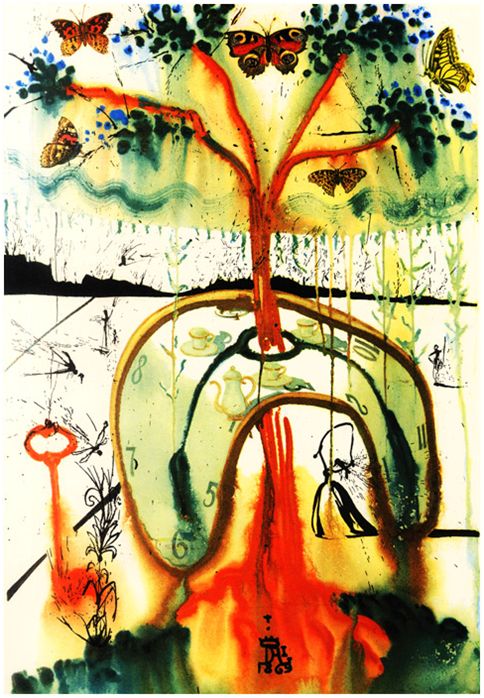
'Mad Tea Party' in  'Alice In Wonderland'
 
Artist:   Salvador Dali

Wednesday, December 18, 2013

Honey, I'll Make Sure You Wear the Same Perfume Today...

Caesar: 
"He hath given his empire
Up to a whore." 
[from William Shakespeare's "Antony and Cleopatra" (III, vi, 66-67)]


courtesy: Facebook page

Wikipedia:

"Soong May-ling made several tours to the United States to lobby support for the Nationalist's war effort. She drew crowds as large as 30,000 people and in 1943 made the cover of TIME magazine for a third time."  


In 2009, I read a book review of  "THE LAST EMPRESS / Madame Chiang Kai-shek and the Birth of Modern China" by Hannah Pakula by Jonathan Mirsky.

What struck me most was this:

"...Christopher Isherwood, traveling in China with W. H. Auden, met Madame Chiang in the late 1930s. He caught her aura exactly: “She could be terrible, she could be gracious, she could be businesslike, she could be ruthless. . . . Strangely enough, I have never heard anybody comment on her perfume. It is the most delicious either of us has ever smelt.”..."

And in September 2013, I saw this beautiful snap of Soong Mei-ling (1897-2003) (aka Madame Chiang Kai-shek) and Generalissimo Chiang Kai-shek (1887-1975) in Frontline dated October 4 2013:


Photo:THE HINDU ARCHIVES 

courtesy: Frontline and The Hindu Archives
 
My caption to this photo would be: 

"Honey, Auden and Isherwood really liked my perfume. Now, I'll make sure you wear the same one today."


The original caption is: 

Taipei: January 3, 1950: Madame Chiang reaches for the legion of merit medal sent to Generalissimo Chiang Kai-shek by U.S. President Franklin Roosevelt.

Saturday, December 14, 2013

As I Prepare to Buy AAP Brand of Tooth-powder in 2014...

Today December 14 2013 is 89th Birth Anniversary of Raj Kapoor (1924 - 1988)


Lao Tzu (6th century BCE):

"...The more laws and restrictions there are,
The poorer people become.
The sharper men's weapons,
The more trouble in the land.
The more ingenious and clever men are,
The more strange things happen.
The more rules and regulations,
The more thieves and robbers..."


Thomas Paine (1737- 1809):

"...Society in every state is a blessing, but government even in its best state is but a necessary evil; in its worse state an intolerable one;..."

Alexander Herzen (1812-1870):

"...There are periods when man is free in a common cause. Then the activity towards which every energetic nature strives, coincides with the aspirations of the society in which he lives. At such times—which are rare enough— everything flings itself into the whirlpool of events, in it finds life, joy, suffering and death..." 

Peter Marshall (1946 - ), "Demanding the Impossible: A History of Anarchism", 1992/ 2008 :

"...Anarchism remains not only an ultimate ideal, but increasingly a practical possibility. If we are to survive nuclear annihilation and ecological disaster, if we can steer between the Scylla of roaring capitalism and the Charybdis of authoritarian socialism, then we may reach the land where a free society of relative abundance exists in harmony with nature, where the claims of the free individual are reconciled with general solidarity. Even if we cannot reach it in our lifetimes, we can at least enjoy the exhilaration of the journey, sailing our ship together towards the beckoning horizon without fettering slaves in the hold or shooting the albatross on the way."

Our father encouraged us to watch all Raj Kapoor films. I liked some and found others boring. But I truly love three of them:

1. Jagte Raho (1956)

2. Shree 420 (1955)

3. Mera Naam Joker (1970)

For me, Amit Maitra and Sombhu Mitra's  'Jagte Raho' is the greatest Indian film ever made.  It remains highly underrated. I keep watching it and discovering new 'angles' I had not seen earlier. 

'Mera Naam Joker' is like a Shakespearean tragedy. But it goes little awry in the last third of the film when Padmini arrives on the scene.

As I watched the aftermath of Delhi assembly elections on TV  in December 2013, I remembered more and more of 'Shree 420'.

Whenever Mr. Arvind Kejriwal spoke I kept thinking about Raj Kapoor's speeches from the film...What innocence...What hope!


courtesy: Shemaroo and legal owner of copyright to the film

First, I remembered the scene where Mr. Kapoor tries to sell his brand of tooth powder and almost gets away with it. I would never get angry with RK for his attempt to con the crowd because I always prefer him to Nemo.


Nemo (on right) and his toothless crony 

 courtesy: Shemaroo and legal owner of copyright to the film

Similarly I have millions of questions for  AAP but I am likely to vote for it next time around - the way I would have voted in favour of Janata party in 1977 had I been eligible to vote then- because I prefer RK's likely anarchy to Nemo's regime.

I hope Mr. Kejriwal also makes the speech like the one RK makes towards the end of the film when he reminds people that you can't build a house for Rs. 100.


courtesy: Shemaroo and legal owner of copyright to the film 

"Delhiites, They all are Shree 420 alright but you have to pay a reasonable price for a unit of electric power and a kg of onions."

No matter what, I know the life of a common man over the ages has always been like that of RK's character in 'Jagte Raho' but with a new hope in my heart,  I am ready to try AAP brand of tooth powder in 2014 because I am just fed up of Nemo and his toothless crony.

Wednesday, December 11, 2013

Dead GA Still Speaks...जी ए म्हणाले आम्हाला, युरिडिसी म्हणाली ऑर्फियसला

Today December 11 2013 is 26th Death Anniversary of G A Kulkarni (जी ए कुलकर्णी)

Paul Koudounaris:
 “Pushed into the footnotes of European religious history, charnels were once part of a dialogue with death that has now fallen silent. For the people who constructed them, however, the dialogue was loud and clear, and the dead were not expected to be mute.”
"Then I saw again all the oppressed who are suffering under the sun, and beheld the tears of the oppressed, and they had no comforter, and with their oppressors there was violence, and they had no comforter; and I esteemed the dead happy who have died long ago, more than the living who are still alive; and happier than both, him who hath not been born." 

(Ecclesiastes 4: 1–2)
Edith Hall. 2005:

"Greek drama is being performed on both the commercial and amateur stages of Britain, as of the world, with greater frequency than at any point since classical antiquity. At times during the 1990s more plays by Euripides or Sophocles were available to the London theatre-goer than works by any other author, including Shakespeare."


 "Orpheus and Eurydice"  Artist: Christian Gottlieb Kratzenstein

"...Several months later, I was sitting in a theater watching Sarah Ruhl’s play Eurydice. After marrying Orpheus, Eurydice dies. In the underworld, there is a chorus of stones that addresses the audience.

Eurydice wants to speak to you.
But she can’t speak your language anymore.
She talks in the language of dead people now.

This was it. Further to the communiqué I had received at my mother’s grave, and to my problem with poetry while mourning.
The play said: elegies are false. They think they can talk to the dead, but dead people speak in the language of the dead, and we can’t."

(Joy Katz, 'Left Behind", November 2013) 

This reminded me of G A Kulkarni's allegory (रूपककथा) stort-story 'Orpheus' (ऑर्फियस)now part of his book 'Pinglavel' (पिंगळा वेळ), 1977.

Here is an example given by GA of how dead people perhaps speak. 

(मृत) युरिडिसी म्हणाली ऑर्फियसला:

"… तू चुकलास.  माहीत असणे निराळे आणि स्वतः हाडामांसात मृत्यू भोगणे निराळे. तू तो भोगला नाहीस; मी तो भोगला आहे …"

(Eurydice to Orpheus:

"...You are wrong. Knowing is one thing and experiencing the death in one's own flesh and bones another. You did not experience it; I have experienced it...") 


Sunday, December 08, 2013

When Nanasaheb Peshwa Dies on January 14 1761...

Today December 8 2013 is 293rd Birth Anniversary of  Nanasaheb Peshwa aka Balaji Baji Rao (नानासाहेब पेशवे / बाळाजी बाजीराव)

John Darwin:  

"Why do the products of Westernized culture (in science, medicine, literature and the arts) still command for the most part the highest prestige?"
 
Prof. Dr. John Darwin is a formidable name among historians. He is a faculty of history at University of Oxford.

Among others, he has written impressive 'The Empire Project: the Rise and Fall of the British World System 1830-1970' (Cambridge, 2009).

 I have already quoted Prof. Darwin on this blog earlier here

For Caravan, July 2013, Srinath Raghavan has reviewed historian Sanjay Subrahmanyam's book. There, Dr. Darwin has been praised as one of the "best historians" of the younger generation, in the league of the likes of  the late Eric Hobsbawm of older generation.
historian Sanjay Subrahmanyam
SRINATH RAGHAVAN
SRINATH RAGHAVAN

In the earlier post, I hailed his two books as 'masterly'. One of the two is 'The Empire Project' and the other is 'After Tamerlane: The Global History of Empire', 2007.


I was thumbing through the latter and,  as is the habit, went to the pages where he writes on Marathas.

"The Maratha confederacy has long been portrayed as a predatory horde that reduced northern India to anarchy. But behind its rise can be seen something more interesting than an alliance of freebooters. The Marathas’ territorial conquests were marked not by scorched earth but by their elaborate revenue system, whose voluminous records are preserved at Poona (modern Pune). Maratha leaders aimed not at general devastation but at the gradual absorption of the Mughal domain into the sphere of their svarajya or ‘sovereignty’. Their object was not so much the absolute overthrow of Mughal power as its enforced devolution: hence the eagerness with which they sought to cloak their rule with the authority of Mughal grants and decrees. The Maratha enterprise, suggests a modern study, is best seen as the struggle of an emerging Hindu gentry, under their sardars or chiefs, to share Mughal sovereignty and revenues in ways that reflected the rising importance of new landholding groups...

...South Asia in the first half of the eighteenth century should not be seen as a region that was drifting from stagnation to anarchy. In the northern interior the triangular conflict between Marathas, Mughals and the transmontane invaders was also a struggle between ‘gentry’ groups, who were striving to build a stable and sedentary order of towns, markets and settled agriculture, and ‘warrior’ groups who were part of the old tradition of nomadic pastoralism on the upland plains connecting northern India and Central Asia."

Although little sobering is this: 'the Maratha confederacy has long been portrayed as a predatory horde that reduced northern India to anarchy'. 

Now, comes a howler from the professor.

"In a further battle at Panipat, in 1761, the Afghans crushed the Maratha army and killed the peshwa, chief minister of the confederacy."

We know that the then peshwa Nanasaheb Peshwa  on that day  was not even on the battlefield and was at least a 1000 km away in Maharashtra, and died a natural death, no doubt accelerated by the defeat,  five months later! On that day in the battlefield,  peshwa's cousin and son were killed.

I felt sad reading this blunder in Dr. Darwin's book. 

Nanasaheb Peshwa- earlier on this blog, I have been critical of him here and praised him here-  was one of the most important personalities of 18th century, not just in the Indian context but that of the South Asia, West Asia and colonizing nations of Europe. One may argue that he was at least as important, if not more, as George II of Great Britain, British monarch from 1727-1760.


When you look up 1761 in Wikipedia, it lists only 16 events for the year. The first one is the third battle of Panipat.  When you look up 1947  in Wikipedia, it lists about 113 events for the year. One of them is independence of India

T S Shejwalkar (त्र्यं शं शेजवलकर) narrates  how “wise-man” and a key adviser to the peshwa, Sakharam-Bapu Bokil (सखाराम बापू  बोकील),  had started making plans,  based on Maratha empire’s existing sway over large parts of South Asia, to reach Iran 

I don't think, since his death,  any other native Marathi speaking personality has influenced 'world affairs' more. (No wonder 18th century Marathas get decent coverage in Darwin's book on global history.) All great  Marathi speaking personalities of 19th, 20th and 21st century India have at best influenced South Asian political/ social affairs.

Nanasaheb remains largely unsung in today's Maharashtra including Pune. I wonder why. 

Is it because he was a Brahmin? Wasn't he a product of his time like most men and women?  

Personally speaking, I have started hating Napoleon Bonaparte (1769-1821) since reading "1812: Napoleon's Fatal March on Moscow", 2004 by Adam Zamoyski but Mr. Bonaparte is recently rated by some to be the second greatest person in the history of mankind, next only to Jesus

Historical personalities are not fairly judged by the yardstick of political correctness of the present.
 
Artist: George Price, The New Yorker, November 1 1941