मेघदूत: "नीचैर्गच्छत्युपरि दशा चक्रनेमिक्रमेण"

समर्थ शिष्या अक्का : "स्वामीच्या कृपाप्रसादे हे सर्व नश्वर आहे असे समजले. पण या नश्वरात तमाशा बहुत आहे."

G C Lichtenberg: “It is as if our languages were confounded: when we want a thought, they bring us a word; when we ask for a word, they give us a dash; and when we expect a dash, there comes a piece of bawdy.”

C. P. Cavafy: "I’d rather look at things than speak about them."

Martin Amis: “Gogol is funny, Tolstoy in his merciless clarity is funny, and Dostoyevsky, funnily enough, is very funny indeed; moreover, the final generation of Russian literature, before it was destroyed by Lenin and Stalin, remained emphatically comic — Bunin, Bely, Bulgakov, Zamyatin. The novel is comic because life is comic (until the inevitable tragedy of the fifth act);...”

सदानंद रेगे: "... पण तुकारामाची गाथा ज्या धुंदीनं आजपर्यंत वाचली जात होती ती धुंदी माझ्याकडे नाहीय. ती मला येऊच शकत नाही याचं कारण स्वभावतःच मी नास्तिक आहे."

".. त्यामुळं आपण त्या दारिद्र्याच्या अनुभवापलीकडे जाऊच शकत नाही. तुम्ही जर अलीकडची सगळी पुस्तके पाहिलीत...तर त्यांच्यामध्ये त्याच्याखेरीज दुसरं काही नाहीच आहे. म्हणजे माणसांच्या नात्यानात्यांतील जी सूक्ष्मता आहे ती क्वचित चितारलेली तुम्हाला दिसेल. कारण हा जो अनुभव आहे... आपले जे अनुभव आहेत ते ढोबळ प्रकारचे आहेत....."

Kenneth Goldsmith: "In 1969 the conceptual artist Douglas Huebler wrote, “The world is full of objects, more or less interesting; I do not wish to add any more.”1 I’ve come to embrace Huebler’s ideas, though it might be retooled as “The world is full of texts, more or less interesting; I do not wish to add any more.” It seems an appropriate response to a new condition in writing today: faced with an unprecedented amount of available text, the problem is not needing to write more of it; instead, we must learn to negotiate the vast quantity that exists. How I make my way through this thicket of information—how I manage it, how I parse it, how I organize and distribute it—is what distinguishes my writing from yours."

Tom Wolfe: "The first line of the doctors’ Hippocratic oath is ‘First, do no harm.’ And I think for the writers it would be: ‘First, entertain.’"

विलास सारंग: "… . . 1000 नंतर ज्या प्रकारची संस्कृती रुढ झाली , त्यामध्ये साधारणत्व विश्वात्मकता हे गुण प्राय: लुप्त झाले...आपली संस्कृती अकाली विश्वात्मक साधारणतेला मुकली आहे."

Tuesday, September 17, 2013

Echoes of Soundarya Lahari...Daniela Jaglenka Terrazzini


Artist: Daniela Jaglenka Terrazzini 


"How Uma Became ParvatiChange is at the heart of many religions and all good stories. 

This illustration depicts the dance through which Uma changes form into the hideous goddess Kalee - developing a third eye and dripping blood. I know that Daniela relished conveying the darkness and raw power of this scene. This illustration clearly shows the influence of Aubrey Beardsley, both in its exploration of female psychology and its striking deployment of line. Thankfully, this terrible transformation is only temporary, as Uma later becomes the beautiful Parvati"

(The Guardian, August 8 2013)

Wikipedia:

"Soundarya Lahari's hundred and three shlokas (verses) eulogize the beauty, grace and munificence of Goddess Parvati / Dakshayani, consort of Shiva."

"निसर्ग-क्षीणस्य स्तनतट-भरेण क्लमजुषो
नमन्मूर्ते र्नारीतिलक शनकै-स्त्रुट्यत इव ।
चिरं ते मध्यस्य त्रुटित तटिनी-तीर-तरुणा
समावस्था-स्थेम्नो भवतु कुशलं शैलतनये ॥ 79 ॥"


source: http://www.vignanam.org/veda/soundarya-lahari-devanagari.html

[("Oh daughter of the mountain,
You who is the greatest among women,
Long live your pretty hips,
Which look fragile,
Which are by nature tiny,
Which are strained by your heavy breasts,
And hence slightly bent,
And which look like the tree,
In the eroded banks of a rushing river."), translation by  P. R. Ramachander
     
http://shankaracharya.org/soundarya_lahari.php]

Friday, September 13, 2013

Michel de Montaigne: a Humble and Inglorious Life; that Does Not Matter

Today September 13 2013 is 421st Death Anniversary of Michel Eyquem de Montaigne

Michel de Montaigne:

"I set forth a humble and inglorious life; that does not matter.  You can tie up all moral philosophy with a common and private life just as well as with a life of richer stuff." 

"When I play with my cat, who knows whether she is not making me her pastime more than I make her mine?"

 
Anthony Gottlieb:
 
"…Bakewell, Frampton and Kent all stress that the distinctive mark of Montaigne is his intellectual humility. Like Socrates, Montaigne claims that what he knows best is the fact that he does not know anything much. To undermine common beliefs and attitudes, Montaigne draws on tales of other times and places, on his own observations and on a barrage of arguments in the ancient Pyrrhonian skeptical tradition, which encouraged the suspension of judgment as a middle way between dogmatic assertion and equally dogmatic denial. Montaigne does often state his considered view, but rarely without suggesting, explicitly or otherwise, that maybe he is wrong. In this regard, his writing is far removed from that of the most popular bloggers and columnists, who are usually sure that they are right. ..”

Michael Dirda:

"Suppose that Earth was invited to join the Intergalactic Congress of Planets, and its chair-being, Zinglos-Atheling, wanted to know more about our strange species. What one person in history would you choose to best represent humanity? On the one hand, Socrates and Jesus are a bit too saintly (or more than saintly) to be wholly representative; on the other, Charlie Sheen and Lindsay Lohan are, as the saying goes, all too human.You could hardly go wrong by picking Michel de Montaigne..."
 
There is no equivalent of  Montaigne in MarathiNot just that, I guess, his essays have still not been translated into Marathi. What a pity!
 
The first essays in Marathi were written only in 19th century. The two essay writers from the period that come immediately to mind are Lokhitwadi (लोकहितवादी) and Vishushastri Chiplunkar (विष्णुशास्त्री चिपळूणकर). 

P G Sahasrabuddhe (पु ग सहस्रबुद्धे) writes about Lokhitwadi's essays:

"...शुद्ध, प्रौढ, पल्लेदार, प्रवाही, ओघवती भाषा हे निबंधांचे मोठे वैभव असते. लोकहितवादींच्या शतपत्रांत त्याची फार उणीव आहे आणि ती पदोपदी भासते. व्याकरणशुद्ध भाषा लिहिण्याचीसुद्धा  ते कसोशी करीत नाहीत…"

("... chaste, mature, strong, flowing language is the big wealth of essays. Lokhitwadi's essays lack it and that is constantly felt. He doesn't even attempt to write grammatically pure language...")

['Lokhitwadinchi Shatpatre' (लोकहितवादींची शतपत्रे), Edited by Dr. Pu G Sahasrabuddhe, 1960/2007]

Hence, Dr.  Sahasrabuddhe says,  Vishunshastri, Tilak (टिळक), Aagarkar (आगरकर), Rajwade (राजवाडे) were better essayists than him.

Marathi Vishwakosh (मराठी विश्वकोश) says Chiplunkar was influenced by Joseph Addison and Lord Macaulay. As we have seen on this blog earlier, Tilak/Agarkar were by J S Mill and Herbert Spencer

For my taste, some of Rajwade's essays are among the best early essays written in Marathi. A few of them still remain very fresh and readable.

However,  I feel none of the gentlemen mentioned above - British or Indian- comes close to the depth, width and literary qualities of Montaigne's work.  

I have chosen two examples from  the Frenchman's output.


Title of XIX essay in "The Essays of Montaigne" is "That To Study Philosophy Is to Learn To Die"

"Cicero says—[Tusc., i. 31.]—"that to study philosophy is nothing but to prepare one's self to die." The reason of which is, because study and contemplation do in some sort withdraw from us our soul, and employ it separately from the body, which is a kind of apprenticeship and a resemblance of death; or, else, because all the wisdom and reasoning in the world do in the end conclude in this point, to teach us not to fear to die..."

Now how to illustrate this?


Artist: Salvador Dali 

Courtesy: Brainpickings.org


(George Orwell writes about Dali's art: "Dead faces, skulls, corpses of animals occur fairly frequently in his pictures..." Montaingen's essay then was a good excuse to draw a skull!)
 
Look at the following picture. Happy couple? Man dealing too lasciviously with the woman?


 Artist: Salvador Dalí

Courtesy: Brainpickings.org

"A man, says Aristotle, must approach his wife with prudence and temperance, lest in dealing too lasciviously with her, the extreme pleasure make her exceed the bounds of reason. What he says upon the account of conscience, the physicians say upon the account of health: "that a pleasure excessively lascivious, voluptuous, and frequent, makes the seed too hot, and hinders conception": 'tis said, elsewhere, that to a languishing intercourse, as this naturally is, to supply it with a due and fruitful heat, a man must do it but seldom and at appreciable intervals: 


"Quo rapiat sitiens Venerem, interiusque recondat."

["But let him thirstily snatch the joys of love and enclose them in  his bosom."—Virg., Georg., iii. 137.]
 
I see no marriages where the conjugal compatibility sooner fails than those that we contract upon the account of beauty and amorous desires; there should be more solid and constant foundation, and they should proceed with greater circumspection; this furious ardour is worth nothing."

(Chapter V——'Upon Some Verses Of Virgil') 

Look again at the picture above. Is the man Dali himself? 

This is what Dali writes in his autobiography- "The Secret Life of Salvador Dalí", 1942- about his first meeting with his future wife, Gala: 

"          I threw back Gala's head, pulling it by the hair, and trembling with complete hysteria, I commanded:
‘Now tell me what you want me to do with you! But tell me slowly, looking me in the eye, with the crudest, the most ferociously erotic words that can make both of us feel the greatest shame!’
Then Gala, transforming the last glimmer of her expression of pleasure into the hard light of her own tyranny, answered:
‘I want you to kill me!’"
 Orwell adds: "He is somewhat disappointed by this demand, since it is merely what he wanted to do already. He contemplates throwing her off the bell-tower of the Cathedral of Toledo, but refrains from doing so."

After reading this, the question that haunts me : "What happened next to the lady in the picture? 

Tuesday, September 10, 2013

Has The Story of All of Us Changed Much?


David Hume (‘Of Liberty and Necessity’ in the first Enquiry):


"...It is universally acknowledged that there is a great uniformity among the actions of men, in all nations and ages, and that human nature remains still the same in its principles and operations. The same motives always produce the same actions: The same events follow from the same causes. Ambition, avarice, self-love, vanity, friendship, generosity, public spirit: these passions, mixed in various degrees, and distributed through society, have been, from the beginning of the world, and still are, the source of all the actions and enterprises, which have ever been observed among mankind. Would you know the sentiments, inclinations, and course of life of the Greeks and Romans? Study well the temper and actions of the French and English: You cannot be much mistaken in transferring to the former most of the observations which you have made with regard to the latter. Mankind are so much the same, in all times and places, that history informs us of nothing new or strange in this particular..."
 

'Mankind: The Story of All of Us',  a popular TV series in US,  was recently shown in India on History channel


I wish I looked this good even in 21st century...

I saw its episode titled "Inventors". Its short description on the website of the channel is as follows:

"On a unique planet, a unique species takes its first steps: Mankind begins. But it s a world full of danger. Threatened by extinction, we innovate to survive–discovering fire and farming; building cities and pyramids; inventing trade–and mastering the art of war. From humble beginnings, we become the dominant creature on the planet. Now the future belongs to us."

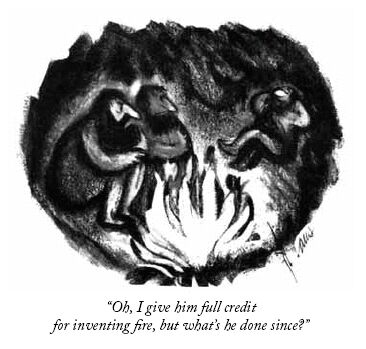
The subject of discovering fire has always fascinated cartoonists.

Here is my pick of them.
  

 Artist : Robert Kraus (1925-2001), The New Yorker, July 1960


The guy who invented the fire , no less, is relaxing and his fellow cavemen are bitching about him- "what's he done since?".

The above is easily one of the best cartoons I have seen. The cartoon is almost of the same age as me. I am so boring and falling apart while the cartoon keeps delighting.

Then making fire was not an easy skill. The guys who mastered it were perhaps hard to find. Just like today's plumbers, electricians, LPG cylinder delivery men etc. People waited for them endlessly, saying encouraging words like : 'we have to stick around' until they came.


  Artist: David Sipress, The New Yorker, June 2013


Saturday, September 07, 2013

Historical Truth and Malfunctioning of Word Processor

Maitri Upanishads:

‘As one acts and conducts himself, so does he become. The doer of good becomes good. The doer of evil becomes evil. One becomes virtuous by virtuous action, bad by bad action’ 

Wendy Doniger:


“India is a country where not only the future but even the past is unpredictable. You could easily use history to argue for almost any position in contemporary India: that Hindus have been vegetarians, and that they have not; that Hindus and Muslims have gotten along well together, and that they have not; that Hindus have objected to suttee, and that they have not; that Hindus have renounced the material world, and that they have embraced it; that Hindus have oppressed women and lower castes, and that they have fought for their equality. Throughout history, right up to the contemporary political scene, the tensions between the various Hinduisms, and the different sorts of Hindus, have simultaneously enhanced the tradition and led to incalculable suffering.”

Dwijendra Narayan Jha:

"...Togadia and others speak of Muslim hostility towards Hindus. But what happened in Karnataka? Lingayats occupied Jain temples. They put their tilak [a Hindu symbol] on Jain statues, appropriated other religious places of worship. In fact, Jains were so much oppressed by the Lingayats that they had to seek protection from the Vijaynagara rulers. In Tamil Nadu, 8,000 Jains were impaled at a Madurai court, as mentioned in a historical text. It is not only Muslims who did it. This has been done by all religions. Similar things happened in Europe also. Churches were damaged by Muslims. Sects within Christianity fought against each other. We always say that Hinduism is the most tolerant. If there is anything like the Hindu, there is a streak of intolerance in all historical texts. Vaishnavas and Saivites have fought all the time..."

(Frontline, December 18 2009) 

Dominique Lapierre and Larry Collins, 'Freedom at Midnight', 1975, page- 378:

"...On both sides of the border a man's sexual organ became, in the truest sense, his staff of life. In India, Sikhs and Hindus prowled the cars of ambushed trains; slaughtering every male they found who was circumcised. In Pakistan Muslims raced along the trains murdering every man who was not. There were periods of four and five days at a stretch during which not a single train reached Lahore or Amritsar without its complement of dead and wounded..."

 
Nicholas Taleb:

"....journalism may be the greatest plague we face today- as the world becomes more and more complicated and our minds are trained for more and more simplification".

Marathi daily Loksatta (लोकसत्ता)  has reviewed 'Buddhist Warfare', 2010  by Michael Jerryson (Editor) , Mark Juergensmeyer (Editor) on September 7 2013. Read it here.

 The summary at the top says:

"बौद्ध धर्म हा शांतताप्रिय आहे, असं सर्वसाधारणपणे मानलं जातं. पण या पुस्तकातले दाखले पाहिले की, या समजाला मोठमोठे तडे जातात. हा धर्मही ख्रिश्चन, इस्लाम या धर्माइतकाच हिंसक आहे, असं वाटायला लागतं..."

"It is generally considered that Buddhism is peace-loving. But if you see the evidences in this book, that understanding cracks. One starts thinking that even this religion is as violent as Christianity and Islam..."

 I chuckled after reading this. Why doesn't the reviewer include Hinduism in that list? 

If he didn't wish to say Hinduism specifically, he could have said: "one starts thinking that even this religion is as violent as other major religions".  ("हा धर्मही इतर प्रमुख धर्मांतकाच हिंसक आहे, असं वाटायला लागतं").

It can't be that the reviewer forgot about the Hinduism while writing this statement. 

Therefore, there are three likely reasons for this omission.

1. You don't know  history. 2. You don't want to say Hinduism  because most readers of the paper are Marathi speaking Hindu's. 3. Your word processor malfunctioned.

Without referring to the violence that took place, in the name of Hinduism, in 20th/21st  century India, here are a couple of reasons why it has something to do with history and not word processor.


"What is perhaps especially valuable about The Buddha and the Sahibs is Allen's gentle reminder of exactly how and why Buddhism died out in the land of its birth. Every child in India knows that when the Muslims first came to India that they desecrated temples and smashed idols. But what is conveniently forgotten is that during the Hindu revival at the end of the first millennium AD, many Hindu rulers had behaved in a similar fashion to the Buddhists.

It was because of this persecution, several centuries before the arrival of Islam, that the philosophy of the Buddha, once a serious rival to Hinduism, virtually disappeared from India: Harsha Deva, a single Kashmiri raja, for example boasted that he had destroyed no less than 4,000 Buddhist shrines. Another raja, Sasanka of Bengal, went to Bodh Gaya, sacked the monastery and cut down the tree of wisdom under which the Buddha had received enlightenment.

According to Buddhist tradition, Sasanka's "body produced sores and his flesh quickly rotted off and after a short while he died". At a time when Islamaphobia is becoming endemic in both India and the west, and when a far-right Hindu government is doing its best to terrorise India's Muslim minority, the story of how an earlier phase of militant Hinduism violently rooted out Indian Buddhism is an important and worrying precedent, and one that needs very badly to be told, and remembered."

(The Guardian,


John Keay:

"...
In the course of perhaps several campaigns, more triumphs were recorded by the Cholas, more treasure was amassed, and more Mahmudian atrocities are imputed. According to a Western Chalukyan inscription, in the Bijapur district the Chola army behaved with exceptional brutality, slaughtering women, children and brahmans and raping girls of decent caste. Manyakheta, the old Rashtrakutan capital, was also plundered and sacked...

 ...The classic expansion of Chola power began anew with the accession of Rajaraja I in 985. Campaigns in the south brought renewed success against the Pandyas and their ‘haughty’ Chera allies in Kerala, both of which kingdoms were now claimed as Chola feudatories. These triumphs were followed, or accompanied, by a successful invasion of Buddhist Sri Lanka in which Anuradhapura, the ancient capital, was sacked and its stupas plundered with a rapacity worthy of the great Mahmud...

...When, therefore, Rajendra I succeeded Rajaraja and assumed the reins of power in 1014, his priority was obvious. Sri Lanka was promptly reinvaded and more treasures and priceless regalia seized; prising open even relic chambers, says a Sri Lankan chronicle, ‘like blood-sucking yakkhas they took all the treasures of Lanka for themselves’..."

('INDIA A HISTORY: From the Earliest Civilisations to the Boom of the Twenty-First Century', 2000/ 2010)


Artist: Saul Steinberg