मेघदूत: "नीचैर्गच्छत्युपरि दशा चक्रनेमिक्रमेण"

समर्थ शिष्या अक्का : "स्वामीच्या कृपाप्रसादे हे सर्व नश्वर आहे असे समजले. पण या नश्वरात तमाशा बहुत आहे."

G C Lichtenberg: “It is as if our languages were confounded: when we want a thought, they bring us a word; when we ask for a word, they give us a dash; and when we expect a dash, there comes a piece of bawdy.”

C. P. Cavafy: "I’d rather look at things than speak about them."

Martin Amis: “Gogol is funny, Tolstoy in his merciless clarity is funny, and Dostoyevsky, funnily enough, is very funny indeed; moreover, the final generation of Russian literature, before it was destroyed by Lenin and Stalin, remained emphatically comic — Bunin, Bely, Bulgakov, Zamyatin. The novel is comic because life is comic (until the inevitable tragedy of the fifth act);...”

सदानंद रेगे: "... पण तुकारामाची गाथा ज्या धुंदीनं आजपर्यंत वाचली जात होती ती धुंदी माझ्याकडे नाहीय. ती मला येऊच शकत नाही याचं कारण स्वभावतःच मी नास्तिक आहे."

".. त्यामुळं आपण त्या दारिद्र्याच्या अनुभवापलीकडे जाऊच शकत नाही. तुम्ही जर अलीकडची सगळी पुस्तके पाहिलीत...तर त्यांच्यामध्ये त्याच्याखेरीज दुसरं काही नाहीच आहे. म्हणजे माणसांच्या नात्यानात्यांतील जी सूक्ष्मता आहे ती क्वचित चितारलेली तुम्हाला दिसेल. कारण हा जो अनुभव आहे... आपले जे अनुभव आहेत ते ढोबळ प्रकारचे आहेत....."

Kenneth Goldsmith: "In 1969 the conceptual artist Douglas Huebler wrote, “The world is full of objects, more or less interesting; I do not wish to add any more.”1 I’ve come to embrace Huebler’s ideas, though it might be retooled as “The world is full of texts, more or less interesting; I do not wish to add any more.” It seems an appropriate response to a new condition in writing today: faced with an unprecedented amount of available text, the problem is not needing to write more of it; instead, we must learn to negotiate the vast quantity that exists. How I make my way through this thicket of information—how I manage it, how I parse it, how I organize and distribute it—is what distinguishes my writing from yours."

Tom Wolfe: "The first line of the doctors’ Hippocratic oath is ‘First, do no harm.’ And I think for the writers it would be: ‘First, entertain.’"

विलास सारंग: "… . . 1000 नंतर ज्या प्रकारची संस्कृती रुढ झाली , त्यामध्ये साधारणत्व विश्वात्मकता हे गुण प्राय: लुप्त झाले...आपली संस्कृती अकाली विश्वात्मक साधारणतेला मुकली आहे."

Tuesday, September 10, 2013

Has The Story of All of Us Changed Much?


David Hume (‘Of Liberty and Necessity’ in the first Enquiry):


"...It is universally acknowledged that there is a great uniformity among the actions of men, in all nations and ages, and that human nature remains still the same in its principles and operations. The same motives always produce the same actions: The same events follow from the same causes. Ambition, avarice, self-love, vanity, friendship, generosity, public spirit: these passions, mixed in various degrees, and distributed through society, have been, from the beginning of the world, and still are, the source of all the actions and enterprises, which have ever been observed among mankind. Would you know the sentiments, inclinations, and course of life of the Greeks and Romans? Study well the temper and actions of the French and English: You cannot be much mistaken in transferring to the former most of the observations which you have made with regard to the latter. Mankind are so much the same, in all times and places, that history informs us of nothing new or strange in this particular..."
 

'Mankind: The Story of All of Us',  a popular TV series in US,  was recently shown in India on History channel


I wish I looked this good even in 21st century...

I saw its episode titled "Inventors". Its short description on the website of the channel is as follows:

"On a unique planet, a unique species takes its first steps: Mankind begins. But it s a world full of danger. Threatened by extinction, we innovate to survive–discovering fire and farming; building cities and pyramids; inventing trade–and mastering the art of war. From humble beginnings, we become the dominant creature on the planet. Now the future belongs to us."

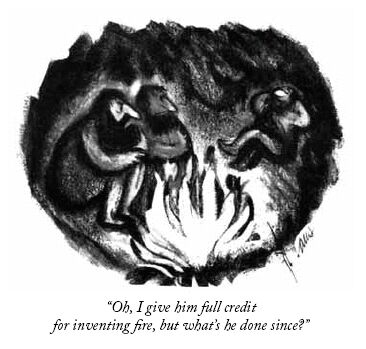
The subject of discovering fire has always fascinated cartoonists.

Here is my pick of them.
  

 Artist : Robert Kraus (1925-2001), The New Yorker, July 1960


The guy who invented the fire , no less, is relaxing and his fellow cavemen are bitching about him- "what's he done since?".

The above is easily one of the best cartoons I have seen. The cartoon is almost of the same age as me. I am so boring and falling apart while the cartoon keeps delighting.

Then making fire was not an easy skill. The guys who mastered it were perhaps hard to find. Just like today's plumbers, electricians, LPG cylinder delivery men etc. People waited for them endlessly, saying encouraging words like : 'we have to stick around' until they came.


  Artist: David Sipress, The New Yorker, June 2013


Saturday, September 07, 2013

Historical Truth and Malfunctioning of Word Processor

Maitri Upanishads:

‘As one acts and conducts himself, so does he become. The doer of good becomes good. The doer of evil becomes evil. One becomes virtuous by virtuous action, bad by bad action’ 

Wendy Doniger:


“India is a country where not only the future but even the past is unpredictable. You could easily use history to argue for almost any position in contemporary India: that Hindus have been vegetarians, and that they have not; that Hindus and Muslims have gotten along well together, and that they have not; that Hindus have objected to suttee, and that they have not; that Hindus have renounced the material world, and that they have embraced it; that Hindus have oppressed women and lower castes, and that they have fought for their equality. Throughout history, right up to the contemporary political scene, the tensions between the various Hinduisms, and the different sorts of Hindus, have simultaneously enhanced the tradition and led to incalculable suffering.”

Dwijendra Narayan Jha:

"...Togadia and others speak of Muslim hostility towards Hindus. But what happened in Karnataka? Lingayats occupied Jain temples. They put their tilak [a Hindu symbol] on Jain statues, appropriated other religious places of worship. In fact, Jains were so much oppressed by the Lingayats that they had to seek protection from the Vijaynagara rulers. In Tamil Nadu, 8,000 Jains were impaled at a Madurai court, as mentioned in a historical text. It is not only Muslims who did it. This has been done by all religions. Similar things happened in Europe also. Churches were damaged by Muslims. Sects within Christianity fought against each other. We always say that Hinduism is the most tolerant. If there is anything like the Hindu, there is a streak of intolerance in all historical texts. Vaishnavas and Saivites have fought all the time..."

(Frontline, December 18 2009) 

Dominique Lapierre and Larry Collins, 'Freedom at Midnight', 1975, page- 378:

"...On both sides of the border a man's sexual organ became, in the truest sense, his staff of life. In India, Sikhs and Hindus prowled the cars of ambushed trains; slaughtering every male they found who was circumcised. In Pakistan Muslims raced along the trains murdering every man who was not. There were periods of four and five days at a stretch during which not a single train reached Lahore or Amritsar without its complement of dead and wounded..."

 
Nicholas Taleb:

"....journalism may be the greatest plague we face today- as the world becomes more and more complicated and our minds are trained for more and more simplification".

Marathi daily Loksatta (लोकसत्ता)  has reviewed 'Buddhist Warfare', 2010  by Michael Jerryson (Editor) , Mark Juergensmeyer (Editor) on September 7 2013. Read it here.

 The summary at the top says:

"बौद्ध धर्म हा शांतताप्रिय आहे, असं सर्वसाधारणपणे मानलं जातं. पण या पुस्तकातले दाखले पाहिले की, या समजाला मोठमोठे तडे जातात. हा धर्मही ख्रिश्चन, इस्लाम या धर्माइतकाच हिंसक आहे, असं वाटायला लागतं..."

"It is generally considered that Buddhism is peace-loving. But if you see the evidences in this book, that understanding cracks. One starts thinking that even this religion is as violent as Christianity and Islam..."

 I chuckled after reading this. Why doesn't the reviewer include Hinduism in that list? 

If he didn't wish to say Hinduism specifically, he could have said: "one starts thinking that even this religion is as violent as other major religions".  ("हा धर्मही इतर प्रमुख धर्मांतकाच हिंसक आहे, असं वाटायला लागतं").

It can't be that the reviewer forgot about the Hinduism while writing this statement. 

Therefore, there are three likely reasons for this omission.

1. You don't know  history. 2. You don't want to say Hinduism  because most readers of the paper are Marathi speaking Hindu's. 3. Your word processor malfunctioned.

Without referring to the violence that took place, in the name of Hinduism, in 20th/21st  century India, here are a couple of reasons why it has something to do with history and not word processor.


"What is perhaps especially valuable about The Buddha and the Sahibs is Allen's gentle reminder of exactly how and why Buddhism died out in the land of its birth. Every child in India knows that when the Muslims first came to India that they desecrated temples and smashed idols. But what is conveniently forgotten is that during the Hindu revival at the end of the first millennium AD, many Hindu rulers had behaved in a similar fashion to the Buddhists.

It was because of this persecution, several centuries before the arrival of Islam, that the philosophy of the Buddha, once a serious rival to Hinduism, virtually disappeared from India: Harsha Deva, a single Kashmiri raja, for example boasted that he had destroyed no less than 4,000 Buddhist shrines. Another raja, Sasanka of Bengal, went to Bodh Gaya, sacked the monastery and cut down the tree of wisdom under which the Buddha had received enlightenment.

According to Buddhist tradition, Sasanka's "body produced sores and his flesh quickly rotted off and after a short while he died". At a time when Islamaphobia is becoming endemic in both India and the west, and when a far-right Hindu government is doing its best to terrorise India's Muslim minority, the story of how an earlier phase of militant Hinduism violently rooted out Indian Buddhism is an important and worrying precedent, and one that needs very badly to be told, and remembered."

(The Guardian,


John Keay:

"...
In the course of perhaps several campaigns, more triumphs were recorded by the Cholas, more treasure was amassed, and more Mahmudian atrocities are imputed. According to a Western Chalukyan inscription, in the Bijapur district the Chola army behaved with exceptional brutality, slaughtering women, children and brahmans and raping girls of decent caste. Manyakheta, the old Rashtrakutan capital, was also plundered and sacked...

 ...The classic expansion of Chola power began anew with the accession of Rajaraja I in 985. Campaigns in the south brought renewed success against the Pandyas and their ‘haughty’ Chera allies in Kerala, both of which kingdoms were now claimed as Chola feudatories. These triumphs were followed, or accompanied, by a successful invasion of Buddhist Sri Lanka in which Anuradhapura, the ancient capital, was sacked and its stupas plundered with a rapacity worthy of the great Mahmud...

...When, therefore, Rajendra I succeeded Rajaraja and assumed the reins of power in 1014, his priority was obvious. Sri Lanka was promptly reinvaded and more treasures and priceless regalia seized; prising open even relic chambers, says a Sri Lankan chronicle, ‘like blood-sucking yakkhas they took all the treasures of Lanka for themselves’..."

('INDIA A HISTORY: From the Earliest Civilisations to the Boom of the Twenty-First Century', 2000/ 2010)


Artist: Saul Steinberg

Friday, September 06, 2013

Attired Man Though Has Lost the Trust...आवृत माणसाने मात्र कसा गमावला भरवसा


G.C. Lichtenberg:


"It is a good thing Heaven has not given us the power to alter our bodies as much as we would like to and as much as our theories might happen to require. One man would cover himself with eyes, another with sexual organs, a third with ears, etc."

Desmond Morris:

"There are one hundred and ninety-three living species of monkeys and apes. One hundred and
ninety-two of them are covered with hair. The exception is a naked ape self-named Homo sapiens."


If I get to quote one Marathi poem as a tribute to John Gray's book "Straw Dogs: Thoughts on Humans and Other Animals", 2003,  it would be this:

म. म. देशपांडे - 'भरवसा':

"नंगधडंग खार
नाही विचार
की कुणी पाहतो
चाहतो
हा कावळाही तसाच
कमरेला वस्त्र नाही
बेटय़ाच्या
अनावृत इथे सारे
पशु, पक्षी, वृक्ष, वारे
आवृत माणसाने
मात्र कसा
गमावला भरवसा"

(quoted in Loksatta here.)

The poem ends with these words :

"bare everything here
animals, birds, trees, winds
attired man
though has 
lost the trust."

p.s.

Avadhoot Dongre (अवधूत डोंगरे) informed on July 2 2013:

"...देशपांड्यांचा उल्लेख 'रेघे'वर मागे एकदा आलेला आहे. दिलीप चित्र्यांच्या 'साहित्य आणि अस्तित्त्वभान - ' ह्या शब्दालय प्रकाशनाने प्रकाशित केलेल्या खंडातही या देशपांड्यांच्या एका कवितेबद्दलचं म्हणणं आहे. आणि बहुतेक देशपांड्यांच्या कवितांचं एक पुस्तक पद्मगंधा प्रकाशनाने काढलंय. ही माहिती कदाचित तुम्हाला आधीपासून असेल. पण तुम्ही त्याबद्दल उत्सुकता दाखवलेली दिसली म्हणून..."

Monday, September 02, 2013

The Decent Whore Index and Worth of INR

"Today" in this post means  at the end of  August 2013

Christopher Ryan and Cacilda Jethá in "Sex At Dawn", 2010:

"(Charles) Darwin says your mother’s a whore. Simple as that. Lest you think we’re being flip, we assure you that the bartering of female fertility and fidelity in exchange for goods and services is one of the foundational premises of evolutionary psychology."

P D Smith:

"The voices of ordinary people have been elided from the histories left to us by the Romans. But in this wonderfully vivid book ('Invisible Romans'), Robert Knapp uses the evidence of tombstones, literature, graffiti, letters and proverbs to put ordinary men and women – prostitutes, housewives, slaves and gladiators – at the heart of Roman history..."

The Economist, "Sex doesn't sell", May 25 2013.

"TIMES are tough for Debbie, a prostitute in western England who runs a private flat with other “mature ladies”. She does two or three jobs a day. A year ago she was doing eight or nine. She has cut her prices: “If I hadn’t, I wouldn’t still be open.” She says that she can now make more money doing up furniture and attending car-boot sales than she can turning tricks...

...The days of being able to make a full-time living out of prostitution are long gone, reckons Vivienne, at least in larger towns and cities. “It’s stupidly competitive right now,” she laments. More people are entering prostitution, agrees Cari Mitchell of the English Collective of Prostitutes. Some working women in Westminster say they have halved their prices because the market has become so saturated. In London, and increasingly elsewhere, immigrants provide strong competition... "

Alfred Hitchcock:

"You know why I favor sophisticated blondes in my films? We're after the drawing-room type, the real ladies, who become whores once they're in the bedroom."


William Shakespeare:"He hath given his empire /Up to a whore." --Caesar from "Antony and Cleopatra" (III, vi, 66-67)


Artist:  Unknown to me

Ziauddin Barani (1285–1357) was a  historian and political thinker who lived in Delhi Sultanate.


Historian John Keay writes with the help of his writings about the efforts of  ruler Ala-ud-din Khilji (reign 1290-1316)  to control prices: 

 "...The success of this price-fixing policy resulted in its extension to just about every other commodity known to the Delhi bazaars. Textiles, groceries, slaves, whores, cattle, in fact everything ‘from caps to shoes and from combs to needles’ had its fixed price and its market regulators. It was not just one of the first recorded examples of planned economic management but also one of the most ambitious. And therein partly lay its undoing..."   


('India / A History: From the Earliest Civilisations to the Boom of the Twenty-First Century' , 2000/2010)  
 

Even whores had their prices fixed and also had a market regulator in 13th century India! (Remember what happened to India's National Spot Exchange Ltd in August 2013?)
 
The Big Mac index was invented by The Economist in 1986 as a lighthearted guide to whether currencies are at their “correct” level.

In July 2013, when INR was quoting at 59.98 to 1 US$, the index showed that Indian currency was undervalued by 67.1%.

"(The Big Mac Index) is based on the theory of purchasing-power parity (PPP), the notion that in the long run exchange rates should move towards the rate that would equalise the prices of an identical basket of goods and services (in this case, a burger) in any two countries. For example, the average price of a Big Mac in America in July 2013 was $4.56; in China it was only $2.61 at market exchange rates. So the "raw" Big Mac index says that the yuan was undervalued by 43% at that time."

Can we use any other  "basket of goods and services" instead of a Big Mac?

I have almost finished reading a biography of one of my favourite actors (and also one of the most learned Hindi film stars of all time) Meena Kumari by Vinod Mehta. The book has been reissued in 2013 after its first and only edition in 1972. I consider the late actor quite sexy. Her emoting including all that weeping adding to her seductive charm. 

I have always liked Mr. Mehta's writing style since his  (now defunct) "Sunday Observer" days. Therefore, although, these days, I seldom read his  'Outlook' or see his numerous appearances on TV, I bought the book.

The book is largely about Meena Kumari as a person, her relationships and hardly about the art of cinema. I would have also liked to read about her two films I really liked- Azaad 1955 and Kohinoor. 1960. She sparkles in them.

This is what Mehta writes on page 15-16 of the book:

"(in 1932, when Meena Kumari was born)...You could get nicely drunk for 84 paise (a bottle of beer costing 28), buy a kilo of sugar for 3 paise, smoke a packet of Gold Flake cigarette for 10 paise, get a woolen suit for Rs. 3, find a decent whore for Rs. 4. This then was the scenario..."

[Reminiscent of Saadat Hasan Manto, Khushwant Singh and Bhau Padhye (भाऊ पाध्ये). Particularly towards the end of the quote.]

I wondered if those prices in rupee, more than 80 years ago,  tell us anything about the value of INR in 2013. So I did some math. 


Price of gold at the beginning of year 1932 was US$ 20.67 (£ 5.90 in London market)  per fine ounce. Today, it is around  US$ 1,395.80.  The gold is up almost 70 times. By that logic, the 4 rupee 'decent' whore must be now worth only Rs. 270.

Now, I have not been to a whore yet but I am sure you don't get a 'decent' one at Rs. 270 in Mumbai today.

Wikipedia informs: "The Indian Rupee was pegged to the British Sterling (Pound) from 1926 to 1966 at INR 13.33 to 1 BSP."

Using that route,  INR 4 in 1932 was equal to 0.3 BSP. In 1932, those pounds could buy 0.05086 (0.3 divided by 5.90) fine ounce of gold  which is today worth US$ 1395.80. At today's exchange rate of 1 USD to 65.7050 INR, it is Rs. 4,664.

Can one buy a decent  whore at that price in Mumbai today?

I could have done the same math for beer, sugar or Gold Flake but I chose whore instead because, as Robert Knapp says in one of the quotes at the beginning, they are at the heart of any history.


 "Uthti hai har nigaah kharidaar ki tarah"

 Rehana Sultan singing  Madan Mohan's deeply moving composition and words of Majrooh Sultanpuri in Rajinder Singh Bedi's 'Dastak', 1970

courtesy: indus and/or current copyright holder of the film

Saturday, August 31, 2013

Dahi Handi...Lament For an Unknown Govinda

Adrian Shubert, 'Death and Money in the Afternoon', 1999:

"The bullfight was the clearest symptom of what (José Ortega y Gasset) Ortega saw as the prime pathology of Spanish history from the eighteenth century on: “For the first time Spain sealed itself off hermetically from the rest of the world, even from its own hispanic world. I call this the tibetanization of Spain.” Ortega’s contention that the bullfight embodied Spain’s rejection of the modern world, and especially its rejection of the Enlightenment, has remained alive and influential."

"Before and beyond all else, the bullfight was a business. Its purpose, from its inception, was to make money: for private institutions and public purposes as well as for the growing myriad of individuals for whom it was a source of income, sometimes the sole source of income."

 Orson Welles:

"Well, there are two kinds of people who follow the bulls, as they say in Spanish. There are those people who follow because they love the bullfighters, and there is a very small minority who are interested in the bulls, and I was always most interested in the bulls."
Marathi news TV channels showed almost nonstop coverage of Dahi Handi festival in Mumbai, Thane, Pune  on most of afternoon/evening hours of August 29th 2013. 

Going against the grain, in a wonderful example of incisive reporting,  Loksatta (लोकसत्ता), a Marathi (मराठी) daily, on  August 30 2013:

"असंवेदनांचा उत्सव: डीजेचा ढणढणाट, राजकारण्यांची चमकोगिरी आणि मादक नाचगाण्याच्या धुंदीत हरवत चाललेल्या या सणामुळे सामान्यांच्या कानाबरोबरच जणू मनेही बधिर झाली आहेत. घरात साधे खेळताना पडणाऱ्या मुलाला पाहिले की काळजात चर्र होते. पण गोविंदा पथकांच्या सर्वात वरच्या थरावर पाच-सात वर्षांची चिमुरडी मुले सलामी देत होती. मनोरा पडल्यानंतर खाली कोसळणाऱ्या या कोवळ्या शरीरांशी जणू कुणालाच काही देणेघेणे नव्हते. माणुसकीला पायदळी तुडवत दहीहंडीचा उत्सव साजरा होत होता. कुणाचा हातपाय मोडला तर बाजूलाच उभ्या असलेल्या रुग्णवाहिकेत टाकून रुग्णालयात रवानगी व्हायची. या जखमी गोविंदांचे जणू कुणालाच सोयरसुतक नव्हते. असंवेदनांचाच उत्सव जागोजागी पाहायला मिळत होता..."

("Festival of insensitivities:  Along with ears, it's like minds of common people have become numb because of fading of the festival in blaring music of DJ, glittering of politicos and inebriation that comes with sensuous singing and dancing  It's heartbreaking to see a kid slipping while playing even at home. But the top layers of Govinda-teams  that were making human pyramids were made up of five-seven year old kids. When the pyramid collapsed,  it was as if no one was concerned about those tender bodies. Dahi-handi festival was being celebrated by crushing humanity. If anyone broke his hand or leg, he was being dispatched to the hospital in an ambulance standing by. No one as if was concerned about those injured Govinda's. The festival of insensitivities could be seen in a number of places...")

This reminded me of another 'festival' of insensitivities: Bullfighting, a traditional spectacle of Spain and  a few other nations.

Is it just a  coincidence that Spanish castellers participate in Dahi Handi festivals?

Spiegel Online interviewed Spanish Matador Juan José Padilla on April 12 2012. Read it here.

Here I reproduce a small part of the interview:

"...Padilla: You don't understand the full picture. We toreros have a different view of things. The bull doesn't suffer because he's in a state of complete abandon. And that state gives rise to beauty.

SPIEGEL: You and your assistants spend about 20 minutes exhausting the bull to the point of apathy. The mounted picador mauls him with his lance, the loss of blood weakens the animal, and the muscles in his neck are so mutilated that he can hardly lift his head anymore. During the deathblow, the sword penetrates between the shoulder blades, going past the spine and into the intestines. But the blade is often deflected by a bone, and the matador has to try again. The stab wound usually doesn't kill the bull outright, which is why the assistants goad him on to move his head back and forth and to keep moving until he falls to the ground. Only then is he deliberately killed with a thrust of the sword to the neck. How is this abandon? And where's the beauty in it?

Padilla: I won't answer that question. I'm not sitting here to begin an argument with opponents of bullfighting. I won't waste any time addressing the arguments of bullfighting opponents..."

 Artist: Garrett Price, The New Yorker, October 26 1940

"I don't think you'll find falling of the kids to their death in the program, dear."

Below I reproduce first part of great Federico García Lorca's poem Lament For Ignacio Sanchez Mejias”,  translated from Spanish into English (Mr. Mejías, friend of the poet was killed in a bullfight):

"1. Cogida and death

At five in the afternoon.
It was exactly five in the afternoon.
A boy brought the white sheet
at five in the afternoon.
A trail of lime ready prepared
at five in the afternoon.
The rest was death, and death alone.

The wind carried away the cottonwool
at five in the afternoon.
And the oxide scattered crystal and nickel
at five in the afternoon.
Now the dove and the leopard wrestle
at five in the afternoon.
And a thigh with a desolated horn
at five in the afternoon.
The bass-string struck up
at five in the afternoon.
Arsenic bells and smoke
at five in the afternoon.
Groups of silence in the corners
at five in the afternoon.
And the bull alone with a high heart!
At five in the afternoon.
When the sweat of snow was coming
at five in the afternoon,
when the bull ring was covered with iodine
at five in the afternoon.
Death laid eggs in the wound
at five in the afternoon.
At five in the afternoon.
At five o'clock in the afternoon.

A coffin on wheels is his bed
at five in the afternoon.
Bones and flutes resound in his ears
at five in the afternoon.
Now the bull was bellowing through his forehead
at five in the afternoon.
The room was iridescent with agony
at five in the afternoon.
In the distance the gangrene now comes
at five in the afternoon.
Horn of the lily through green groins
at five in the afternoon.
The wounds were burning like suns
at five in the afternoon.
At five in the afternoon.
Ah, that fatal five in the afternoon!
It was five by all the clocks!
It was five in the shade of the afternoon!
...

...

..."