मेघदूत: "नीचैर्गच्छत्युपरि दशा चक्रनेमिक्रमेण"

समर्थ शिष्या अक्का : "स्वामीच्या कृपाप्रसादे हे सर्व नश्वर आहे असे समजले. पण या नश्वरात तमाशा बहुत आहे."

G C Lichtenberg: “It is as if our languages were confounded: when we want a thought, they bring us a word; when we ask for a word, they give us a dash; and when we expect a dash, there comes a piece of bawdy.”

C. P. Cavafy: "I’d rather look at things than speak about them."

Martin Amis: “Gogol is funny, Tolstoy in his merciless clarity is funny, and Dostoyevsky, funnily enough, is very funny indeed; moreover, the final generation of Russian literature, before it was destroyed by Lenin and Stalin, remained emphatically comic — Bunin, Bely, Bulgakov, Zamyatin. The novel is comic because life is comic (until the inevitable tragedy of the fifth act);...”

सदानंद रेगे: "... पण तुकारामाची गाथा ज्या धुंदीनं आजपर्यंत वाचली जात होती ती धुंदी माझ्याकडे नाहीय. ती मला येऊच शकत नाही याचं कारण स्वभावतःच मी नास्तिक आहे."

".. त्यामुळं आपण त्या दारिद्र्याच्या अनुभवापलीकडे जाऊच शकत नाही. तुम्ही जर अलीकडची सगळी पुस्तके पाहिलीत...तर त्यांच्यामध्ये त्याच्याखेरीज दुसरं काही नाहीच आहे. म्हणजे माणसांच्या नात्यानात्यांतील जी सूक्ष्मता आहे ती क्वचित चितारलेली तुम्हाला दिसेल. कारण हा जो अनुभव आहे... आपले जे अनुभव आहेत ते ढोबळ प्रकारचे आहेत....."

Kenneth Goldsmith: "In 1969 the conceptual artist Douglas Huebler wrote, “The world is full of objects, more or less interesting; I do not wish to add any more.”1 I’ve come to embrace Huebler’s ideas, though it might be retooled as “The world is full of texts, more or less interesting; I do not wish to add any more.” It seems an appropriate response to a new condition in writing today: faced with an unprecedented amount of available text, the problem is not needing to write more of it; instead, we must learn to negotiate the vast quantity that exists. How I make my way through this thicket of information—how I manage it, how I parse it, how I organize and distribute it—is what distinguishes my writing from yours."

Tom Wolfe: "The first line of the doctors’ Hippocratic oath is ‘First, do no harm.’ And I think for the writers it would be: ‘First, entertain.’"

विलास सारंग: "… . . 1000 नंतर ज्या प्रकारची संस्कृती रुढ झाली , त्यामध्ये साधारणत्व विश्वात्मकता हे गुण प्राय: लुप्त झाले...आपली संस्कृती अकाली विश्वात्मक साधारणतेला मुकली आहे."

Monday, December 12, 2011

Did Mario de Miranda ever get to sit in the Bulb?

Whenever I got a chance, I read "The Illustrated Weekly of India" in 1970's as a schoolboy. My father either got them from where he worked or from 'raddi' (रद्दी) at M/s Chougule grocery store at Miraj (मिरज).

I still remember its coverage of India's victorious cricket tour of England in 1971. Raju Bharatan wrote the story that had some luscious pictures of England's green-top wickets where English fast bowler John Price knocked out stumps of a couple of India's batsmen and Eknath Solkar (एकनाथ सोलकर) took some breathtaking catches at forward shortleg.

I knew Khushwant Singh was TIWI's editor in 1970's but I never read his column then. However, I always stopped by and gazed at Mario's illustration on the "Editor's Page"...a pile of books, a bottle of scotch, and a girlie magazine...It was so funny and yet intriguing...

I never sought them but I kept coming across Mr. Mario's pictures. When they were big and complex, I read them like a matrix- first by rows -left to right and then by columns- top to bottom. I didn't want to miss out any detail. It was like reading the frontpage of a newspaper.

I never considered him a great cartoonist like Vasant Sarwate (वसंत सरवटे), Abu Abraham and R K Laxman- his contemporaries- but he never failed to make me smile.

Sunday, December 11, 2011

English 'Ralph Darnell' is NOT scarce. Marathi 'Plaseecha Ranasangram' of D B Mokashi is!

Curtis White:

"We know that the major players are positioning themselves for a very uncertain future, but there are really only two major players, Amazon and Google. Everyone else is trying to figure out the best way to go bankrupt or to become something else, not publishers, God knows, but “content providers” for whatever word vessels the future will offer. From their point of view, the book was just a “platform” that had its day but it’s done now, and so what?" (October 21 2011)

Mike Dash:

"For me, it’s the history that exists beyond the margins and the textbooks and what we normally consider to be history"

(FiveBooks Interviews, December 7 2011)

Once in six months or so I visit 'Varada Prakashan' (वरदा प्रकाशन) in Pune to buy books.

Last time I was there, in August 2011, one of the books I bought was:

"Plaseecha Ranasangram" Author: Colonel Meadows Taylor, Narrator Di Ba Mokashi, August 1974 ("प्लासीचा रणसंग्राम", लेखक: कर्नल मेडोज टेलर, निवेदक: दि बा मोकाशी)

The book is based on 'Ralph Darnell' by Meadows Taylor, 1865.

Mr. Taylor became very famous for his book 'Confessions of a Thug', 1839. The book became a best seller in 19th century Britain. (More on it at the end of this post.)

That book was translated into Marathi as 'Thagachee Jabanee' (ठगाची जबानी ) by Prof Va Shi Apte (वा शि आपटे ). It made waves even in Marathi, running into two editions. Mokashi mentions in his preface how he as a kid enjoyed reading it.

I did not know who Colonel Meadows Taylor was but I have always liked whatever DBM has written. 'Plaseecha Ranasangram' was no exception.

Among other things, the book informs us the extent to which the British empire was built on deception in this country...Robert Clive constantly reminding me of Tony Blair.

On the back cover of Marathi book, publisher says:

"...मूळ कादंबरी 'राल्फ डार्नेल' अत्यंत दुर्मिळ आहे ..."

(...The original book 'Ralph Darnell' is very scarce...)

Not really.

Thanks to the internet- Google Books, Archive.org- 'Ralph Darnell' is not scarce any more. But what is scarce is Mokashi's Marathi book!

I wonder whether Varada Prakashan will reprint it once the current print of 1995 is sold out.

I was looking for six volumes of Rajaram shastri Bhagwat's (राजरामशास्त्री भागवत) literature edited by Durga Bhagwat (दुर्गा भागवत) published by Varada. Mr. Bhave told me how it took decades for them to sell out the last edition of R Bhagwat's literature and that it was very unlikely that he would publish them again.

The late D B Mokashi is one of the best Marathi writers of 20th century and many of his books are not available in bookshops and almost none of them is availabe in softcopy format.

I have already argued here that Marathi and the other Indian languages need Google books far more than the English and others.

My conviction is now even stronger.

from : Confessions of a Thug

p.s.

Mike Dash, the author of 'Thug' 2005, quoted at the top of this post, says this about 'Confessions of a Thug' by Meadows Taylor:

"...These early accounts influenced the way in which Thuggee was perceived, both in India and elsewhere. They were expanded on in a hugely successful contemporary novel entitled Confessions of a Thug written by Meadows Taylor, a British officer based in Hyderabad. Taylor turned his own experiences of the anti-Thug campaign into what was widely acclaimed as the greatest ‘chiller’ of its day, and his protagonist (a murderer named Ameer Ali, whose ‘confession’ was based on the deposition of a real Thug) was more ruthless, more successful and more free from the pangs of conscience than even the killers whose confessions had peppered the first historical accounts. Ali’s ‘guiltless confessions of multiple murder’ were – a reviewer in the Literary Gazette declared – ‘enough to freeze the blood in our veins’, and Taylor himself was flattered to hear that the young Queen Victoria herself was so impatient to read his final chapters that she could not wait for the pages to be bound, asking that the running sheets to be sent directly to her as they came off the press..."

Tuesday, December 06, 2011

Dev Anand mightn't Agree but there is More Sunshine in the Fall of a Leaf

George Orwell:

"Like every other writer, Shakespeare will be forgotten sooner or later..."

('Lear, Tolstoy and the Fool', 1947)

Dev Anand in 1999:

"When Pakistan was formed, we laughed at that time — Lahore and Bombay are one, how can this be — but it happened.

So who knows, as long as there are humans in this world, miracles are possible.”

Mohan Churiwala, Mr. Anand's closest associate:

"He hugged Nanda and wept inconsolably

After a special screening of Hum Dono (Rangeen), Nanda, a recluse, went to meet him at his office.When the door opened, she looked at him said “Devsaab, pehchana?” Devsaab came towards her, hugged her and started weeping. Nanda left in a few minutes and asked me outside, “Why did he get so emotional?” Later, she told me that they were meeting each other after 48 years, after 1963. Tears kept flowing down his cheeks even after Nanda had left." (The Times of India, December 18 2011)


A. O. SCOTT wrote on November 18 2011 in The New York Times:

"...But there is also something about cinema’s essentially modern character that makes it vulnerable to fears of obsolescence. The camera has an uncanny ability to capture the world as it is, to seize events as they happen, and also to conjure visions of the future. But by the time the image reaches the eyes of the viewer, it belongs to the past, taking on the status of something retrieved. As for those bold projections of what is to come, they have a habit of looking quaint as soon as they arrive.
Nostalgia, in other words, is built into moviegoing, which is why moviegoing itself has been, almost from the beginning, the object of nostalgia..."

If so I wonder why Mr. Dev Anand never liked to talk about past or even remember it. After all his art is deeply rooted in nostalgia!

I have really enjoyed and still enjoy watching some of his films:

Tere Mere Sapne (1971), Johny Mera Naam (1970), Jewel Thief (1967), Guide (1965), Tere Ghar Ke Samne (1963), Hum Dono (1961), Bombai Ka Baboo (1960), Kala Bazar (1960), Kalapani (1958), Nau Do Gyarah (1956), Paying Guest (1956), C.I.D. (1956), Taxi Driver (1954) and above all Baazi (1951). (Think of it, 'just' 14 films.)

Like ‘Godfather’ or ‘Casablanca’ or 'Jagte Raho', I can watch a part of 'Baazi' every day.

Seldom in the history of Hindi films more talent came together to make a film than this Navketan venture:

Directed by Guru Dutt
Produced by Dev Anand
Written by Balraj Sahni (screenplay, story, dialogue)
Lyrics by Sahir Ludhianvi
Starring Dev Anand, Geeta Bali
Music by S. D. Burman
Sung by Geeta Dutt

Bhaichand Patel writes in The Asian Age, Dec 4 2011:

"...Balraj Sahni, a classmate of Chetan in Lahore, was roped in to write the script, plagiarised from the Hollywood film Gilda, starring Rita Hayworth and Glenn Ford. Geeta Bali was to play one of the two lead female roles. The other went to someone fresh out of college, Kalpana Kartik (real name Mona Singha) who was related to Chetan’s wife. She later became Mrs Dev Anand. One of Baazi’s strongest attractions was its catchy music composed by S.D. Burman and sung beautifully by Geeta Roy, soon to become Mrs Guru Dutt. Neither of these two marriages worked, but let us not go into that!
Baazi’s story centres on a seedy gambling club and one of its patrons, played by Dev Anand. It was a dark film made in the film noir style borrowed largely from Warner Brothers’ productions starring, most times, Humphrey Bogart. This short-lived trend in our cinema had begun earlier with Gyan Mukherjee’s Sangram, with Ashok Kumar playing a gangster, and continued with films like Jaal, Aar Paar and CID..."

But for me his finest performance was on TV- his interview on “Rendezvous with Simi Garewal”. I was deeply moved the way he described his relationship with his mother and the hurt caused by her death before he came to Bombay. I thought in a way he never got over his loss. He still missed his mother and he probably never found the real love.

The last Dev Anand starred or directed film I watched was Des Pardes (1978). So for me, even before his death, he had been a memory for almost 33 years.

I don't know what Mr. Anand thought of immortality. But about him, there was a lot of talk about positive thinking, living in the present, fitness regime, frugal eating, company of young people, health checkups in London, working in one's 80's etc.

Considering all this, he would be disappointed with number 88.

I guess he would also agree with Woody Allen's views expressed in : "I don't want to achieve immortality through my work. I want to achieve immortality through not dying." or "Rather than live on in the hearts and minds of my fellow man, I’d prefer to live on in my apartment.”

In Mr. Anand's case: "in my Bandra penthouse".

For immortality, American futurist Ray Kurzweil proposes not resurrecting the body but instead shedding it altogether and uploading minds into cyberspace. Had the technology been available, I wonder Mr. Anand would have signed up for the program?

I also wonder what he would have thought of John Gray's views on such efforts:

"Freezing our bodies or uploading our minds into a supercomputer will not deliver us from ourselves. Wars and revolutions will disturb our frozen remains, while death will stalk us in cyberspace – also a realm of mortal conflict. Science enlarges what humans can do. It cannot reprieve them from being what they are."

I would like to remember Mr. Anand as a guy who portrayed many enjoyable moments of what we are.

Following cartoon of Sudhir Tailang has appeared in The Asian Age on Dec 5 2011.

I like Mr. Tailang's imagination but I just hope Mr. Anand is making a film from 1950's or 1960's or 1970's. It will be that much better if he gets his younger brother Vijay / Goldie to direct it and he goes in front of the camera. If not, it will be a film made in heaven to be shown in hell as a punishment!

Sunday, December 04, 2011

Where did Primal Couple of Paradise go to Stool?

I read Nicholas Lezard's review of "A Pocket Philosophical Dictionary" by Voltaire, translated by John Fletcher in Guardian, November 15 2011.

It says:

"...In the essay with the marvellous title "All Is Good" he cites a Syrian creation myth which tells how the primal couple, dwelling in Paradise, decide to eat cake instead of ambrosia and, suddenly needing to "go to the stool" (this is an earthy book) are directed by an angel to a tiny planet which is "the privy for the entire universe". "They went there and never came back," writes Voltaire, "and since then the world has been the way it is.""

On that not-so-tiny-planet, where exactly did they go?

No prizes for guessing...20 00 N, 77 00 E...region now called India.

The Times of India had this on October 2 2011:

"With India accounting for 58 per cent of all open defecations in the world, the government on Sunday sought active involvement of all parties concerned including women panchayat representatives to sensitise the people in creating awareness about public hygiene.

"On the occasion of Gandhi Jayanti, I would like to mention one such case which is a shame on all of us. No other country in the world where about 60 per cent women have to go to the field for open defecation," rural development minister Jairam Ramesh said in a function organised by the Hunger Project..."

The Telegrpah of Calcutta reported on Nov 14 2011:

"Rural development minister Jairam Ramesh today described India as the “dirtiest and filthiest” country in the world where people with mobile phones go out to answer the “call of nature”...

...“Today, if you go to many parts of India, you have women with a mobile phone going out to answer the call of nature. I mean it is paradoxical,” the minister, who also holds charge of sanitation, said at an event here.

"You have a mobile phone and you don't have a toilet. When you have a toilet, you don't use the toilet... (but) use it as a godown."...”

I understand the minister's frustration but I don't understand when he says it is "paradoxical".

Does he mean one should not use mobile while defecating or if one owns a mobile one should not defecate in open?

Has there been a study why people, especially in rural India, prefer to defecate in open even when they have access to a toilet? Is it because it probably requires less water? Why do 60% Indian women go to the field for defecation?

I asked my wife if she had a view. She said: Maybe they want to get away from their oppressive life for a short time.


Courtesy: Photograph: Garry Weaser for the Guardian

Guardian Books Blog says:

"...No writer owned the arena of toilet reading more than Henry Miller. He read truly great books on the lavatory, and maintained that some, Ulysses for instance, could not be fully appreciated elsewhere. The environment was one that enriched substantial works – extracted their flavour, as he put it – while lesser books and magazines suffered. He singled out Atlantic Monthly.

Miller went so far as to recommend toilets for individual authors. To enjoy Rabelais, he advised a plain country toilet, "a little outhouse in the corn patch, with a crescent sliver of light coming through the door". Better still, he said, take a friend along, to sit with you for half an hour of minor bliss..."

Do some of 'those' Indians seek 'minor bliss' when they defecate in open by choice?

As a kid, I have done it a few times. And I feel, there is some merit in 'minor bliss' theory!

Wednesday, November 30, 2011

Creative Commons- J C Bose and V K Rajwade

Today Nov 30 2011 is 153rd Birth Anniversary of Sir Jagadish Chandra Bose.

WSJ November 30 2011:

"To accelerate research breakthroughs on brain diseases, the Allen Institute puts all its data online for use without fees."


I knew so little about Jagadish Chandra Bose before I read Stefany Anne Golberg's article "If You Pick Us, Do We Not Bleed?" dated Nov 22 2011.

She says:

"...He was the first person from the Indian subcontinent to receive a U.S. patent, and is considered one of the fathers of radio science, alongside such notables as Tesla, Marconi, and Popov...For Bose, thinking of life as a unity wasn’t just about theories — it had real world implications. Though patents were granted to Bose, he never sought them out for personal gain, preferring that his inventions be "open to all the world to adopt for practical and money-making purposes."..."

This reminds me of Vishwanath Kashinath Rajwade (विश्वनाथ काशिनाथ राजवाडे).

There have been some very moving obituaries written in Marathi.

Bal Gangandhar Tilak (बाळ गंगाधर टिळक) wrote quite a few. Pralhad Keshav Atre (प्रल्हाद केशव अत्रे) was a master of the art.

But the best obit I have read in Marathi- and one of the best in any language- is by T S Shejwalkar (त्र्यं. शं. शेजवलकर) writing on V K Rajwade's death.

Three years after Rajwade's death, in December 1929, Shejwalkar invokes Robert Browning's "A Grammarian's Funeral" for it.

Shejwalkar quotes this from Browning peom:

"He would not discount life, as fools do here,
Paid by instalment.
He ventured neck or nothing-heaven's success
Found, or earth's failure:
"Wilt thou trust death or not?" He answered "Yes:
Hence with life's pale lure!"
That low man seeks a little thing to do,
Sees it and does it:
This high man, with a great thing to pursue,
Dies ere he knows it.
That low man goes on adding one to one,
His hundred's soon hit:
This high man, aiming at a million,
Misses an unit. "

and goes on to say:

"...By which yardstick will you compare (Ramakrishna Gopal) Bhandarkar, who never avoided the writing of even the most profitable textbooks, with Rajwade who printed on his books "no rights are reserved"?..."

["...सर्वांत जास्त फायदेशीर अश्या शालोपयोगी क्रमिक पुस्तकांचे लेखन हि न टाळणारे (रामकृष्ण गोपाळ) भांडारकर, "कोणताही हक्क राखून ठेवलेला नाही" असे आपल्या पुस्तकांवर लिहिणार्या राजवाड्यांशीँ कोणत्या मापाने तुलणार?..."]

from: 'Tryambak Shankar Shejwalkar Nivadak Lekh Sangraha', Aggregator-H V Mote, Introduction- G D Khanolkar, 1977

('त्र्यंबक शंकर शेजवलकर निवडक लेख संग्रह', संग्राहक-ह. वि. मोटे, परिचय-गं. दे. खानोलकर, १९७७)

Aren't likes of Bose and Rajwade harbinger of contemporary movements like Creative Commons CC0 — “No Rights Reserved”?

"CC0 enables scientists, educators, artists and other creators and owners of copyright- or database-protected content to waive those interests in their works and thereby place them as completely as possible in the public domain, so that others may freely build upon, enhance and reuse the works for any purposes without restriction under copyright or database law."


What is the difference between 'creative commons' and copyright? Here is an artist's naughty answer:

"creative commons vs copyright"

Artist: Marcelo Braga

Sunday, November 27, 2011

A Compliment that Marie might have received from Pierre!

When I read Kiran Karnik's article in the The Times of India on Nov 10 2011, it was hard to believe that Indian government of the day was almost toppled in the name of U.S.–India Civil Nuclear Agreement in year 2008:

"Despite repeating 'Open Sesame' many times over for three years, the door that was to usher us into the nuclear club remains tightly shut. No genie to grant our wishes magically appears even after endless rubbing of the lamp. Were we taken for a ride and sold a dud lamp?...There is now a sea change in the global nuclear scenario. Following the tsunami-induced problems in Fukushima, there is worldwide concern about nuclear safety......It is now clear that the benefits of signing the nuclear deal no longer exist and the gains are, at best, minimal. Yet, the cost - especially in terms of strategic space and manoeuvrability - remains high..."


And the subject of 'nuclear' led me to tragic Curie family. And Marie in particular.

November 7 2011 was 144th birth anniversary of great Marie Skłodowska Curie.

Google honoured Ms. Curie with following doodle on the occasion:


Robin McKie:

To Einstein, she was 'as cold as a herring'; much of the French scientific establishment detested her; and she was reviled for her 'wanton' antics. Yet Marie Curie was also a loyal wife, a distraught widow, a passionate lover, and a patriot. For good measure, she won two Nobel Prizes...

...In the end, however, Marie was done down by her offspring. Radium - 'her child', as she called the element that she kept by her bed to watch its baleful glow - had battered her body with its emanations for more than 30 years. At 66, her fingers were blackened and cracked; she was nearly blind; suffered from tinnitus; was plagued by headaches and on 3 July 1934 died of aplastic pernicious anaemia, doubtless caused by radium radiation.

Brenda Maddox:

Hndsight is the bane of biography. Feminism is one of the most distorting of lenses. To see Marie Curie forced to sit among the audience in Stockholm while her husband, Pierre, gave the lecture following their joint receipt of the Nobel Prize in 1903 is infuriating.

If Marie was treated like this what chance my great-grandmothers stood in year 1903?

Or even Dr. Anandi Gopal Joshi (आनंदी गोपाळ जोशी), the first Indian woman- along with Kadambini Ganguly- to obtain a medical degree through training in Western medicine, did in year 1886.

And here is an artist's imagination of a compliment Ms. Curie might have received one of those days:

'Pierre Curie pays Marie a compliment.'

Artist: Richard Jolley (RGJ), The Spectator, UK

Tuesday, November 22, 2011

D'Oliveira Helped me Understand Our Own Dalit's Pain Just a Little Better

Wikipedia:

"People responsible for the disposal of night soil are considered untouchables in India."

Vic Marks:

"In Peter Oborne's excellent book Basil D'Oliveira. Cricket and Conspiracy: The Untold Story the author tells us how D'Oliveira was invited to lunch by Nelson Mandela a few years ago after a coaching trip to South Africa. Oborne describes their parting. "At the end Mandela rose from his chair and hugged D'Oliveira. "Thanks for coming, Basil", he said. "You must go home now. You've done your bit.""

Christophe Jaffrelot:

We also have to admit that on behalf of this vision he (M K Gandhi) was not prepared to let Dalits emancipate themselves the way Ambedkar wanted to emancipate them because he equated that emancipation strategy with separatism.

For the Ambedkarites, this is probably a cause of resentment that remains the strongest. They do not believe in Harijanism, which they find patronising.

Jean Dreze, Amartya Sen:

"...the fact that not even one of the 315 editors and other leading members of the printed and electronic media in Delhi surveyed recently by the Centre for the Study of Developing Societies belonged to a scheduled caste or scheduled tribe, and that at the other end, 90 per cent belonged to a small coterie of upper castes that make up only 16 per cent of the population, obviously does not help to ensure that the concerns of Dalits and adivasis are adequately represented in public debates." (Outlook, Nov 14 2011)


If my 17-year old cricket loving son asks: 'Who the hell was Basil D'Oliveira?', he should be pardoned.

The Times of India on November 20 2011 covered Mr. D'Oliveira death by giving more than half a page. (Remember, the same newspaper is hardly covering one of the best test cricket matches currently taking place between two strong teams in D'Oliveira's South Africa!)

South African test cricket team playing a test match against visiting Australian team wore black armbands on Nov 19 2011.

Why?

I knew very little about Basil D'Oliveira before year 1968. Although, I knew his name, he was not a prominent player like M C Cowdrey, G Boycott, J Snow in the English team. And then D'Oliveira affair happened.

It was extensively covered in Marathi newspaper 'Maharashtra Times' (महाराष्ट्र टाइम्स) on its sports page. I read every single word. I still remember mild pleasure I felt when the English cricket team's tour to SA was cancelled.

Not that I understood apartheid fully even then. It was also confusing because Mr. D'Oliveira looked white in pictures! I would not hear about a man called Nelson Mandela for a few more years.

But it was clear apartheid was something as horrible as our own untouchability. At that time in Miraj I used to see every day a female municipal employee carrying night soil on the head.

Saying no to D'Oliveira was like preventing that female municipal employee from entering Hindu temple's sanctum sanctorum. Or our own kitchens.

It was unfair. But did I really understand the pain of D'Oliveira or a Dalit?

I like to think D'Oliveira affair sensitised me at least a little bit to that pain. The pain of discovery- perhaps expressed in following moving picture- that Band-Aids of every flesh colour are still NOT available!


Artist: William O'Brian, The New Yorker, May 10 1963

p.s. This is the second appearance of this wonderful cartoon on this blog. For the first instance, read this.

Saturday, November 19, 2011

Jhansi Ki Rani: Of Godse and Goya

Today November 19 2011 is 176th birth anniversary of Lakshmi Bai, the Rani of Jhansi


The Telegraph, UK, April 14 2012:

"George Washington has been named as the greatest foe ever faced by the British...The one woman on the list was Rani of Jhansi, who fought British forces in nineteenth century India..."

Kathryn Harrison:


We don’t need narratives that rationalize human experience so much as those that enlarge it with the breath of mystery. For as long as we look to heroes for inspiration, to leaders whose vision lifts them above our limited perspective, who cherish their values above their earthly lives, the story of Joan of Arc will remain one we remember, and celebrate.


Mark Twain on Joan of Arc:

“I studied that girl, Joan of Arc, for 12 years, and it never seemed to me that the artists and the writers gave us a true picture of her. They drew a picture of a peasant. . . . But they always missed the face — the divine soul, the pure character...All the rules fail in this girl’s case. In the world’s history she stands alone — quite alone."

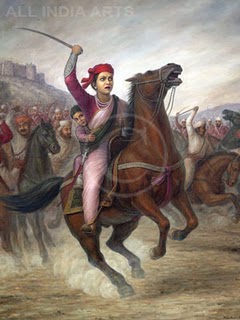
No, Mr. Twain. She does NOT stand alone. India's Rani Lakshmi Bai stands shoulder to shoulder with her.


Artist: Unknown to me

(Does the strapped kid look 12 years old?)

Jhansi's Rani has always been around since I was a kid.

Be it B R Tambe's (भा. रा. तांबे) moving poem:

'रे हिंदबांधवा, थांब या स्थळी । अश्रु दोन ढाळी ॥
ती पराक्रमाची ज्योत मावळे । इथे झांशीवाली ॥'

or Pratibha Ranade's (प्रतिभा रानडे) sensitive and scholarly portrayal 'Zashichi Rani Laxmibai' (झांशीची राणी लक्ष्मीबाई), June 2003 .

But I have always felt a touch of sadness around her. It was never like seeing pictures of Shivaji and his lieutenants.

After I read Godse Bhataji aka Vishnubhat Godse (गोडसे भटजी / विष्णुभट गोडसे)'s classic 'Maza pravas' (माझा प्रवास), 1883, the feeling became even darker because Godse's description of the empire's cruelty inflicted on Jhansi, after its fall, is heart wrenching. (Read a related post on this here.)

Godse's description of his meetings with the Rani are also very vivid and moving.

This is how Godse describes the Rani's escape with her 12-year old son tied to her back:

"बाईसाहेब स्वतः पांढरे घोड्यावर स्वार जाहाली. घोडा तो सुमार अडीच हजार रुपये किमतीचा खंदा होता. त्याजवर आपण बसून आंगावर पायजमा वगैरे सर्वपुरुष पोषाग होताच. टाकीण बूट घातले होते व सर्वांगास तारांचे कवच घातले होते, बराबर अर्ध एक पैसा सुद्धा घेतला नव्हता. फक्त रुप्याचा पेला पदरी बांधून ठेविला होता. कम्बरेस ज्यम्बा वगैरे हतेरे होती. खाकेत तलवार लाविली होती आणि रेसिमकाठी धोतरानी पाठीसी बारा वर्षाचा मुलगा दत्तक घेतलेला बांधून जय शंकर शब्द करून किल्ल्या खाली स्वारी उतरली..."


Artist: Francisco José de Goya y Lucientes (1746-1828)

COURTESY: INSTITUTO CERVANTES, NEW DELHI and Frontline Oct. 07, 2011

"YSON TAN FIERAS": In his portrayal of women caught in conflict, Goya shows women as victims of invaders, and also as guerilla fighters. Here, a woman guerilla fighter who has tied her child around her shoulders while fighting....Much like Lakshmibai.

She is Goya's Jhansi Ki Rani!

Tuesday, November 15, 2011

Peter Roebuck: Regret comes over us for the Life Unled

Peter Roebuck:

"Nothing is sadder than the extinguishing of a young life. Besides the loss itself, and the pain that follows, the premature ending of a life serves as shock, reminds of the fragility and foolishness of our existences. When Princess Di died, her country temporarily became a better place. When David Hookes departed, the sorrow reached beyond his immediate circle and into the masses. Partly, it is the loss of a friend. Partly, it is the realisation that we have been wasting our lives upon nonsense.

Not that it lasts. Still we complain about traffic wardens and shampoo bottles that will not open, and the weather, and the neighbours and taxes and noise and the rest of it. And then a child dies, or a friend is suddenly removed, or a familiar face vanishes, whereupon regret comes over us for the life unled."

('Departures' from 'IT TAKES ALL SORTS', 2005)

Albert Camus:


"There is but one truly serious philosophical problem and that is suicide. Judging whether life is or is not worth living amounts to answering the fundamental question of philosophy. All the rest – whether or not the world has three dimensions, whether the mind has nine or twelve categories – comes afterwards. These are games; one must first answer..."

('The Myth of Sisyphus')


I do not like most Cricket writers today.

But the late Peter Roebuck did NOT belong there. He was up there with two fellow Australians: Jack Fingleton- writer of such classics like 'Cricket Crisis', 'Brightly Fades the Don', 'The Ashes Crown the Year'- and Ian Chappell.

I lap up their every word.

As I have said earlier, one of the few bright spots in India's Sportstar was Mr. Roebuck's occasional column.

PR will be remembered for many things. But I will remember him especially for his reporting of third day of second test between India and Australia played at Melbourne Cricket Ground on 26-30 December 1999.

It was a debut series of then fiery and fit Brett Lee.

PR writes:

"This was a day to remember, a day on which Brett Lee made a startling first appearance in his country's colors and Sachin Tendulkar stood alone at the crease defying formidable odds with courage and skill.

It was a glorious confrontation between old and new, mighty and promising, an expression of the great gifts of the game, the brilliance of batsmanship, the excitement of pace and the powers needed to reach the gods. Meanwhile, a superb leg-spinner also bowled with artistry and cunning as he pursued his own landmark. It wasn't a day to have stayed in bed. There haven't been many better...

...Meanwhile, Tendulkar stood firm like St Paul's Cathedral in the Blitz. Any fool can score runs against tame bowling. Anyone can impress in easy circumstances. Like a true champion, Tendulkar rises in the tightest corners. He, too, had to keep an eye on Lee's yorkers and took evasive action as the speedster flung down a bumper. It was a tremendous struggle between them, as the master craftsman fought tooth and nail, while the gregarious youngster streamed into bowl and ended a metre or two from his adversary.

Tendulkar alone could resist the force of this fierce assault. He seemed to be playing in a different match from anyone else except Sourav Ganguly, for whom Lee reserved the fastest ball of the day. Unaffected by the wickets tumbling around him, and realising the need to push the score along, Tendulkar moved from caution to aggression as he launched a breathtaking attack on the Australian bowling.

Eight long years ago, he appeared in this land as a teenager with superb skills and enough spirit to fuel an entire team. Now he has reappeared as a man bearing responsibility and carrying it lightly, for he does not allow any situation to be his master.

When Tendulkar reached his 100, the entire crowd rose in acclamation. His dismissal, caught on the boundary, brought the crowd to its feet a second time.
It had been the perfect day. The visiting champion had scored a century. And a new fast bowler had arrived on the scene."

Today, almost 12 years later, we have very different Messers Tendulkar and Lee from what are described here. Once I adored them, now I don't like watching either of them. And now Mr. Roebuck too has departed.

Peter Roebuck:

"...Yet it is the vulnerability that is interesting. Impregnability is an act. Kerry O’Keeffe’s recent autobiography was appreciated because he described his hard times and his failings. It was an act of courage, not a sales pitch. Writing those sorts of books is not about self-expression but self-examination. Everything else belongs in a comic book."

('Dealing with life' from 'IT TAKES ALL SORTS', 2005)

Sunday, November 13, 2011

Grotesque Looking Gangs of India: Vasant Sarwate Lalit Diwali 2011

William Butler Yeats:

TURNING and turning in the widening gyre
The falcon cannot hear the falconer;
Things fall apart; the centre cannot hold;
Mere anarchy is loosed upon the world,
The blood-dimmed tide is loosed, and everywhere
The ceremony of innocence is drowned;
The best lack all conviction, while the worst
Are full of passionate intensity.
('The Second Coming')


This is what historian Vishwanath Kashinath Rajwade (विश्वनाथ काशिनाथ राजवाडे) said almost a century ago:

"तात्पर्य, हिंदुस्थानांत होऊन गेलेली सर्व सरकारे मूठभर अल्पसंख्यांकांची आहेत व ह्या मूठभर अल्पसंख्यांकांचे सरकार त्यांच्याच सारख्या इतर मूठभर परंतु समबल किंवा वरचढबल अल्पसंख्यांक सरकारच्या ऊर्फ टोळीच्या हातून नाश पावते. त्यात गावकर्यांचा हात शपथेला सुद्धा नसतो."

(In summary, all the governments of Hindusthan have been of handful minorities and these administrations of handful minorities are destroyed by equally or more powerful minority governments or gangs. The people don't play their hand even for taking oath.)

['Maharashtra va Uttarkokanachee vasahat' (महाराष्ट्र व उत्तरकोंकणची वसाहत) from 'The Mahikavati Bakhar' (महिकावतीची बखर), 1924]

The first word that entered my mind when I saw Vasant Sarwate's (वसंत सरवटे) picture below was 'gangs' (टोळ्या) mentioned in Rajwade quote.

Gangs of corrupt politicians, crooked bureaucrats, robber baron businessmen, bakelite celebrities, crony capitalists, fundamentalists of all hue, terrorists, cacophonic media...

Rajwade wrote the quoted lines when India was not free.

Democracy was supposed to change that. The group in white attire carrying a flag in Sarwate's picture on the right reminds me of that hope, that promise, that 'tryst with destiny'.

UK's Financial Times is not a Left Wing paper.

Edward Luce is their Washington bureau chief. Earlier he was their South Asia Bureau Chief based at New Delhi. He is the author of 'In Spite of the Gods: The Strange Rise of Modern India' (2006).

He writes about American democracy in November 2011:

"A driver is stuck in a jam in Washington. A man knocks on his window: “Terrorists have kidnapped Congress, and they’re asking for $100m otherwise they’ll burn them with gasoline,” the man says. “We’re going from car to car to get donations.” What are people giving on average, asks the driver? “Oh, about a gallon,” comes the reply.

Mischievous though it is, the joke received a good reception when it was recently circulated to an email list of Washington insiders – a group of retired diplomats and academics. It is difficult to imagine Bob Hope delivering such a gag. In today’s climate, no amount of contempt seems too much for the country’s once highly trusted democratic institutions."

And one can argue that Indian democracy is in worse shape than American. No amount of contempt seems too much for the country’s once highly trusted democratic institutions.

As venerable Martin Wolf (of FT again) says: As inequality rises, the sense that we are equal as citizens weakens. In the end, democracy is sold to the highest bidder. That has happened often before in the history of republics.

Another thing that came to my mind on seeing Sarwate's cover was a famous song from Raj Kapoor's 'Awaara' (1951)- 'Mujhko chahiye bahar'...Its imaginary hell represented by flames and grotesque statues and a desperate cry of Manna Dey- voice of pathos seeking hope- 'Mujhko ye narak na chahiye; mujhko phool, mujhko geet, mujhko preet chahiye...Mujhko chahiye bahar'.

I still remember how disturbed I felt watching the sequence first time on big screen in 1970's. I needed some balm which came with serene 'ghar aaya mera pardesi'.

Director: Raj Kapoor; Cinematography: Radhu Karmakar; Art Direction: M.R. Achrekar; Set Decoration: K. Damodar

Artist: Vasant Sarwate, Lalit (ललित), November-December 2011

(I see one light violet colour face wearing bindi/pendant. I feel it represents a gang of bakelite celebrities.)

Sarwate himself says about the picture that, while drawing it, his own cover of Sahitya Academy Award winning collection of poems of Mangesh Padgaonkar's (मंगेश पाडगांवकर) 'Salam' (सलाम),1980- salute- was on his mind.

I know 'Salam'. I have heard Padgaonkar reciting it from the stage of Balgandharva Natyagraha (बालगंधर्व नाटय़गृह) in Miraj (मिरज). I liked it OK.

But when my overwhelming feeling is of deep fear, almost terror, only when I recover from it slightly, I may raise my hand in salute (salam), for survival!

Click on the respective year to see Sarwate's past covers of Lalit Diwali 2010, 2009, 2008 and 2007.

click on the above to get a larger view of part of Rajwade's original article

['Rajwade Lekhsangrah' (राजवाडे लेखसंग्रह) editor: Tarkateerth Lakshman-shastri Joshi (संपादक: तर्कतीर्थ लक्ष्मणशास्त्री जोशी), 1958]