मेघदूत: "नीचैर्गच्छत्युपरि दशा चक्रनेमिक्रमेण"

समर्थ शिष्या अक्का : "स्वामीच्या कृपाप्रसादे हे सर्व नश्वर आहे असे समजले. पण या नश्वरात तमाशा बहुत आहे."

G C Lichtenberg: “It is as if our languages were confounded: when we want a thought, they bring us a word; when we ask for a word, they give us a dash; and when we expect a dash, there comes a piece of bawdy.”

C. P. Cavafy: "I’d rather look at things than speak about them."

Martin Amis: “Gogol is funny, Tolstoy in his merciless clarity is funny, and Dostoyevsky, funnily enough, is very funny indeed; moreover, the final generation of Russian literature, before it was destroyed by Lenin and Stalin, remained emphatically comic — Bunin, Bely, Bulgakov, Zamyatin. The novel is comic because life is comic (until the inevitable tragedy of the fifth act);...”

सदानंद रेगे: "... पण तुकारामाची गाथा ज्या धुंदीनं आजपर्यंत वाचली जात होती ती धुंदी माझ्याकडे नाहीय. ती मला येऊच शकत नाही याचं कारण स्वभावतःच मी नास्तिक आहे."

".. त्यामुळं आपण त्या दारिद्र्याच्या अनुभवापलीकडे जाऊच शकत नाही. तुम्ही जर अलीकडची सगळी पुस्तके पाहिलीत...तर त्यांच्यामध्ये त्याच्याखेरीज दुसरं काही नाहीच आहे. म्हणजे माणसांच्या नात्यानात्यांतील जी सूक्ष्मता आहे ती क्वचित चितारलेली तुम्हाला दिसेल. कारण हा जो अनुभव आहे... आपले जे अनुभव आहेत ते ढोबळ प्रकारचे आहेत....."

Kenneth Goldsmith: "In 1969 the conceptual artist Douglas Huebler wrote, “The world is full of objects, more or less interesting; I do not wish to add any more.”1 I’ve come to embrace Huebler’s ideas, though it might be retooled as “The world is full of texts, more or less interesting; I do not wish to add any more.” It seems an appropriate response to a new condition in writing today: faced with an unprecedented amount of available text, the problem is not needing to write more of it; instead, we must learn to negotiate the vast quantity that exists. How I make my way through this thicket of information—how I manage it, how I parse it, how I organize and distribute it—is what distinguishes my writing from yours."

Tom Wolfe: "The first line of the doctors’ Hippocratic oath is ‘First, do no harm.’ And I think for the writers it would be: ‘First, entertain.’"

विलास सारंग: "… . . 1000 नंतर ज्या प्रकारची संस्कृती रुढ झाली , त्यामध्ये साधारणत्व विश्वात्मकता हे गुण प्राय: लुप्त झाले...आपली संस्कृती अकाली विश्वात्मक साधारणतेला मुकली आहे."

Wednesday, May 15, 2013

When All That Is Over, Will Rankala Be Still There?

Paul Kingsnorth: 

"What am I to do with feelings like these? Useless feelings in a world in which everything must be made useful. Sensibilities in a world of utility. Feelings like this provide no “solutions”. They build no new eco-homes, remove no carbon from the atmosphere. This is head-in-the-clouds stuff, as relevant to our busy, modern lives as the new moon or the date of Lughnasadh. Easy to ignore, easy to dismiss, like the places that inspire the feelings, like the world outside the bubble, like the people who have seen it, if only in brief flashes beyond the ridge of some dark line of hills."

('Confessions of a Recovering Environmentalist', Orion Magazine, Jan/Feb 2012)

 In May 2013, I went to Kolhapur (कोल्हापूर) after almost a decade.

I visited Ambabai (अंबाबाई) temple.

It has now become very crowded for my taste. Although more majestic and elegantly beautiful than the most, once it was like a temple in my neighborhood where we loved to go as kids, the way we went to Dutt (दत्त)  temple at Miraj. Now, it's a destination for almost all  Hindu religious tourism. Commerce, wealth and security on display are overwhelming.

Is it better to meet Ambabai in one's heart?

As a kid,  I always wondered: if the main temple is so crowded, why are the most other temples on the campus so empty? Are other deities less important or less magnanimous? This time too I wondered the same because when we went to Shakambhari (शाकंभरी) temple, there was almost no one. Even the priest  was sitting outside.

Earlier, I visited  Rankala (रंकाळा). Once, I used to go there at least once a year. What a pleasure it was walking a couple of km to the lake (some of it on unpaved road) with my elder cousin - Diluappa (दिलुअप्पा) and loitering there for a while and breathing deep in that cool gust. I felt as if I never left the place...I felt 40 years younger.

There were kites/hawks  flying over, occasionally swooping in to pick up pieces of bread/ trash thrown by visitors into the water. But that act of vandalism by humans had no effect on me.  Rankala was simply overwhelmingly seductive...Ambabai's in her Temple/ All's right with the world!

 This is how H G Wells describes 'the end' in his ‘The Time Machine’:


“The darkness grew apace; a cold wind began to blow in freshening gusts from the east, and the showering white flakes in the air increased in number. From the edge of the sea came a ripple and whisper. Beyond these lifeless sounds the world was silent. Silent? It would be hard to convey the stillness of it. All the sounds of man, the bleating of sheep, the cries of birds, the hum of insects, the stir that makes the background of our lives—all that was over. As the darkness thickened, the eddying flakes grew more abundant, dancing before my eyes; and the cold of the air more intense. At last, one by one, swiftly, one after the other, the white peaks of the distant hills vanished into blackness. The breeze rose to a moaning wind. I saw the black central shadow of the eclipse sweeping towards me. In another moment the pale stars alone were visible. All else was rayless obscurity. The sky was absolutely black.”


When "All the sounds of man, the bleating of sheep, the cries of birds, the hum of insects, the stir that makes the background of our lives—all that was over" arrives, will Rankala still be there?

I hope so.


Artist: Les Edwards, 1979 portraying when 'all that was over'

Monday, May 13, 2013

Did Shivaji-maharaj Eat Good, Maharashtra-grown Mangoes?... Dar sift-e-ambah

Today May 13 2013 is Aakshay Trutiya (अक्षय तृतीया) day in  Maharashtrian calendar. My wife believes one should eat the first ripe mango of the season this day.


Steven Weinberg:

"...I am not so sure that world unification is an unmixed blessing. It has the side effect of shrinking the psychological space in which we live. A few hundred years ago large areas of the map were blank, leaving the imagination free to fill them with strange peoples and animals. Even Queen Victoria, who, it is said, tried to taste every fruit grown in the British Empire, never had a chance to try a mango or a durian. Now we can fly anywhere, and we buy mangoes in our local supermarkets. This is not my idea of utopia. Wouldn't it be more exciting to eat a mango if it could be done nowhere but in India? What is the good of getting somewhere quickly if it is no different from the place one has left?..." 

('Five and a Half Utopias', The Atlantic, January 2000) 

Zahir-ud-din Muhammad Babur (1483-1530) in the 'Tuzuk-i-Baburi': 

"Hindustan is a country of few charms. Its people have no good looks; of social intercourse, paying and receiving visits there is none; of genius and capacity none; of manners none; in handicraft and work, there is no form or symmetry, method or quality. There are no good horses, no good dogs, no grapes, musk melons or first-rate fruits, no ice or cold water, nor bread or cooked food in bazaars; no hamams, no colleges, no torches or candlesticks,"

Maybe but what about mangoes, Mr. Babur-Sir?...Did you eat any good mangoes when you were here?

The question that has bothered me  for the past  few years is : Did Shivaji-maharaj (1630-1680) eat good, Maharashtra-grown mangoes?

I mean not necessarily Alphonso and Payari variety on which I have gorged on whenever I have been able to live in Maharashtra during the Mango-months (May and June)

The best years of course were when I lived in Miraj c 1961-1981 where my father, stretching his limited resources,  really pampered us with the best of mangoes..Devgad, Ratnagiri...every year. Experience of eating such quality mangoes in those numbers was - please note Dr. Weinberg- like living in utopia- "mango utopia".

Coming back to the original question:  most people of Maharashtra DO NOT bother about such things when it comes to Shivaji. 

Whenever Shivaji is mentioned, it is always about battles, army, navy, administration, forts and also caste based politics, his memorial in the Arabian sea...

But for me, 'mango question' is very important. And my guess is Shivaji did NOT eat good mangoes that were grown in Maharashtra.

One of my favourite Marathi books has been 'Peshwekalin Maharashtra' by Vasudev Krushna Bhave, 1936 ('पेशवेकालीन महाराष्ट्र',  वासुदेव कृष्ण भावे). I keep reading it from time to time and it always gives.

Mr. Bhave writes 

"शाहू महाराजांपूर्वी महाराष्ट्रात नाव घेण्याजोग्या फुलबागा व फळबागा अगदी विरळा होत्या; त्यांजकडे लक्ष पुरविण्यास पूर्वीच्या महाराजांना स्वारस्य नव्हते… शाहूमहाराजांनी महाराष्ट्रास रानटी स्थितीतून सुसंकृत  स्थितीत उद्योग केवढा चालवला होता..."

"Before Shahu-maharaj there were very few flower-gardens and fruit-gardens worth their names in Maharashta; earlier rulers had no interest in paying attention to them...So busy was Shahu-maharaj taking Maharashtra from barbaric to civilized society..." 

Mr. Bhave argues that since Shahu-maharaj (1682- 1749) had lived  in the custody of the Mughals (but as a prince) he had tasted the best of flowers and fruits. 

Penelope Hobhouse writes on "The Babur NamaBy Zahir al-Din Babur, edited by Dilip Hiro:

"(Babur) was a great warrior and commander – descended from both Tamburlaine and Genghis Khan – but also with a wonderful eye for nature and landscape. It’s rare to combine warfare and gardening. In The Babur Nama he describes the country in Fergana in Uzbekistan where he grew up, for example, noting the topography and the plants, even though he left when he was only 12. He describes the Judas tree in bloom, and planting willows around a pond and spotting wild tulips in the fields up above Kabul.
I’m writing a book about Mughal gardens at the moment, trying to follow Babur’s trail down from Afghanistan, through the Punjab and on to Delhi. And the amazing thing is that, even when campaigning, if he paused amongst beautiful scenery, he would have his men do some landscaping, enlarging a stream here or moving a bank there. He must have been the most extraordinary man and his memoir makes the best kind of bedside reading: intrigue, conquest, history on an epic scale and gardening!"


Illustrations in the Baburnama regarding the fauna of South Asia.

courtesy: Wikipedia

Is that a mango tree in the bottom right?

Saturday, May 11, 2013

Mars One: An Indian Astronaut, Not Chinese, Delivers a Baby on Her Way to Mars

James Lovegrove: 

“…Contrary to received opinion, science fiction’s preoccupation has always been the here and now. Its far-flung planets and future timelines are merely a way to analyse the contemporary. In this respect, it is the most politically engaged of all literary genres. Motifs that may appear trashy to the uninitiated - space exploration, extraterrestrials, futuristic technology - can in fact be surprisingly sophisticated tools for dissecting and examining the world as it is…"


(FT, February 9 2007)


Laurie Penny asks in New Statesman, April 30 2013  "Modern life is science fiction – but would you dare go on a one-way mission to Mars?" and explains:


"If you were offered a one-way ticket to Mars, would you take it? It’s a serious question. The first manned Mars landing, organised by a Dutch company called Mars One, has put out a call for applicants. In 2018, the planets will literally align, making a journey to the Red Planet more than feasible. You don’t have to be a trained astronaut but you must be willing to spend 521 days in a very small space with three other people, with limited supplies and drinking water reclaimed from your own effluvia. You will also be under constant video surveillance, because this mission to Mars is relying on global TV networks to cover its considerable budget. It’s the ultimate Big Brother, with no way out: after a year and a half the colonists will either shag or kill each other, or both. The ratings will be fantastic.
Most of all, you must be willing to say goodbye for ever to your family, your friends, the barista at your favourite coffee shop. This is a one-way trip: even if they make it through the gruelling physical ordeal of the journey, it is possible none of the astronauts will ever come home."

This is the reality of  man's mission to Mars...possibly in year 2018, non-Governmental project, 521 days journey, one way ticket, funded by reality TV..."a very small space with three other people"...Could you imagine a woman delivering a baby in such an environment?

On learning that about 600 Chinese have lined up to travel on Mars One, Marathi daily Loksatta, on May 4 2013,  felt worried sick that 'colonizers' Chinese were now going to invade Mars (after recently 'invading' India)! The paper also felt that China had now become 'Mars' in Indian nation's horoscope.

I have not a read a lot of science fiction. In Marathi, I have not read almost any beyond Jayant Narlikar (जयंत नारळीकर)  and Narayan Dharap (नारायण धारप).

The other day,  I read the late D B Mokashi's (दि बा मोकाशी) science fiction short story 'Sharavati' ('शरावती) first published in Diwali 1963, almost 50 years ago. 1963 is the year of John F. Kennedy assassination, Vietnam war...Cuban Missile Crisis and India-China war were just a year old that Diwali

I like a lot of what Mr. Mokashi has written. This story too is interesting but can't be called one of his best and, another thing,  he can't really write about politics. His praise for Indian civilization and nation- unnecessary for the story line-  is not just jarring and but not even entirely factual. (Is it prompted by India's crushing defeat by China towards the end of 1962?)

Mokashi imagines that an Indian woman astronaut 'Sharavati' is travelling to Mars in year 1980 and soon after the journey begins discovers that she is pregnant!

How did she get pregnant? During a break in her training for the Mars mission, she meets her husband alone as their kids are away.

Eventually, she delivers a baby boy in space- apparently with less trouble because of zero gravity-  and returns to earth successfully as her mission is aborted by its possible collision with an asteroid. (Today, Mokashi would have been advised not to bring Sharavati and her kid back to the earth but instead make them colonize Mars by reaching there!)

I have already quoted David Graeber earlier on this blog:

"As someone who was eight years old at the time of the Apollo moon landing, I remember calculating that I would be thirty-nine in the magic year 2000 and wondering what the world would be like. Did I expect I would be living in such a world of wonders? Of course. Everyone did. Do I feel cheated now? It seemed unlikely that I’d live to see all the things I was reading about in science fiction, but it never occurred to me that I wouldn’t see any of them."

Manned Mars mission is one of "any of them".

Cory Doctorow has said : "science fiction writers don't predict the future (except accidentally), but if they're very good, they may manage to predict the present.

Although unwanted pregnancies were of immediate concern in 1963, Mokashi is certainly onto something bigger than that in his story. At the end of the story, I got a feeling that it was steeped in feminist ideology. And I think that is where Mokashi succeeds and predicts the future: 2013.

Mokashi imagines J L Nehru c 1980 to be not just alive but riding a horse and giving interviews on the subject of Sharavati's predicament. We know Nehru died in 1964 but it's interesting to see how the generation of Mokashi could not quite contemplate Nehru's death just an year earlier. 

Mokashi imagines a kind of media frenzy we see today. But he hands out a certificate of good conduct to Indian journalists vis-a-vis their foreign counterparts.  Surprisingly,  he doesn't imagine TV in India in 1980 and he is right because TV went on rampage in India only after 1982.

 Mokashi tells us a little about the world politics of 1980. World has seen WW III in 1965 and is on the brink of WW IV in 1980.   

Mokashi's world of 1980 is quadripolar: Yellow skinned (पीतवर्णीय), America+Russia+Europe, all of Asia,  and Negroes. He sees the world divided on the lines of racial schisms and not economic / ideological ones. (I was confused by just one thing how yellow skinned and all of Asia are two exclusive groupings? Isn't Asia = yellow+brown+ some white?)

That's quite a bold prediction  considering how powerful Russian block was in 1963. Therefore, not only Mokashi sees the fall of Soviet Union and demise of communism but predicts America and Russia coming together. It's also interesting to note how race was going to prevail over other things in his future. (If we consider India, we know how caste, religion and language have prevailed over economic and other factors.)

Mokashi says we may think of this state of world politics as barbaric in 2001. On the contrary,  we all think this to be normal.  

Towards the end, Mokashi tells us that thanks to 'Sharavati pregnancy' episode, humans end up colonizing Mars in 1980 and those colonies now are thriving in year 2001. 

If so, the following should not surprise us. 


In January 2008, there was a report in Daily Mail of UK:

“The photo of what looks like a naked woman with her arm outstretched was among several taken on the red planet and sent back to Earth by NASA's Mars explorer Spirit.”

I am just worried about one thing: Is she Chinese and of child-bearing age and, if so, will she mate only with another Chinese?


courtesy: Barcroft Media and Daily Mail, UK

Thursday, May 09, 2013

Fading of Ana's Neo Red and BJP's Saffron in 5 Years


Ms. Ana Ivanovic beat Dinara Safina to win the 2008 French Open, surely first of many to come.

BJP won Karnataka at the same time. It was hailed 'Dakshin-Vijay' (दक्षिण विजय), surely first of many to come.


Saffron and Neo Red were victorious colours.

This is the post I wrote on June 9 2008: "BJP Saffron and Ivanovic Neo Red are going to be Huge this Summer."

As of May 6, 2013, Ms. Ivanovic is ranked no. 16 in the Women's Tennis Association (WTA) rankings and never looks to me a champion player she looked that summer, 5 years ago, let alone winning another Grand Slam tournament again.

BJP will be number two or even three party in new Karnataka assembly.

Tuesday, May 07, 2013

I Want Durga Bhagwat to be in Literary Feuds!

Today May 7 2013 is 11th Death Anniversary of Durga Bhagwat  (दुर्गा भागवत)

DWIGHT GARNER:

"The sad truth about the book world is that it doesn’t need more yes-saying novelists and certainly no more yes-saying critics. We are drowning in them. What we need more of, now that newspaper book sections are shrinking and vanishing like glaciers, are excellent and authoritative and punishing critics — perceptive enough to single out the voices that matter for legitimate praise, abusive enough to remind us that not everyone gets, or deserves, a gold star."


(The New York Times, August 15 2012)

RACHEL DONADIO:

‘To some, the paucity of feuds is connected to the larger state of literary culture. “It’s not because we no longer have feuds,” said Fran Lebowitz, the writer. “It’s because we no longer have literature.” ’

(“Art of the Feud”, The New York Times, November 19 2006)

On her 10th death anniversary,  I said: I have nothing new to write about her. I still haven't.

But I miss her.

Among other things, I miss her participation in Marathi literary feuds! What a passionate critic-cum-fighter she was- "excellent, authoritative and punishing".

I still remember the way she took on the late P L Deshpande ( पु ल देशपांडे) and Mr. Govind Talwalkar (गोविंद  तळवलकर)- both then Sumo wrestlers on Maharashtra's middle class cultural mat-  on the editorial pages of "Maharashtra Times" (महाराष्ट्र टाइम्स) in 1970's.

First my father read those articles aloud and laughed. Then I read them myself. I wish they never stopped feuding! [There is one puzzle still unsolved from those days. Ms. Bhagwat had accused Mr. Talwalkar on making a pun on the name of Amte (आमटे) in personal chats. I have never figured what it could be.]

Alas, now there are no big literary feuds in Marathi.

Literary feuds can end up in a real fight. Head butting for instance.

In India this year,  we almost had one when Mr. Girish Karnad attacked Mr. V S Naipaul but sadly there was no retaliation from Mr. Naipaul and hence no fight and fun.

The sixth episode of the The Simpsons' eighteenth season "Moe'n'a Lisa" has Jonathan Franzen fighting with Michael Chabon.

"Franzen and Chabon are hysterical. They get in heated fight, Franzen breaks a table over Chabon's head, Chabon accuses him of fighting like Anne Rice"

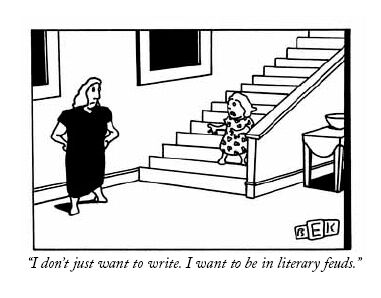
Look at the following picture of Mr. Kaplan. Little girl is telling her mom: I don't just want to write. I want to be in literary feuds.

What an ambition! "I want to be in literary feuds" Like Durga Bhagwat, I may add!

Artist : Bruce Eric Kaplan, The New Yorker, 27 June 1994

Saturday, May 04, 2013

Which IPL Team Soliyas Mendis Plays For? He Can't Play in Chennai! He Can't Draw in Ajanta!

Mark Twain:

‎"So much blood has been shed by the Church because of an omission from the Gospel: 'Ye shall be indifferent as to what your neighbor's religion is.' Not merely tolerant of it, but indifferent to it. Divinity is claimed for many religions; but no religion is great enough or divine enough to add that new law to its code."


Oren Harman:

"Aristotle was a cynic. Sure, the Bible exhorts to “Love thy neighbor as thyself,” but he knew better. “The friendly feelings that we bear for another,” instructed his Ethics, “have arisen from the friendly feelings that we bear for ourselves.”"


"In March 1954, the Union Cabinet met and decided to unilaterally define the border of India with China. The colour wash was replaced by a hard line, and the Survey of India issued a new map, which depicts the borders as we know them today. All the old maps were withdrawn and the depiction of Indian boundaries in the old way became illegal. Indeed, if you seek out the White Paper on Indian States of 1948 and 1950 in the Parliament library, you will find that the maps have been removed because they too showed the border as being “undefined” in the Central and Western sectors.
What was the government up to? Did it seriously think it could get away with such a sleight of hand? Or was there a design that will become apparent when the papers of the period are declassified? Not surprisingly, the other party, the People’s Republic of China, was not amused and, in any case, there are enough copies of the old documents and maps across the world today to bring out the uncomfortable truth that the boundaries of India in these regions were unilaterally defined by the Government of India, rather than through negotiation and discussions with China."


Year 2013 has been characterized by a lot of negative news flow on Sri Lanka in Indian media. And on China and on Pakistan...Marathi media, particularly on China-Pakistan, have become even more bellicose than their Hindi/English counterparts..."India has been always been peaceful but should not be taken for granted etc"...


John Keay:

"...The classic expansion of Chola power began anew with the accession of Rajaraja I in 985. Campaigns in the south brought renewed success against the Pandyas and their ‘haughty’ Chera allies in Kerala, both of which kingdoms were now claimed as Chola feudatories. These triumphs were followed, or accompanied, by a successful invasion of Buddhist Sri Lanka in which Anuradhapura, the ancient capital, was sacked and its stupas plundered with a rapacity worthy of the great Mahmud...When, therefore, Rajendra I succeeded Rajaraja and assumed the reins of power in 1014, his priority was obvious. Sri Lanka was promptly reinvaded and more treasures and priceless regalia seized; prising open even relic chambers, says a Sri Lankan chronicle, ‘like blood-sucking yakkhas they took all the treasures of Lanka for themselves’..."

('INDIA A HISTORY: From the Earliest Civilisations to the Boom of the Twenty-First Century', 2000/ 2010)


I was stunned seeing pictures of Buddhist art of Sri Lanka in Frontline dated April 19 2013. I think some of the art gives Ajanta run for its money.


Apsaras, Mural, Sigiriya, c. 5th century.

Artist: Unknown

Photo Artist: Benoy K. Behl

And I didn't even know that such art existed...I have often wondered: Why do I know so little about my neighbourhood while I seem to know 'so much' about a country thousands of miles away? Have I really achieved freedom?


Sanghamitra brings the holy Bodhi Tree to Sri Lanka

Artist: Soliyas MendisMural, Kelaniya Vihara, early 20th century. 

Photo artist: Benoy K. Behl
 
"The painter Soliyas Mendis travelled to India in the end of the 19th century to study the paintings of Ajanta. When he returned to Sri Lanka, he created a new style of art, which has its roots in the gentle expressions and exquisite grace of the Ajanta paintings. His work represents a valuable link and continuation of the ancient style of Buddhist paintings. The paintings also display a close affinity to the style of the Sigiriya paintings and are distinctly Sri Lankan."


Wednesday, May 01, 2013

Karl Marx...8th Chiranjivi? अश्वत्थामा बलिर्व्यासो हनुमांश्च विभीषणः...

Today May 1 is  International Workers' Day and May 5 2013 is 195th Birth Anniversary of Karl Marx

अश्वत्थामा बलिर्व्यासो हनुमांश्च विभीषणः। कृपः परशुरामश्च सप्तैते चिरंजीविनः॥

George Orwell:

"Progress is not an illusion, it happens, but it is slow and invariably disappointing. There is always a new tyrant waiting to take over from the old — generally not quite so bad, but still a tyrant. Consequently two viewpoints are always tenable. The one, how can you improve human nature until you have changed the system? The other, what is the use of changing the system before you have improved human nature? They appeal to different individuals, and they probably show a tendency to alternate in point of time. The moralist and the revolutionary are constantly undermining one another. Marx exploded a hundred tons of dynamite beneath the moralist position, and we are still living in the echo of that tremendous crash. But already, somewhere or other, the sappers are at work and fresh dynamite is being tamped in place to blow Marx at the moon. Then Marx, or somebody like him, will come back with yet more dynamite, and so the process continues, to an end we cannot yet foresee. The central problem — how to prevent power from being abused — remains unsolved. Dickens, who had not the vision to see that private property is an obstructive nuisance, had the vision to see that. ‘If men would behave decently the world would be decent’ is not such a platitude as it sounds."

Terry Eagleton:

"There’s irony in the fact that in the midst of the most affluent civilization history has witnessed people are scavenging in rubbish baskets for food. That’s the kind of contradiction I think Marx was talking about. I also stressed how much Marx admired the way that capitalism had in a very short space of time accumulated such wealth—material, spiritual, cultural—but that it couldn’t do that without the contradiction of generating inequality at the same time; we’re seeing a stark instance of that in Greece today. So that’s the kind of thing I’d point to to show the relevance of Marx. Even within the anti-capitalist movement, Marx is not a majority presence. One has to say that. It’s partly because of the discrediting of Marxism by Stalinism, which will take a long time for the Marxist left to recover from. But I’m not myself madly concerned about whether people stick the label “Marxist” onto themselves as long as they take a critical stance towards the present situation. It doesn’t matter what they call themselves."


Jonathan Sperber:

“The man who would write the Communist Manifesto just five years later was advocating the use of the army to suppress a communist workers’ uprising!”

Karl Marx on German-Jewish socialist Ferdinand Lassalle:

"It is now completely clear to me, that, as proven by the shape of his head and the growth of his hair, he [Lassalle] stems from the Negroes who joined the march of Moses out of Egypt (if his mother or grandmother on his father’s side did not mate with a nigger). Now this combination of Jewry and Germanism with the negroid basic substance must bring forth a peculiar product. The pushiness of this lad is also nigger-like."

Once I was almost a card-carrying Marxist- communist. That was long time ago.  

Then I used to buy lots of low-cost English translated Russian books from frequently held exhibitions in Kolhapur and Sangli

Most of the books I bought,  including those by greats Alexander Pushkin and Fyodor Dostoyevsky,  went almost unopened. The only such books I read were of  metallurgy, an engineering subject

I thought my book-buying spree,  wasting in the process my father's very hard earned money, was helping the cause of revolution.   It was not helping anyone, really. 

I loved and read and re-read Anil Barve's (अनिल बर्वे) poetic play in Marathi-  'Thank you Mister Glad' ('थँक यु मिस्टर ग्लाड') and I cried and although I wanted to die like the protagonist there,  by then I had lost faith in revolutions (even before I lost it in bachelorhood).

For a while later I was a 'socialist' and then one day I saw and read Vijay Tendulkar's (विजय तेंडुलकर) 
"Kanyadan" (कन्यादान) and since then I have seen, read and heard so many 'socialists' like Nath Deolalikar (नाथ देवळालीकर) in India. They now belong to all the castes. 


Artist: James Thurber, The New Yorker, October 30 1937 (btw This is the month my mother was borne!)

But all along I never forgot Marx because of the late Prabhakar Padhye's (प्रभाकर  पाध्ये) Marathi book 'Manav aani Marx' ('मानव आणि मार्क्स') that I had read in the late 1970's. I have never forgot parts of the book.

My respect for Karl Marx has never diminished ever since my father told me that the veteran boar Old Major in 'Animal Farm' was him.

For me,  today he is a Don Quixote like character. Some people may judge him as a failure but more importantly for me he is a dreamer and eternal. I like to think of him as 8th Chiranjivi (चिरंजीवी).

 Wikipedia defines them as " long lived beings in Hinduism who are to remain alive through this Kali Yuga until the next Satya Yuga".

As long as we have so much economic inequality in this Kali Yuga,  Marx will continue to prick our conscience.

Like Ashwathama,  he will continue to come to our door...Like King Bali he will continue to hold mirror to the fundamental unfairness of our system...Like Parashurama he will remind us the mindless slaughter that happened in his name...

Karl Marx sure didn't know how to to get to  Satya Yuga, if one exists, and admittedly his self styled followers have slaughtered innocent men and women in millions, but he knows what Satya Yuga may look like:


‘…in communist society, where nobody [has] one exclusive sphere of activity but each can become accomplished in any branch he wishes, society regulates the general production and thus make it possible for me to do one thing today and another tomorrow, to hunt in the morning, fish in the afternoon, rear cattle in the evening, criticize after dinner, just as I have in mind, without ever becoming a hunter, fisherman, cowherd, or critic."

In a recent essay, John Gray says: "No doubt the belief that humankind is evolving toward a more harmonious condition affords comfort to many; but we would be better prepared to deal with our conflicts if we could put Marx’s view of history behind us, along with his nineteenth-century faith in the possibility of a society different from any that has ever existed."

But I doubt if humans will ever stop dreaming of a "society different from any that has ever existed." And how can they as long as Chiranjivi Marx keeps showing up at their doors or their dreams?


Sunday, April 28, 2013

If Marathas and Tipu-sultan Came Together... एक दरबारचित्र आणि दोन मोठ्या चुका नवीन पुस्तकातील

Loksatta dated April 28 2013 has published edited version of preface written by M/s Suhas Bahulkar and Deepak Ghare (सुहास बहुळकर,  दीपक घारे) for their own book 'Shilpakar Charitrakosh' (शिल्पकार चरित्रकोश') that is going to be published on May 4 2013.

I look forward to the book.

However,  I was startled by this part of their preface:

"सवाई माधवरावांच्या काळातील पुण्यातील रेसिडेन्ट मॅलेट यानेही जेम्स वेल्स या चित्रकाराला आमंत्रित करून एक भव्य चित्र रंगवण्यास सांगितले होते. हे चित्र इंग्रज, मराठे व टिपू सुलतान यांच्यात ६ ऑगस्ट १७९० रोजी झालेल्या त्रिवर्ग तहाचे..."

(Pune 'Resident' Malet during the reign of Sawai Madhavrao had invited artist James Wales and asked him to paint a majestic picture. That picture was of a tripartite treaty between the British, Maratha and Tipu sultan done on August 6 1790...)


Artist: Thomas Daniell, commissioned by Sir Charles Malet circa 1805

courtesy: Tate Gallery and Wikimedia Commons

I have already written about this picture on September 23 2007.

Like the picture above, funnily there are two blunders in Bahulkar/Ghare statement as well!

1:  The artist of the picture is Thomas Daniell and NOT James Wales.

(p.s. It has been claimed that the painting was started by James Wales and his team but completed by Thomas Daniell. Visit here to read about it.)

2:  The treaty was NOT with Tipu sultan but it was AGAINST HIM. It was among the Nizam , Marathas and the British! If Marathas and Tipu sultan had come together, the history of India would have turned out to be quite different. The British were most scared of that possibility. The way USA is scared today of India and China coming together.


If the book on the history of art starts with such bloomers, can I trust such a book for anything else other than  pretty pictures in there?

Saturday, April 27, 2013

Drinking at the same Watering Hole...Lion, Johnny-come-lately and Vinod Khanna

Natalie Angier:

"...Thirstiness is a universal hallmark of life. Sure, camels can forgo drinking water for five or six months and desert tortoises for that many years, and some bacterial and plant spores seem able to survive for centuries in a state of dehydrated, suspended animation. Yet sooner or later, if an organism plans to move, eat or multiply, it must find a solution of the aqueous kind..."


Robin McKie

“…we still dig up plenty of 100-million-year-old dinosaur bones today. However, those ancient animals thrived for tens of millions of years. By contrast, Homo sapiens has lasted around 100,000. By that reckoning, we are a bunch of Johnny-come-latelies.” 


"A lion quenching thirst by drinking water at nearby pond in Nehru Zoological Park in Hyderabad."

 Photo: Nagara Gopal

courtesy: The Hindu, April 2013

When I saw the majestic picture above, I remembered following great picture.

 Hunter who is probably out to hunt the lion is drinking with that same lion at a watering hole...in fact, if you watch closely, the hunter will be  drinking small quantity of water already mouthed by the lion...


                                                                   'Thirst'

Artist: Laszlo Reber  (László Réber) 1920-2001, Hungarian graphic artist, illustrator, cartoonist

[I have taken this picture from one of Vasant Sarwate's (वसंत सरवटे) books. This is Sarwate's one of favourite cartoons. During the period I was writing this post, he called. I told him I was not finding the artist in Google search. He got up, looked up Reber's book and helped me locate him. He also promised to send me the book's preface. This is Sarwate for me. Great artist, kinder man!]

....and how can Darwin say: humans are like other animals?...they need a water bag....unless they are Vinod Khanna in "Mera Gaon Mera Desh", 1971.


courtesy: Shemaroo and the distributor of the film, the publisher of the film

(This picture and movie became cult things for us. We never drank this alright! But we swooped down like this as a part of the thieves-cops (चोर-पोलीस) game we played.)

Thursday, April 25, 2013

Where is Pervez Musharraf's White House?


These days it has been great fun to watch Pakistan's former dictator Pervez Musharraf. It maybe schadenfreude but I have no guilt.

I have never liked him largely because he has blood of Indian and Pakistani soldiers martyred in The Kargil War.


Artist: James Stevenson, The New Yorker, February 28 1970