मेघदूत: "नीचैर्गच्छत्युपरि दशा चक्रनेमिक्रमेण"

समर्थ शिष्या अक्का : "स्वामीच्या कृपाप्रसादे हे सर्व नश्वर आहे असे समजले. पण या नश्वरात तमाशा बहुत आहे."

G C Lichtenberg: “It is as if our languages were confounded: when we want a thought, they bring us a word; when we ask for a word, they give us a dash; and when we expect a dash, there comes a piece of bawdy.”

C. P. Cavafy: "I’d rather look at things than speak about them."

Martin Amis: “Gogol is funny, Tolstoy in his merciless clarity is funny, and Dostoyevsky, funnily enough, is very funny indeed; moreover, the final generation of Russian literature, before it was destroyed by Lenin and Stalin, remained emphatically comic — Bunin, Bely, Bulgakov, Zamyatin. The novel is comic because life is comic (until the inevitable tragedy of the fifth act);...”

सदानंद रेगे: "... पण तुकारामाची गाथा ज्या धुंदीनं आजपर्यंत वाचली जात होती ती धुंदी माझ्याकडे नाहीय. ती मला येऊच शकत नाही याचं कारण स्वभावतःच मी नास्तिक आहे."

".. त्यामुळं आपण त्या दारिद्र्याच्या अनुभवापलीकडे जाऊच शकत नाही. तुम्ही जर अलीकडची सगळी पुस्तके पाहिलीत...तर त्यांच्यामध्ये त्याच्याखेरीज दुसरं काही नाहीच आहे. म्हणजे माणसांच्या नात्यानात्यांतील जी सूक्ष्मता आहे ती क्वचित चितारलेली तुम्हाला दिसेल. कारण हा जो अनुभव आहे... आपले जे अनुभव आहेत ते ढोबळ प्रकारचे आहेत....."

Kenneth Goldsmith: "In 1969 the conceptual artist Douglas Huebler wrote, “The world is full of objects, more or less interesting; I do not wish to add any more.”1 I’ve come to embrace Huebler’s ideas, though it might be retooled as “The world is full of texts, more or less interesting; I do not wish to add any more.” It seems an appropriate response to a new condition in writing today: faced with an unprecedented amount of available text, the problem is not needing to write more of it; instead, we must learn to negotiate the vast quantity that exists. How I make my way through this thicket of information—how I manage it, how I parse it, how I organize and distribute it—is what distinguishes my writing from yours."

Tom Wolfe: "The first line of the doctors’ Hippocratic oath is ‘First, do no harm.’ And I think for the writers it would be: ‘First, entertain.’"

विलास सारंग: "… . . 1000 नंतर ज्या प्रकारची संस्कृती रुढ झाली , त्यामध्ये साधारणत्व विश्वात्मकता हे गुण प्राय: लुप्त झाले...आपली संस्कृती अकाली विश्वात्मक साधारणतेला मुकली आहे."

Monday, March 23, 2009

Posturing of Prakash Karat while Watching a Mao-esque Great Leap Forward

David Pilling says in FT March 18, 2009:

India’s messy democracy works rather well:… China’s murderous Great Leap Forward shows that unchecked authoritarian states are even more prone than messy democracies to make catastrophic mistakes. Indian democracy, as the strong performance of some of its better-run states demonstrates, is perfectly compatible with good governance and fast growth. The hope for next month’s elections is that these qualities can somehow emerge victorious at a national level, however clamorous and baffling the process.”

T N Ninan says in Business Standard March 21, 2009:

“new CPI(M) website was launched on Wednesday, a couple of days after the party’s election manifesto was released. The manifesto is notable in that it does not promise outcomes (what rate of growth, how much increased equality, what level of reduction in unemployment, etc), but makes a list of random observations without any coherent framework: give the states more rights, protect the public sector, offer everyone guaranteed employment, etc…

From the third largest party in the Lok Sabha, this is a document that shows little thought, devoted to endless posturing so that it does not have to offer serious solutions.”


Artist: Mick Stevens, The New Yorker, March 23 2009, Cartoon Caption Contest #185

My caption:

“Listen light-weight…I am Prakash Karat…I am impressed by your Great Leap Forward. Would you be a prime ministerial candidate of our yet-to-be-named front?”

Tuesday, March 17, 2009

Now Showing: Amitabh’s Uranium

In India, the most talked about element in year 2008 was uranium. Panacea to all our problems of national security and energy.

DRAKE BENNETT (NYT March 8, 2009):

“When it comes to press coverage, uranium does pretty well among its peers on the periodic table. Surely strontium or seaborgium or even manganese would kill for its name recognition. But how well do we really know the element in whose long, mushroom-shaped shadow we all live? If someone handed you two rocks and asked which was uranium, would you have any idea how to tell?

Probably not. For most of us, uranium is an abstraction, more like a vitamin or a gigabyte than like, say, copper. We know it is important, and we know more or less what it’s for, but it’s not something we’d recognize by sight.

With “Uranium: War, Energy, and the Rock That Shaped the World,” the journalist Tom Zoellner sets out to rectify that lack of familiarity. Part history and part travel narrative, the book presents the atomic age not through its scientists or grand strategists, but through its raw material: an undistinguished-looking ore, more common than tin, whose destructive power when refined is hard, even today, to imagine. As Zoellner writes, “A single atom of uranium is strong enough to twitch a grain of sand. A sphere of it the size of a grapefruit can eliminate a city.”…”

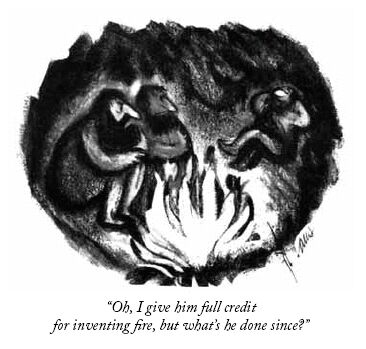
Uranium deserves to be featured in a blockbuster Hindi film: “Amitabh’s Uranium” (inspired by Mackenna's Gold , 1969)


Artist: Alain, The New Yorker, 8 March 1947

Wednesday, March 11, 2009

Was Holi-2009 Safer?

BBC reported in March 2008:

“A Delhi-based NGO has organised a campaign against drink driving in the city to ensure a safer Holi festival. Activists say thousands of people die in India in road accidents during the two-day festival.

Holi is the Hindu spring festival, when people typically spray each other with coloured water. It is also when traditionally people take alcohol or drinks laced with bhang - an intoxicant derived from the leaves and buds of the cannabis plant.”


Artist: David Sipress, The New Yorker, March 16 2009, Cartoon Caption Contest # 184

My caption:

“Mr. Holmes, I swear all these Dancing Men died on the road, not here. This is where they lay in wet clothes before my bouncers got rid of them.”

Monday, March 09, 2009

Humans made Fire 790,000+ Years ago...

Humans made fire 790,000+ Years ago and it has been useful ever since.

For instance, more than 100,000 young women were killed in fires in India in a single year, and many of those deaths were tied to domestic abuse, according to a new study published on Monday March 02, 2009.

Business Line reported on November 9, 2008:

"...In rural areas (of India), firewood and chips is by far the most important energy source for cooking. There has been no change over the years — as many as 75.4 per cent of rural households primarily depended on this source in 2006-07, against 75.5 per cent in 1999-00...Surprisingly, 41 per cent of urban households in Kerala depend on firewood and chips, followed by Chhattisgarh and Madhya Pradesh (35-36 per cent) and Rajasthan (34 per cent)..."

Reuters reported on October 26, 2008:

"A new study shows that humans had the ability to make fire nearly 790,000 years ago, a skill that helped them migrate from Africa to Europe.

By analysing flints at an archaeological site on the bank of the river Jordan, researchers at Israel's Hebrew University discovered that early civilizations had learned to light fires, a turning point that allowed them to venture into unknown lands..."

Maybe.


Artist : Robert Kraus, The New Yorker, July 1960

Friday, March 06, 2009

Park Your Nano Right in Your Drawing Room

The Times of India March 3, 2009: "Bookings for Nano will start from March 23: Tata Motors has advanced the booking date for its Nano, touted as the world's cheapest car, in India by three weeks,"


Artist: R K Laxman, The Times of India, September 1 2007


Artist: Tom Cheney, The New Yorker, 9 March 2009, Cartoon Caption Contest 183

my caption:

"I told you: our neighbour's drawing room was right above our bedroom."

Tuesday, March 03, 2009

India’s Lazy Cats Start Building Pyramids in My Drawing Room


Artist: Victoria Roberts, The New Yorker, March 2 2009 Cartoon Caption Contest 182

My caption:

"I know election fever has gripped India. My fat lazy cats have started building pyramids in my drawing room.”

Sunday, March 01, 2009

Why Mahatma Gandhi didn’t find History Very Useful

Historian T S Shejwalkar त्र्यंबक शंकर शेजवलकर (1895 - 1963) argued that Mahatma Gandhi didn’t have much use of history. (Preface to “Panipat 1761”, 1968)

I always wondered why.

After reading John Gray's "Straw Dogs" (2002) I have found a likely reason.

"...If we truly leave Christianity behind, we must give up the idea that human history has any meaning...In India, it was a collective dream, endlessly repeated. The idea that history must make sense is just a Christian prejudice."


Artist: George Price, The New Yorker, 14 August 1948

Friday, February 27, 2009

Unclaimed $1,456 B in Swiss Banks may soon help Indian Democracy

FT reported on February 20, 2009:

“As many as 52,000 American customers hid UBS accounts from the authorities in violation of tax laws, a US government lawsuit against the Swiss bank alleged on Thursday.

The Department of Justice filed a suit seeking to force UBS to disclose the holders of accounts with about $14.8bn in assets.

… UBS reached a landmark settlement with the US government in which the Swiss bank admitted having enabled clients to evade taxes, agreed to pay $780m in fines and turn over about 250 client names to the US…”

PRAFUL BIDWAI wrote in Frontline Feb 13, 2009:

“…Indian businessmen have stashed away billions of dollars in bank accounts abroad. According to a recent report attributed to the Swiss Banking Association, the estimated amount is an astronomical $1,456 billion, higher than the deposits from all other countries put together…”

India may not get $1,456 billion but even the fine amount of $780m looks pretty good.

Timing couldn’t be better because the impending Loksabha elections will surely deplete $1,456 billion considerably.

But spare a thought for an unknown Swiss banker handling Indian accounts. He may lose part of his bonus.

(Since 2001, Mike Luckovich has drawn a few brilliant cartoons of Osama bin Laden and his partner. Here is the latest one.)


Artist: Mike Luckovich

Wednesday, February 25, 2009

M F Husain Draws Statue of Liberty in Oscar Gown

The Asian Age of Feb 24, 2009 has printed the tribute of M F Husain to A R Rahman.

Mr. Husain has drawn Statue of Liberty tastefully, in Oscar gown, wielding Tanpura. She is displaying her considerable assets alright but not nude.

I wonder if he could have shown similar taste drawing Seeta. Read more about it here.


Artist: M F Husain, The Asian Age, February 24, 2009

Tuesday, February 24, 2009

Crouching Housing, Hidden Sanitation and Slum Dog Billionaire

I am happy for SDM but have always felt that good art needs no certification. Rabindranath would be Rabindranath- Dnyaneshwar ज्ञानेश्वर of Bengali-without the Nobel.

A R Rahman may be very good but Indian cinema has created many similar musical giants since Kundan Lal (K.L.)Saigal. (Wasn't he the tallest of them all?)

David Pilling has written "Can slumdogs become millionaires in India?" in FT February 18, 2009.

He says: "...Why are there no slums in China? China is better run than India, with more powerful city mayors who build basic infrastructure to support wealth-creating migrants. Indian politicians court the rural vote. Corruption corrodes infrastructure plans, though some states, such as Gujarat, are improving. China is authoritarian; when workers are no longer required, they can be shipped back to the countryside. A registration system maintains a strict distinction between urban and rural citizens. Democratic India must not go down this route. But it can learn from China by providing clean water, sewerage and basic housing...

...One critic of the film said it was “inconceivable” that a tea-boy from the slum would be allowed on to a television quiz show. Until that changes, India will only progress so far."

So what Mr. Pilling? Watching "Boot Polish"(1954) and listening to its soulful music, people of this country had tears in their eyes and great hope in their hearts and they have clung on to them since then.

And then we will have SDM-II aka SDB. It will eclipse Godfather-II.


Artist: Sudhir Tailang, The Asian Age, February 24, 2009