Launched on Nov 29 2006, now 2,500+ posts...This bilingual blog - 'आन्याची फाटकी पासोडी' in Marathi- is largely a celebration of visual and/or comic ...तुकाराम: "ढेकणासी बाज गड,उतरचढ केवढी"...George Santayana: " Everything in nature is lyrical in its ideal essence, tragic in its fate, and comic in its existence"... श्रीमंत बाळासाहेब पंतप्रतिनिधी : "बहुश्रुतता असल्याशिवाय सुसंस्कृतता नाही"
मेघदूत: "नीचैर्गच्छत्युपरि च दशा चक्रनेमिक्रमेण"
समर्थ शिष्या अक्का : "स्वामीच्या कृपाप्रसादे हे सर्व नश्वर आहे असे समजले. पण या नश्वरात तमाशा बहुत आहे."
G C Lichtenberg: “It is as if our languages were confounded: when we want a thought, they bring us a word; when we ask for a word, they give us a dash; and when we expect a dash, there comes a piece of bawdy.”
C. P. Cavafy: "I’d rather look at things than speak about them."
Martin Amis: “Gogol is funny, Tolstoy in his merciless clarity is funny, and Dostoyevsky, funnily enough, is very funny indeed; moreover, the final generation of Russian literature, before it was destroyed by Lenin and Stalin, remained emphatically comic — Bunin, Bely, Bulgakov, Zamyatin. The novel is comic because life is comic (until the inevitable tragedy of the fifth act);...”
सदानंद रेगे: "... पण तुकारामाची गाथा ज्या धुंदीनं आजपर्यंत वाचली जात होती ती धुंदी माझ्याकडे नाहीय. ती मला येऊच शकत नाही याचं कारण स्वभावतःच मी नास्तिक आहे."
".. त्यामुळं आपण त्या दारिद्र्याच्या अनुभवापलीकडे जाऊच शकत नाही. तुम्ही जर अलीकडची सगळी पुस्तके पाहिलीत...तर त्यांच्यामध्ये त्याच्याखेरीज दुसरं काही नाहीच आहे. म्हणजे माणसांच्या नात्यानात्यांतील जी सूक्ष्मता आहे ती क्वचित चितारलेली तुम्हाला दिसेल. कारण हा जो अनुभव आहे... आपले जे अनुभव आहेत ते ढोबळ प्रकारचे आहेत....."
Kenneth Goldsmith: "In 1969 the conceptual artist Douglas Huebler wrote, “The world is full of objects, more or less interesting; I do not wish to add any more.”1 I’ve come to embrace Huebler’s ideas, though it might be retooled as “The world is full of texts, more or less interesting; I do not wish to add any more.” It seems an appropriate response to a new condition in writing today: faced with an unprecedented amount of available text, the problem is not needing to write more of it; instead, we must learn to negotiate the vast quantity that exists. How I make my way through this thicket of information—how I manage it, how I parse it, how I organize and distribute it—is what distinguishes my writing from yours."
Tom Wolfe: "The first line of the doctors’ Hippocratic oath is ‘First, do no harm.’ And I think for the writers it would be: ‘First, entertain.’"
विलास सारंग: "… इ. स. 1000 नंतर ज्या प्रकारची संस्कृती रुढ झाली , त्यामध्ये साधारणत्व व विश्वात्मकता हे गुण प्राय: लुप्त झाले...आपली संस्कृती अकाली विश्वात्मक साधारणतेला मुकली आहे."
Wednesday, January 24, 2007
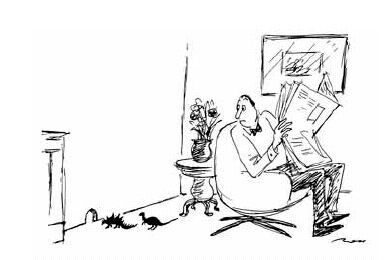
Honey, I shrunk the Jurassic Park
Jurassic Park is a tale of an experiment which has gone horribly wrong.
What if we shrunk the giant dinos like Stegosaurus and Trex? Can we co-exist?
On a practical note, are roaches and mosquitoes basically dinos shrunk?
Thursday, January 18, 2007
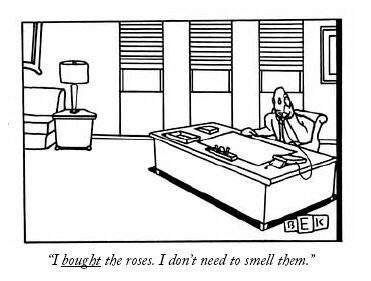
Smell the flowers along the way
Tuesday, January 16, 2007
Being symbiotic with people
After fighting bloodiest battle of the time, Pandavas, the victors, began their final journey towards heaven atop Himalayas, a dog accompanied them.
All except the eldest brother- Yudhishthira- died on their way. Only Yudhishthira and the dog reached the door of the heaven. Indra came on his chariot to get pious and truthful Yudhishthira to heaven. Yudhishthira paid his respect to Lord Indra and asked his companion dog to get into the chariot. Indra was shocked, “A dog to heaven?” When Yudhishthira refused to go to heaven without the dog, the God of Death, Dharmaraj Yama emerged out of the dog and blessed Yudhishthira. Yama was testing the steadfastness of Yudhishthira.
If there was any other animal instead of dog, it may not have understood when Yudhishthira motioned it to get into the chariot!
The Economist in Feb 2004 had a story "Sensitive souls" on dogs. Why did dog become man's best friend?
It says: "NO SPECIES has developed a closer relationship with humanity than the dog. But that relationship's basis—what it is about dogs that allows them to live at ease with people—is still little understood. After all, dogs are descended from wolves, which are big, scary carnivores that would certainly have competed with early man for prey, and might not have been averse to the occasional human as a light snack……
sensitivity to human social cues is a recent genetic adaptation that has evolved specifically to allow dogs to enter a new ecological niche—that of being symbiotic with people."
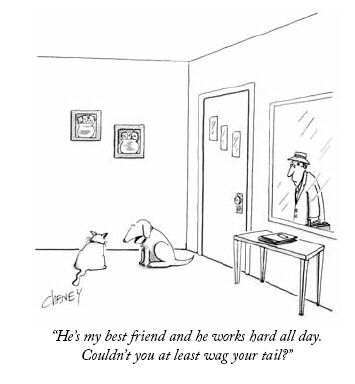
Therefore no amount of teaching or coercion will help a cat to wag its tail!
Artist : Tom Cheney Publication: The New Yorker Nov 11 1985
Sunday, January 14, 2007
Free Tagore and Sane-guruji
This change was outrageous and Tagore himself would have cried foul.
"Jawaharlal Nehru's literary works, turned over toprivate publishers last year (1994), have emerged bestsellers. And the books,re-born with a more stylish and contemporary look, are bringing rich returnsfor their two main royalty owners - his great grandchildren Rahul and Priyanka Gandhi. The copyrights of Nehru's writings, published for decades by OxfordUniversity Press and the National Book Trust and funded by Jawaharlal NehruMemorial Fund and Children's Book Trust, were handed over last year to Penguin India Ltd. So the Gandhi siblings will continue to get 10-15 percent royalty on the sales of these books till 2024. "
The Economist (Apr 15th 2004 ) : "Copyright was originally designed to restrict publishers from exerting too much control over information; today it constrains individuals from creating new works".
Lessig says: ".....we come from a tradition of “free culture”—not “free” as in “free beer” (to borrow a phrase from the founder of the freesoftware movement2), but “free” as in “free speech,” “free markets,” “free trade,” “free enterprise,” “free will,” and “free elections.” A free culture supports and protects creators and innovators. It does this directly by granting intellectual property rights. But it does so indirectly by limiting the reach of those rights, to guarantee that follow-on creators and innovators remain as free as possible from the control of the past. A free culture is not a culture without property, just as a free market is not a market in which everything is free. The opposite of a free culture is a “permission culture”—a culture in which creators get to create only with the permission of the powerful, or of creators from the past."
In his famous book "Free Culture" he says: ".......the free culture that I defend in this book is a balance between anarchy and control. A free culture, like a free market, is filled with property. It is filled with rules of property and contract that get enforced by the state. But just as a free market is perverted if its property becomes feudal, so too can a free culture be queered by extremism in the property rights that define it. That is what I fear about our culture
today. It is against that extremism that this book is written."
Therefore, let Bible be Bible first and then S&S publication!
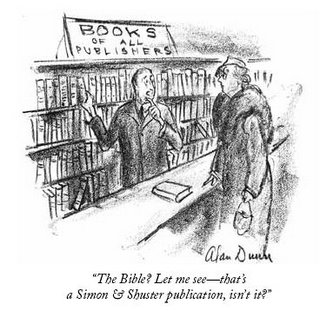
Artist : Alan Dunn Publication: The New Yorker 31 Oct1936
All my genius is in my nostrils
Artist : George Price Publication: The New Yorker 7 Nov 1936Friedrich Nietzsche: "All my genius is in my nostrils."
Mine too! Not for its Aryan straightness -far from it, it is quite Dravidian- but for its core function-SMELLING. For me, olfactory clues are more reliable than visual ones. When I walk into a gathering or a crowd, I am concerned about the smell. If it smells well, I settle down.
Lara Feigel has written a brilliant essay “Turning up our noses” for Pospect Magazine December 2006.
She says: “Humankind, even in its most primitive form, had a brain very similar to ours now, yet we have a much weaker sense of smell than our cave-dwelling ancestors. Indeed, congenital anosmia is on the increase, so the whole human race may be heading for an anosmic future. Characteristically, Freud suggests that ancient psychosexual anxieties are behind this decline in our nasal capabilities. For him, it all began when man raised himself from the ground to walk on two feet, flashing his genitals to all and sundry. The shame of this sudden exposure, the theory goes, triggered a species-wide repression of the sense of smell. Humans found genitals less embarrassing when they were seen but not smelt. This meant that men were no longer able to smell menstruation or ovulation. Smell became less important in creating sexual excitement, and humans began to be turned on more by the look of each other's bodies than the odour. As evidence for this view of smell as a forbidden, repressed sensation, Freud cites the fact that his hysterical patients often had extremely sensitive noses…
The 17th-century poet Robert Herrick found Julia's sweat as much of a turn-on as Napoleon did Josephine's 200 years later. (He famously sent word from the thick of battle that she should abstain from washing now that his return was nigh.) ”
I don’t want to be part of such an anosmic future when I have to say : “I can’t smell a thing”. I would rather be Freud’s hysterical patient!
Anti incumbency
"For decades now, India's underprivileged have used elections to register their protests against joblessness, inequality and corruption. In the 2004 general elections, they voted out a central government that claimed that India was "shining," bewildering not only most foreign journalists but also those in India who had predicted an easy victory for the ruling coalition."
For first few decades of our republic's existence, Congress party ran away with all the electoral success.
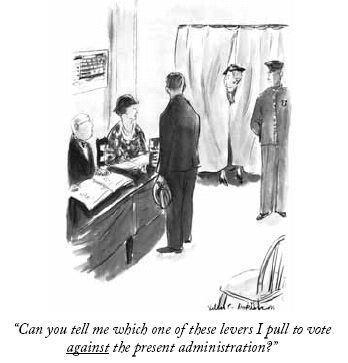
Not any more. Now the party in government, except places like West Bengal, gets trounced because our voter behaves like...

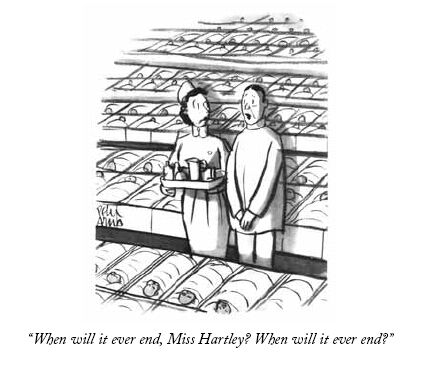
Artist : Helen E Hokinson Publication: The New Yorker 31 Oct 1936
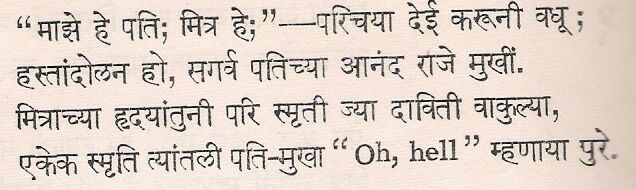
Oh, hell


In Marathi literature, poet the late B S Mardhekar बा. सी. मर्ढेकर is next to only the giants - saint-poets - Dnyaneshwar, Eknath, Tukaram and Ramdas. He was deeply entrenched in native traditions and also influenced by Western poetry of T S Eliot, W H Auden among few others.
Literary critic Shri M V Dhond म वा धोंड has written perceptively on Mardhekar’s poetry. Dhond has discovered meanings there, which may pleasantly surprise even Mardhekar!
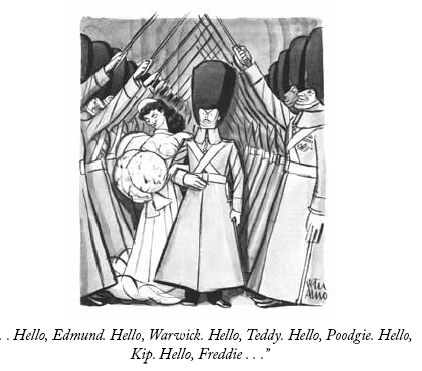
But the poem above is straightforward and meant as a caption for Peter Arno's picture from The New Yorker of 25 July 1936.
The Guide
Raju towards the end is forced to fast to bring rains. Food is on his mind all the time. But then..."If by avoiding food I should help the trees bloom, and the grass grow, why not do it thoroughly? For the first time in his life he was making an earnest effort, for the first time he was learning the thrill of full application, outside money and love; for the first time he was doing something in which he was not personally interested. He felt suddenly so enthusiastic that it gave him a new strength to go through the ordeal....."
And then it rains.................Next, can Raju prevent wars? Sure, if we learn to breath properly!
Artist: Helen E Hokinson Publication : The New Yorker 25 Jul 1936
Saturday, January 13, 2007
Thomas Malthus, eat my shorts
Artist : Peter Arno Publication: The New Yorker 17 Oct 1936World 6,569,534,871 @ 13:41 GMT (EST+5) on Jan 13, 2007 and counting!
courtesy: http://www.census.gov/main/www/popclock.html
What Should a Billionaire Give – and What Should You?

Artist : Richard Decker Publication : The New Yorker 26 Dec 1936
On December 17, 2006 for NYT, Peter Singer has written thought provoking "What Should a Billionaire Give – and What Should You?"
He says: “The Nobel Prize-winning economist and social scientist Herbert Simon estimated that “social capital” is responsible for at least 90 percent of what people earn in wealthy societies like those of the United States or northwestern Europe. By social capital Simon meant not only natural resources but, more important, the technology and organizational skills in the community, and the presence of good government. These are the foundation on which the rich can begin their work. “On moral grounds,” Simon added, “we could argue for a flat income tax of 90 percent.” Simon was not, of course, advocating so steep a rate of tax, for he was well aware of disincentive effects. But his estimate does undermine the argument that the rich are entitled to keep their wealth because it is all a result of their hard work. If Simon is right, that is true of at most 10 percent of it.”
Singer's Answer:
In India and other similar countries, people like me who enjoyed huge public subsidies in higher education should remember this all the time.