मेघदूत: "नीचैर्गच्छत्युपरि दशा चक्रनेमिक्रमेण"

समर्थ शिष्या अक्का : "स्वामीच्या कृपाप्रसादे हे सर्व नश्वर आहे असे समजले. पण या नश्वरात तमाशा बहुत आहे."

G C Lichtenberg: “It is as if our languages were confounded: when we want a thought, they bring us a word; when we ask for a word, they give us a dash; and when we expect a dash, there comes a piece of bawdy.”

C. P. Cavafy: "I’d rather look at things than speak about them."

Martin Amis: “Gogol is funny, Tolstoy in his merciless clarity is funny, and Dostoyevsky, funnily enough, is very funny indeed; moreover, the final generation of Russian literature, before it was destroyed by Lenin and Stalin, remained emphatically comic — Bunin, Bely, Bulgakov, Zamyatin. The novel is comic because life is comic (until the inevitable tragedy of the fifth act);...”

सदानंद रेगे: "... पण तुकारामाची गाथा ज्या धुंदीनं आजपर्यंत वाचली जात होती ती धुंदी माझ्याकडे नाहीय. ती मला येऊच शकत नाही याचं कारण स्वभावतःच मी नास्तिक आहे."

".. त्यामुळं आपण त्या दारिद्र्याच्या अनुभवापलीकडे जाऊच शकत नाही. तुम्ही जर अलीकडची सगळी पुस्तके पाहिलीत...तर त्यांच्यामध्ये त्याच्याखेरीज दुसरं काही नाहीच आहे. म्हणजे माणसांच्या नात्यानात्यांतील जी सूक्ष्मता आहे ती क्वचित चितारलेली तुम्हाला दिसेल. कारण हा जो अनुभव आहे... आपले जे अनुभव आहेत ते ढोबळ प्रकारचे आहेत....."

Kenneth Goldsmith: "In 1969 the conceptual artist Douglas Huebler wrote, “The world is full of objects, more or less interesting; I do not wish to add any more.”1 I’ve come to embrace Huebler’s ideas, though it might be retooled as “The world is full of texts, more or less interesting; I do not wish to add any more.” It seems an appropriate response to a new condition in writing today: faced with an unprecedented amount of available text, the problem is not needing to write more of it; instead, we must learn to negotiate the vast quantity that exists. How I make my way through this thicket of information—how I manage it, how I parse it, how I organize and distribute it—is what distinguishes my writing from yours."

Tom Wolfe: "The first line of the doctors’ Hippocratic oath is ‘First, do no harm.’ And I think for the writers it would be: ‘First, entertain.’"

विलास सारंग: "… . . 1000 नंतर ज्या प्रकारची संस्कृती रुढ झाली , त्यामध्ये साधारणत्व विश्वात्मकता हे गुण प्राय: लुप्त झाले...आपली संस्कृती अकाली विश्वात्मक साधारणतेला मुकली आहे."

Tuesday, April 15, 2014

Noah's Ark and Rama's Bridge: Powered by Geology

Today Chaitra-purnima (चैत्र पोर्णिमा) April 15 2014 is Hanuman Jayani (हनुमान जयंती) and the birth anniversary of my aunt Kumud-mavashi (कुमुद-मावशी)

When I lived in Miraj (मिरज), a town of gymnasiums (तालीम), the day used to be very special.

Wendy Doniger, 'The Hindus : an alternative history', 2009:

"..Indeed flood myths are found in most of the mythologies of the world: Africa, the Near East, Australia, South Seas, Scandinavia, the Americas, China, Greece. They are widespread because floods are widespread, especially along the great rivers that nurture early civilizations (and even more widespread in the lands watered by the monsoons). There are significant variants: Some cultures give one reason for the flood, some other reasons, some none; sometimes one person survives, sometimes several, sometimes many (seldom none—or who could tell the story?—though the creator sometimes starts from scratch again); some survive in boats, some by other means. 

In the oldest extant Indian variant, in the Brahmanas, Manu, the first human being, the Indian Adam, finds a tiny fish who asks him to save him from the big fish who will otherwise eat him. This is an early expression of concern about animals being eaten, in this case by other animals; “fish eat fish,” what we call “dog eat dog,” is the Indian term for anarchy. The fish promises, in return for Manu’s help, to save Manu from a great flood that is to come. Manu protects the fish until he is so big that he is “beyond destruction” and then builds a ship (the fish tells him how to do it); the fish pulls the ship to a mountain, and when the floodwaters subside, Manu keeps following them down. The text ends: “The flood swept away all other creatures, and Manu alone remained here.” The theme of “helpful animals” who requite human kindness (think of Androcles and the lion) teaches two morals: A good deed is rewarded, and be kind to (perhaps do not eat?) animals..."

Noah, a Hollywood film, was released on March 28 2014 in US. There is a lot of debate that is going on whether the real life event influenced the Biblical myth.

Smithsonian.com mentions ten such stories from around the world and the geology that may have influenced them.

One of them is Rama setu

Courtesy: Wikimedia Commons

Saturday, April 12, 2014

I Wish That's All He Did...George W Bush Paints


Karl Rove, a senior adviser to George W Bush, October 2004:

"We're an empire now, and when we act, we create our own reality. And while you're studying that reality – judiciously, as you will – we'll act again, creating other new realities, which you can study too, and that's how things will sort out. We're history's actors … and you, all of you, will be left to just study what we do."  


George W. Bush, Indian Prime Minister Dr. Manmohan Singh's friend, is in the news again.

He has been busy making his own "new realities", this time not with his verbal strokes, like WMD or War-on-terror,  but with his paint-brush.


Artist: George W. Bush

Courtesy: AP


A lot of people, as usual led by Jon Stewart, are having a lot of fun.

Political leaders making art is one of my favourite subjects. It has appeared on this blog twice earlier: once for Mr. Bal Thackeray and once for Mr. Winston Churchill.

My wish:  they only did the art instead of politics. I feel the same for Mr. Bush.

And as is typical of Bush. he has been accused of using Google image search for his inspiration and not his actual meetings with the leaders or the White House photo archive, if one exists.


Artist: Charles E. Martin, The New Yorker, 6 February 1954


Artist: Kipper Williams


courtesy: Spectator, UK, April 2014

Tuesday, April 08, 2014

Urmila, Three Salutes to You...Or Is It? उर्मिले, त्रिवार वंदन तुला?

Today April 8 2014 is Shriram Navami

I don't know much about Urmila, Laxman's wife in Ramayana.

But generally, I had heard some good things about her. 

The following wonderful song in Marathi, for instance,  written by Raja Mangalvedhekar ( राजा मंगळवेढेकर), composed by Prabhakar Jog ( प्रभाकर जोग), sung by Ram Phatak (राम फाटक) praises her.

You may listen to it here

"उर्मिले, त्रिवार वंदन तुला !

त्यजुनि राजसुख जरी जानकी
वनात गेली प्रभु-सांगाती
राजमंदिरी तूच साहिल्या वियोगातल्या कळा !

सतत साउलीसम रामाला
भ्राता लक्ष्मण कृतार्थ झाला
तुझ्या मनातिल मुक्या भावना, कधी न तो उमगला !

अंधारातिल तू ज्योतीसम
आयु वेचिले अपुले कण कण
सुख-तृप्‍तीचा कधि न तुला गे वाराही लाभला !

राम-जानकी वियोगातुनी
घडले रामायण हे भुवनी
तुझी तपस्या, तुझा त्याग परि नच लोकी ठसला !

थोरचरित तू, दूर राहुनी
सुगंध भरला तू रामायणि
उपेक्षाच परि तुझ्या कपाळी न्याय जगी आगळा !"

Imagine my shock when I saw the following picture.


"Indian Mythology has it's very own Sleeping Beauty!"

 Art by Saboo Achu

courtesy: The Amar Chitra Katha Studio page on FB

 Apart from the fact that she doesn't look all that beautiful, Urmila slept for 14 years!

She took all the sleep of Lakshmana so that he could remain awake and ever attentive to Rama and Sita’s needs. Even if that is so, she should have been awake for at least 8 hours of the day.

The song says:

 "तुझ्या मनातिल मुक्या भावना, कधी न तो उमगला !"

(He never understood your unspoken feelings)...How couldn't he have? He surely would have asked why she slept for that long...Was she feeling that unwell?

The song further says:

 "अंधारातिल तू ज्योतीसम
आयु वेचिले अपुले कण कण
सुख-तृप्‍तीचा कधि न तुला गे वाराही लाभला !"

(You pecked flame-like bright spots of your life in darkness...you never enjoyed breeze of bliss...)

Sure if you sleep for 14 years, it's all darkness around you.

तुझी तपस्या, तुझा त्याग परि नच लोकी ठसला !

(Your penance, your sacrifice did not register on collective memory of the people.)

How can it if you disappear, for 14 years, from people's sight?

Wednesday, April 02, 2014

Threaten Them With Democracy


Pankaj Mishra, November 2013:

"...Many observers of India are generally impressed by the procedures of Indian democracy, with its routine elections. India, Bhagwati and Panagariya assert, “has all elements of a liberal democracy with the poor and the underprivileged having access to effective politics at the ballot box.” But as Sen and Drèze point out, “the success of a democracy depends ultimately on the vigor of its practice.” Certainly, creeping authoritarianism of the kind witnessed in India can make political reform from below seem more urgent than economic engineering from the top. “Educate, agitate, and organize,” the disenchanted low-caste author of India’s constitution B.R. Ambedkar exhorted. Many more Indians will have to exercise these democratic rights if they wish to transform the profoundly damaging elitist character of Indian society and politics..."

John Dos Passos, 'U. S. A', 1930:

"....America our nation has been beaten by strangers who have turned our language inside out who have taken the clean words our fathers spoke and made them slimy and foul 

their hired men sit on the judge’s bench they sit back with their feet on the tables under the dome of the State House they are ignorant of our beliefs they have the dollars the guns the armed forces the powerplants

they have built the electric chair and hired the executioner to throw the switch 

all right we are two nations 

America our nation has been beaten by strangers who have bought the laws and fenced off the meadows and cut down the woods for pulp and turned our pleasant cities into slums and sweated the wealth out of our people and when they want to they hire the executioner to throw the switch..."
 
Leader, Economic & Poltical Weekly, March 22 2014:

"...Sadly, this is not the age of independent journalists; it is the high noon of media corporations. The “Masked Ball of Democracy” toasts to the coming “free and fair elections” – “There is a magic to it that people in totalitarian states can never grasp”, the largest English-language newspaper pompously declares. The truth is that elections often go to the highest bidder, and this election may indeed bring a totalitarian party to power..."

Edward Luce, FT, 'America’s democracy is fit for the 1%', March 30 2014:

"...Should one person one vote be replaced by one dollar one vote? Most economists agree that the effects of technology and globalisation will result in even more inequality in the years ahead, perhaps spectacularly so. The only real countervailing force is politics.
It would be a tragedy for US democracy were its political system to act as a spur, rather than a check, on the extremes of our age."
 
India's federal elections will soon be upon us.


Artist: David Sipress, The New Yorker, September 2013

Friday, March 28, 2014

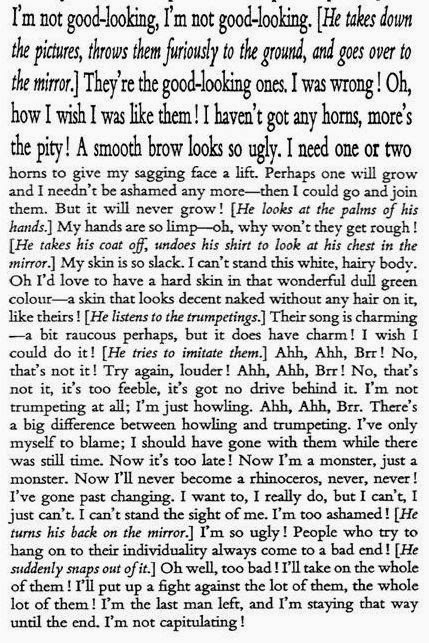
I Need One or Two Horns to Give My Sagging Face a Lift

Today March 28 2014 is 20th Death Anniversary of Eugène Ionesco, the creator of Rhinoceros, 1959


From : 'Rhinoceros', 1959


Cartoon Caption Contest #421

Artist: Joe Dator, The New Yorker, March 2014

 My caption:

"Honey, I Need One or Two Horns to Give My Sagging Face a Lift."

or

"Honey, I'm Not Trumpeting At All; I'm Just Howling."


Monday, March 24, 2014

2057 Ides of March...240 August 30th


This month 2057 years ago Roman emperor Julius Caesar was assassinated


William Shakespeare:

"Let's be sacrificers, but not butchers, Caius.
...And, gentle friends,
Let's kill him boldly, but not wrathfully;
Let's carve him as a dish fit for the gods,
Not hew him as a carcass fit for hounds;
And let our hearts, as subtle masters do,
Stir up their servants to an act of rage,
And after seem to chide 'em."
      --Brutus from "Julius Caesar" Act 2, scene 1, 166, 171–177

Charles Simic, March 2014:

"...It is the selective morality of our interventionists that offends me. They judge acts of violence not by their consequences, but on whether someone else or we are the perpetrators—if the acts are done by us they tend to have their full approval. Hypocrites who are blind or indifferent to their own country’s atrocities are not well suited for playing the part of moral conscience of the world,...There are few things that never change in this world of ours, but one of them happens to be the near certainty that those who raise their voices against injustice get betrayed in the end."

Judith Flander:

“Murder is like hearing blustery rain on the windowpane when sitting indoors. It reinforces a sense of safety, even of pleasure, to know that murder is possible, just not here.”

Colin Wilson, ‘CRIMINAL HISTORY OF MANKIND’, 1984:

“…Crime is renewed in every generation because human beings are children; very few of us achieve anything like adulthood. But at least it is not self-perpetuating, as human creativity is…”


Caesar's assassination lives in memory largely because of Shakespeare’s great play. 

The most memorable assassination in the medieval history of Maharashtra is that of Narayanrao Peshwa (नारायणराव पेशवा) that took place on the afternoon of August 30 1773 during the Ganesh Chaturthi festival.

There is very little literature in Marathi based on that event, let alone any great one. There is no great painting, done later, either.

This is surprising because Pune then was the most powerful force in the politics of South Asia.

A Marathi novel (not a good one) based on this event was one of the earliest serious books I read as a kid. I have often imagined the bloody event. The Peshwa was not alone to be killed that afternoon. Apparently, almost a dozen people, including two women, and even a couple of cows were killed along with him.

How the young man of just eighteen must have run for his life...did he stumble and fall while running? Which all places he ran to before he got killed? How messy the crime scene must have looked...who cleaned it? How was Peshwa's body prepared for cremation? How was the news received by the stalwarts of the Peshwa court? Which exact Marathi words were used by the plotters of the murder? Did anybody speak like Brutus and Antony? Was it raining that day in Pune?

There is so much tragic drama in all this...

I also think that the event has a great significance as a turning point in Maharashtra's politics.

People, led by Brahmins,  became audacious in their acts to grab the power. They started getting confident that they would eventually get away even with a regicide.

 John Gray says: "The true lesson of Machiavelli is that the alternative to politics is not law but unending war." Maybe this murder averted a revolt or an immediate start of an unending war among various factions that existed in Peshwa's regime.

Another lesson, and a shocking one,  of Machiavelli's 'The Prince' is not that politics demands dirty (bloody?) hands, but that politicians shouldn’t care.


I feel every political event in Maharashtra's politics,  that ordinary people judge as a 'shameful' one,  has its roots in that afternoon of August 1773.  A sitting Brahmin 'king' was brutally slaughtered, in his own house, during one of the biggest Hindu festivals, apparently on the orders of his uncle and right under his nose.

The uncle went on to live for another ten years and continued to play a significant role in the politics of Maharashtra until his death. His son, Baji Rao II, went on to become the 'king' in due course and 'served' the people of India the longest among all the Peshwas.

In India, today, all this does not sound strange at all.

 Should Vijay Tendulkar (विजय तेंडुलकर) have paid more attention to this political murder than the episode of Ghashiram Kotwal (घाशीराम कोतवाल) to write his political satire?

R G Gadkari (राम गणेश गडकरी), Annasaheb Kirloskar (अण्णासाहेब किर्लोस्कर), G B Deval (गो ब देवल), S K Kolhatkar (श्रीपाद कृष्ण कोल्हटकर), K P Khadilkar (कृष्णाजी प्रभाकर खाडिलकर) never wrote any (well-known) play based on the event.

I wonder why.


 'The Death of Caesar', 1804-1805, Oil on Canvas  Artist: Vincenzo Camuccini (1771-1844)  courtesy:  Wikimedia Commons