मेघदूत: "नीचैर्गच्छत्युपरि दशा चक्रनेमिक्रमेण"

समर्थ शिष्या अक्का : "स्वामीच्या कृपाप्रसादे हे सर्व नश्वर आहे असे समजले. पण या नश्वरात तमाशा बहुत आहे."

G C Lichtenberg: “It is as if our languages were confounded: when we want a thought, they bring us a word; when we ask for a word, they give us a dash; and when we expect a dash, there comes a piece of bawdy.”

C. P. Cavafy: "I’d rather look at things than speak about them."

Martin Amis: “Gogol is funny, Tolstoy in his merciless clarity is funny, and Dostoyevsky, funnily enough, is very funny indeed; moreover, the final generation of Russian literature, before it was destroyed by Lenin and Stalin, remained emphatically comic — Bunin, Bely, Bulgakov, Zamyatin. The novel is comic because life is comic (until the inevitable tragedy of the fifth act);...”

सदानंद रेगे: "... पण तुकारामाची गाथा ज्या धुंदीनं आजपर्यंत वाचली जात होती ती धुंदी माझ्याकडे नाहीय. ती मला येऊच शकत नाही याचं कारण स्वभावतःच मी नास्तिक आहे."

".. त्यामुळं आपण त्या दारिद्र्याच्या अनुभवापलीकडे जाऊच शकत नाही. तुम्ही जर अलीकडची सगळी पुस्तके पाहिलीत...तर त्यांच्यामध्ये त्याच्याखेरीज दुसरं काही नाहीच आहे. म्हणजे माणसांच्या नात्यानात्यांतील जी सूक्ष्मता आहे ती क्वचित चितारलेली तुम्हाला दिसेल. कारण हा जो अनुभव आहे... आपले जे अनुभव आहेत ते ढोबळ प्रकारचे आहेत....."

Kenneth Goldsmith: "In 1969 the conceptual artist Douglas Huebler wrote, “The world is full of objects, more or less interesting; I do not wish to add any more.”1 I’ve come to embrace Huebler’s ideas, though it might be retooled as “The world is full of texts, more or less interesting; I do not wish to add any more.” It seems an appropriate response to a new condition in writing today: faced with an unprecedented amount of available text, the problem is not needing to write more of it; instead, we must learn to negotiate the vast quantity that exists. How I make my way through this thicket of information—how I manage it, how I parse it, how I organize and distribute it—is what distinguishes my writing from yours."

Tom Wolfe: "The first line of the doctors’ Hippocratic oath is ‘First, do no harm.’ And I think for the writers it would be: ‘First, entertain.’"

विलास सारंग: "… . . 1000 नंतर ज्या प्रकारची संस्कृती रुढ झाली , त्यामध्ये साधारणत्व विश्वात्मकता हे गुण प्राय: लुप्त झाले...आपली संस्कृती अकाली विश्वात्मक साधारणतेला मुकली आहे."

Friday, March 09, 2007

the passage of time

Simone Weil
“All the tragedies which we can imagine return in the end to the one and only tragedy: the passage of time.”

Artist : Dean Victor Publication: The New Yorker 30 May 2005

Existing or Pre-existing?

Indians are increasingly being asked to save more for their health care by going in for health insurance. Their neighbourhood doctor no more treats them without myriad and expensive diagnostic tests. Health insurance we are told is the way to go.

Paul Krugman recently asked in his NYT column: "Is the health insurance business a racket?" He concludes: "It’s the ugly incentives provided by a system in which giving care is punished, while denying it is rewarded."

My limited personal experience has taught me that insurance companies invent ways to deny you benefit. Language is a powerful tool in their hand..........

Artist: Michael Crawford Publication: The New Yorker 23 May 1994

He's from Texas

George W. Bush has finally arrived with all his horns blazing!

Artist : Dana Fradon Publication: The New Yorker 7 March 1994

Let them eat cake

Marie Antoinette may or may not have said: "Let them eat cake". But we all know the sentiment behind such a statement.

For sure, ordinary folks have always suffered through history. Suffering on a scale, most of blog reading/writing people like us cannot imagine.

I am reading "The Last Mughal" by William Dalrymple. The debate whether 1857 events should be called first war of Indian independence or mutiny will go on but the overwhelming sense I get is the suffering of ordinary people of Delhi all through that.

Similarly M V Dhond's Marathi book "Marhati Lavani" describes the painful struggle of population of Pune while rule of Peshwa degenerated in late 18th/early 19th century.

Therefore, you wonder if D D Kosambi amongst all is closest to the truth when he says: “It seems to me that Gita philosophy, like so much else in India’s ‘spiritual’ heritage, is based in the final analysis upon the inability to satisfy more than the barest material needs of a large number”

There could be many Quixotian solutions to this. Use politically correct language. Stop calling poor, poor! Stop calling third class compartment, third class. That is what Indian Railway did when one day they just erased one line from III to make it II!


Artist : Bernard Schoenbaum Publication: The New Yorker 28 Mar 1994

मैं तुम्हारे बच्चे कि माँ बनने वाली हूँ

A lot of Hindi films has this dialogue- "I am going to be mother of your child."

And then all hell breaks loose! It always is 'information of startling nature' to the receipent of the news. As if stokes indeed got the babies.

Artist : Peter Arno Publication: The New Yorker 26 Dec 1936

Nasty but cute!

Every generation has its fads. (needless to say older generations don't like most of them. Socrates: “Children nowadays love luxury, have bad manners, contempt for authority, disrespect for elders”).

Most interesting of those fads is their language. You would be very lucky to understand it if you are not one of them. SMS makes it even worse -that 'weird' language is further transformed.
Artist : Barbara Shermund Publication: The New Yorker 20 Jun 1936

Thursday, March 08, 2007

Think Win-Win

Those like me who have worked in corporate world know this oft-repeated phrase. It works!

Here is a classic win-win talk. Often one is confused on whose 'win'.
Artist : Arnie Levin Publication: The New Yorker 16 May 1994

Soft Skills

Nothing is absolute.

It is the spin we give that matters today. Look how Tony Blair 'sold' Iraq war to Brits. Corporate world calls it marketing.

Artist: Eric Teitelbaum Publication: The New Yorker 13 Jun 1994

International Women's Day

Is this what every woman tells every man - 'I have evolved and you haven't"!

Artist : Ed Fisher Publication: The New Yorker 7 May 1960
Thursday, February 01, 2007

It’s because we no longer have literature

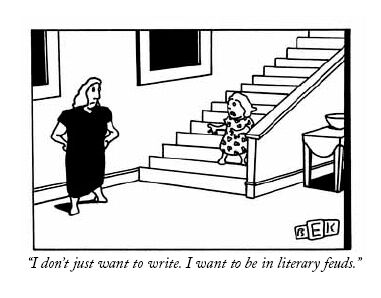
In my childhood, before the age of TV, feud was the second most effective crowd puller. First of course was a death in the neighbourhood. Third was a road accident and so on.

Literary feuds can get very exicitng if participants are sufficiently bitchy. In Marathi world, there have been many such feuds.

For instnace- Khandekar Vs. Phadke “Is art only for the sake of art?”. P K Atre Vs. many. B S Mardhekar Vs. G D Madgulkar, P L Deshpande (with a sideshow Govind Talwalkar) Vs. Durga Bhagwat दुर्गा भागवत, Jaywant Dalvi Vs. many and so on.

My father’s first book – “Dhoka, Hamrasta Pudhe Ahe” was savaged by many as obscene but literary critic D K Bedekar defended it, creating quite a spectacle for onlookers. (btw- My father got so scared by fracas, he has never wrtten another controversial book since.)

These days there is almost a drought of feuds in Marathi literary world. In Marathi literary magazine Lalit, some abortive attempts are made from time to time to start one. Alas, those attempts are just that- abortive.

RACHEL DONADIO has written an essay “Art of the Feud” for NYT Nov 19 2006:

‘To some, the paucity of feuds is connected to the larger state of literary culture. “It’s not because we no longer have feuds,” said Fran Lebowitz, the writer. “It’s because we no longer have literature.” ’

Artist : Bruce Eric Kaplan Publication: The New Yorker 27 Jun 1994