मेघदूत: "नीचैर्गच्छत्युपरि दशा चक्रनेमिक्रमेण"

समर्थ शिष्या अक्का : "स्वामीच्या कृपाप्रसादे हे सर्व नश्वर आहे असे समजले. पण या नश्वरात तमाशा बहुत आहे."

G C Lichtenberg: “It is as if our languages were confounded: when we want a thought, they bring us a word; when we ask for a word, they give us a dash; and when we expect a dash, there comes a piece of bawdy.”

C. P. Cavafy: "I’d rather look at things than speak about them."

Martin Amis: “Gogol is funny, Tolstoy in his merciless clarity is funny, and Dostoyevsky, funnily enough, is very funny indeed; moreover, the final generation of Russian literature, before it was destroyed by Lenin and Stalin, remained emphatically comic — Bunin, Bely, Bulgakov, Zamyatin. The novel is comic because life is comic (until the inevitable tragedy of the fifth act);...”

सदानंद रेगे: "... पण तुकारामाची गाथा ज्या धुंदीनं आजपर्यंत वाचली जात होती ती धुंदी माझ्याकडे नाहीय. ती मला येऊच शकत नाही याचं कारण स्वभावतःच मी नास्तिक आहे."

".. त्यामुळं आपण त्या दारिद्र्याच्या अनुभवापलीकडे जाऊच शकत नाही. तुम्ही जर अलीकडची सगळी पुस्तके पाहिलीत...तर त्यांच्यामध्ये त्याच्याखेरीज दुसरं काही नाहीच आहे. म्हणजे माणसांच्या नात्यानात्यांतील जी सूक्ष्मता आहे ती क्वचित चितारलेली तुम्हाला दिसेल. कारण हा जो अनुभव आहे... आपले जे अनुभव आहेत ते ढोबळ प्रकारचे आहेत....."

Kenneth Goldsmith: "In 1969 the conceptual artist Douglas Huebler wrote, “The world is full of objects, more or less interesting; I do not wish to add any more.”1 I’ve come to embrace Huebler’s ideas, though it might be retooled as “The world is full of texts, more or less interesting; I do not wish to add any more.” It seems an appropriate response to a new condition in writing today: faced with an unprecedented amount of available text, the problem is not needing to write more of it; instead, we must learn to negotiate the vast quantity that exists. How I make my way through this thicket of information—how I manage it, how I parse it, how I organize and distribute it—is what distinguishes my writing from yours."

Tom Wolfe: "The first line of the doctors’ Hippocratic oath is ‘First, do no harm.’ And I think for the writers it would be: ‘First, entertain.’"

विलास सारंग: "… . . 1000 नंतर ज्या प्रकारची संस्कृती रुढ झाली , त्यामध्ये साधारणत्व विश्वात्मकता हे गुण प्राय: लुप्त झाले...आपली संस्कृती अकाली विश्वात्मक साधारणतेला मुकली आहे."

Saturday, January 13, 2007

Not intent on arriving

Lao Tzu : A good traveler has no fixed plans, and is not intent on arriving.

I like to move absolutely aimlessly. Just watching life. Other than air travel done for business, once begun I have enjoyed almost every journey in my life. Even when I was going away from my mother.

Although I agree with Walter de la Mare when he says:
"No, No, Why further should we roam
Since every road man Journeys by,
Ends on a hillside far from Home
Under an alien sky", I want to see that sky.

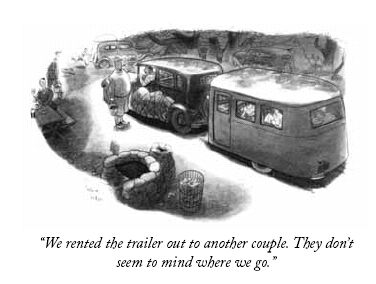
I will be renting the trailer below.

Artist : Richard Decker Publication : The New Yorker 18 Jul 1936

Friday, January 12, 2007

On the edge of intolerable frustration

Artist : Richard Decker Publication: The New Yorker 4 Jul 1936

Technology could be frustrating. We all experince it all the time. Frustrating for all - seller, buyer, user.

Andrew Odlyzko says : "We were frustrated with computers a decade ago, we are frustrated with them now, and will continue to be frustrated in the future. As long as technology offers enticing new products and services, we will continue to live on the edge of intolerable frustration...

If the level of frustration is not going to decrease, is there any point in developing new technologies, and in paying any attention to ease of use? There certainly is. We will still be frustrated, but at a higher level of functionality, and there will be more of us willing to be frustrated....

Building complicated systems that work is hard. Building ones that work and are user-friendly is much harder.
"

Edward Tenner points out: "Microsoft has triumphed because it has given us what we asked for: constant novelty coupled with acceptable stability, rather than the other way around. ... People talk simplicity but buy features and pay the consequences. Complex features multiply hidden costs and erode both efficiency and simplicity."

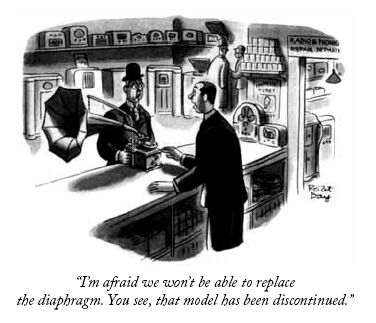
Artist : Robert J. Day Published : The New Yorker 29 Feb 1936

Thursday, January 11, 2007

Not simply That sort of thing

Organized religion is doing well for itself outside Europe.

In India it is more visible, noisier, more violent, more conservative. Queues outside temples get longer and wealthier. Superstars and sport-stars make headlines not just for their sex lives, income tax problems and political connections but also for their religiosity.

Scientist Jayant Narlikar observed wryly how young people consult horoscopes before finalizing their marriage though their parents or grandparents may not have done so for their own. More educated people think astrology is a science just like astronomy. Probably more exact. TV Programs on astrology have far higher TRP's than those on science.

Jagdish Bhagwati in Oct 2006: "I was actually surprised with the Hindu ceremony (at a public function where Bhagwati lectured on October 18), with all this pujas , Sanskrit slokas and lighting the lamp. Of course, I know it's Diwali; but it was a Hindu ceremony throughout. And I was a bit horrified. I am used to Gandhiji's way of doing things - little bits from the Koran, the Bible, and the Gita and Zoroastrian texts. Nobody even thought about it. They were all busy lighting lamps with Sanskrit slokas going on and invoking Lakshmi, the Goddess of wealth. I mean, Goddess Lakshmi and Ganesh are Hindu things. They were supremely oblivious of the fact that some Muslim or Parsi might not appreciate it, much as they might be tolerant. This is our culture. But our culture is more broad-based than just Hinduism."

When Indians talk it is always “fate” and never “luck” or “chance”. And fate is what is decided by either stars or is pre-determined at the time of birth.

How about religious institutions like Shankaracharya or Roman Catholic Church? They always don’t seem to be doing as well. There was a big controversy about Kanchi Shankaracharya in 2004 when he was accused and arrested of murder charge. Church’s biggest problem seems to be not Osama but sex scandals.
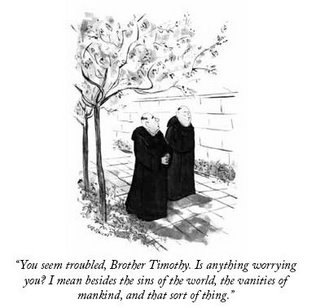
Artist : James Stevenson publication: The New Yorker 1 Oct 1960

Is Timothy 2007, who in picture above looks so pious, a paedophile and is worried about pending internal enquiry? After all it surely cannot be dismissed as lightly as “that sort of thing”.
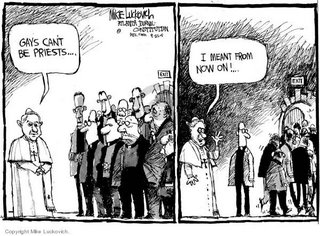
Artist : Mike Luckovich

One thing that surely should be said in favour of exiting priests is – they all are honest about their past. How many of us can claim that?
Nothing personal. Just want to kill you.

Such talk is always ominous. “Purely political”, “just business”, "Nothing personal".

When you hear it, one can be sure massive bloodshed is around. It takes away any personal responsibility from an individual and assigns it to something abstract.

Marlon Brando “ ….if the Mafia had been black or socialist, Corleone would have been dead or in jail. But because the Mafia patterned itself so closely on the corporation, and dealt in a hard-nosed way with money, and with politics, it prospered. The Mafia is so…American. To me a key phrase in the story is that whenever they wanted to kill somebody it was a matter of policy. Just before pulling the trigger they told him: “Just business. Nothing personal”. When I read that, McNamara, Johnson, and Rusk flashed before my eyes.”


Artist : R K Laxman Published: Times of India Jan 9, 2007

Wednesday, January 10, 2007

Advertisement for Life?

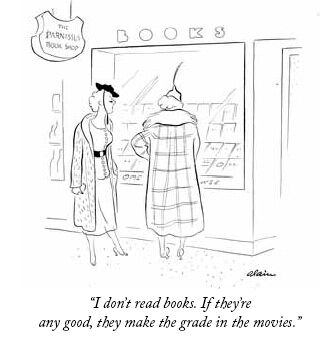
Artist : Alan Dunn publication: The New Yorker 15 Feb 1936

Oh, do they?

Today she may end up not watching another movie in her life because hardly any one is based on a good book.

I don’t know the last decent Hindi film based on a good book. 1983’s Ardha Satya ("Half Truth") based on Sri Da Panwalkar’s story? Yesterday, I read Vinod Khanna, mega- star of yester-years, saying as much - dearth of good scripts and scrpt-writers.

What about Hollywood?

LYNN HIRSCHBERG writing in New York Times Magazine, November 14, 2004 “What Is an American Movie Now?” said:

“…America seemed, at best, an absurd, vaguely comic place. When you look at the big international hits of the year, it is easy to understand why the world views America with certain disgust. Shrek may be a lovable (and Scottish) ogre, but nearly every other global hero in American movies is bellicose, intellectually limited, stuck in ancient times or locked in a sci-fi fantasy.
American films used to be an advertisement for life in the states -- there was sophistication, depth, the allure of a cool, complex manner. Now most big studio films aren't interested in America, preferring to depict an invented, imagined world, or one filled with easily recognizable plot devices.

"Our movies no longer reflect our culture," said a top studio executive who did not wish to be identified. "They have become gross, distorted exaggerations. And I think America is growing into those exaggerated images. My fear is that it's the tail wagging the dog -- we write the part, and then we play the part."

Tuesday, January 09, 2007

Modern Times

It was interesting to read Jagdish Bhagwati invoking Chaplin's Modern Times in his comments to Financial Times on Jan 3, 2007 titled "Technology, not globalisation, drives wages down".

He says: "Recall how he (Charlie) goes berserk on the assembly line, the mechanical motion of turning the spanner finally getting to him. There are assembly lines today, but they are without workers; they are managed by computers in a glass cage above, with highly skilled engineers in charge.
Such technical change is quickly spreading through the system. This naturally creates, in the short-run, pressure on the jobs and wages of the workers being displaced."

What about alienation? I thought the scene from Modern Times was more about Charlie's alienation than his wages.

What is true of a call center worker in 1936 below is perhaps still valid for a swanky BPO factory in India today.

Artist : Alain publication- The New Yorker 11 Jan 1936

Monday, January 08, 2007

Culture Vulture of Pune

I have been living in Pune since 1999. Pune they say is a cultural capital of province of Maharashtra, India.

For me culture is first and foremost civility and I think Pune lags behind many other cities of India in that regard. I have seen people here getting ruder and ruder. But even I was shocked to learn this.

"Parking woes assume serious proportions Times of India December 22 2006

Pune: One would never have imagined that serious crimes like culpable homicide, assault and threats would replace squabbles over parking of vehicles in the city. Developments over the past four days only go to prove that parking woes are now leading to serious crimes.

Barely four days ago, a man lost his life allegedly over the issue of parking, in Bibvewadi (my suburb).

In another case, the same night, Prashant Chaudhari (32) of Sanghvinagar lodged a complaint with the Chatushrungi police station (noncognizable offence registration number 5103/06), alleging that a top army officer assaulted him over the issue of parking and threatening him with dire consequences.

These are not stray cases. Police stations of Deccan Gymkhana, Vishrambaug, Faraskhana, Khadak, Swargate, Bund Garden and Cantonment have received complaints of brawls involving motorists over parking of vehicles. "

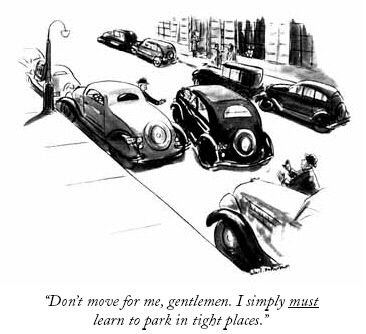
Pleading guy in the picture has to careful. At Pune, he may never need to park his vehicle again!


Artist : Helen E Hokinson published The New Yorker 4 Jan 1936

Sunday, January 07, 2007

God bless you!

Few bad or evil things can have some good consequences. Unintended mostly.

Friedrich Nietzsche claimed- war built courage & honor in men.

Black plague of 14th century that annihilated third of Europe's population may have caused emergence of the Renaissance.

Tragic crash of meteor 65 million years ago wiped out dinosaurs giving a chance to rat like mammals to launch their bid to rule the earth one day in future.

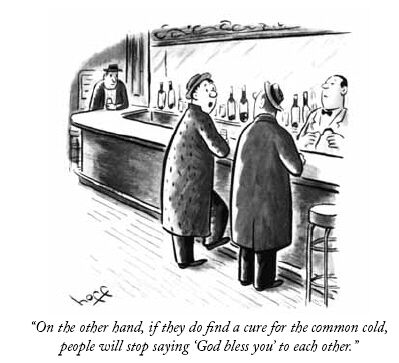
Leave alone these big things. Even a minor (not so minor for those like me who suffer from it) ailment like common cold too can have a positive fall-out.

Artist : Sidney Hoff published The New Yorker March 5 1960

BTW- man may achieve whatever. For example virtual sex as in Minority Report. But he will not stop dreaming of eradicating common cold. Good luck!

Saturday, January 06, 2007

Uninfomed opinion

Television has bred our familiarity with strangers.

For instance, Sunil Gavaskar is someone who comes to our drawing room every day of the cricket match. Talking intimately. Gossiping. Therefore, we have an opinion on everything Gavaskar does or has done in the past, not just related to cricket.

Uninformed opinion is perhaps the most important characteristics of our age.

Artist: Everett Opie published The New Yorker Jan 30 1960

p.s After I wrote above, I came across following in FOUAD AJAMI's review of Pervez Musharraf's books "IN THE LINE OF FIRE, A Memoir" (NYT Jan 7 2007).

"We may not know Bahrain but we can be friends with its king; we may not have known Persian ways, nothing, for instance, of the seminarian culture of Qum, but we knew Shah Mohammed Reza Pahlavi, and our travelers and diplomats and journalists felt at home in his court. Jordan may be a realm apart, a place of poverty and a breeding ground of angry warriors of the faith, but young King Abdullah II and his queen, Rania, are fixtures on the international circuit. And now that we have extravaganzas like Davos, no land is truly foreign, the exotic rulers can rub shoulders with Oliver Stone and Angelina Jolie. They can all serve on panels together. Why bother learning Arabic, Farsi or Urdu, when the rulers of distant lands offer a shortcut for the voyeurs and the travelers. "

Therefore, if Opie were to draw this picture from Kennedy's viewpoint, it might read: "It is hard for me to have an opinion about Sheikh or his camel since I haven't met them or been to his land or studied anything about his culture........hey but hold on, I am meeting him at Davos next month and then maybe I will know enough about all this to invade and occupy his land"

We’re killers, but we won’t kill today

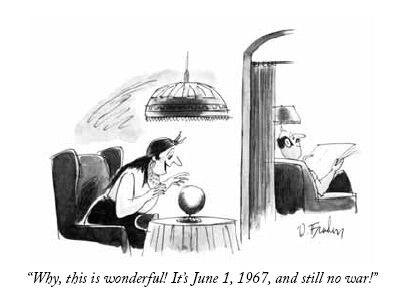
Artist: Dana Fradon published : The New Yorker 24 Dec 1960

Dear Mr. Fradon,

It is very likely I have no clue to your cartoon here. However, I am going to try because I like it.
In December '60, your lady character did some crystal ball gazing to proclaim “no war”. I envy her ball’s optimism. Yes, it is very wonderful if anyone or anything foretells no war for next 7 years. But I have some bad news to report from year 2007. ‘1960’ was as bad a decade as any in 20th century- easily the bloodiest century in human history by some distance.

The lady in your picture perhaps shared her findings with our Prime Minister Nehru (who often was a target of the late Shankar of your tribe, India’s most celebrated cartoonist) because he too believed that there would be no wars.

Our nation had lost most of its innocence during ethnic cleansings following 1947's partition and assassination of Mahatma Gandhi. We lost the rest when we fought two horrible conflicts- with China in 1962 and Pakistan in 1965 - paving the way for what economist Surjit Bhalla calls "rotten age period (1960 to 1980) of declining growth and increasing poverty". During the time, India as a country went nowhere while our East Asian neighbors marched on to tiger-hoods lifting millions out of poverty.

Elsewhere the world looked down the barrel of nuclear gun with 1961’s Bay of Pigs Invasion and another bloody chapter was written in the history of Middle East with 1967’s Six-Day War (Third Arab-Israeli War). Btw- you know ink in the latter is still very wet. As I write this, one more colourful chapter is being written there.

You may visit Wikipedia to learn the complete list of conflicts at: http://en.wikipedia.org/wiki/List_of_wars_1945%E2%80%931989#1960_-_1969

However, I want to end on an optimistic note of Star Trek’s Capt. James T. Kirk

“We’re human beings, with the blood of a million savage years on our hands. But we can stop it. We can admit that we’re killers, but we won’t kill today.”

Sincerely,