मेघदूत: "नीचैर्गच्छत्युपरि दशा चक्रनेमिक्रमेण"

समर्थ शिष्या अक्का : "स्वामीच्या कृपाप्रसादे हे सर्व नश्वर आहे असे समजले. पण या नश्वरात तमाशा बहुत आहे."

G C Lichtenberg: “It is as if our languages were confounded: when we want a thought, they bring us a word; when we ask for a word, they give us a dash; and when we expect a dash, there comes a piece of bawdy.”

C. P. Cavafy: "I’d rather look at things than speak about them."

Martin Amis: “Gogol is funny, Tolstoy in his merciless clarity is funny, and Dostoyevsky, funnily enough, is very funny indeed; moreover, the final generation of Russian literature, before it was destroyed by Lenin and Stalin, remained emphatically comic — Bunin, Bely, Bulgakov, Zamyatin. The novel is comic because life is comic (until the inevitable tragedy of the fifth act);...”

सदानंद रेगे: "... पण तुकारामाची गाथा ज्या धुंदीनं आजपर्यंत वाचली जात होती ती धुंदी माझ्याकडे नाहीय. ती मला येऊच शकत नाही याचं कारण स्वभावतःच मी नास्तिक आहे."

".. त्यामुळं आपण त्या दारिद्र्याच्या अनुभवापलीकडे जाऊच शकत नाही. तुम्ही जर अलीकडची सगळी पुस्तके पाहिलीत...तर त्यांच्यामध्ये त्याच्याखेरीज दुसरं काही नाहीच आहे. म्हणजे माणसांच्या नात्यानात्यांतील जी सूक्ष्मता आहे ती क्वचित चितारलेली तुम्हाला दिसेल. कारण हा जो अनुभव आहे... आपले जे अनुभव आहेत ते ढोबळ प्रकारचे आहेत....."

Kenneth Goldsmith: "In 1969 the conceptual artist Douglas Huebler wrote, “The world is full of objects, more or less interesting; I do not wish to add any more.”1 I’ve come to embrace Huebler’s ideas, though it might be retooled as “The world is full of texts, more or less interesting; I do not wish to add any more.” It seems an appropriate response to a new condition in writing today: faced with an unprecedented amount of available text, the problem is not needing to write more of it; instead, we must learn to negotiate the vast quantity that exists. How I make my way through this thicket of information—how I manage it, how I parse it, how I organize and distribute it—is what distinguishes my writing from yours."

Tom Wolfe: "The first line of the doctors’ Hippocratic oath is ‘First, do no harm.’ And I think for the writers it would be: ‘First, entertain.’"

विलास सारंग: "… . . 1000 नंतर ज्या प्रकारची संस्कृती रुढ झाली , त्यामध्ये साधारणत्व विश्वात्मकता हे गुण प्राय: लुप्त झाले...आपली संस्कृती अकाली विश्वात्मक साधारणतेला मुकली आहे."

Showing posts with label john gray. Show all posts

Sunday, May 18, 2025

Humble Facts Mock Heroic Fantasies

John Gray, "Straw Dogs: Thoughts on Humans and Other Animals", 2002:

"...The qualities we say we value above all others cannot withstand ordinary life. Happily, we do not value them as much as we say we do..."

 Jonathan Jones, The Guardian, January 12 2024:

"...Ancient mythology meets cheeky realism in this fresco from an Italian villa. The man staring back at you at the right, who stands outside the painted story, has a face etched with character, sadness and experience. His eyes disrupt the calm landscape where the god Apollo is slaying a one-eyed giant. Apollo was a figure of reason and harmony, who in another story has the satyr (one of a class of lustful, drunken woodland gods.) Marsyas flayed alive for beating him in a musical contest. Is the man who intrudes on the scene a modern Marsyas? At his feet a cat kills a bird and apples are depicted with perfect accuracy. Humble facts mock heroic fantasies."


Apollo Killing the Cyclops by Domenichino, c 1616-18

Monday, September 02, 2024

Carol Reed& Graham Greene's 'The Third Man' @75...Orson Welles and James McNeill Whistler

I must have seen The Third Man a few times. What I like most about it is portrayal of Europe after WWII. And its darkness. 

John Gray, August 10 2012:

""In Italy, for 30 years under the Borgias, they had warfare, terror, murder and bloodshed, but they produced Michelangelo, Leonardo da Vinci and the Renaissance. In Switzerland they had brotherly love, they had 500 years of democracy and peace - and what did that produce? The cuckoo clock."

When Orson Welles spoke these lines as Harry Lime, the charismatic villain at the heart of the film The Third Man, released in 1949, Welles can't have realised how they would resonate ever after. Graham Greene, who wrote the screenplay, credited the lines to Welles, and it seems clear the actor added them when some extra dialogue was needed while the film was being shot.

The lines became lodged in the mind because they encapsulated an uncomfortable and at the same time compelling idea. His history may not have been factually accurate - the Swiss were a major military power in Renaissance times and the cuckoo clock originated some time later in Bavaria - but the idea that culture thrives in conditions of war and tyranny has an undeniable basis in fact..." 

What could be the ultimate source of the cuckoo clock line?

Wikipedia:

"...The likeliest source is the painter James Abbott McNeill Whistler. In a lecture on art from 1885 (published in Mr Whistler's "Ten O'Clock" [1888]), he said "The Swiss in their mountains ... What more worthy people! ... yet, the perverse and scornful [goddess, Art] will have none of it, and the sons of patriots are left with the clock that turns the mill, and the sudden cuckoo, with difficulty restrained in its box! For this was Tell a hero! For this did Gessler die!" In a 1916 reminiscence,[29] American painter Theodore Wores said that he "tried to get an acknowledgment from Whistler that San Francisco would some day become a great art center on account of our climatic, scenic and other advantages. 'But environment does not lead to a production of art,' Whistler retorted. 'Consider Switzerland. There the people have everything in the form of natural advantages—mountains, valleys and blue sky. And what have they produced? The cuckoo clock!"..."


Wednesday, August 21, 2024

Philip Ball's Enjoyable Drubbing of Richard Dawkins

John Gray:

"...In a well-known passage at the end of Civilization and Its Discontents (1930), Freud declared: “I have not the courage to rise up before my fellow-men as a prophet, and I bow to their reproach that I can offer them no consolation…” What is most in demand at the start of the 21st century, in contrast, is consolation and nothing else. Enlightenment fundamentalism—the insistence by writers such as Christopher Hitchens and Richard Dawkins that our salvation lies in affirming a highly selective set of “Enlightenment values”—serves this emotional need for meaning rather than any imperative of understanding. Like the religions they disparage, but with less profundity and little evident effect, the varieties of Enlightenment thinking on offer today are balm for the uneasy soul. The scientific-sounding formulae with which they appease their anxiety—the end of history, the flat world, the inexorable but forever delayed process of secularisation—are more fantastical than anything in Freud’s “gloomy mythology.”..."

 In Maharashtra, for a group of people, Richard Dawkins has been a 'deity'  oops "a great social reformer" for some time!...his takedown was necessary, of course the people I referred mayn't learn a thing from this...

 James McConnachie, The Times UK, Jan 7 2004:
 
"...You could read this book as a 500-page drubbing of Richard Dawkins. It is not a personal attack — although some barbed words are aimed — but it is a robust and sustained takedown of the “simplistic”, “distorted”, “barren” and “intellectually thin” notion that biology is all about the gene. There is very much more to life than that, according to Philip Ball. It might even have some meaning.
 
...He wonders why genes were ever worshipped so ardently. Maybe it is because DNA conveniently offers a new home for the age-old idea of an “essence”, or soul. Maybe it has something to do with the male scientists who have so often pushed gene-centric thinking while their female colleagues have pushed back. Ball coyly declines to offer any interpretation of that last, curious fact, but I’m happy to try to fill in. Does glorifying DNA cry up the relatively limited role of the man in the creation of a child?
 
As for Dawkins’s notorious claim that we are machines made by genes, this “alarming gambit” represents “a sterilisation of the life sciences”. It gives the gene “an almost sentient agency it does not possess”. Biologists have developed an allergy to words such as “purpose” and “meaning” — which all too easily open the door to those waiting to usher a god back in. Ball does not want to do that, but he does want to revalorise life — rich, complex multicellular life — while shoving the gene back in its proper place.
 
For Ball, the possession of agency — and purpose, and even meaning — is precisely how you might characterise life. Life, then, is not the servant of the selfish gene. Life happens at other levels. In the cell. In the organism. In us."


Wednesday, February 21, 2024

Knowing only Life until they are on the Brink of Dying....John Gray and Amy Hwang on Cats

 John Gray, 'Feline Philosophy: Cats and the Meaning of Life', 2020 :

"...Cats were many things in ancient Egypt: sometimes companions of human beings as they passed on to another life, at other times manifestations of gods, at still others protectors of the gods. That they could be all of these at once testifies to the subtlety of the archaic Egyptian mind. But it also speaks to the presence of cats themselves. Cats symbolized an affirmation of life in a world preoccupied with the dead. Egyptian religion responded to the prospect of death by preparing for life in another world, but it needed cats to preserve a sensation of being alive in the realm beyond the grave. Knowing only life until they are on the brink of dying, cats are not ruled by death. The Egyptians had good reason for wanting cats to join them in the journey through the underworld.

When it came to death, humans and cats were in the same boat. No one in ancient Egypt believed that humans have souls while cats do not. But if the soul is untouched by death, the feline soul is closer to immortality than the human soul can ever be."

 <Knowing only life until they are on the brink of dying, cats are not ruled by death.>...how true...Cat on the deathbed is thinking only of napping...that is soul untouched by death!


 Artist: Amy Hwang, The New Yorker, August 2023

Thursday, June 15, 2023

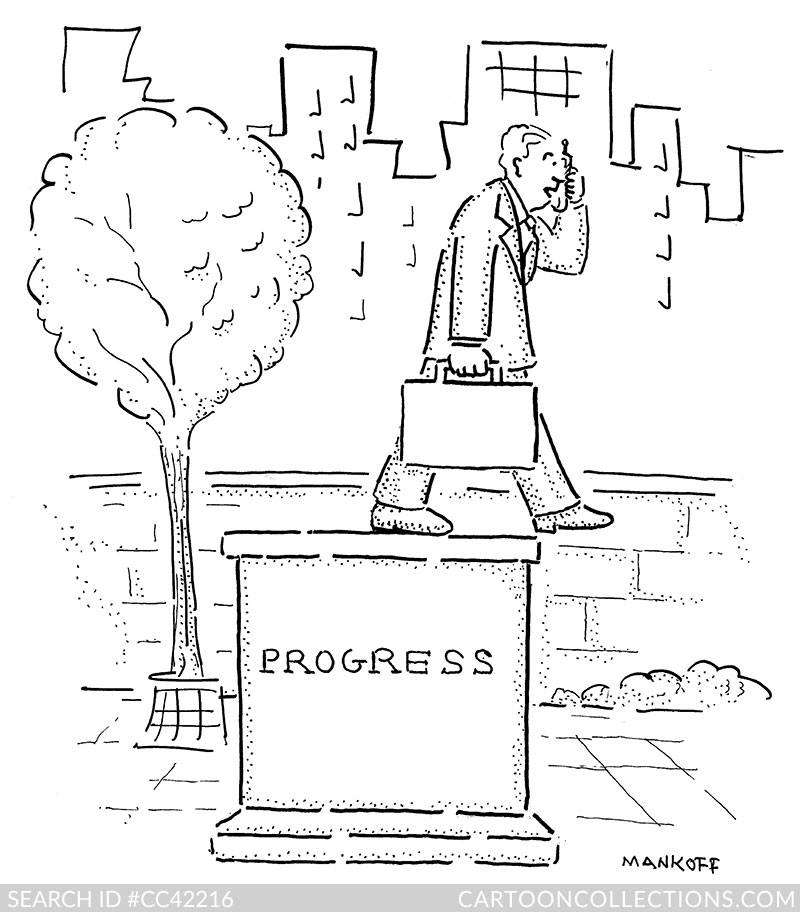
Stepping Off the Progress Pedestal


John Gray:

“Today liberal humanism has the pervasive power that was once possessed by revealed religion. Humanists like to think they have a rational view of the world; but their core belief in progress is a superstition, further from the truth about the human animal than any of the world’s religions.

Outside of science, progress is simply a myth.”

Karl Kraus:

“Progress celebrates Pyrrhic victories over nature.”

Jill Lepore:

“The idea of progress—the notion that human history is the history of human betterment—dominated the world view of the West between the Enlightenment and the First World War. It had critics from the start, and, in the last century, even people who cherish the idea of progress, and point to improvements like the eradication of contagious diseases and the education of girls, have been hard-pressed to hold on to it while reckoning with two World Wars, the Holocaust and Hiroshima, genocide and global warming. Replacing “progress” with “innovation” skirts the question of whether a novelty is an improvement: the world may not be getting better and better but our devices are getting newer and newer.”


Artist: Bob Mankoff, April 2019