मेघदूत: "नीचैर्गच्छत्युपरि दशा चक्रनेमिक्रमेण"

समर्थ शिष्या अक्का : "स्वामीच्या कृपाप्रसादे हे सर्व नश्वर आहे असे समजले. पण या नश्वरात तमाशा बहुत आहे."

G C Lichtenberg: “It is as if our languages were confounded: when we want a thought, they bring us a word; when we ask for a word, they give us a dash; and when we expect a dash, there comes a piece of bawdy.”

C. P. Cavafy: "I’d rather look at things than speak about them."

Martin Amis: “Gogol is funny, Tolstoy in his merciless clarity is funny, and Dostoyevsky, funnily enough, is very funny indeed; moreover, the final generation of Russian literature, before it was destroyed by Lenin and Stalin, remained emphatically comic — Bunin, Bely, Bulgakov, Zamyatin. The novel is comic because life is comic (until the inevitable tragedy of the fifth act);...”

सदानंद रेगे: "... पण तुकारामाची गाथा ज्या धुंदीनं आजपर्यंत वाचली जात होती ती धुंदी माझ्याकडे नाहीय. ती मला येऊच शकत नाही याचं कारण स्वभावतःच मी नास्तिक आहे."

".. त्यामुळं आपण त्या दारिद्र्याच्या अनुभवापलीकडे जाऊच शकत नाही. तुम्ही जर अलीकडची सगळी पुस्तके पाहिलीत...तर त्यांच्यामध्ये त्याच्याखेरीज दुसरं काही नाहीच आहे. म्हणजे माणसांच्या नात्यानात्यांतील जी सूक्ष्मता आहे ती क्वचित चितारलेली तुम्हाला दिसेल. कारण हा जो अनुभव आहे... आपले जे अनुभव आहेत ते ढोबळ प्रकारचे आहेत....."

Kenneth Goldsmith: "In 1969 the conceptual artist Douglas Huebler wrote, “The world is full of objects, more or less interesting; I do not wish to add any more.”1 I’ve come to embrace Huebler’s ideas, though it might be retooled as “The world is full of texts, more or less interesting; I do not wish to add any more.” It seems an appropriate response to a new condition in writing today: faced with an unprecedented amount of available text, the problem is not needing to write more of it; instead, we must learn to negotiate the vast quantity that exists. How I make my way through this thicket of information—how I manage it, how I parse it, how I organize and distribute it—is what distinguishes my writing from yours."

Tom Wolfe: "The first line of the doctors’ Hippocratic oath is ‘First, do no harm.’ And I think for the writers it would be: ‘First, entertain.’"

विलास सारंग: "… . . 1000 नंतर ज्या प्रकारची संस्कृती रुढ झाली , त्यामध्ये साधारणत्व विश्वात्मकता हे गुण प्राय: लुप्त झाले...आपली संस्कृती अकाली विश्वात्मक साधारणतेला मुकली आहे."

Tuesday, March 26, 2013

Can You Spot Me in the Crowd?

संपादकीय, लोकसत्ता , मार्च 28 2013:

"...लोकप्रतिनिधींनी हक्कभंग ठराव आणला म्हणून कोल्हेकुई करणारे काही जण सत्ताधारी भुजांच्या आधारे आपल्यात नसलेले बळ कसे वाढवीत होते याचे स्मरण शिमग्याच्या पवित्र दिनी करणे समयोचितच ठरणार नाही काय? काही पक्षीयांकडून झालेल्या कथित हल्ल्यांच्या न झालेल्या खोटय़ा जखमा मिरवण्यात ज्यांनी आयुष्य व्यर्थ घालवले तेच त्याच कथित हल्लेखोर पक्षप्रमुखांचे चरणतीर्थ घेण्यासाठी रांगेत उभे असतील तर ते दृश्य कधीही शिमग्याच्याच स्मृती जागवणार यात विशेष ते काय?..."

These days in Maharashtra a three-cornered contest is being fought:

Law Makers, Cops, Two Marathi TV news channels....

One does not know where it is going but I know how it will end: Amicably...the old order and peace will be restored...after all they are all respectable,  award-winning/ decorated/ elected citizens of the greatest democracy on this planet...

But while it is going on, it's not even good entertainment...worse than the Marathi TV serials, including the one supposedly comic one

Although the quote at the top reminds of the great Aesop, in such times, I remember only one thing:  George Orwell's 'Animal Farm'


from movie 'Animal Farm', 1954

courtesy: Halas and Batchelor, a British animation company

This is how the great book ends:

“The pigs and farmers return to their amiable card game, and the other animals creep away from the window. Soon the sounds of a quarrel draw them back to listen. Napoleon and Pilkington have played the ace of spades simultaneously, and each accuses the other of cheating. The animals, watching through the window, realize with a start that, as they look around the room of the farmhouse, they can no longer distinguish which of the cardplayers are pigs and which are human beings.”


from movie 'Animal Farm', 1954

courtesy: Halas and Batchelor, a British animation company and  BBC


I am in this second picture.  Can you spot me? Or am I in the first picture ?

Saturday, March 23, 2013

How Will Your Verse Be?...सांस्कृतिक आळस व स्वभाषेबद्दल तुच्छता !

John Keating: 

"...We don't read and write poetry because it's cute. We read and write poetry because we are members of the human race. And the human race is filled with passion. And medicine, law, business, engineering, these are noble pursuits and necessary to sustain life. But poetry, beauty, romance, love, these are what we stay alive for. To quote from Whitman, "O me! O life!... of the questions of these recurring; of the endless trains of the faithless... of cities filled with the foolish; what good amid these, O me, O life?" Answer. That you are here - that life exists, and identity; that the powerful play goes on and you may contribute a verse. That the powerful play *goes on* and you may contribute a verse. What will your verse be?..."


Nathan Heller:


"But given the wild outpouring of praise online, one has to wonder how much of what you see is just a public put-on. “OMG your Cartagena vacation looks AMAZING!!!”: Is this an expression of envy, interest, or a desire to have me shut up about it? The distance between earnestness and disingenuousness is vanishingly small, and—more alarming still—seems to matter less and less."   


अशोक शहाणे :

"...त्यात परत रामदासांनी मराठी मन अचूक हेरूनच  का काय, पण 'टवाळा आवडे विनोद' असे म्हणून टाकल्यावर नंतरच्या मराठी लोकांनी नेमकं तेच खरं  मानलं  अन  इथले लोक टवाळकीला विनोद समजायला लागले..." 

(महाराष्ट्र टाइ म्स , 1994 /  नपेक्षा, 2005)

अरुण  साधू:

"…एक विचित्र अशा ऐतिहासिक न्यून गं डाने  मराठी माणसाचे  व्यक्तिमत्व  आधुनिक का ळात  फाटून गेले आहे.. त्यात भर घातली आहे ती मराठी वृत्त पत्रांनी , मथळ्यान्मधे , उप मथळ्यान्मधे  मजकुरामधें जणू  शिवाजीमहाराज  किंवा  विष्णूशास्त्री चिपळूणकर  यांच्यावर सूड घेतल्यासारखी  इंग्रजी  शब्दसमुच्चयांची  मस्तवालपणे भेसळ  केली जाते . तेच बोलतानाही . सांस्कृतिक आळस  व  स्वभाषेबद्दल  तुच्छता !…"

(ललित , मार्च  2013)


Jaywant Dalwi (जयवंत दळवी) writes in his essay, dated 1980's,  on his close friend Vasant Sarwate (वसंत सरवटे) that if he asked Sarwate about a book and if the reply was "it's interesting", it meant only one thing-  "trash" (भिकार)!

When I first read this I could not stop laughing, for the way Dalvi used the Marathi word 'bhikar'.

Luckily, I have now met Mr. Sarwate a few times, also spoken to him on phone a few times,  and have always heard very carefully if he calls anything "interesting". (He might have called this blog 'interesting' once or twice!)

These days Marathi speaking "TV celebrities" use only following words to describe anything- from their poodle to cinematic  or theatrical experience-:

 'cute, amazing, incredible...'

"...judging something “cute” often “infantilizes" the beholder, as we melt into a puddle of oohs and aahs at the sight of a baby bunny eating a baby carrot. But just as a child might love a doll to tatters, our absorption with “cuteness” is born of both tenderness and aggression. Something cute is something we condescend to, even as we desire to touch and ruffle and hold and possess it...

...At its most thoughtful, calling something “interesting” might be an expression of indeterminacy, a placeholder for a future conversation. But more often than not, it’s just conversational filler, something dropped in when you don’t feel like judging at all.

(Hua Hsu, Slate, Review of 'Our Aesthetic Categories: Zany, Cute, Interesting' by Sianne Ngai)

"moments when our assumptions around cuteness—the stability of feeling somehow “above” the cute object—melt away, for these images manage to be “helpless and aggressive” at the same time."

Artist: Yoshitomo Nara, 'Yellow in blue', 2005

 "Does anyone ever mean it when they say something is “interesting”—or do we all, in art and conversation, merely aspire to be interesting enough? We usually ponder the present condition by considering our consumer choices or modes of self-presentation. But perhaps the line around our imagination starts elsewhere, in those aesthetic experiences that happen on the edge of comprehension.  Before we are inventories of symbols and things, we are thinking, feeling people navigating a fluid, ever-changing world—a world where everything is interesting but not much more, where cuteness and zaniness are the only scales available to us when confronted with global vastness."


Artist: Robert Weber, The New Yorker 

In this cartoon of Mr. Weber for The New Yorker, we find as the woman does household chores with great intensity, a kid- presumably her- has appeared in the doorway and is saying:

'That was an incredible nap!'... Nothing less- just incredible. She could have also said: That was an amazing nap!
 
Bruce Eric Kaplan (BEK), a great cartoonist-(philosopher) himself and one of my favourites, says about the picture:

 "The meaning of the cartoon was clear to me -- it is a hilarious comment on the fact that we live in a culture that feels comfortable saying that anything is incredible, or, more often these days, "Amazing!" We have incredible lattes, amazing socks, etc. But apparently some readers didn't get this.

I have a theory I just came up with in this moment -- perhaps people don't get the genre of ironic cartoons because they themselves are incapable of irony. But then again, I have only had this theory for a few moments, and it may be completely off base."

Most middle-class Marathi readers, at least in this century, have been raised only on the diet of horseplay on TV / cinema masquerading as humour.  I can say with some confidence that  most of them don't get the genre of ironic cartoons because they themselves are incapable of irony.

At the top of this post,  I have quoted Mr. Ashok Shahane on what people of Maharashtra consider as humour....tomfoolery (टवाळकी)!

Wednesday, March 20, 2013

Username and Password?....तो तूंच हटकलेंस 'कोण' म्हणून

Today March 20 2013 is 57th death anniversary of B S Mardhekar (बा सी मर्ढेकर)...sometimes it's hard to imagine someone with his command of Marathi was writing in that language not too many years ago...

Graham Greene:
"Well, there is no such thing as success. The priest can't hope to become a saint- or else it's an illusory dream which vanishes with time; the writer can't hope to write a book equal those of Tolstoy, Dickens or Balzac. He might have dared to believe in the possibility at the outset, but his books always carry a flaw somewhere."

Very early in his short career,  BSM (1909-1956) knew he was a good poet, a special talent perhaps, or maybe even more.

Why do I say that?

"गेलॉ विदूषक जरी ठरुनी सुहास,
दान्ते-नि-शेक्सपिअर-संगत आसपास
कोठे तरी स्वमरणोत्तर भाग्यकाली-!
हाही विचार न कमी मज शांतिदायी."

[poem no 15, "शिशिरागम" ("shishiragam") from "मर्ढेकरांची कविता" ("Mardhekaranchi Kavita"), 1959-1977; courtesy: राघव बाळ मर्ढेकर (Raghav Bal Mardhekar)]

("Even if I pass on as a grinning joker,
company of Dante and Shakespeare in proximity
somewhere in my good fortune after my death-!
even this thought is no less consoling")

Remember, in 'Shishiragam' collection,  BSM is NOT the poet we now know. There, he comes across as some one following his idol Madhav Julian  (माधव जूलियन) or English romantic poets he studied and later taught.

But then he is already thinking of life after death spent in the neighborhood of Dante and Shakespeare! It's like after playing just one season of Ranji trophy cricket with some success, you seek the company of Don  Bradman and Garry Sobers in your afterlife!

If you do that you are either a pompous fool or you must be really good and confident about your creative future. For me, Mardhekar was the latter.

What might have happened when rather young BSM met his maker?


Artist: Arnie Levin, The New Yorker, May 29 2000

courtesy: the artist, the magazine and  Bob Mankoff's blog

(Now, user name and password are confidential. No one is supposed to ask them to you, especially  very openly. But then where's the problem if it's perhaps the last time you will ever need them?)

Mardhekar was perhaps ushered in without this formality and shown his dwelling next to Dante and Shakespeare! I hope so.

Or was he?

"आलो क्षणिचा विसावा म्हणून;
टेकले पाय:
तो तूंच हटकलेंस 'कोण' म्हणून
आणि मनांतले शिणलेले हेतू
शेण झाले"

[the last and unnumbered poem of the section 'Kanheen Kavita' from 'Mardhekaranchee Kavita', 1959/1977 ('कांही कविता', 'मर्ढेकरांची कविता')]

("I came to rest momentarily;
touched down feet:
At once you confronted with "who"
and the tired aspirations in the mind
turned to shit")

Is "who" in the poem above refers to "Username and password?"

Saturday, March 16, 2013

Empower the the Election Commission to Ban the Nonelected Expression!

SIMON CRITCHLEY:

"...When asked by Lysias the pharmacist if he believed in the gods, Diogenes the Cynic  replied, “How can I help believing in them when I see a god-forsaken wretch like you?” When he was asked what was the right time to marry, he said, “For a young man not yet, for an old man never at all.” When asked what was the most beautiful thing in the world, Diogenes replied, “Freedom of speech.” Sadly, it remains one of the most dangerous..."


Almost all the political parties in India are against some expression or the other-   by artists or ordinary citizens like me, who are nobody. Artists get police protection and media attention. I am left to fend for myself.

The expressions include cartoons, paintings, books, plays, speeches, thoughts, cinema, blog-post, FB post, Twitter post...

Wikipedia informs:

"Political parties that wish to contest local, state or national elections are required to be registered by the Election Commission of India (EC). In order to gain recognition in a state, the party must have had political activity for at least five continuous years, and send at least 4% of the state's quota to the Lok Sabha (India's Lower house), or 3.33% of members to that Legislative Assembly of that state..."

If so, why not empower the EC of India to ban any expression that is not acceptable to even one political party.

That is, we can have a transparent online process where a recognized political party raises an objection to a particular expression...TV channels get the live feed of that...They start running the story if it's TRP- worthy...Democracy at its best....political parties represent people....elections and media are the backbones of any democracy...the EC gets the final vote on the subject..

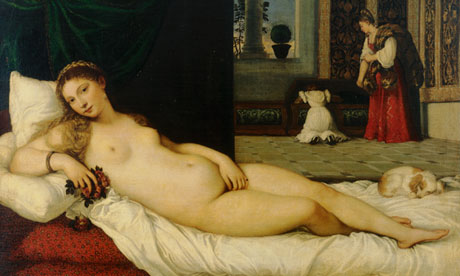
Jonathan Jones writes on his Art Blog in The Guardian 'Dirty old masters: should the EU ban pornographic paintings?':

"...Europe's greatest art has long been an aid to, and celebration of, sexual fantasy. Will a ban on porn affect our art heritage?...Europe's great artists were making pornography long before the invention of the camera, let alone the internet. In my new book The Loves of the Artists, I argue that sexual gratification – of both the viewers of art, and artists themselves – was a fundamental drive of high European culture in the age of the old masters. Paintings were used as sexual stimuli, as visual lovers' guides, as aids to fantasy. This was considered one of the most serious uses of art by no less a thinker than Leonardo da Vinci, who claimed images are better than words because pictures can directly arouse the senses. He was proud that he once painted a Madonna so sexy the owner asked for all its religious trappings to be removed, out of shame for the inappropriate lust it inspired. His painting of St John the Baptist is similarly ambiguous...."


Venus of Urbino by Titian

The Venus of Urbino by Titian.

Photograph: Nicola Lorusso/Alinari Archives/Corbis , The Guardian

Many Indians were/are  well familiar with the sentiments expressed above:

"Paintings were used as sexual stimuli, as visual lovers' guides, as aids to fantasy. This was considered one of the most serious uses of art by no less a thinker than Leonardo da Vinci, who claimed images are better than words because pictures can directly arouse the senses."

I fell ill in Kolkata in 1991 supposedly by amebiosis...its water they said, its weather some others. Some advised to go to "the West" for change of water and weather.

We went to  Khajuraho coinciding with the annual dance festival there

But the flesh and blood were no match for the stone. Not only I was cured in a dayI was massively turned on by what I saw on the temple walls there. I was back...(I won't go further than this to protect my wife's privacy.)

Today,  as I suffer from high blood pressure, I wonder where I should go to "snap out of it"! Khajuraho does not sound right but who knows!


'A temple relief at Khajuraho features a couple in a sexual embrace with a man and a woman masturbating to either side.'

courtesy: Wikipedia and Mr. Henry Flower

Wednesday, March 13, 2013

Illegal Let, then Sublet and then Pay not even a Halfpenny of Rent!

Since we started laying rice-grain, ground glucose biscuits and clean water saucer on our terrace, we have been visited by many birds. We have now counted a few generations of sparrows. And I recognize at least two crows. (I wish I were as healthy as them!)

In one of the most beautiful essays I have read, George Orwell writes:

"Indeed it is remarkable how Nature goes on existing unofficially, as it were, in the very heart of
London. I have seen a kestrel flying over the Deptford gasworks, and I  have heard a first-rate performance by a blackbird in the Euston Road.  There must be some hundreds of thousands, if not millions, of birds living inside the four-mile radius, and it is rather a pleasing thought that none of them pays a halfpenny of rent"


('Some Thoughts on the Common Toad', 1946)


 Artist: David Sipress, The New Yorker, November 2012

Saturday, March 09, 2013

If Tukaram Was Alive Today


WELCOME BACK
MISTER TUKARAM!
WE'VE MADE A LIST
OF 'MODERN'
THINGS FOR YOU
 TO DO

*GO TO M-TOWN (ask The Pune Times for the directions to reach there)

*USE TWITTER (or Facebook)

*BE A JUDGE ON 'SA RE GA MA PA' (or a dance contest featuring Marathi Bollywood hottie)

*WRITE FOR AN 8-PM-MARATHI TV SERIAL (or write a screenplay of blockbuster Marathi movie based in your times featuring the practice of sati or any such regressive social practice against which you might have railed all your life.)

*WRITE A COLUMN FOR A WEEKEND EDITION OF A MARATHI DAILY WITH A TITLE SUCH AS 'KAUTUKA' (कौतुक) [or write for  two-dozen 2013 'Diwali anks'. Sorry, you are too late to make it to 'Lalit' poetry special.]

CAN'T I WRITE
ABHANGS? I LIKE
WRITING ABHANGS...

WELL...
I SUPPOSE SO.
IF YOU REALLY WANT TO...


Read the above after soaking in this wonderful picture:

Artist: Tom Gauld, November 26 2012

Wednesday, March 06, 2013

Sarang Chapalgaonkar... Who? केल नीट म्हणजे बराबर मझा येतो ...

"When the spring arrives
And I sit outside, working,
I am never bored.
With a chisel in hand
I can raise flowers from stones."  

(A Japanese Haiku quoted by the late N J Nanporia in his article on Japan in The Times of India dated around 1980)

Steve Rose, The Guardian, February 28 2013:

"..."Indian films have this obsession with hygienic clean spaces, even though the country's not so clean," says Anurag Kashyap. "They're either shot in the studios or shot in London, in America, in Switzerland – clean places. Everywhere except India." By contrast, Kashyap's latest movie, Gangs Of Wasseypur, seems determined to show the India you don't see in the movies. Wasseypur is a nondescript industrial town in Bihar, India's poorest region. And rather than drugs or casinos, these gangs are fighting for control of coal mines and scrap metal. It was filmed on bustling streets and industrial wastelands, even – since one of the movie's central clans are butchers by trade – an abattoir. "That was difficult," Kashyap recalls. "The smell was so bad. While we were shooting, 60 buffaloes and a camel got slaughtered before our eyes. I don't think any of us could eat meat for a month."..."

Sarang Chapalgaonkar (सारंग चपळगावकर),  for me Sarang-mama,  is dead. He died on December 20 2012. He was my wife's mother's maternal uncle (मामा).

He was an interesting, handsome  man...He was a groupie of  Pune city's one biographer V N Natu ('आधीच पुणे  गुलजार'  वि. ना. नातू.....Btw- I really like Natu's book)...Knowing my tastes, he strongly recommended to me Hari Narayan Apte's (हरि नारायण आपटे) book 'Madhali Sthiti' (मधली स्थिती). I have still not able to get hold of the book.

We could talk for hours on many subjects. Once he told me how the Dalits were not allowed to construct houses in a certain direction of the Pune city because the wind blew from that direction into the city!

He spent his entire working life- from 1942 for 39 years-  in Indian (central) railways. A few years go, he wrote a book- "Tikit Please" (तिकीट प्लीज)- based on his experiences there. It was only for private circulation.

It turned out to be a wonderful book. I finished it in one sitting. A lot of the then celebrities make guest-appearances in the book. Among them are Manohar Malgaonkar (मनोहर माळगावकर),  Bal Gandharva (बालगंधर्व)...

Mr. Malgaonkar presented him with his autographed book and Balgandharva treated him with great  sensitivity and affection . The latter experience made Sarang-mama cry and reading that made me cry! Another instance of Balgandharva's greatness.

But the best thing about the book comes in its foreword by the author:

"टी सी म्हणून साधारण वाटणाऱ्या नोकरीत मी अत्यंत स्वाभीमानाने व समाधानाने दिवस काढले. त्या नोकरीचा मला अद्याप अभिमान वाटतो."

("I spent days with dignity and satisfaction working in an ordinary sounding job like ticket-checker. I still feel proud of that job.")


How rarely I get to read such a sentiment in a native Indian language.

Reminded me of following set of dialogues:

",,,उषा: तुम्हांला सगळ्याचाच मझा वाटतो.

काकाजी: पाहिलं नीट म्हणजे बराबर मझा दिसतो. इंदूर स्टेशनात एकदा एक भंगी दोन लंब्या झाडू घेऊन कचरा काढीत होता. उषा, अरे ऐश्या झाडू फिरवीत होता, की तुझ्या सतीशला बॅट देखील फिरवता येणार नाही तशी."

("...Usha: You think everything is fun.

Kakaji: If you look carefully, you notice fun alright. At Indore station once a street-sweeper was sweeping using two long brooms. Usha, the way he was brandishing broom, your Satish would't be able to wave even a (cricket) bat.")

['Tujhe Ahe Tujapashi', 1957 (तुझें आहे तुजपाशीं) by P L Deshpande (पु  देशपांडे)]

So many books remain unwritten in Marathi....

Has there been a great Marathi book by a nurse? By a house-maid? By an under taker at crematorium?  By autopsy (post-mortem) conductors? By a butcher? By a person engaged in manual scavenging? By an auto-rickshaw or a tonga driver? By an ST bus conductor? By a postman? By a dangerous-chemical factory worker? By MSEDCL worker exposed to high-voltage live wires? By a coal-engine train driver?.....What 'Marathi' or language do they use on the job?

And I am not talking about some howling rebel (विद्रोही) books, not the kind whose authors are now 'parallel' celebrities making monthly/quarterly appearances on TV channels anchored by 'socialist' anchors,  but written matter-of-factly, making people appreciate: Despite all the likely misery of the job, I did it with quiet dignity and satisfaction and my job was perhaps as important as that of an IT professional or a journalist or a priest or a publisher or an artist or a doctor or an architect or a teacher or a lawyer or an ad-man or an actor or a writer or a builder or a politician or a broker or a pilot or a cricketer or Miss Beauty-queen or a TV anchor...

Saturday, March 02, 2013

Tukaram, Richard Feynman, Helen E Hokinson: We Are Only An Atom

John Gray:

"When people look to religion for the meaning of life, they eventually find mystery. When they look to science for meaning they end up in mere incoherence."

Brian Greene:

" In 1929, the American astronomer Edwin Hubble discovered that distant galaxies are all rushing away from us. And the best explanation for this cosmic exodus came directly from general relativity: much as poppy seeds in a muffin that’s baking move apart as the dough swells, galaxies move apart as the space in which they’re embedded expands. Hubble’s observations thus established that there was no need for a cosmological constant; the universe is not static."


 courtesy: 'Feynman' by Jim Ottaviani (Author), Leland Myrick (Illustrator)

Richard Feynman has said:

"If, in some cataclysm, all of scientific knowledge were to be destroyed, and only one sentence passed on to the next generation of creatures, what statement would contain the most information in the fewest words? I believe it is the atomic hypothesis that all things are made of atoms — little particles that move around in perpetual motion, attracting each other when they are a little distance apart, but repelling upon being squeezed into one another. In that one sentence, you will see, there is an enormous amount of information about the world, if just a little imagination and thinking are applied."

 When I read it, I immediately thought of Tukaram (तुकाराम):
 
"अणुरेणियां थोकडा ।
तुका आकाशाएवढा ॥१॥"

( midget like atom-molecule
Tuka is sky-like)


Tukaram of course did not know about the atomic hypothesis, as we know it today, but isn't he saying something equally profound here?


Maybe he is  telling us how small atoms-molecules make the big sky.

Maybe he is telling us how we can grow from being a lowly dwarf to a leviathan like the sky.

Maybe he is telling us we are sometimes like an atom-molecule while other times like the sky.

Maybe he is telling us that the universe is not static.

Maybe he is telling us that when your perspective changes things look different.

Maybe he is telling us about the feeling of awe that comes from understanding the beauty of nature. (Mr. Feynman describes it thus: ...It’s an appreciation of the mathematical beauty of nature, of how she works inside; a realization that the phenomena we see result from the complexity of the inner workings between atoms; a feeling of how dramatic and wonderful it is. It’s a feeling of awe — of scientific awe —)


 Artist: Helen E Hokinson (1893-1949), The New Yorker, July 12 1930

Wednesday, February 27, 2013

Hey, Best Actress or Nominee, What is Your Erotic Capital?


JOANNE LIPMAN, The New York Times, October 23 2009:

"The truth is, women haven’t come nearly as far as we would have predicted 25 years ago. Somewhere along the line, especially in recent years, progress for women has stalled. And attitudes have taken a giant leap backward…

… The conversation online about women, as about so many other topics, degenerated from silly and snarky to just plain ugly — and it seeped into the mainstream.

Recently, before a TV appearance, I did an Internet search on one of the interviewers so I could learn more about her — and got a full page of results about her breasts. .."


Catherine Hakim:
"The meritocratic capitalist values of the Western world invite us to admire people who exploit their human capital for personal gain. I can see no reason at all why people who exploit their erotic capital for its full value should not be equally admired."
I watched the Oscars partly on the morning of February 25 2013 and partly on the same evening.

It was OK.  I had not seen it for last couple of years.

I was quite surprised by 'bluntness' of Seth MacFarlane's song WeSaw Your Boobs”. It was funny. But it seems to have enraged a few.


picture courtesy:  Oscars.org | Academy of Motion Picture Arts and Sciences and CBS News 

Amy Davidson says in The New Yorker:

"...“We Saw Your Boobs” was as a song-and-dance routine in which MacFarlane and some grinning guys named actresses in the audience and the movies in which their breasts were visible. That’s about it. What made it worse was that most of the movies mentioned, if not all (“Gia”), were pretty great—“Silkwood,” “Brokeback Mountain,” “Monster’s Ball,” “Monster,” “The Accused,” “Iris”—and not exactly teen-exploitation pictures. The women were not showing their bodies to amuse Seth MacFarlane but, rather, to do their job..."

I completely agree with Ms. Davidson but Seth is still right and funny: We did see (some of) those- and not all of them pretty-  boobs anyway!

A few months ago, I  saw 'The Reader' (2008) starring Kate Winslet, who incidentally features longest in Mr. MacFarlane's song. 

The movie is ordinary, forgettable and stands out largely for Ms. Winslet's nudity and her sexually explicit scenes with a  mid-teenager.  So how can one say that movie is strictly NOT  a "teen-exploitation"...It reminded me of "Mera Naam Joker", 1970 and 'Summer of '42", 1971...both films, by the way, much better than 'The Reader'.

I wonder why KW was given the Academy Award for Best Actress for that film.

A book by Catherine Hakim 'Honey Money: The Power of Erotic Capital' was published in 2011.

Book description on Amazon.com says: 

"...Catherine Hakim's groundbreaking book reveals how erotic capital is just as influential in life as how rich, clever, educated or well-connected we are. Drawing on hard evidence, she illustrates how this potent force develops from an early age, with attractive children assumed to be intelligent, competent and good. She examines how women and men learn to exploit it throughout their lives, how it differs across cultures and how it affects all spheres of activity, from dating and mating to politics, business, film, music, the arts and sport. She also explores why erotic capital is growing in importance in today's highly sexualised culture and yet, ironically, as a 'feminine' virtue, remains sidelined. "Honey Money" is a call for us to recognize the economic and social value of erotic capital, and truly acknowledge beauty and pleasure. This will not only change the role of women in society, getting them a better deal in both public and private life - it could also revolutionize our power structures, big business, the sex industry, government, marriage, education and almost everything we do."

The author Ms. Hakim wrote in an article in 2010:

"Erotic capital goes beyond beauty to include sex appeal, charm and social skills, physical fitness and liveliness, sexual competence and skills in self-presentation, such as face-painting, hairstyles, clothing and all the other arts of self-adornment. Most studies capture only one facet of it: photographs measure beauty or sex appeal, psychologists measure confidence and social skills, sex researchers ask about seduction skills and numbers of partners. Yet women have long excelled at such arts: that’s why they tend to be more dressed up than men at parties. They make more effort to develop the “soft skills” of charm, empathy, persuasion, deploying emotional intelligence and “emotional labour.” Indeed, the final element of erotic capital is unique to women: bearing children. In some cultures, fertility is an essential element of women’s erotic power. And even though female fertility is less important in northern Europe (where families are smaller) women’s dominant position in this market has been reinforced in recent decades by a much-lamented phenomenon: the sexualisation of culture...Like it or not, erotic capital is now as valued as economic and human capital. As Chairman Mao advised—walk on two legs."


ERIC WILSON said in The New York Times September 12, 2008:

 “No one blinked at the Marc Jacobs fashion show last week when the model Freja Beha Erichsen appeared in a sheer black top that revealed that she was wearing a nipple ring. No one blushed at the Chris Benz show when Sasha Luss and Ekat Kiseleva posed in see-through camisoles. No one seemed particularly hot or bothered that Ali Stephens’s breasts were clearly visible through her dress when she walked for Derek Lam. No one was outraged that Francisco Costa showed a transparent raincoat at Calvin Klein with nothing but a thong underneath.

Peek-a-boo was the biggest trend at the New York Fashion Week that ended on Friday,

…But nudity, like fashion, has lost much of its power to shock.

We have become so desensitized to images of naked celebrities, sex tapes and Internet pornography that designers are hard-pressed to create anything that seems really transgressive.” 

Yes, nudity might have lost its power to shock but who knows how it works on Oscar juries!


An iconic shot of the late Ms. Elizabeth Taylor splashing in the ocean, from the set of 'Suddenly, Last Summer' (1959). (Ms. Taylor received nomination  for the Academy Award for Best Actress for this role.)


© Sunset Boulevard/Corbis.

Saturday, February 23, 2013

Setsuko Hara 原 節子: A Japanese Nutan नूतन... Touch of Melancholy...Sigh

Today February 23 2013 is 22nd Death Anniversary of Nutan

After seeing a Setsuko Hara film, the novelist Endo Shusaku wrote "We would sigh or let out a great breath from the depths of our hearts, for what we felt was precisely this: Can it be possible that there is such a woman in this world?"

In year 2012, I saw two Japanese films  'Late Spring', 1949 and 'Tokyo Story', 1954. Both masterpieces by Yasujiro Ozu, both starring Setsuko Hara.

Watching them was like reading G A Kulkarni's (जी ए कुलकर्णी) 'Kairi' ( कैरी)  one more time. Such tenderness, such lyricality, such beauty, such simplicity and yet very little sentimentality...While I have known GA's story for more than thirty years, where was 'Tokyo Story'?

I am glad I did not 'meet' Ms. Hara at a more impressionable age unlike Ms. Nutan. If I had, I would have madly fallen in love with her, would have lost the sleep for a few days.

Ms. Hara's partnership with  Mr. Ozu reminds me of Nutan's partnership with Bimal Roy.


Setsuko Hara, in Yasujiro Ozu's masterpiece 'Tokyo Story'

Photograph courtesy: the distributor of the film or  the publisher of the film.


In Hrishikesh Mukherjee's Anari, 1959

Image courtesy: Wikipedia

Ms. Hara foreswore the acting profession in 1963 and became a Greta Garbo-like figure. Nutan never did anything like that but she too remained an enigma for me.

They both- June borne- look stunning on B&W screen. While they are there, I look at nothing else. I also notice  a touch of melancholy that goes with an incredible amount of beauty. 

That's what makes them special.